Stop Sign 30 X 30: Defending Florida Traffic Tickets
Discover how stop sign 30 x 30 dimensions, placement, and Florida law affect your traffic ticket defense. Learn valid defenses now.

You got a stop sign ticket, and your first instinct was probably the same one I hear all the time: the sign was there, so the case must be open and shut. That assumption costs drivers points, money, and opportunities.
A Stop Sign 30 X 30 issue is not trivial. It goes to whether the sign matched the engineering standard, whether it was placed where a driver could reasonably respond to it, and whether the officer's version of events lines up with what Florida law requires. In court, I've seen drivers focus on excuses that go nowhere while ignoring the technical flaws that can move a case.
If you were cited in Florida, don't treat the sign as unquestionable just because it was red and octagonal. Start with the standard. Then inspect the placement. Then compare the intersection to what the law demands of you.
Table of Contents
What the Stop Sign 30 X 30 Standard Actually Means
A Florida driver rolls through an intersection, gets stopped, and hears the usual line: you passed a stop sign, so the case is straightforward. It often is not. Before anyone talks about whether the vehicle stopped, I want to know what sign was posted, where it was posted, and whether it matched the standard the government is supposed to follow.
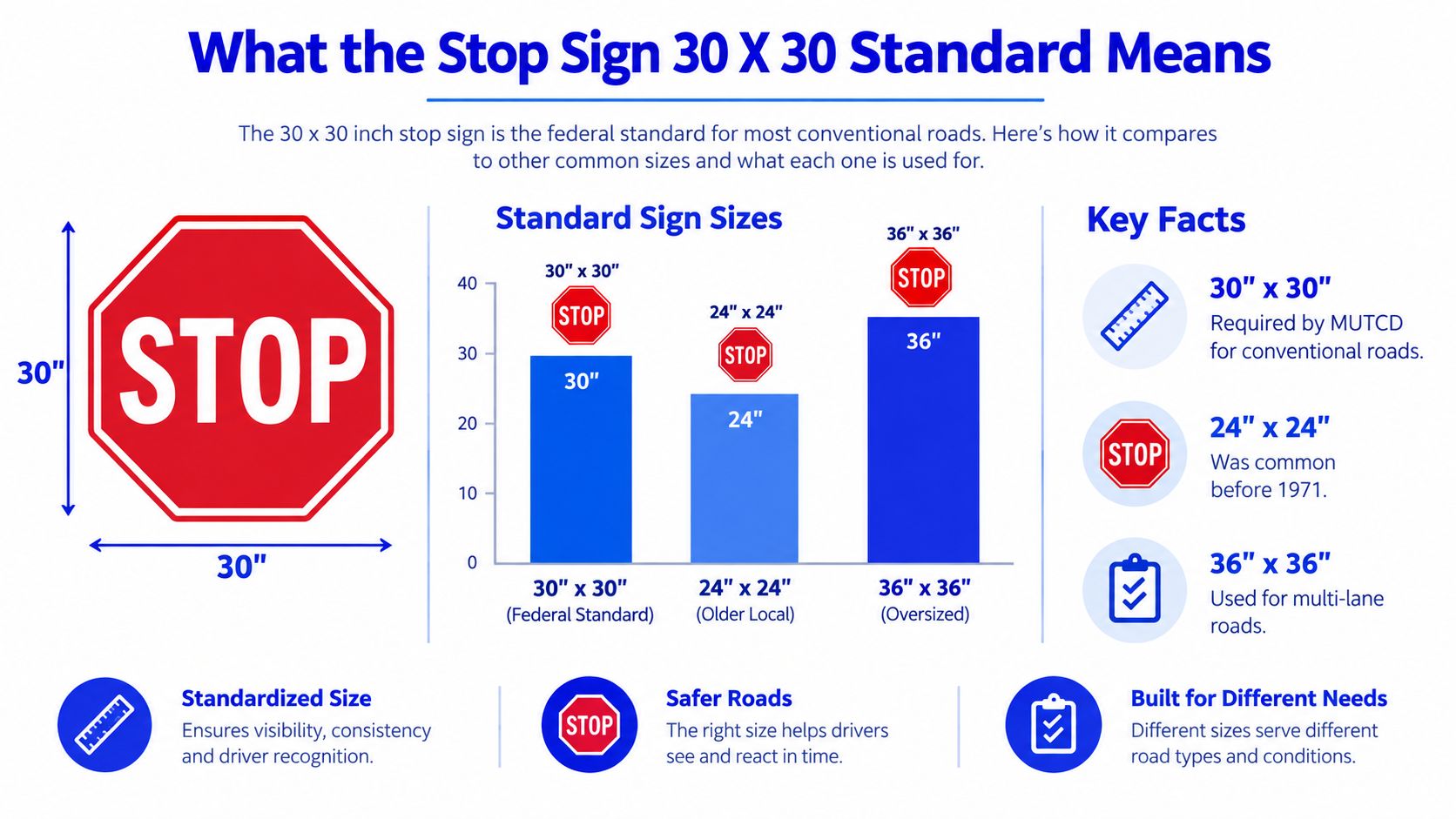
For a typical road, a 30 x 30 stop sign means a STOP sign with a 30-inch by 30-inch face, mounted in the standard octagonal shape and used as the baseline size for conventional roads under the MUTCD. The federal table for regulatory sign sizes lists 750 x 750 mm, or 30 x 30 inches, as the standard size for conventional roads, with 36 x 36 inches used on expressways and 24 x 24 inches allowed only as a minimum in limited settings (FHWA MUTCD standard sign dimensions and application).
That distinction matters in a defense file.
If the intersection was an ordinary Florida approach and the sign was smaller than the standard size, the city or county may have created a visibility problem before the officer ever wrote the ticket. A smaller sign is not an automatic dismissal, but it is the kind of technical defect that can change how a judge views notice, driver perception, and the reliability of the citation.
Why 30 x 30 became the baseline
The size did not appear by accident. A historical summary of stop-sign development notes that early signs were smaller, the octagonal shape was standardized early on, and the modern red stop sign became the familiar standard later as uniformity and recognition took priority (history of the stop sign).
From a courtroom standpoint, the history matters for one reason. Traffic control devices are supposed to be uniform enough that drivers can recognize them quickly and respond safely. A 30 x 30 sign gives more visual target area than an older 24 x 24 sign, which is exactly why size, color, shape, and placement are not cosmetic details.
What the standard includes besides size
The 30 x 30 label does not refer only to dimensions. The same baseline standard also assumes the familiar red background, white legend and border, and the octagonal shape associated with STOP signs. On a normal approach, the sign is generally expected on the right side where a driver would look for it.
That gives you a practical framework for reviewing a citation:
Was the road a conventional road where 30 x 30 was the expected standard?
Was a smaller sign used without a clear reason?
Was the sign configured like a proper STOP sign, not just roughly similar?
Was it positioned where a driver on approach would reasonably detect it?
Those are defense questions, not trivia.
Stop sign size standards
Road Type | Standard Size (Inches) | Standard Size (Millimeters) |
|---|---|---|
Conventional road | 30 x 30 | 750 x 750 |
Expressway | 36 x 36 | 900 x 900 |
Minimum size allowed in limited settings | 24 x 24 | 600 x 600 |
Drivers who check the sign standard usually build better cases than drivers who walk in apologizing. For a plain-language explanation of the duty to stop once a valid sign is in place, read Stop means stop at a sign in Florida.
Florida Statutes Governing Stop Sign Enforcement
A stop sign citation in Florida doesn't rest on an officer's opinion alone. It rests on Chapter 316. If you want to challenge the ticket intelligently, start with the actual statute the court will care about.
The key provision is Florida Statute 316.123. It says that a driver approaching a stop intersection indicated by a stop sign must stop at a clearly marked stop line, or if there is no stop line, before entering the crosswalk, or if there is no crosswalk, at the nearest point where the driver has a view of approaching traffic before entering the intersection (Florida Statute 316.123).
Why the stopping location matters
That statutory sequence matters more than many drivers realize. The law does not say “stop somewhere near the sign.” It gives an ordered set of locations. If the officer says you failed to stop, your defense begins by identifying which legal stopping point existed at that intersection.
Use this checklist:
Look for a stop line. If there was a clearly marked line, that's the required stopping point under the statute.
Check for a crosswalk. If no line existed, the crosswalk becomes the legal marker.
Assess your view. If neither marking existed, the law shifts to the nearest point where you could see approaching traffic before entering.
If the sign was placed in a way that made one of those statutory stopping points unclear, hidden, or functionally unsafe, that problem can affect the validity of the citation itself.
What drivers often miss
Drivers often argue, “I slowed down,” or “I looked both ways.” Those statements usually don't win. The stronger question is whether the roadway and sign setup gave you a fair chance to comply with the exact stopping sequence Florida law requires.
The statute defines where you must stop. A defense often turns on whether the intersection was configured so that you could identify and use that location safely and clearly.
That's why the technical side of the sign matters. If the traffic-control device was undersized for the approach, hard to detect, or poorly positioned relative to the stop line or crosswalk, your case may be more than a simple credibility contest. It may be a compliance problem.
If you want the broader legal context before deciding how to fight the ticket, review Florida traffic laws that commonly affect citation defenses.
How Sign Placement Affects Citation Validity
A stop sign can be the correct size and still fail in the field. That happens more often than drivers think. Visibility problems don't disappear just because the metal panel itself meets a dimension standard.
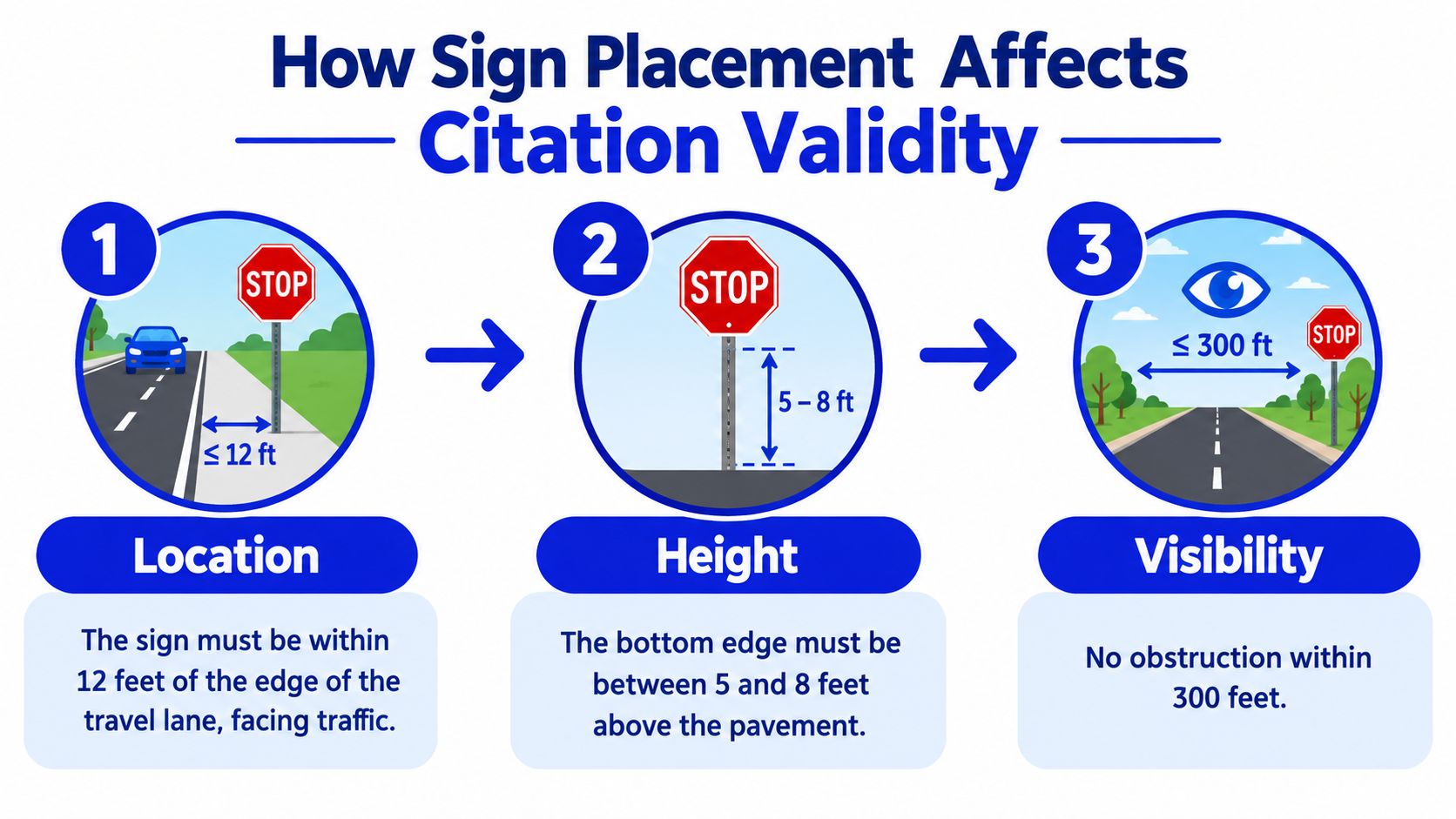
The MUTCD says stop signs should be placed as close as practicable to the intersection while optimizing visibility, and when visibility is restricted, a Stop Ahead sign should be installed in advance (MUTCD placement and Stop Ahead guidance). That language matters because it ties enforceability to what a driver could realistically see and process on approach.
Where placement problems show up
In real cases, placement failures usually look ordinary at first glance. A tree branch blocks part of the sign. A parked van on the approach narrows the driver's sight line. The sign is angled in a way that favors one approach but weakens another. A curve, wall, or hedge shortens the time available to recognize the stop condition.
Common trouble spots include:
Obstructed approach: Vegetation, utility poles, or parked vehicles interfere with a clear view.
Late recognition: A curve or offset approach causes the sign to appear too late for a normal response.
Poor relation to the intersection: The sign sits in a position that doesn't clearly correspond to where a driver must stop under the roadway markings.
Missing advance warning: Restricted visibility exists, but no Stop Ahead sign warns the driver in time.
How this affects a Florida defense
Legal and technical facts meet. Florida Statute 316.123 tells you where to stop. The MUTCD guidance addresses whether the sign was placed so a driver could identify the stop condition in time to comply. If those two things don't line up, the prosecution's case gets weaker.
A useful defense file often includes:
Evidence Type | Why It Matters |
|---|---|
Driver-approach photos | Shows what was visible before the intersection |
Video from the same lane | Captures timing, angle, and obstructions |
Photos of foliage or parked vehicles | Documents interference with sight lines |
Intersection markings | Clarifies whether the legal stopping point was identifiable |
A valid sign isn't just the right shape. It has to function as a warning device for approaching traffic.
This is one reason many stop sign cases deserve more scrutiny than they get. Drivers who want to understand how courts view traffic-control-device violations can review violation of a traffic control device in Florida.
The 30-Foot Parking Buffer and Its Legal Impact
Many drivers think the stop sign itself is the whole case. It isn't. What sits near the sign can matter almost as much as the sign.
Florida Statute 316.1945 makes it unlawful to stop, stand, or park within 30 feet upon the approach to a stop sign located at the side of a roadway (Florida Statute 316.1945). That buffer exists for a practical reason. Drivers need a clear line of sight as they approach the sign and the intersection.
Why this creates leverage
If a vehicle was parked illegally within that statutory buffer, the problem isn't just inconvenience. It can interfere with the driver's opportunity to see the sign soon enough, connect it to the stopping point, and assess cross traffic safely.
That opens a defense angle many people miss:
Blocked sight line: A vehicle near the sign may have obscured the sign face or reduced reaction time.
Confused stopping point: A large parked vehicle can hide pavement markings or distort the driver's view of the crosswalk.
Compromised intersection view: Even if you stopped, the obstruction may have forced you to inch forward to gain a view of approaching traffic.
Visible doesn't always mean legally adequate
Officers and judges hear the phrase “the sign was visible” all the time. The better question is whether visibility was legally adequate for the actual approach. A sign that becomes visible only at the last moment may still support a defense when the approach was compromised by unlawful parking or another avoidable obstruction.
Case-screening point: If you went back and saw vehicles regularly crowding the approach to the sign, document it. Repeated obstruction near a stop sign can change how a citation should be evaluated.
This issue also helps explain why photographs taken later can still matter. They don't have to recreate the exact traffic scene to show that the intersection routinely suffers from blocked approach views and weak sight lines.
For a broader look at how Florida roadway signs affect enforcement and driver obligations, read Florida traffic signs and what they legally require.
When Stop Sign Defects Become Legal Defenses
Not every imperfection wins a case. Courts won't usually throw out a citation because a sign shows minor wear or because the driver didn't notice it. But some defects go to the core of enforceability.
The modern federal standard draws a meaningful line between roadway types. The MUTCD table in the current federal edition lists a STOP sign as 30 x 30 inches for single-lane approaches and 36 x 36 inches for multilane approaches (MUTCD 11th edition STOP sign sizing table). Federal guidance used by Florida agencies also lists 30 x 30 inches as the standard for conventional and low-volume roads, 36 x 36 inches as the minimum for multi-lane approaches, and 48 x 48 inches as an oversized option in some settings (FDOT roadway design bulletin on STOP sign sizes).
Defects that deserve real attention
A defense becomes stronger when the defect affects recognition, reaction time, or legal clarity. Focus on failures like these:
Undersized sign for a multilane approach: If the road geometry called for a larger STOP sign and the installation used a smaller one, that's worth examining closely.
Poor placement tied to weak visibility: A sign can be the correct size and still be ineffective if the approach doesn't allow adequate recognition.
Mismatch with pavement control: When the sign and the stopping point don't align clearly, the state may struggle to prove straightforward noncompliance.
A larger sign alone doesn't prove a violation, and a smaller sign alone doesn't automatically erase one. The point is whether the departure from standard affected the driver's ability to respond as the law required.
What doesn't usually carry the day
Some arguments sound good but often go nowhere:
Weak Argument | Why It Usually Fails |
|---|---|
“I didn't see it” | Courts often treat that as a driver issue unless supported by evidence |
“Everyone rolls that stop” | Other drivers don't decide your case |
“The sign looked old” | Age alone usually isn't enough without a compliance or visibility link |
The strongest stop sign defenses connect a physical defect to the legal duty the state says you violated.
That's why evidence matters more than frustration. Photos, lane-count analysis, roadway layout, and officer notes can reveal whether the sign setup met the conditions needed for fair enforcement. If video exists, preserve it quickly. For examples of how footage can change a stop sign case, see how stop sign video evidence can support a defense.
Protecting Your License After a Stop Sign Citation
A stop sign ticket is easy to underestimate until the consequences start stacking up. You pay it, points hit your license, and the record follows you longer than you expected. That's why the right response starts early, before you lock yourself into the wrong option.
What to do right away
Start with the facts at the scene if you still can. Return to the intersection safely. Photograph the approach from your lane, the sign face, any stop line, any crosswalk, and anything that interferes with visibility. If a parked vehicle, hedge, fence, or curve affected what you could see, capture that condition clearly.
Then gather the paperwork. Your citation, court date, and any officer notes or comments matter. If you have dashcam footage, save the original file and a backup copy.
Use this triage list:
Document the intersection
Preserve video
Map the approach and lane count
Compare the sign setup to the roadway
Get legal review before admitting the violation by payment
Where legal review makes the difference
A proper review doesn't just ask whether you stopped. It asks whether the state can prove a valid stop-control setup and a clear violation under Florida law. That includes sign size, roadway type, approach visibility, placement, and whether the statutory stopping point was identifiable.
One available option is Ticket Shield, PLLC, a Florida traffic defense firm that handles stop sign cases statewide and allows drivers to communicate directly with their attorney by phone or text rather than through middlemen or automated apps. That direct access matters when your defense depends on intersection-specific details and quick evidence review.
Later in the process, video can become one of the most useful tools in the file. This explainer shows how visual evidence can expose issues a paper citation won't.
A stop sign case often looks simple only because no one has pulled it apart yet. Once you do, technical defects and legal gaps can give you room to fight.
Get a Free Consultation and Fight for No Points
You don't protect your license by assuming the ticket is correct. You protect it by testing the sign, the placement, the officer's observations, and the statutory basis for the charge. That is how stop sign cases are won, reduced, or positioned for a result that avoids unnecessary damage to your record.
Florida drivers also need to be careful about who handles the case. You should know whether you're dealing with a lawyer or a system built around intake staff, call centers, and automated chat flows. In a stop sign case, details matter. You need someone who can review the intersection, the sign standard, and the legal weaknesses without sending you through layers of non-lawyer screening.
Ticket matters should be handled strategically, not passively. A direct attorney review can identify whether the sign was undersized for the roadway, whether visibility was compromised, whether the stopping point was unclear under Florida Statute 316.123, or whether parking and obstruction issues affected the approach.
The objective is not “handling” the citation. It's protecting your record and avoiding points that can follow you long after the court date. If you've been cited over a stop sign in Florida, act before the easiest option becomes the most expensive one for your license.
Visit Ticket Shield, PLLC for a free consultation if you're facing a Florida stop sign citation and want a lawyer-led defense with direct attorney communication by phone or text. We'll evaluate the sign size, placement, visibility, and statutory issues that many drivers miss, with one goal in mind: No Points on your license.