Florida Traffic Signs: A Complete Legal Reference Guide
Florida traffic signs explained with statute citations, sign categories, meanings, and ticket defense angles for Florida drivers facing civil traffic citations.

You're handed a Florida traffic citation after an officer says you failed to obey a sign. You may remember the roadway clearly, but not the sign, or you may have seen a sign that was blocked by foliage, damaged, poorly positioned, or difficult to read. That detail matters. A traffic ticket based on a sign depends on more than the officer's conclusion that you should have noticed it.
Florida's sign system gives an official traffic-control device legal force through authorization, design, placement, visibility, and compliance with applicable standards. If one of those pieces is missing, your defense may begin with the sign itself. This guide explains how Florida traffic signs work and how a Florida traffic defense attorney can examine the evidence behind a citation.
Table of Contents
Why Florida Traffic Signs Matter When You Are Pulled Over
The officer may tell you that the ticket is for failing to obey a stop, yield, speed, lane-use, or other regulatory sign. The citation doesn't punish “bad driving” in the abstract. It alleges that you failed to obey a specific official traffic-control device at a particular location.
That distinction gives you practical defense questions:
Was the sign officially authorized?
Was it installed under the correct agency's jurisdiction?
Could a reasonable driver see and understand it in time?
Was the sign obstructed, damaged, rotated, faded, or hidden?
Did the alleged violation occur within the sign's regulatory area?
Florida Statute 316.074 requires drivers to obey official traffic-control devices placed in accordance with Chapter 316, unless a police officer directs otherwise. The same statute treats a violation as a noncriminal traffic infraction punishable as a moving violation under Chapter 318. The word official is important. The State still has to establish that the device carried lawful authority and applied to the roadway where the stop occurred. Florida Statute 316.074
Practical rule: A sign citation should be tested against the physical scene, not accepted solely because the citation names a sign.
Start preserving evidence immediately. Photograph the sign from the driver's approach, record the lighting and weather conditions, note nearby trees or parked vehicles, and identify whether the roadway geometry allowed enough time to react. Don't alter the scene, but do document what you observed before maintenance crews or changing conditions erase useful evidence.
The rest of this guide treats Florida traffic signs as potential evidence. Their shape and color help identify the rule, but lawful authority and usable visibility can determine whether the State can prove the violation.
The Legal Authority Behind Every Florida Traffic Sign
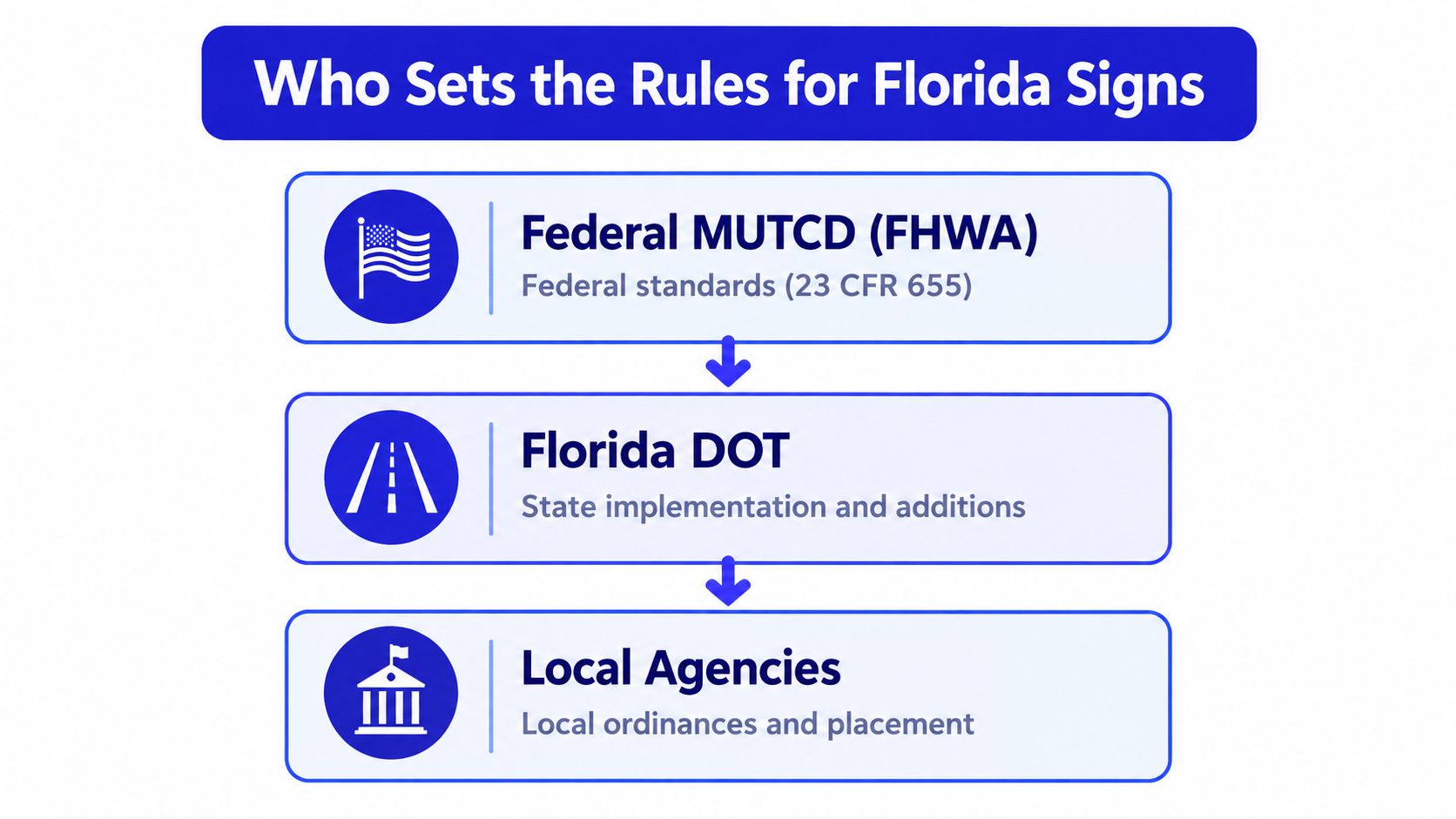
Florida traffic signs operate within a layered legal and technical structure. At the federal level, the Federal Highway Administration's Manual on Uniform Traffic Control Devices, commonly called the MUTCD, establishes national standards for traffic-control devices. FDOT identifies the MUTCD as the national standard for road markings, highway signs, and traffic signals, and says those standards apply on public streets, highways, bikeways, and private roads open to public travel. The current edition identified by FDOT is the 11th Edition with Revision 1, dated December 2025. FDOT's MUTCD information
Florida adds its own legal authority. Section 316.0745, Florida Statutes, requires FDOT to adopt a uniform system of traffic-control devices, publish a manual, and publish minimum specifications for certified devices. The statute also makes it unlawful to buy or sell a device unless it conforms to the published standards and is certified as conforming before sale. Florida Statute 316.0745
State and local jurisdiction
Section 316.006, Florida Statutes, assigns original jurisdiction over state roads to FDOT. Municipalities control streets and highways within their boundaries, except state roads, while counties and other authorized governmental entities exercise jurisdiction provided by statute. The important limitation is consistent across jurisdictions. Traffic-control devices must conform to FDOT's manual and specifications. Florida Statute 316.006
FDOT's signing guidance explains that Florida formally adopted the MUTCD under Rule 14-15.010, Florida Administrative Code. Sign designs intended to control traffic must comply with the MUTCD and the Standard Highway Signs supplement, although Florida may create state-specific designs that remain in substantial compliance with the federal baseline. FDOT also maintains a Highway Sign Library for standardized and approved designs on the State Highway System. FDOT's signing FAQ
Product approval matters too
A sign can appear familiar and still create a compliance issue if the equipment or installation fails Florida requirements. FDOT's TERL compliance matrices state that traffic-control signals and devices sold or installed in Florida must conform to FDOT specifications and be listed on the Approved Product List, in addition to meeting MUTCD requirements. The matrices identify equipment-specific categories, including portable regulatory signs, portable changeable message signs, portable traffic-control signals, pedestrian signal assemblies, and rectangular rapid flashing beacons. FDOT product specifications and compliance information
For a citation defense, the controlling agency and approval trail matter. A careful review may include the sign design, installation records, maintenance history, and location data. A driver or attorney researching related authorities can also use a case law search with AI to organize Florida decisions and legal materials. For a broader overview of the governing framework, review Florida traffic laws and sign authority.
Regulatory Signs and What They Mean for Your Ticket
Regulatory signs command, prohibit, or limit conduct. They're the signs most likely to appear in a civil traffic citation because they communicate an enforceable instruction. The sign's appearance matters, but the citation should also identify the Florida statute the officer believes you violated.
A stop sign usually leads to an allegation under Section 316.123, which governs stops at intersections and stop signs. The State may need to show where the stop was required, whether the stop line or crosswalk was visible, and whether the sign was positioned so an approaching driver could identify the obligation. A yield sign generally relates to right-of-way duties under Section 316.123, while Section 316.072 addresses obedience to traffic-control devices. Read the exact statute printed on your citation instead of relying on the sign label alone.
Speed-limit signs work differently from stop and yield signs because the posted limit establishes the regulatory number for that roadway segment. Florida's unlawful-speed statute, Section 316.183, must be considered alongside the location, direction of travel, and sign placement. A defense may focus on whether the posted limit was visible before the alleged speed, whether a prior limit remained applicable, or whether the officer measured speed inside the correct zone.
Do-not-enter, wrong-way, turn-prohibition, one-way, and lane-use signs can create similar issues. Their legends and arrows must communicate a clear restriction, and their orientation must match the movement being regulated. A sign facing the wrong direction or hidden behind another object can undermine the claim that you knowingly disobeyed a lawful device.
Sign or conduct | Florida Statute | Typical fine | Points |
|---|---|---|---|
Stop-sign violation | Section 316.123 | Varies by citation and jurisdiction | Review current DHSMV schedule |
Traffic-control-device violation | Section 316.074 | Varies by citation and jurisdiction | Review current DHSMV schedule |
Unlawful speed | Section 316.183 | Varies by alleged speed and location | Review current DHSMV schedule |
Turn or lane restriction | Applicable Chapter 316 provision | Varies by citation and jurisdiction | Review current DHSMV schedule |
Florida law and local court schedules determine the amount owed. The verified materials for this guide don't establish a universal fine range or a complete point table, so don't rely on an online chart that omits the county, statute, or current schedule. For a focused discussion of device-based citations, see traffic-control-device violations in Florida.
Warning Signs Florida Drivers Cannot Afford to Miss
Warning signs alert you to a roadway condition, but they don't all impose the same direct command as a stop or yield sign. Their defensive importance comes from context. A warning sign may help the State explain why a driver should have reduced speed or anticipated a hazard, while poor visibility may help the defense show that the warning wasn't reasonably available.
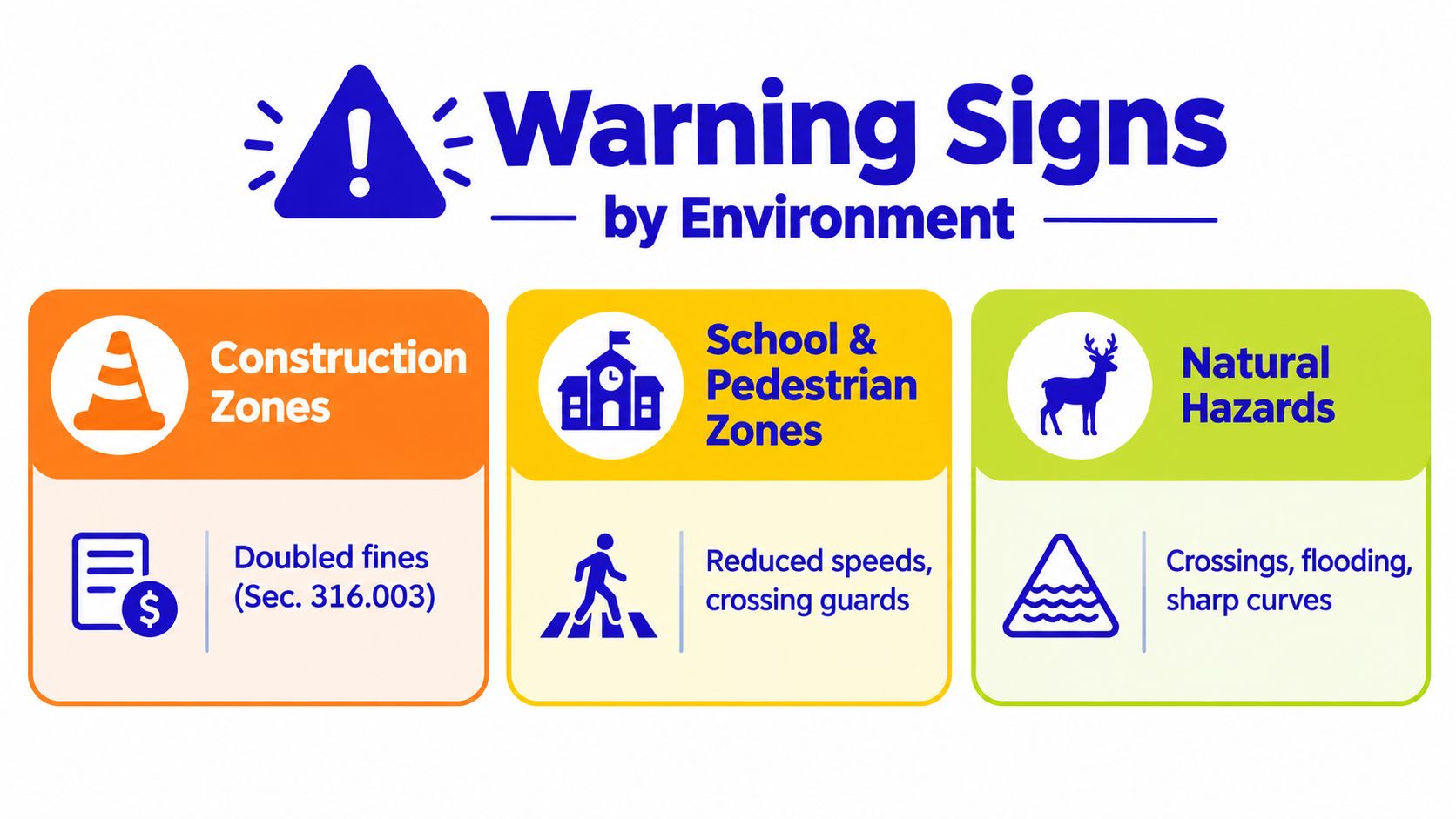
Construction and active work areas
Orange diamond signs, lane-shift arrows, flagger symbols, and related devices identify changing traffic conditions. Florida's traffic-control framework treats these devices as engineered components of the roadway, not casual decorations. If the alleged conduct occurred in a work area, examine whether the sign was upright, visible, correctly positioned, and consistent with the lane pattern.
The supplied planning materials refer to doubled fines under Section 316.003, but the verified data doesn't establish that proposition or a specific work-zone penalty. Don't assume an enhanced penalty applies because an orange sign was nearby. Confirm the statute written on the citation and the facts supporting the claimed zone.
School and pedestrian areas
School advance signs, crossing signs, reduced-speed assemblies, pedestrian signs, and bicycle warnings require careful timing and location analysis. The existence of a school-related sign doesn't automatically establish that a reduced-speed rule was active when the officer stopped you. Check the sign's supplemental panel, the roadway direction, the time conditions, and whether the alleged conduct occurred within the marked area.
Curves, crossings, and natural hazards
Curve, winding-road, intersection, railroad-crossing, flooding, bicycle, and pedestrian warnings provide roadway information. An advisory-speed plaque can be important evidence about the road's design, but it isn't automatically the same as a posted regulatory speed limit. Your attorney should distinguish an advisory recommendation from the statute charged.
Visibility remains central. Dense foliage, dusk, glare, rain, a damaged sign face, or a vehicle blocking the approach can affect whether a driver had a fair opportunity to recognize the warning. Photograph the approach from the driver's perspective, not just a close-up taken from the shoulder.
Guide and Informational Signs Across Florida Roads
Guide and informational signs help drivers find their way. They include route markers, street-name signs, destination signs, motorist-service signs, and recreational or cultural-interest signs. A wrong turn or misunderstood direction generally doesn't create a moving violation by itself, but the sign can become important when reconstructing where a driver traveled and when an officer observed the alleged conduct.
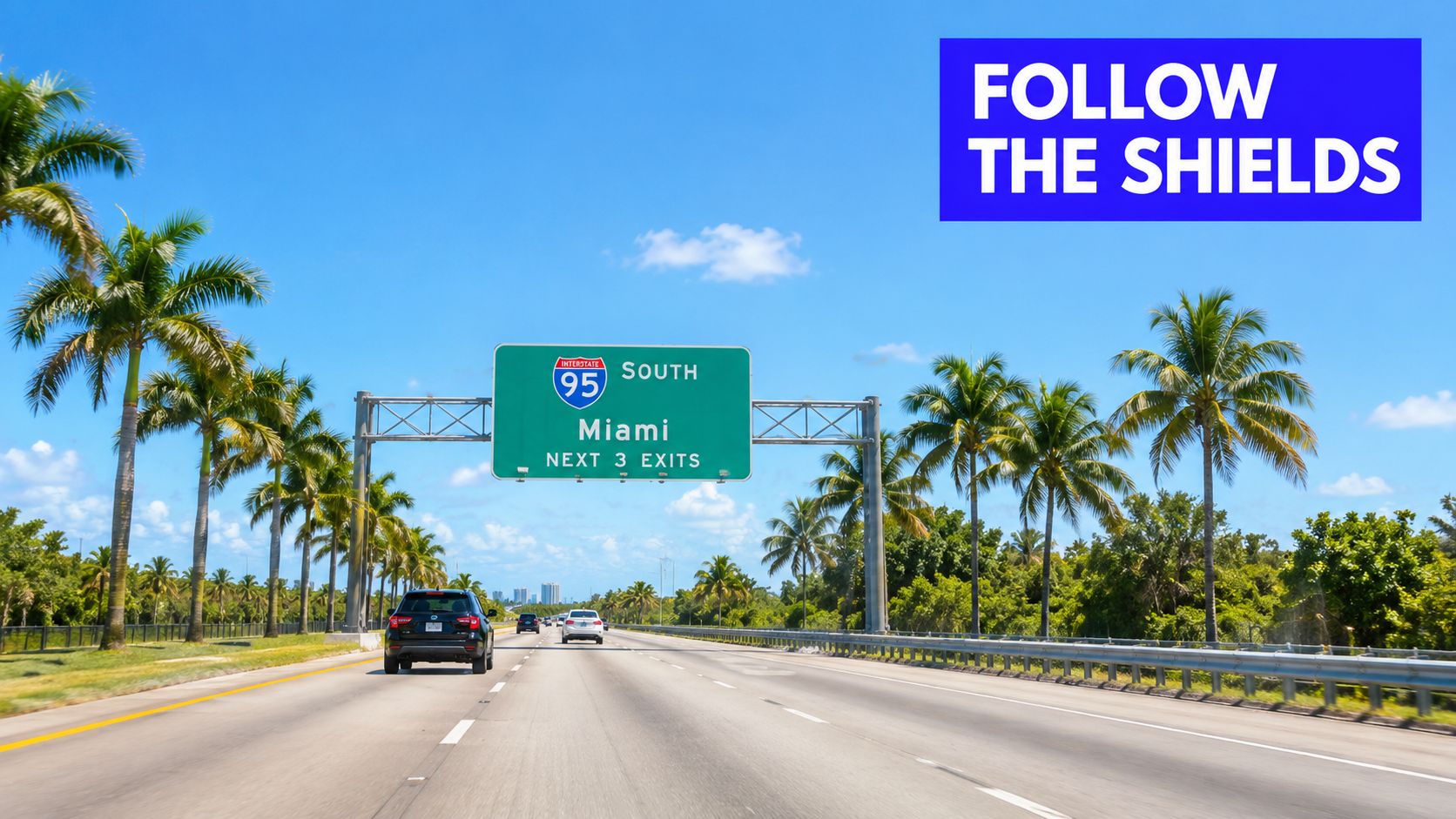
Route markers distinguish Interstate, United States, and Florida State Road routes through standardized shields and colors. Those visual differences help identify the route, but a driver who follows the wrong marker usually hasn't violated a traffic command merely by choosing an unintended road. The marker may still establish the roadway identity, especially when the citation describes an intersection or zone imprecisely.
Street-name signs are often the most familiar guide signs in a local driving environment. They help establish the intersection and can support a mistaken-location defense when the citation, officer's notes, photographs, or roadway layout point to different streets. Compare the citation's location with the actual signs, lane configuration, and nearby intersections.
Motorist-service signs identify services such as fuel, food, lodging, or hospitals. Recreational and cultural signs identify destinations and attractions. FDOT's sign programs regulate how these signs appear on eligible roadways, but their primary function is directional and informational rather than punitive.
Your defense lawyer should still photograph them when they clarify the route or prove the stop occurred outside a claimed restriction. Misreading a guide sign may explain your movements, but it won't automatically erase a properly supported regulatory violation.
How Sign Color and Shape Reveal the Rule
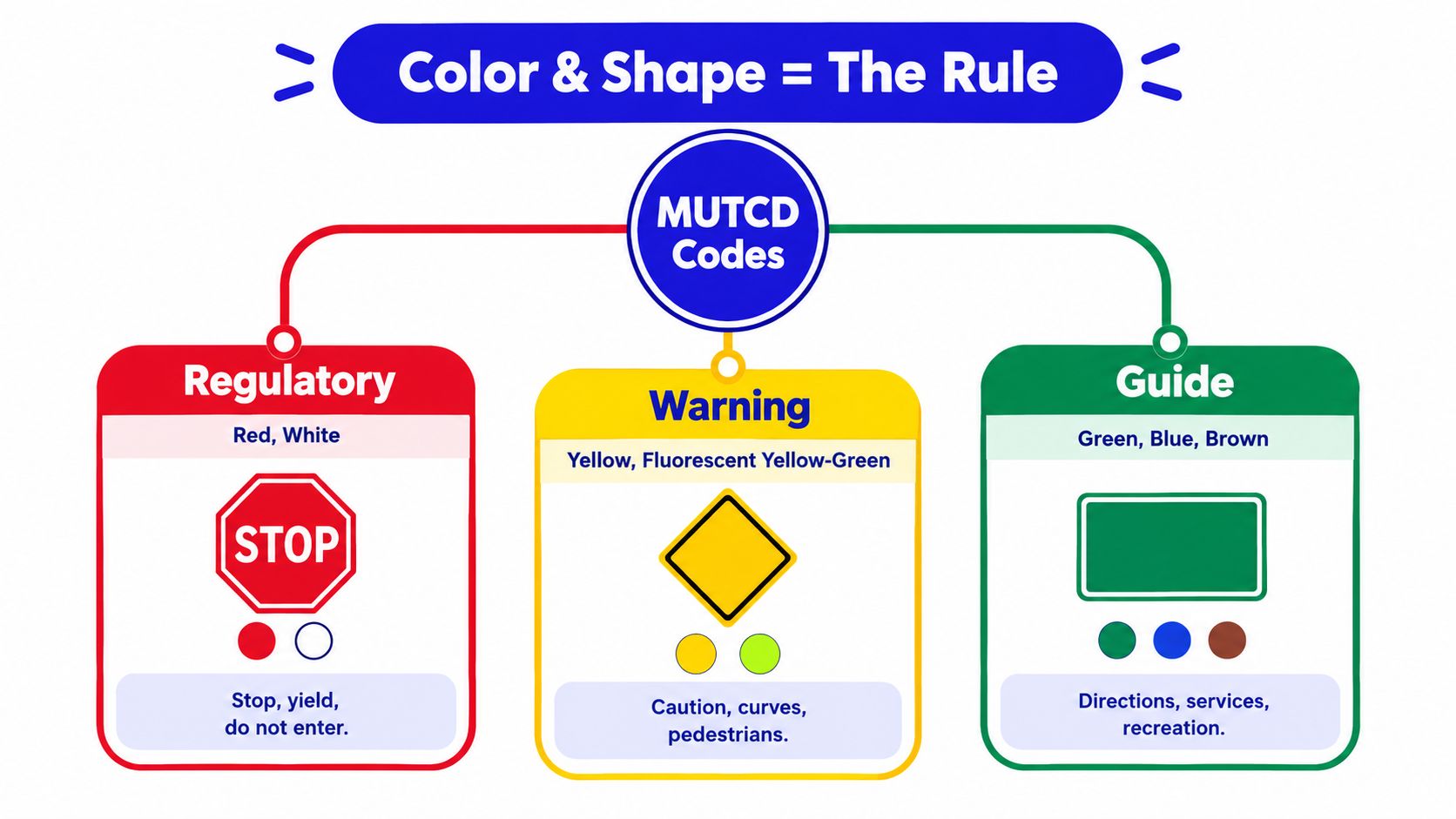
Florida traffic signs use a visual language built around MUTCD conventions. That language helps drivers classify a sign before they can read every letter, and it helps attorneys evaluate whether the device looked like the type of official sign the State claims it was.
Red usually signals prohibition, stopping, yielding, or restricted entry. White with black legend commonly communicates a regulatory instruction, such as a speed limit or lane-use requirement. Yellow signals a general warning, while fluorescent yellow-green is used for selected pedestrian, bicycle, and school-related warnings. Green, blue, and brown commonly identify guide, service, and recreation information.
Shapes identify the category
Octagon: Reserved for STOP signs. If the sign's silhouette is incomplete or obscured, document what an approaching driver could see.
Inverted triangle: Identifies YIELD. The orientation matters, especially where a sign has been rotated or struck.
Diamond: The standard warning shape for roadway hazards, changing alignment, crossings, and similar conditions.
Pennant: Identifies a no-passing-zone warning.
Circle: Commonly associated with railroad-crossing warnings and other specialized traffic information.
Rectangle: Used broadly for regulatory, guide, and informational signs, so the legend and color become essential.
A defense doesn't require a sign to be completely absent. The issue may be whether its color, shape, legend, contrast, orientation, or retroreflective performance allowed a driver to understand the rule in time. Section 316.0745 ties Florida's uniform system to published standards and certified devices. That gives counsel a framework for asking whether the physical sign matched the legal device described in the citation.
Don't make a legal conclusion from a blurry photograph alone. Preserve the original image, document the approach distance, and have counsel compare the scene with applicable FDOT and MUTCD requirements.
Defending a Florida Traffic Sign Citation
A damaged or hidden sign isn't an excuse by itself. It's a factual defense that must be documented and connected to the legal requirement that the device be official and properly placed.
Section 316.077 prohibits unauthorized signs, signals, markings, or devices that imitate official traffic-control devices, attempt to direct traffic, or conceal or interfere with an official device. The statute reinforces the central point: Florida distinguishes between an authorized traffic-control device and an object that merely looks like one. Florida Statute 316.077
Build the physical record
Take photographs from the direction of travel. Capture the entire approach, the sign face, nearby obstructions, lane markings, lighting, and the point where a driver could first read the legend. Record whether vegetation, graffiti, parked vehicles, construction equipment, or structural damage interfered with recognition.
A lawyer may seek installation and maintenance records, agency photographs, sign-replacement records, and available reflectivity or inspection information. FDOT's research on Miami-Dade traffic signs identified deeper installations, soil plates, concrete foundations, and third-party hardware as methods that can improve sign stability. That research supports a practical conclusion: mounting and durability are engineering issues, especially after severe weather or repeated roadway impacts. Miami-Dade traffic-sign research summary
Match the sign to the alleged violation
Confirm the exact stop location, direction of travel, and regulatory boundary. A sign can be present at an intersection while the alleged conduct occurs beyond the area it controls. Compare photographs, mapping information, officer notes, roadway diagrams, and any available agency records.
Temporary signs deserve separate scrutiny. Verify who authorized the device, whether the temporary traffic pattern was active, and whether the sign's placement matched the applicable Florida requirements. If you received a stop-sign citation, review the evidence and practical defense issues discussed in Florida stop-sign ticket defense guidance.
Florida Driver Obligations Under Section 316.074
Section 316.074 places a direct duty on drivers to obey official traffic-control devices lawfully placed on the roadway. If a police officer directs traffic differently, the officer's direction controls. Otherwise, the posted device governs the movement it lawfully regulates.
A violation is a noncriminal traffic infraction and a moving violation under the statute. The consequences can include a fine, points, insurance effects, or administrative problems depending on the charge and your record. The verified materials don't establish a universal point value or suspension schedule for every sign citation, so check the exact charge and current Florida Department of Highway Safety and Motor Vehicles information before choosing a response.
What you should do after receiving the citation
Read the statute number. Don't rely only on the officer's description of the sign.
Preserve the scene. Photograph the sign, approach, lane markings, and obstructions.
Avoid immediate admissions. A casual explanation can later be treated as evidence.
Check the response deadline. Missing a deadline can create separate complications.
Get legal advice before selecting an outcome. Payment, a hearing, and other available options can affect your record differently.
Florida's sign law requires obedience, but it doesn't eliminate the State's obligation to prove that the device was official, applicable, and lawfully placed. That distinction should guide your next decision.
Quick Reference Table of Common Florida Sign Citations
Use the citation itself as the starting point. The statute, location, and alleged conduct must align, and the fine or point result may depend on the current schedule and the county handling the case.
Violation | Florida Statute | Typical fine | Points |
|---|---|---|---|
Failure to stop at a stop sign | Section 316.123 | Varies by citation and jurisdiction | Review current DHSMV schedule |
Disobedience to a traffic-control device | Section 316.074 | Varies by citation and jurisdiction | Review current DHSMV schedule |
Unlawful speed in a school area | Section 316.1895 | Varies by citation and applicable conditions | Review current DHSMV schedule |
Failure to yield | Section 316.072 or applicable right-of-way provision | Varies by citation and jurisdiction | Review current DHSMV schedule |
Improper lane change or movement | Section 316.085 or applicable provision | Varies by citation and jurisdiction | Review current DHSMV schedule |
The supplied data doesn't verify fixed fine ranges or point assignments for these entries. A Florida traffic attorney can identify whether the charge is accurately stated and whether the sign or roadway evidence supports it.
Cross-Reference Checklist Before You Contest a Sign Ticket
Before paying or entering a plea, assemble the evidence that connects the citation to the physical sign.
Identify the agency: Determine whether FDOT, a county, or a municipality controlled the roadway.
Confirm the device: Compare the sign's design, legend, color, shape, and placement with applicable Florida and MUTCD standards.
Document visibility: Photograph the driver's approach and record foliage, vehicles, lighting, weather, damage, and sight distance.
Check the location: Confirm the GPS position, travel direction, intersection, and regulatory boundary.
Request records: Ask for installation, maintenance, inspection, replacement, and authorization records through the appropriate public-records process.
Verify the citation: Compare the statute, date, time, location, and alleged conduct with the scene.
Preserve originals: Keep original photographs and videos with their timestamps and metadata.
Don't assume every roadside camera or electronic device carries the same authority as a standard sign. For related questions about Florida roadway enforcement technology, review Florida DOT traffic cameras and citations. If the records conflict with the officer's description, give that conflict to a lawyer before you make a final decision.
Protect Your License With a Florida Traffic Defense Attorney
A sign citation deserves a defense based on the device, the roadway, and the proof, not just your recollection of what happened. A Florida traffic defense attorney can investigate authorization, placement, visibility, and the statute charged, then pursue an outcome designed to protect your driving record.
Ticket Shield, PLLC is a lawyer-led Florida firm where clients can communicate directly with an attorney by phone or text, rather than relying on automated apps, corporate answering services, or middlemen. Learn more about working with a Florida traffic defense lawyer.
Visit Ticket Shield, PLLC for a free consultation about your Florida traffic-sign citation. The firm can review the sign, citation, and available defenses while pursuing the ultimate goal of “No Points” on your license.