Navigating a "Violation Traffic Control Device" Ticket in Miami-Dade
Discover how a violation traffic control device charge could affect your Florida ticket and what options you have.
Attorney Advertisement. Office in Broward.
Ever received a "violation of traffic control device" ticket in Florida? It's one of those catch-all terms for disobeying just about any official sign, signal, or pavement marking that's there to manage the flow of traffic in places like Miami-Dade County.
This can cover everything from the obvious stuff, like running a red light or rolling through a stop sign, to things you might not even think about, like making an illegal U-turn or crossing over a solid white line. Our practice focuses on traffic and DUI defense, and our goal is to protect your license and record.
Decoding Florida Traffic Control Device Violations in Miami-Dade
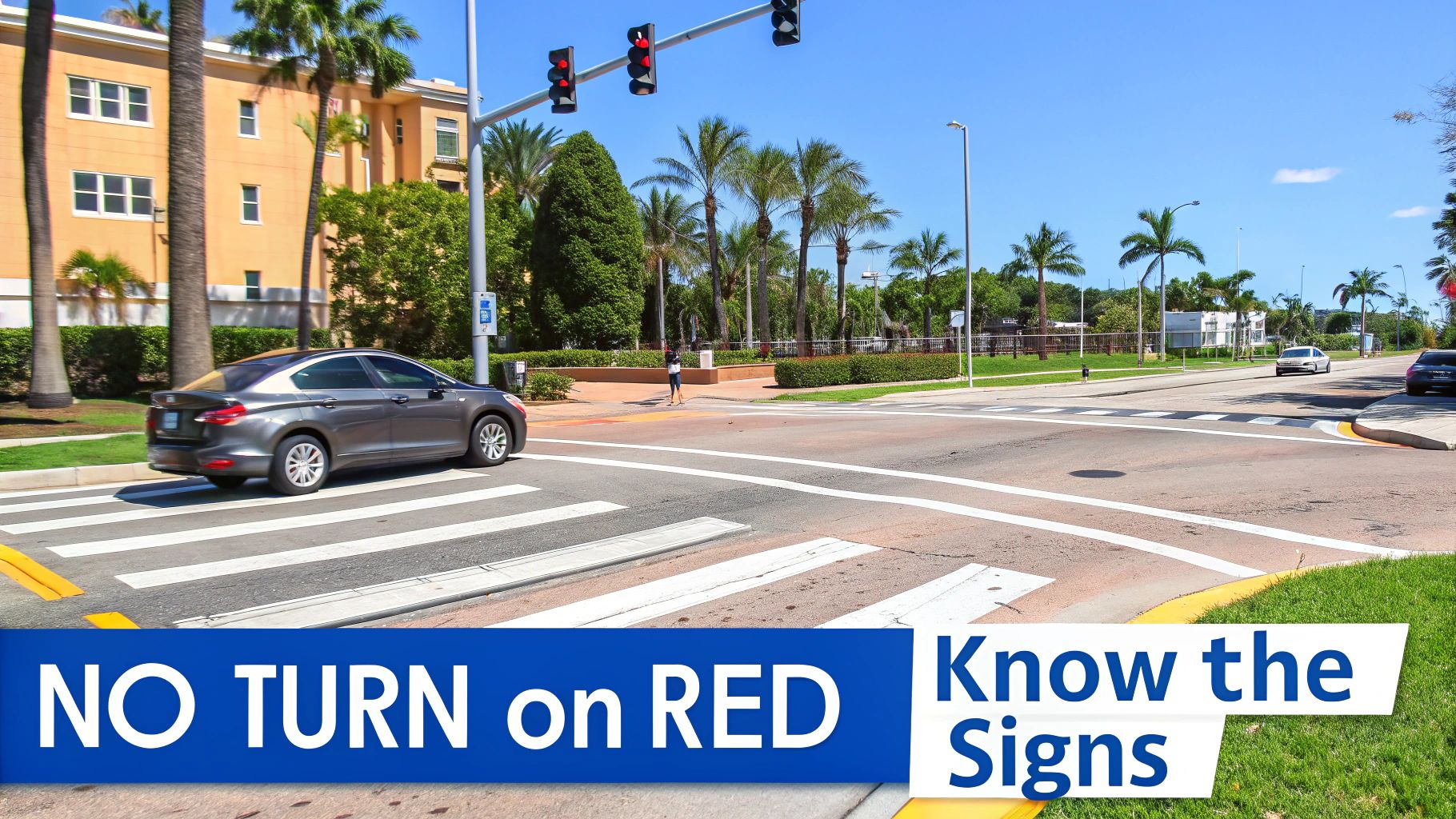
Think of Florida's roadways—especially in a jam-packed place like Miami-Dade County—as a complex system with a very clear rulebook. Traffic control devices are the language of that system. They're constantly giving you instructions to keep things predictable and, most importantly, safe.
When a driver fails to follow one of those instructions, they've committed a violation of a traffic control device.
And we're not just talking about flooring it through a yellow light that’s just turned red. The definition is much broader. It includes a ton of common driving maneuvers that might seem minor but can absolutely get you a ticket. One small mistake on a busy road like Biscayne Boulevard or in the express lanes on I-95 is all it takes to see an officer's lights in your rearview mirror.
Common Examples in Miami-Dade and Across Florida
The term "traffic control device" covers a huge range of signs, signals, and road markings you see every single day. Getting a ticket usually means an officer saw you fail to follow the directions given by one of them.
Here’s a quick look at some of the most common situations we see that lead to these tickets.
Common Traffic Control Device Violations in Florida
The following table provides a snapshot of frequent violations and their potential consequences under Florida law, giving you a better idea of what's at stake.
Violation Type | Governing Florida Statute | Potential License Points | Common Miami-Dade Scenario |
|---|---|---|---|
Running a Red Light | § 316.075 | 3-4 | Proceeding through an intersection on US-1 after the light has clearly turned red. |
Failing to Stop | § 316.123 | 3 | Not coming to a full and complete stop at a stop sign in a residential Coral Gables neighborhood. |
Illegal Turn on Red | § 316.075(3)(c) | 3 | Making a right turn on red where a "No Turn on Red" sign is visibly posted at a busy downtown intersection. |
Improper Lane Change | § 316.085 | 3 | Crossing the solid white lines to enter or exit the express lanes on I-95 outside of the designated areas. |
Disobeying Yield Sign | § 316.122 | 3 | Failing to yield to oncoming traffic at a yield sign when merging onto the Palmetto Expressway. |
These examples just scratch the surface, but they highlight how easily a momentary lapse in attention can lead to a citation. These devices are in place for one critical reason: to prevent accidents and keep everyone on the road safe. That’s why law enforcement in high-traffic areas like Miami-Dade is always on the lookout for these kinds of violations.
Why This Ticket Is More Than a Simple Fine
Getting cited for a violation traffic control device might feel like a minor headache, but the ripple effects can be surprisingly big. Under Florida law, this is a moving violation. That means a conviction will add points to your driver's license.
For most people, those points can quickly lead to a spike in insurance premiums that you'll be paying for years to come.
A ticket is more than just a piece of paper; it's an official accusation. Simply paying the fine is an admission of guilt, which guarantees that points will be added to your driving record, potentially impacting your insurance rates and driving privileges.
Understanding just how broad the definition of a violation traffic control device is the first step in protecting your driving record. It's not just about major offenses; even a small, split-second mistake can land you with a ticket. That's why it's so important to learn more about the specifics of traffic control device tickets and understand your options for handling it. We're here to cut through the legal jargon and show you exactly how these common violations happen and why handling them the right way is so critical.
Understanding the True Cost of a Miami-Dade Traffic Ticket
That dollar amount printed on your traffic ticket? Think of it as just the down payment. It’s the first thing you see, but it’s nowhere near the real price you’ll pay if you get a conviction for a violation traffic control device in Florida.
Many drivers make the mistake of just paying the ticket to get it over with, not realizing they’re pleading guilty. That’s the moment the real consequences—the ones that can follow you for years—start to kick in.
The first hit comes from the Florida driver's license point system. It’s designed to track moving violations, and a conviction for blowing past a stop sign or running a red light will typically slap three points on your license. If that mistake happens in a school zone, it jumps to four points.
These points might not sound like a big deal at first, but they add up fast. Every point is a step closer to serious trouble.
The Point System and Your License
The Florida Department of Highway Safety and Motor Vehicles (FLHSMV) has strict limits on how many points you can accumulate before they suspend your license. A single ticket gets you dangerously close to those thresholds:
12 points in a 12-month period means a 30-day suspension.
18 points in an 18-month period will get you a 3-month suspension.
24 points in a 36-month period, and you’ll lose your license for a full year.
Just one or two tickets in a year could easily put your license on the line, threatening your ability to get to work, school, or just handle your daily life in Miami-Dade.
The Lasting Impact on Your Insurance Premiums
Beyond the points, the biggest long-term financial gut punch comes from your auto insurance company. Insurers see a violation traffic control device conviction as a red flag—a sign that you’re a higher-risk driver.
When your policy is up for renewal, you may see a serious price hike. A single ticket like this can send your insurance rates soaring by 15% to 30%. For the average driver in Florida, that means hundreds of extra dollars out of your pocket every single year, for the next three to five years.
Let's do the math: a 20% increase on a $2,500 annual premium costs you an extra $500 a year. Over three years, that’s $1,500—all from one ticket. You can get a deeper look at how a citation impacts your wallet in our detailed guide on the cost of a ticket for running a red light.
Amplified Consequences for Specific Drivers
While everyone feels the sting of a ticket, for certain drivers, the stakes are much, much higher.
For professional and young drivers, a traffic violation is not just an inconvenience; it can be a direct threat to their livelihood or future driving privileges. The stakes are considerably higher.
Take someone with a Commercial Driver's License (CDL) in Miami-Dade. Their job literally depends on a clean driving record. A conviction could jeopardize their employment or make finding a new job nearly impossible. It's the same for teen drivers in Florida, who are under a much stricter set of rules. One violation can lead to harsh penalties or a license suspension far faster than it would for an adult.
The true cost isn't just about money; it’s about protecting your future on the road.
What Are Your Options After a Miami-Dade Ticket Hits Your Windshield?
That piece of paper the officer hands you isn't just a notice—it's a fork in the road. Once that citation for violating a traffic control device is in your hand, you're standing at a crossroads with three very different paths forward. Each one has real consequences for your driving record and your wallet.
Your first instinct might be to take the path of least resistance, but it's critical to understand what each choice actually means. The decision you make in the next few days will echo for years, affecting your license, your insurance premiums, and your bank account.
This chart breaks down the main choices drivers have after getting a ticket, showing how different paths lead to vastly different outcomes.
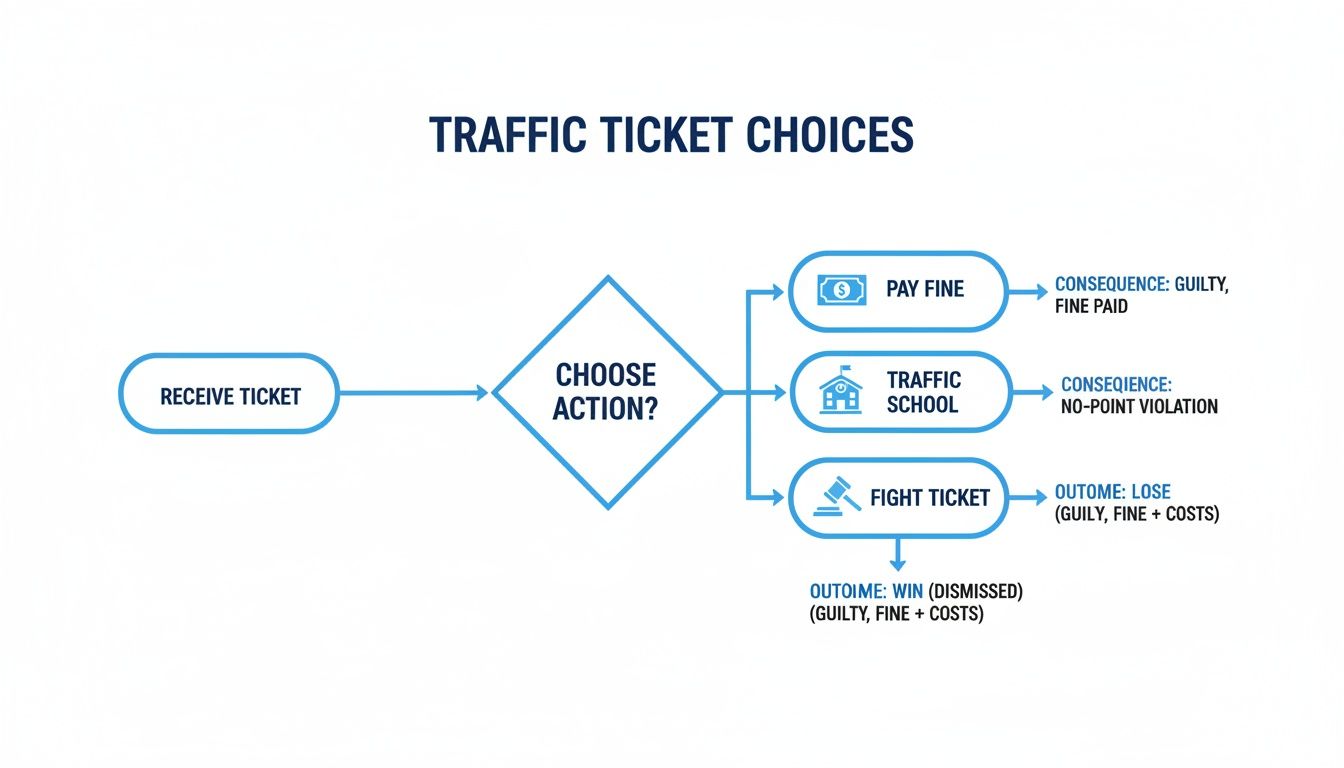
As you can see, simply paying the fine is the only option that locks in negative consequences. Contesting the ticket is the only path that opens the door to a positive result.
Option 1: The Path of Least Resistance—Paying the Fine
Paying the fine is definitely the fastest way to put the ticket behind you, but it comes with a steep, hidden cost. In the eyes of Florida law, paying that ticket is the same as pleading guilty. You're officially admitting you committed the violation.
That admission triggers two immediate and unavoidable penalties:
Guaranteed Points: A conviction is stamped onto your driving record, and the Florida DHSMV will automatically slap three to four points on your license.
Certain Insurance Hikes: Your insurance company will see that conviction at your next renewal and almost certainly raise your premiums—an increase that can stick around for years.
This is often the worst option because it leaves no room for a better outcome. You're accepting all the penalties without putting up a fight. If you’re still considering it, you should learn more about how to pay traffic tickets in Miami-Dade and fully understand the consequences.
Option 2: The Temporary Fix—Electing Traffic School
Another route is electing to attend a driver improvement course, which most people just call traffic school. This option is a bit of a lifeline, as it lets you avoid the points that would otherwise hit your license after a conviction.
But traffic school isn't a get-out-of-jail-free card. The state of Florida puts strict limits on how often you can use it:
You can only choose this option once in any 12-month period.
You're capped at a grand total of five times in your entire life.
Even though it saves you from the points, you're still on the hook for the full fine, plus the cost of the course itself. Think of it as a limited resource in your driving toolkit—it's smart to save it for a time when you absolutely need it.
Option 3: The Proactive Approach—Contesting the Ticket
The third and most strategic move is to contest the ticket in court. When you choose this path, you're not admitting guilt. Instead, you're making the state prove its case against you. It is the only option that gives you a chance at having the ticket dismissed completely.
Contesting your ticket is the only way to potentially avoid the fines, points, and insurance hikes altogether. It puts you back in the driver's seat instead of just accepting the penalties.
By fighting the ticket, you open up the possibility of several positive outcomes, like a complete dismissal, a reduction to a less serious offense, or being found not guilty. If you go this route, it's crucial to be aware of the serious consequences of missing a court date, which can make a bad situation much worse. This proactive approach protects your right to be presumed innocent and is the first step toward the smartest choice of all: having an experienced traffic attorney handle the fight for you.
How to Build a Strong Defense Against Your Miami-Dade Ticket
That piece of paper the officer handed you for a violation traffic control device isn't a final judgment. It’s an accusation, plain and simple. And just like any accusation, you have the right to challenge it. Too many drivers in Miami-Dade make the mistake of thinking a ticket is a lost cause, but the truth is, valid legal defenses are more common than you'd think.
The key is to stop seeing the ticket as a foregone conclusion and start questioning the situation that led to it. Was everything as clear-cut as the officer believed? On the busy, complex roads of Miami-Dade County, there are often subtle details that can form the bedrock of a powerful defense.
Questioning the Officer's Perspective
One of the most effective ways to challenge a ticket is to question whether the officer could have clearly seen what they claim they saw. Officers are human, and their view of an event can be compromised by all sorts of factors. This is a common and often successful angle when contesting a violation traffic control device ticket.
Picture a chaotic Miami intersection at rush hour. A solid defense could easily come down to a few simple questions:
Was there a clear line of sight? Could a city bus, a large truck, or a cluster of turning cars have blocked the officer’s view at the critical moment?
What was the distance and angle? An officer sitting hundreds of feet away or at an odd angle might not have been in a position to accurately judge the exact second a light turned red or if your car came to a complete stop.
Were environmental factors at play? Heavy rain, sun glare, or even the confusing layout of an intersection can easily affect an officer's perception.
An attorney familiar with traffic matters knows how to scrutinize the officer's vantage point and the surrounding conditions to find weaknesses in the state's case. Remember, the burden of proof is on them, and a questionable viewpoint can create the reasonable doubt needed for a favorable outcome.
Proving the Traffic Control Device Was Obscured
Another powerful defense is to show that the traffic signal or sign itself wasn't even visible. You can't be expected to obey a traffic control device that you couldn't reasonably see. This strategy requires you to gather proof that the device was blocked from view when the alleged violation happened.
For example, a stop sign hidden behind overgrown palm fronds in a Miami neighborhood or a "No Turn on Red" sign that has been bleached illegible by the relentless Florida sun might not be legally enforceable.
An obscured, damaged, or improperly placed traffic control device can render a citation invalid. The law requires these devices to be positioned so that an ordinarily observant person can see and react to them.
Evidence is everything here. Snapping clear photos or taking a quick video of the obscured sign from your perspective—as soon as you can after getting the ticket—can be incredibly persuasive in court. This kind of visual proof directly attacks the core of the state's accusation.
The Necessity Defense: Was Your Action Unavoidable?
Sometimes, breaking a traffic law is the only way to avoid a much worse outcome, like a serious accident. This is known as the "necessity defense." To use it successfully, you have to prove that your action, while technically a violation, was the lesser of two evils.
Imagine you're approaching an intersection in Miami when you realize the driver behind you is tailgating aggressively and isn't slowing down. You might have to make a split-second decision to go through a yellow light as it turns red just to avoid getting rear-ended. In that scenario, your action was taken to prevent a certain collision.
Successfully arguing necessity means showing three things:
You were faced with a specific and immediate threat of harm.
The harm you avoided (the crash) was greater than the harm you caused (the violation).
You had no other reasonable, legal alternative.
Dashcam footage can be a game-changer in these situations, providing undeniable proof of the circumstances that forced your hand. Without it, it often becomes your word against the officer's, which is exactly why having professional legal representation to build a compelling and legally sound defense is so important.
The Rise of Red-Light Cameras and Automated Enforcement in Miami-Dade
Traditional traffic enforcement is changing. Instead of seeing flashing lights in your rearview mirror, you might find a citation for a violation traffic control device arriving in your mailbox weeks after the fact. This is the new reality of automated enforcement, a technology that’s becoming more and more common across Florida, especially in high-traffic areas like Miami-Dade.
These systems use sophisticated cameras and sensors tied directly to traffic signals. The moment a vehicle crosses the stop line after a light turns red, the system snaps into action, capturing photos and video of the event, including a crystal-clear shot of the license plate. This digital evidence is then reviewed, and a citation, officially called a Notice of Violation, is mailed straight to the registered owner of the car.
How Automated Citations Differ from Traditional Tickets
Getting a notice from a red-light camera is a totally different ballgame than being pulled over by an officer. A traditional traffic stop is a direct interaction—an officer sees the violation and hands you a ticket right there. An automated citation, however, is generated by a machine based on data it collected.
This distinction is absolutely critical because it changes everything about the evidence and the potential ways to fight it. Here are the key differences you need to know:
No Points Initially: A Florida red-light camera ticket starts its life as a Notice of Violation, which doesn’t carry any points. But if you ignore it and it turns into a Uniform Traffic Citation, a conviction will absolutely add points to your license.
Issued to the Vehicle Owner: The notice is sent to whoever owns the car, no matter who was actually behind the wheel at the time.
Evidence is Photographic: The case against you is built entirely on images and video clips, not the testimony of a police officer.
While this technology is pitched as a way to improve safety, it is not perfect. These systems are complex machines that need precise calibration and constant maintenance to work the way they’re supposed to.
Common Defenses Against Automated Tickets
Just because a camera generated a ticket doesn’t mean it's an open-and-shut case. Automated systems can and do make mistakes, which opens the door for some very effective legal challenges. A knowledgeable attorney knows how to scrutinize the evidence and find the hidden flaws.
For instance, the clarity of the photographic evidence is everything. If the images are blurry, too dark, or don't clearly show your vehicle entering the intersection after the light turned red, the citation can be challenged. We can also question the timing and calibration records for the camera itself. Was the yellow light duration even appropriate for that road's speed limit? These technical details are often the bedrock of a strong defense. You can explore more specifics in our guide on fighting red light camera tickets in Florida.
The rise of this technology reflects a broader trend. Automated systems are increasingly popular. For example, recent surveys show that 82% of parents approve of automated enforcement for school bus violations, highlighting a real public desire for safer roads through technology. This trend is also driving a market for self-service traffic violation processors, which is projected to grow significantly as more drivers run into these automated systems.
Automated enforcement is not infallible. A citation from a camera is an accusation based on machine-generated data, and that data can be challenged on technical grounds by a professional who understands the system's weaknesses.
Fighting an automated violation traffic control device ticket requires a completely different strategy than a traditional citation. Our goal is to protect your record by digging into every technical detail and procedural requirement tied to the automated ticket you received.
Why Hiring a Traffic Attorney Is a Strategic Decision

After getting a ticket for a violation traffic control device, the next move you make is critical. It’s tempting to just pay the fine and get it over with, but that’s the same as pleading guilty. It guarantees points on your license and, almost always, a hike in your insurance rates.
Contesting the ticket is the only way to open the door to a better outcome. But trying to fight it yourself can be challenging. This is where getting professional legal help stops being a cost and becomes a powerful strategic investment.
Hiring an attorney with experience in traffic matters isn’t just about having someone who knows the law. It’s about deploying a strategy built to protect your time, your money, and your driving record. Our job is to manage the entire process for you, creating a stress-free experience while we work toward the best possible result.
Saving You Time and Stress
Your time is valuable. Going to court for a traffic ticket means taking a day off work, navigating the courthouse in Miami-Dade, and then waiting—sometimes for hours—for your case to be called.
This is exactly where having a dedicated firm in your corner makes a huge difference. At Ticket Shield, our attorneys handle court appearances for you in the vast majority of cases. You don't have to miss work. You don't have to disrupt your life. We handle the legal legwork so you can focus on what matters.
An Investment in Your Financial Future
The fine on the ticket is only the beginning. The real financial impact often comes from the long-term spike in your insurance premiums. Since running signals and signs is a major factor in crashes, a conviction for a violation traffic control device can indicate high risk to insurers.
This can easily cause your rates to jump by 15-25%, costing you hundreds, if not thousands, over the next few years. You can get more details on how these trends impact drivers from recent traffic safety outlooks.
When we handle your ticket, our goal is to prevent a conviction, which in turn shields you from those painful insurance hikes. When you compare our one-time, transparent fee against years of paying inflated premiums, the math is often very clear.
Our goal is to protect your license and record. Investing in professional legal help is a proactive measure to safeguard your finances and driving privileges from the long-term consequences of a traffic violation conviction. Past results do not guarantee future outcomes.
The whole process is built for your convenience. From uploading your ticket online to speaking with your attorney, we make sure you're supported every step of the way. Instead of just accepting the penalties, you can put our experience to work for you. Submitting information via our website does not create an attorney-client relationship.
Common Questions About Florida Traffic Tickets
Getting a traffic ticket can leave you with a lot of questions. Here are some straightforward answers to the most common concerns we hear from Florida drivers who've been cited for a violation of a traffic control device in Miami-Dade.
Do I Have to Go to Court for a Traffic Control Device Ticket in Florida?
For the vast majority of our clients, the answer is no. When you hire an experienced traffic attorney from Ticket Shield, we can often handle the court appearance for you.
This approach is designed to save you time, stress, and the hassle of taking a day off work to sit in a courthouse. Our job is to manage the entire legal process from start to finish, so you can go about your life.
Is It Possible to Get a Traffic Control Device Ticket Dismissed?
Yes, getting a ticket dismissed is absolutely a possible outcome. Citations can be challenged and potentially dismissed for all sorts of reasons, from procedural mistakes made by the officer to a lack of solid evidence, or even a successful legal challenge to the ticket itself.
Disclaimer: Past results do not guarantee future outcomes. Our goal is to protect your license and record.
Our firm puts its experience to work reviewing every single detail of your case, looking for any angle that could lead to a dismissal. The goal is always to secure the best possible result for you.
How Many Points Does a Traffic Control Device Violation Add to My License?
A conviction for disobeying a traffic control device in Florida will typically add three (3) points to your driver's license. That number can climb if the violation happened in a school zone or was part of an accident.
Since accumulating points is the fastest way to a license suspension, it's critical to contest the ticket to keep your record clean and protect your driving privileges.
What Should I Do Immediately After Getting a Ticket?
First, don't just pay it. Paying the fine is an admission of guilt, and it triggers all the negative consequences—points, insurance hikes, and a conviction on your record. Instead, if it's safe, pull over and take a clear picture of your ticket and maybe even the intersection or sign involved.
Then, your next move should be contacting an experienced traffic ticket attorney for a free consultation. Acting quickly gives your lawyer the best chance to build a strong case and protect your rights.
Don't let a ticket for a violation of a traffic control device put your license and insurance rates at risk. The team at Ticket Shield, PLLC is here to help drivers across all 67 Florida counties. Submit your ticket online for a free, no-obligation consultation today.