
Stop Sign on Road: Defend Your Florida Ticket
Hit with a ticket for a missing or obstructed stop sign on road? Learn how to document evidence, report the issue, and build a strong Florida defense.

You're driving through a Florida intersection when you notice the stop sign on road is missing, knocked down, or hidden behind vegetation. You slow down, stop where you think the sign should control traffic, and continue. Moments later, an officer pulls you over and writes a citation for failing to stop. Your explanation may be accurate, but an explanation alone won't protect your license.
Treat the situation as both a safety emergency and a potential defense. Stop completely, document what you saw, preserve the intersection's condition, and get legal advice before accepting responsibility. Florida law creates specific stopping duties, but it also recognizes that an official traffic device must be properly positioned and sufficiently legible. That distinction can decide whether a citation stands.
Table of Contents
Immediate Actions When a Stop Sign Is Missing
Your first priority is preventing a collision. If the stop sign has disappeared or is impossible to see, don't roll through the intersection. Reduce speed early, scan for vehicles and pedestrians, and make a complete stop before entering the area where cross traffic could appear.
Florida's stopping rule follows the intersection's physical layout. Under Florida Statute § 316.123, you must stop at the clearly marked stop line. If there's no stop line, stop before the crosswalk. If neither exists, stop at the point nearest the intersecting roadway where you can see approaching traffic, then proceed only when it's safe.
Make the stop defensively
A complete stop means your vehicle's wheels stop moving. A slow roll isn't enough. Keep your vehicle stopped long enough to assess traffic from every direction, especially if the sign's absence has created confusion for other drivers.
Use this sequence:
Brake before the intersection: Don't wait until the front of your vehicle reaches the roadway.
Stop at the controlling location: Use the stop line, crosswalk, or nearest point that gives you a view of traffic, in that order.
Check both directions: Look for vehicles, bicycles, pedestrians, and drivers who may also be uncertain about the missing sign.
Preserve the scene mentally: Note the sign's condition, weather, lighting, vegetation, road markings, and your approach direction.
Avoid arguing roadside: Give the officer your identification and documents, but don't turn the traffic stop into a detailed legal debate.
A missing sign doesn't authorize you to proceed without stopping. It gives you a reason to make an especially careful stop and gather facts that may later support your defense. Review the practical consequences of a rolling stop in this guide to Florida stop-sign tickets, but don't assume a warning or explanation will resolve your citation.
Immediate rule: If you can't see the sign, act as though the intersection requires a stop, then investigate why the traffic control device failed.
Florida Statutes That Protect Your Driving Record
A citation isn't automatically valid merely because an officer issued it. Florida's Chapter 316 contains both the driver's stopping duty and rules governing the traffic control device itself. Your defense should address both.
Section 316.123 establishes the physical stopping sequence. Stop at the marked line first. If there's no line, stop before the crosswalk. If neither is present, stop at the nearest point where you can view approaching traffic before entering the intersection. The statute also recognizes that a driver must stop unless a police officer or traffic control signal directs otherwise.
Section 316.074 adds a broader command. Drivers must obey official traffic control devices placed under Chapter 316, and they can't avoid the device by moving from one roadway to another. But the same statute limits enforcement when the device isn't properly positioned and sufficiently legible to an ordinarily observant person at the time and place of the alleged violation. That language matters when the sign was missing, obscured, turned away, or otherwise not reasonably visible.
The sign's condition can become a legal issue
Your case may involve more than whether your vehicle stopped. It may involve whether the government presented a properly installed and visible device that could communicate the required instruction.
Florida's uniform-sign framework supports that analysis. Under Florida Statute § 316.0745, the Department of Transportation adopts a uniform system of traffic control devices, and devices must conform to the applicable manual and specifications. Section 316.006 also addresses certain multiparty stop signs on private roads and requires conformity with the Department's manual and specifications.
That doesn't mean every imperfect sign automatically defeats a citation. It means the defect deserves factual investigation. A defense lawyer should examine whether the sign was visible from the approach, whether its placement complied with applicable standards, and whether the officer observed a violation of the statutory stopping sequence.
For a plain-language explanation of the legal duty to stop, see Florida's stop-means-stop rule. Don't plead guilty before someone evaluates the sign's condition and the officer's observations.
Documenting the Intersection for Your Defense
Your memory may be accurate, but photographs and video give your attorney something concrete to use. Return to the intersection only when it's safe and legal to do so. Never stand in a travel lane or create a hazard while collecting evidence.
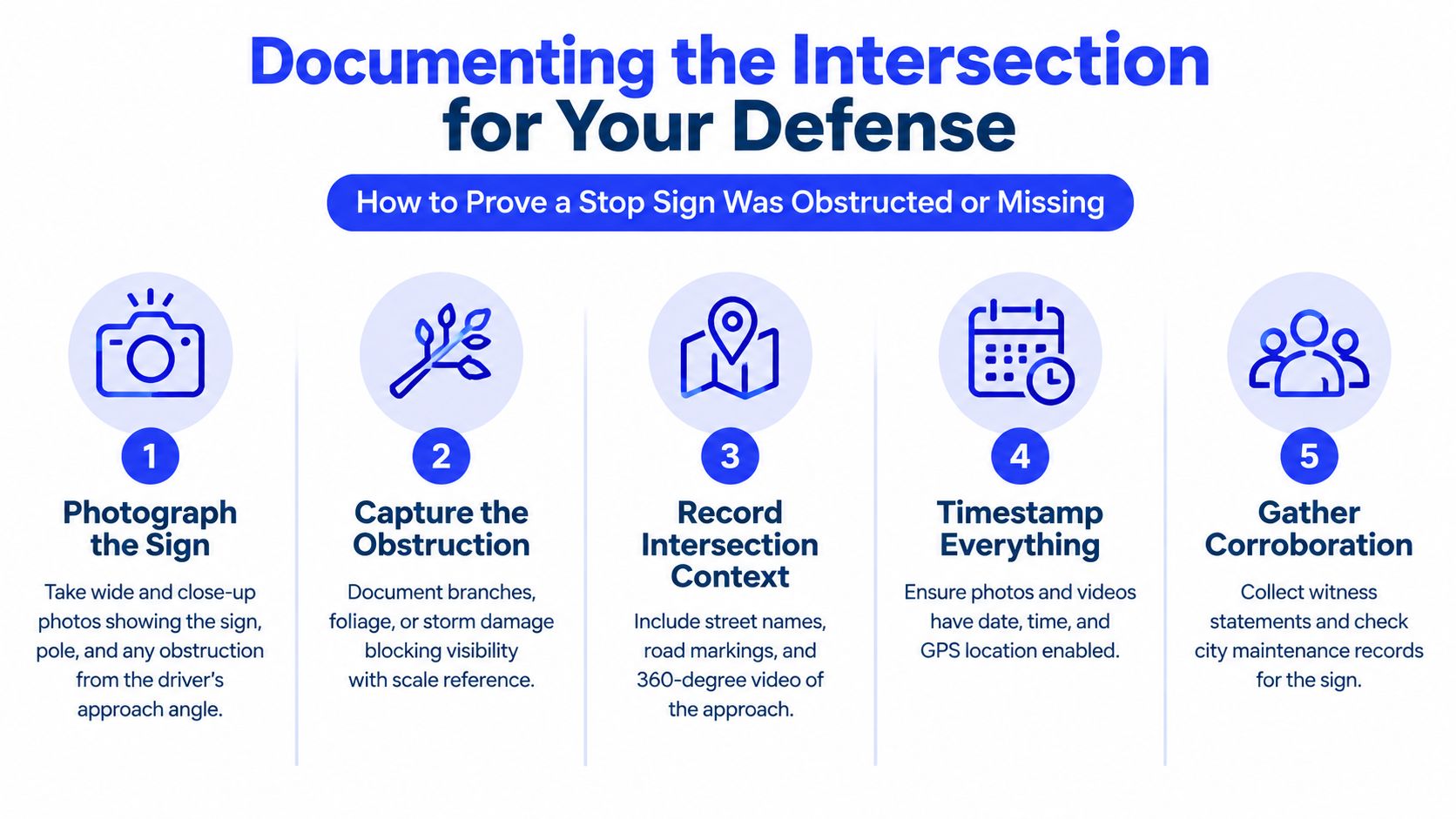
Capture the approach from the driver's perspective. A close-up of a branch isn't enough if it doesn't show how the obstruction affected visibility from the roadway. Take wide photographs that identify the intersection, nearby street names, road markings, signposts, sidewalks, and surrounding buildings. Then take closer images showing the sign, pole, damage, and obstruction.
Build evidence that answers the visibility question
Photograph the intersection from multiple distances along your approach. Include the point where a reasonable driver should first have been able to identify the sign, as well as the point where the sign became visible, if it became visible at all.
Preserve the original files. Don't rely only on screenshots or edited images. Enable date, time, and location information on your phone, and record a continuous approach video when possible. A dashcam recording can be particularly useful because it shows what appeared in front of the vehicle rather than only what the scene looked like after the stop.
Technical guidance emphasizes matching visibility distance and mounting geometry to approach speed and roadway context. It also notes that urban installations with sidewalks should place the bottom of the sign at least 7 feet above the ground or sidewalk, as described in stop-sign placement guidance. That height won't resolve every case, but it gives your attorney a concrete installation issue to examine.
Preserve supporting material too:
Witness information: Record names and contact details for anyone who saw the missing or obstructed sign.
Weather and maintenance evidence: Note storms, fallen branches, construction, or landscaping activity.
Officer paperwork: Keep the citation, notes, photographs, and any material provided during the stop.
Location details: Save the exact intersection and approach direction, not merely the city.
Don't alter the scene. Document it as it existed, and tell your attorney whether the municipality repaired or replaced the sign after your citation.
For related camera and intersection evidence issues, review Florida traffic camera guidance. Preserve the evidence before vegetation is trimmed or a replacement sign removes the original defect.
Why Direct Attorney Access Beats Automated Apps
Automated apps can collect basic citation information. They can't reliably evaluate whether a stop sign was positioned correctly, whether an obstruction affected an ordinarily observant driver, or whether the officer's description matches the intersection you documented.
Those details require a lawyer to review the citation, inspect your photographs and video, identify the controlling Florida statutes, and decide how to present the defect. A generic response may treat your case as an ordinary failure-to-stop allegation even when the infrastructure created the problem.
Your evidence needs legal judgment
Direct communication matters because the facts can change quickly. You may discover that the sign was repaired, the vegetation was removed, or the pole was replaced. A lawyer who can communicate with you by phone or text can ask focused questions while the evidence is still available and tell you what to preserve next.
Ticket Shield, PLLC uses a lawyer-led model in which clients can communicate directly with their attorney by phone or text. That approach differs from automated apps and ticket mills that may route clients through middlemen, corporate answering services, or chatbots.
A lawyer can also distinguish a useful defect from a weak argument. A sign that was technically present but clearly visible may not support the same defense as a sign hidden behind dense foliage or knocked down before the alleged violation. Your representation should be built around the actual intersection, not a prewritten script.
A citation involving a defective traffic device deserves a fact-specific review, not an automated template.
The practical objective is to protect your driving record. Depending on the evidence and the procedural posture of the case, counsel may pursue a dismissal, reduction, or another outcome designed to avoid points. Don't accept a standard resolution before you know whether the sign's condition gives you an advantage.
Reporting the Defect to Strengthen Your Case
Report the missing or damaged stop sign promptly. Contact the city, county, or applicable public works department through its official service channel. Provide the exact intersection, approach direction, nature of the defect, and the date you observed it.
Ask for a confirmation number or written acknowledgment. Save the submission, photographs, emails, and replies. If a storm, crash, or landscaping created the obstruction, include that information without guessing about facts you can't verify.
Create a clear timeline
A maintenance report can help establish when the defect existed and when the agency received notice. Request records concerning inspection, complaints, work orders, repairs, replacement, and sign installation for the intersection. Florida public-records law may provide a route to request government records, but the request should be narrowly written and directed to the agency holding the records.
Your request might identify:
The location: Give the exact intersection and roadway approach.
The device: Describe the stop sign, pole, obstruction, or missing hardware.
The relevant records: Ask for complaints, inspections, work orders, photographs, and repair records.
The time period: Focus on the period surrounding your alleged violation.
The response: Keep the agency's acknowledgment and any production or denial.
Don't trespass on public property, remove vegetation, move a sign, or interfere with traffic control equipment. Reporting the defect helps protect other motorists, but it doesn't replace a legal defense to your citation.
Florida's traffic-device rules can be complicated when the sign's placement and legibility are disputed. Review traffic control device violations in Florida and provide your report to counsel. The report may corroborate your account, identify an agency witness, or show that the condition changed after the ticket.
Secure Your Free Consultation and Avoid Points
A missing or obstructed stop sign can disappear as evidence long before your court date. Vegetation gets cut, damaged posts get replaced, and maintenance crews may correct the intersection without preserving the condition that affected your approach. Start documenting immediately and keep every original file.
Don't make an uninformed election on the citation. A guilty plea or standard disposition may affect your license and insurance consequences, and you may lose the opportunity to challenge the factual basis of the allegation. The right strategy depends on the citation, the officer's wording, the intersection layout, the sign's visibility, and the evidence you preserve.
Choose representation that reviews the real facts
A lawyer should examine the statutory stopping location, the device's placement and legibility, and the proof available from the intersection. Direct access also matters. You should be able to communicate with your attorney by phone or text, rather than relying on an automated chatbot or a corporate call center that can't analyze your photographs.
Visit Ticket Shield's free consultation page and provide the citation details, intersection location, and any photographs or video you have. Ticket Shield, PLLC offers lawyer-led Florida traffic defense with direct attorney communication, focused on protecting your license and pursuing an outcome that avoids points when the facts and law support it.
The objective is clear: No Points on your license. Act before the intersection changes, before deadlines narrow your options, and before you accept a resolution that treats a defective stop sign on road as an ordinary violation.
Visit Ticket Shield, PLLC for a free consultation about your Florida stop-sign citation. Speak directly with a lawyer about the missing or obstructed sign, and pursue a strategic defense focused on achieving “No Points” on your license.

