Stop Means Stop Sign: Florida Law and Penalties
Stop means stop sign in Florida. Learn the legal definition, rolling stop penalties, Florida Statute 316.123, and how to fight your ticket for no points.

In Florida, stop means stop sign means a complete stop at the marked line or crosswalk, and a rolling stop can now cost you up to 6 points on your license. If you already got the ticket, the clock is working against you.
You may think you just eased through a quiet intersection. The officer sees something different, a moving car that never fully stopped, and Florida law treats that as a real driving offense with consequences that reach far beyond one citation.
Table of Contents
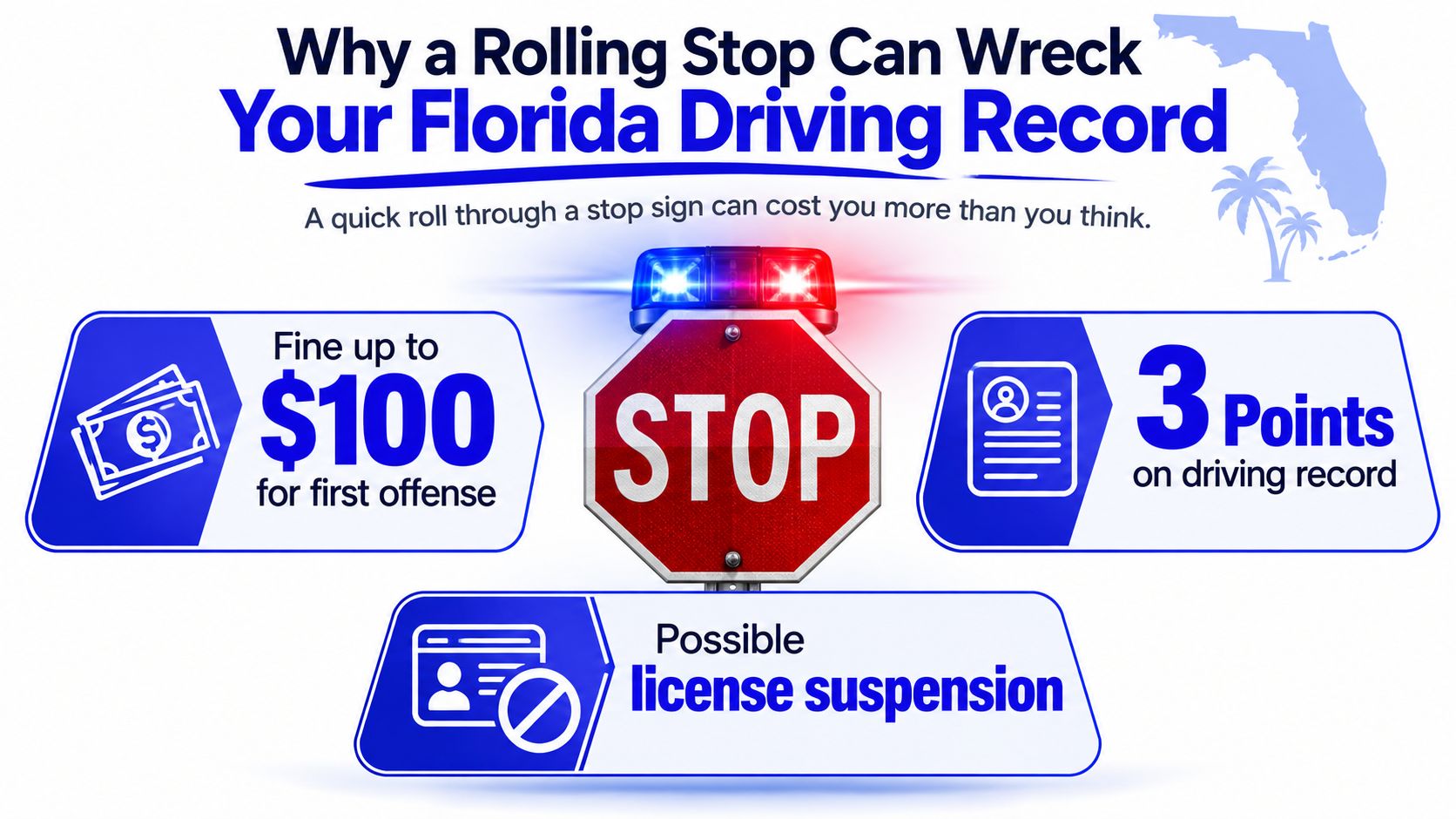
Why a Rolling Stop Can Wreck Your Florida Driving Record
You're late, the road looks empty, and you slow down hard enough to convince yourself it counts. Then the lights come on behind you, and now the stop-sign ticket is sitting in your hand like a small mistake that could turn into a big problem.
Florida drivers need to treat this as a record-protection issue, not a minor annoyance. The state's points system now makes the stakes sharper, because Florida's official schedule treats failing to stop at a traffic-control device or signal as a points offense, and the state court appendix notes that the referenced category was 3 points before July 1, 2024 and 6 points on or after July 1, 2024 (Florida driver points schedule). That is a major jump for a citation many drivers used to shrug off.
Protective rule: if you pay the ticket, you're not “closing the matter,” you're accepting the conviction and everything that comes with it.
That matters because points add up fast, and insurance companies don't ignore stop-sign convictions. They use traffic history to price risk, and a conviction can follow you long after the fine is paid. The smarter move is to fight before the record gets tagged.
If you want a deeper breakdown of how these citations hit your record, review this guide on Florida stop sign points and defenses.
Practical rule: the officer wrote the ticket to protect the road, not your license. You need to protect your license yourself.
A rolling stop is not a harmless shortcut, it's a citation that can snowball into points, insurance trouble, and avoidable damage to your driving record.
What Florida Statute 316.123 Actually Requires
Florida Statute 316.123 is not vague, and it does not leave room for a “close enough” stop. A driver approaching a stop sign must stop at the clearly marked stop line, or if there is no stop line, before the crosswalk, or otherwise at the point nearest the intersecting roadway where the driver can see approaching traffic before entering the intersection (Florida Statute 316.123). After that stop, the driver must yield to vehicles already in the intersection or close enough to be an immediate hazard.
That means zero forward motion. If the car is still creeping, you have not stopped. If you pause after the line, you have not complied with the law. The statute cares about where you stop and whether you yielded.
Here's the clean way to think about it. First, find the stop point. Second, bring the vehicle completely to rest. Third, make sure the stop happens at the correct legal location. Fourth, yield only after you've stopped. Fifth, proceed when it's safe.

If the sign is obscured, the line is faded, or the crosswalk is missing, that can matter in court, but it does not change the basic rule. Florida still expects a real stop. A driver who guesses at the intersection and rolls through is taking a legal risk that officers see every day.
If you need the plain-English version of how these tickets are defended, use this explanation of running a stop sign in Florida.
The officer will usually write down what was visible, where the vehicle was when it moved, and whether the stop was complete. That is why the best defense starts with the exact details, not excuses after the fact.
Full Stop vs Rolling Stop Compliance and Enforcement
The compliance problem is bigger than most drivers want to admit. A transportation safety study summarized prior work by noting that stop-sign violation rates had been over 50% since 1935 (ROSA P report). In the same study, field observations covered 528 hours at 142 sites, where 31,212 vehicles were observed and 21,110 failed to stop.
That pattern is why rolling stops are such easy enforcement targets. Officers do not need a long investigation to write a citation when they can watch a vehicle glide through a control point without a full stop. The violation is visible, the timing is simple to describe, and the driver usually has little to say that changes what the officer observed.
Why police focus on stop-sign violations
The stop-sign case is often won or lost on the officer's observation. If the vehicle never truly came to rest, that fact is hard to erase later.
A separate crash investigation study from four U.S. cities found that nearly 700,000 police-reported crashes occur annually at stop signs, with about one-third causing injuries (PubMed study). That same research found that in 1,788 two-way-stop crash reports, stop-sign violations accounted for about 70% of crashes, and about two-thirds of violation crashes involved drivers who said they had stopped first. That tells you something important. These cases are not just about blatant disregard, they often turn on sight distance and gap judgment.
For Florida drivers, that means enforcement is not some abstract possibility. It's active, it's routine, and it's still being written up as a separate violation in major jurisdictions. Colorado State Patrol has publicly reported 1,218 stop-sign citations in the prior year, and New York's open-ticket data separately tracks “FAILED TO STOP AT STOP SIGN,” which shows how seriously agencies continue to treat this conduct (Colorado State Patrol news release).
If you think “everyone does it,” you're right about the behavior and wrong about the consequence. The fact that many drivers roll through does not make the ticket easier to beat.
The Real Cost of Paying vs Fighting Your Stop Sign Ticket
Paying a stop-sign ticket feels fast, but it is usually the most expensive choice over time. You are not just writing a check. You are admitting guilt, locking in the conviction, and accepting the points, insurance exposure, and long-term record damage that follow.
If you want the mechanics of that choice in one place, read why paying often costs more than fighting. The math is brutal because the fine is only the first hit. The conviction is the part that keeps costing you.
Factor | Paying the Ticket | Fighting with Ticket Shield |
|---|---|---|
Immediate result | You accept the citation | You contest the citation |
Record impact | Conviction stays on your driving history | Goal is dismissal, reduction, or withhold of adjudication |
Points | Can trigger the current Florida point penalty for this offense category | Goal is no points |
Insurance impact | You stay exposed to premium increases | Better chance to avoid the conviction that insurers flag |
Court burden | You handle it alone | A lawyer-led team handles the defense |
Long-term cost | Fine plus downstream consequences | Upfront legal fee with a shot at avoiding the bigger losses |
Florida's post-July 2024 point structure matters here, because the category tied to failing to stop at a traffic-control device or signal is now treated as 6 points for offenses on or after July 1, 2024 (Florida points schedule). That is the kind of record hit that makes a simple citation much more dangerous than it looks on the roadside.
Bottom line: paying the ticket buys convenience and sells off your defenses.
A lawyer-led defense is about preserving options. A conviction gives you none.
Why Automated Ticket Mills Fail Florida Drivers
Automated apps and high-volume ticket mills sell convenience, but convenience is not a defense strategy. These services usually lean on templates, not judgment, and stop-sign cases need more than boilerplate paperwork.
The problem starts with distance. If you never speak directly with the attorney whose name is on your case, important details can slip away. Was the sign hidden by foliage? Was the stop line faded? Was the officer positioned where a full stop could be seen? Those facts matter, and generic intake systems often miss them.
What gets lost in an automated process
Case-specific facts, because nobody slows down to investigate them.
Meaningful attorney contact, because the driver talks to a screen or a call center instead of a lawyer.
Local court strategy, because one-size-fits-all filings look the same to judges and prosecutors.
Defense pressure, because a weak filing can push the driver straight into a conviction.
If you want direct legal help instead of a paperwork machine, Ticket Shield, PLLC offers a lawyer-led stop-sign defense service for Florida drivers, and the value is in the individualized review, not the automation (stop-sign lawyer service). That kind of model matters when the difference between a clean result and a bad one can be the full point penalty.
For a sharper look at the risk of app-based representations, see why a local lawyer beats an app.
If the company can't tell you which lawyer will actually analyze your stop-sign citation, keep looking.
A failed ticket-mill defense doesn't just waste money. It can leave you with the conviction, the points, and no second chance to undo the damage.
Proven Defenses Against Stop Sign Citations
A stop-sign ticket is not automatically unbeatable. Some cases collapse when the facts are documented correctly. The key is to build the defense before the court date, not after the officer has already written the report.
Obstruction and placement issues
If foliage, parked vehicles, or bad placement blocked the sign, that can matter. A driver can't be blamed for failing to react to a sign that was not reasonably visible in time to stop safely. The same logic applies when the stop line is faded or the crosswalk markings are missing, because Florida law ties the stopping point to those markings when they exist.
Officer position and observation limits
An officer can only testify to what was visible from the position where he or she watched the intersection. If the angle was poor, the view was blocked, or the sightline made it hard to tell whether the wheels fully stopped, that observation can be challenged. A stop-sign case is not won by guessing, it's won by proving the observation was unreliable.
Emergency and compliance defenses
There are also situations where a driver stops under pressure from an emergency or follows a traffic-control direction in a way that changes the analysis. Those cases are narrower, but they matter when the facts support them.
If you want the practical version, it usually looks like this:
Photos of the intersection taken quickly, before conditions change.
A diagram of the vehicle path, so the court can see the claimed stop point.
Witness statements from passengers or nearby observers.
A careful review of the citation, because small factual errors can matter.
The important thing is timing. A lawyer can collect this evidence before the hearing and use it to push for dismissal, reduction, or a result that keeps points off your record. A driver who waits until court day is already behind.
Protect Your License with Ticket Shield Today
A stop-sign ticket is not harmless, and in Florida it can now carry up to 6 points under the current penalty structure tied to failing to stop at a traffic-control device or signal (Florida points schedule). If you let it sit, the consequences can spill into your insurance, your license status, and your ability to keep driving without interruption.
The window to act is narrow. Florida's license suspension rules can be triggered by point accumulation, and drivers don't get unlimited time to clean up a citation after the fact. That is why you need a defense plan before the deadline turns a ticket into a licensing problem.
Ticket Shield, PLLC uses a lawyer-led model, so you're not pushed through an automated intake bot or passed around a call center. You get direct communication with the attorney handling your matter, which matters when the goal is to keep points off your license and avoid the insurance fallout that follows a conviction. If you want the service details, review Ticket Shield's stop-sign ticket defense page.
Do not wait and hope the court forgets about it. The system will not protect your record for you, and paying the citation is the fastest way to lock in the damage.
If you've been ticketed for failing to stop in Florida, Ticket Shield, PLLC can review your citation, look for defense issues, and help you fight for No Points on your license. Visit Ticket Shield, PLLC for a free consultation and get a direct attorney review before the ticket starts costing you more.