Running Stop Sign Ticket in Florida: Penalties and Defense
Got a running stop sign ticket in Florida? Learn the statute, points, fines, defenses, and how to fight it without court.

You're driving home, the stop sign is behind you, and the officer has already said the words nobody wants to hear. You have the citation in your hand, your stomach is tight, and you're trying to decide whether this is a minor annoyance or a real problem. Treat it as a real problem. A running stop sign ticket in Florida is rarely about the paper itself, it's about the points, the insurance hit, and the record you'll be stuck managing later.
Table of Contents
The Paper in Your Hand Is Not the Real Problem
The officer hands you the citation, gives you the usual polite exit line, and drives away. That moment feels final. It isn't.
What starts next is the part that matters. You have a short window to decide whether you're going to protect your record or hand the state an easy conviction. Paying it right away closes off your options and turns a manageable traffic case into a permanent moving-violation problem with downstream consequences.
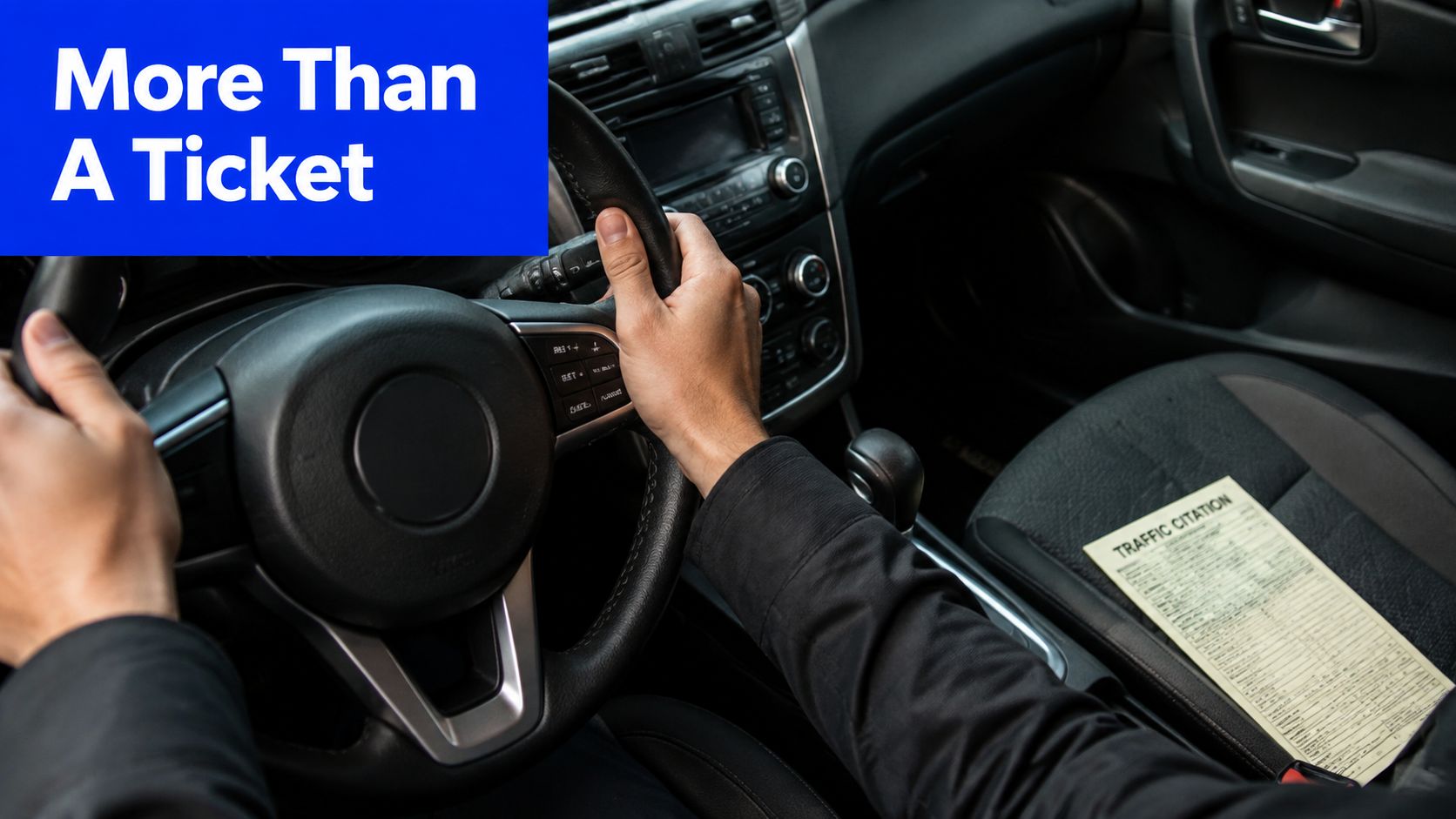
The first days matter more than the next few years
You do not need to panic, but you do need to move fast. The sooner you preserve the facts, the better your odds of fighting the charge, reducing the damage, or negotiating a better outcome. By the time you've let the ticket sit, memories fade, camera footage gets overwritten, and the cleanest defense gets harder to build.
Practical rule: if you might fight the ticket, treat the citation like evidence, not a bill.
That means checking the intersection, saving any dashcam or phone video, and reading the citation carefully before you do anything else. It also means not assuming the officer's version is the whole story. A stop sign case often turns on a split-second detail, not on whether you're a bad driver.
If you want the legal framework for the violation itself, keep the statute review close. A Florida traffic-control-device citation sits inside Chapter 316, and the law is narrower than most drivers think. Florida stop-sign citation guidance is only useful if you use it early, before you give up your options.
Don't confuse convenience with strategy
The fastest move is usually the worst one. Paying may feel clean, but it usually means you accept the points and the insurance fallout without forcing the state to prove its case. If your license, job, or rates matter, that's a bad trade.
You're not deciding whether the stop sign was annoying. You're deciding whether the consequences are worth fighting. That's the critical decision window.
What Florida Law Actually Says About a Stop Sign
Florida treats this as a traffic-control-device issue under Chapter 316, with Florida Statute § 316.075 as the core reference point for traffic-control signals and related enforcement. The state's theory is simple. You approached a legally placed stop sign, and you failed to bring the vehicle to a full stop at the correct control point.
That control point matters. First comes the limit line, then the crosswalk, and if neither is there, the entrance to the intersecting roadway. If the car stops after that point, the state will still call it a violation. A rolling stop is not a workaround, it's usually treated the same as failing to stop at all.
What the officer has to show
The prosecution's burden is narrow, but it's real. The officer needs to connect the vehicle, the sign, and the stop location. If the sign was properly placed but the stop happened too late, the issue is technical, not emotional.
That's why the exact words in the citation matter. Read whether the officer claims you failed to stop at the proper point, ignored the sign entirely, or rolled through the intersection. Those details shape the defense.
A clean defense doesn't start with excuses. It starts with the elements:
Legally placed stop sign, tied to the intersection.
Approach to the correct control point, not just a slowdown before the line.
Failure to reach zero motion before crossing that point.
The fight is usually about where the vehicle stopped, not whether it slowed down.
Why the statute language matters
Florida traffic cases are built on proof, not vibes. If the vehicle hit the limit line and then stopped, the argument gets much harder for the state. If the officer watched from a bad angle, the stop was obscured, or the camera view is unclear, the case can shift fast.
That's why I want you thinking like a record manager, not a guilty driver. A stop-sign ticket is only as strong as the observation behind it. If that observation is weak, the state's case is weaker than it looks on the paper.
The True Cost of a Running Stop Sign Ticket
A Florida stop-sign ticket is a money problem, but the fine is only the first layer. You pay the citation, then you deal with the record, the point hit, and the insurance fallout that follows. Florida stop-sign ticket cost and points overview
The part drivers miss is the collateral damage. One careless stop can affect your premium, your driving record, and the way a court or employer sees you later. If you want a plain breakdown of what that can mean, this cost overview for a running stop sign ticket lays out the usual pressure points.
The money you pay now is not the whole loss
You get hit once at the clerk's window, then again when the ticket starts affecting your insurance. A moving violation changes how carriers price you, and if you drive for work, the record hit can matter just as much as the fine itself. That is why paying quickly is not always the smart move.
Component | Typical Range | Driver Impact |
|---|---|---|
Citation and fees | $150 to $275 | Immediate out-of-pocket cost |
Demerit points | 3 points | Record impact and insurance risk |
Insurance effect | Varies by policy | Longer-term premium pressure |
Why points matter more than the fine
Three points do not sound dramatic until they sit on your record. Then they start working against you at renewal time, and sometimes in other places you never expected. If you already have prior violations, the stop-sign ticket can create a much bigger problem than the citation amount suggests.
Florida traffic-law discussions also point to Florida Statute § 316.075 as the statute context for traffic-control enforcement. Florida traffic signal and stop-sign statute context matters because this is a record-management problem, not just a bill you can mail in and forget.
The only question that matters
Do you want to absorb the hit now, or do you want to fight for a better outcome? If your answer is anything other than automatic payment, treat the citation as damage control. That is the right move.
Defenses and Evidence That Actually Move These Cases
A stop-sign case is won or lost on details the citation never captures. The officer's viewing angle, the sign's placement, the visibility at the intersection, and the exact stop point all matter. If the sign was blocked, the stop line was confusing, or the officer saw only part of the approach, the case can crack.
The proof problem gets even sharper when the video is available. Today, the fight is often about what a dashcam, bodycam, or intersection camera shows, and whether that footage supports the officer's story or yours. Stop-sign ticket defense and evidence guidance points to the narrow proof question that controls these cases: did the vehicle reach zero motion before the stop-control point?
What to preserve immediately
If you're serious about fighting it, preserve everything before you forget what matters.
Dashcam footage: Save the full clip, not just the few seconds around the stop.
Phone video or photos: Capture the intersection, the sign, the line, and any obstruction.
Your notes: Write down the time, weather, traffic, and what you remember seeing.
Vehicle data: If your car records speed or braking info, preserve that now.
The goal is simple. Lock down the scene before it changes. Branches grow, signs get trimmed, cameras overwrite files, and witnesses stop remembering.
What discovery should target
You want the officer's notes, any patrol video, bodycam footage, and any available intersection camera footage. You also want the retention issue addressed quickly. If the agency no longer has the video because it was overwritten, that can matter. If the footage exists but the angle is poor, the visual gap can help the defense.
Protect the video first. Once it's gone, you're arguing from memory against a citation.
The cleanest stop-sign defenses usually come from one of three things, a bad observation point, a bad sign setup, or a bad video record. That is why generic advice falls short. You need evidence, not guesses. If you want a more practical roadmap for dismissal strategy, review stop-sign ticket dismissal tactics and use it before the deadline passes.
Your Options After the Citation
You have four realistic paths. Pay it, use traffic school if you qualify, contest it yourself, or hire counsel to handle the fight for you. The right choice depends on your record, your job, and whether you care more about convenience or protecting your license.

The four paths and what they cost you
Path | What happens | Driver impact |
|---|---|---|
Pay Fine | You resolve it fast | Usually accepts points and closes leverage |
Traffic School | May be available in eligible cases | Can help manage point exposure |
Pro Se Defense | You handle it yourself | Saves attorney fees, but you carry the risk |
Hire Attorney | Counsel handles the case | Better for record protection and negotiation |
If you just want the matter over, paying is the easiest route. If you care about your record, that's usually the weakest move. If you're eligible for traffic school, it may be the middle path, but eligibility isn't the same thing as strategy.
Who should fight hardest
Out-of-state drivers should pay extra attention because a Florida ticket can follow them home through their own state's record systems. Commercial and professional drivers need to think even harder because one point hit can have outsized job consequences. Repeat offenders should be realistic too, because the problem is not one citation, it's the pattern that starts to look reckless.
The decision isn't just about guilt. It's about collateral consequences, and that's where many drivers get trapped.
Florida drivers who want a deeper breakdown can review running a stop sign ticket options before choosing a path. The point is to choose with your eyes open, not after the payment posts.
Why a Lawyer-Led Firm Changes the Math
A lawyer-led firm changes the case because you can talk to the person handling your defense, not a bot, not a script, and not a middleman. In a stop-sign case, that matters because the important calls are procedural and tactical. You're not buying an app, you're hiring judgment.

Direct access beats ticket mills
Automated apps and ticket mills tend to flatten everything into a form. That's a problem when your case depends on the officer's view, the intersection layout, or the possibility of a negotiated resolution. A real attorney can look at the facts, the county, and the likely consequences before making a move.
You want a lawyer who can answer the phone or text you back, not a queue.
That is the difference that matters when the goal is protecting your license. A client who can speak directly with counsel gets faster decisions on video preservation, hearing strategy, and whether to push for dismissal or a lower-impact result.
What direct representation gives you
Ticket Shield, PLLC is a Florida traffic defense firm that handles stop-sign cases statewide, including all 67 Florida counties and major courthouses in Miami-Dade, Broward, Palm Beach, Hillsborough, Orange, and Duval. It uses a lawyer-led model, with client communication by phone or text, and it handles stop-sign tickets as a record-protection problem, not a paperwork problem.
That matters because the right move may be dismissal, negotiation, or a strategy aimed at keeping the case from turning into points on your license. Stop-sign ticket lawyer service is only valuable if it gets used on time, before the case hardens into a conviction path.
County-Specific Notes for Major Florida Jurisdictions
Florida isn't one courthouse. Miami-Dade, Broward, Palm Beach, Hillsborough, Orange, and Duval all have their own courtroom rhythms, clerk procedures, and plea dynamics. If you treat every county the same, you're giving away an advantage.
Miami-Dade's Richard E. Gerstein Justice Building, Broward County Judicial Complex, Palm Beach's Main Judicial Center in West Palm Beach, Hillsborough's Edgecomb Courthouse in Tampa, Orange County Courthouse in Orlando, and Duval County Courthouse in Jacksonville all move cases a little differently. That matters because local practice affects whether a case is more likely to resolve by negotiation, hearing, or document-driven defense.
Why local handling changes outcomes
A generic approach works poorly in traffic court. The officer's notes, the prosecutor's posture, and the clerk process can push the case in different directions depending on the county. If you live in one county and got ticketed in another, you need counsel that already knows the courthouse you're dealing with.
Local knowledge saves time, and in traffic court, time is leverage.
That's especially true if you're trying to avoid a point-heavy outcome or protect a clean record. A statewide defense team is useful because the playbook changes from county to county, even when the violation looks identical on the citation.
Protect Your License With One Strategic Decision
This ticket is small only if you let it be small. The damage comes from points, insurance pressure, and record impact that can follow you for years. If protecting your license matters, don't treat this like a parking citation.
Visit TicketShield.com for a free consultation and fight for No Points on your license.
Ticket Shield, PLLC handles Florida stop sign ticket cases with a lawyer-led approach, so you can speak directly with your attorney by phone or text instead of dealing with middlemen. If you've got a running stop sign ticket, visit Ticket Shield, PLLC for a free consultation and get a clear plan focused on No Points, fewer headaches, and the right next move for your license.