How to Get a Stop Sign Ticket Dismissed in Florida
How to get a stop sign ticket dismissed in Florida: the defenses that work, court deadlines, points rules, and when a lawyer is worth the fee.
The actions you take in the minutes and hours immediately after getting a stop sign ticket can make or break your chances of getting it dismissed. The instinct to just pay the fine and be done with it is strong, but that's an admission of guilt. Instead, your focus should be on gathering the facts and details that can form the foundation of a real challenge.
What to Do Immediately After Getting a Stop Sign Ticket
Seeing those flashing lights pop up in your rearview mirror is a stressful moment for anyone. Whether you're navigating a chaotic intersection in Miami-Dade or on a quiet street in Broward County, the urge to just accept the ticket and pay it is completely understandable.
But that quick decision can haunt you for years in the form of points on your license and higher insurance premiums. The choices you make in the first 24 to 48 hours can help build a case and explore how to get that stop sign ticket dismissed.
Your first moves should be calm and methodical. Panic is your enemy here, as it can cause you to miss small details that could be a huge help later on. Remember, the goal isn't to argue with the officer on the side of the road. It's to start preparing for the legal process that comes next.
Carefully Review Your Citation for Errors
As soon as you’re safely parked, take a hard look at the ticket itself. A traffic citation is a legal document, and every detail on it has to be accurate. Scrutinize it for any mistakes, no matter how small they might seem.
Look closely for errors in these common areas:
Personal Information: Is your name spelled right? Is your address and driver's license number correct?
Vehicle Details: Did the officer list the right make, model, year, and tag number for your car?
Location of Violation: Is the street, intersection, or city—like Broward County—noted correctly? An error here can be a powerful defense.
Statute Number: Does the violation number cited match Florida's law for a stop sign infraction?
A simple typo might not be enough to get the ticket dismissed on its own, but a pattern of sloppy mistakes or a major error (like listing the wrong intersection entirely) can be used by an attorney to challenge the ticket's validity. Think of the citation as the state's first piece of evidence against you and treat it with that level of seriousness.
Document Everything About the Scene
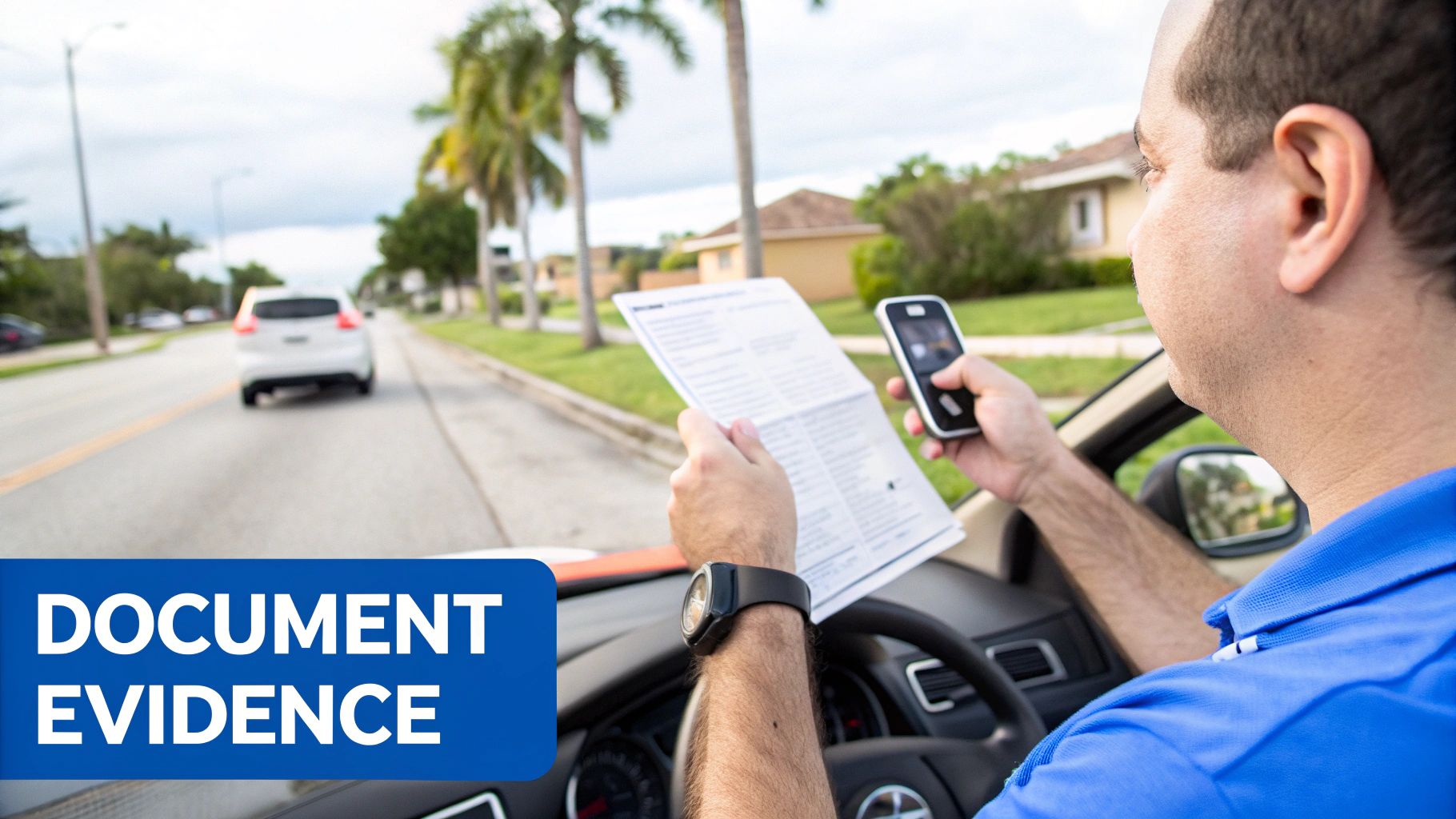
Your memory will fade, but pictures last forever. If it's safe to do so, go back to the intersection where you got the ticket and document the scene. Your phone's camera is your best friend at this stage.
Key Takeaway: The conditions at the time of the incident are absolutely critical. Documenting things like a hidden sign, bad weather, or a confusing intersection provides real, tangible evidence that can back up your defense in court.
Snap photos and take videos from every possible angle, especially from the perspective you had as you approached the stop sign. Zero in on any detail that could have played a role. Was the stop sign blocked by a low-hanging tree branch? Was it faded, worn, and hard to read? These signs might not meet the legal requirements for visibility. A confusing road layout in a new Broward development could also be a factor. This kind of visual evidence is invaluable when it's time to make your case.
This simple process flow shows the most important first steps after you get that ticket in your hand.
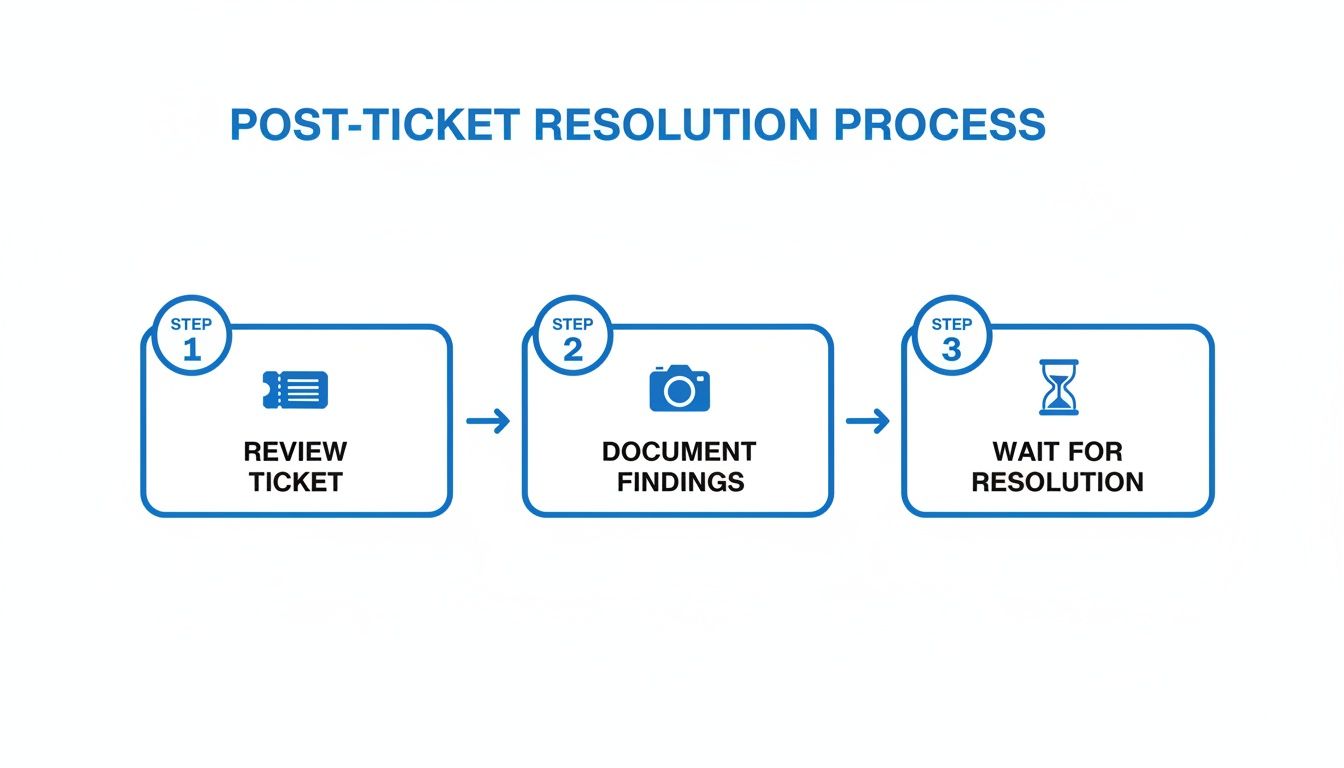
By methodically reviewing the ticket, documenting the scene, and then pausing to weigh your options, you build a much stronger foundation for a potential dismissal.
Understand Your Deadlines but Avoid Hasty Decisions
Every traffic ticket in Florida comes with a strict deadline, usually 30 days, to respond. If you ignore it, you risk getting your license suspended. But don't let that ticking clock pressure you into a bad decision. Rushing to pay the fine or elect traffic school without thinking it through is a common mistake. Check your county clerk's traffic citation instructions and response deadlines and the applicable Florida statute on responding to a citation.
Paying the ticket is a conviction. Choosing traffic school might keep the points off your record, but you can only use that option a handful of times in your life. Florida law limits a driver’s election of a basic driver improvement course to once in a 12-month period and five times in a lifetime; see the Florida statute on driver improvement course elections. The best thing to do first is to pause and talk to a legal professional who can lay out the practical consequences of each choice.
For a clearer picture of the process, it helps to learn what to expect in traffic court and how to prepare. Taking a few days to think strategically is always better than making a snap decision you'll end up regretting.
How We Evaluated the Best Ways to Fight a Stop Sign Ticket
Before you trust any defense idea in this article, you deserve to know where it came from. Our review considered Florida's stop-sign statute, §316.123, as analyzed here, which defines exactly where a driver must stop at a stop-controlled intersection, along with Florida's driver-license points framework and published clerk-of-court procedures for responding to a uniform traffic citation. We also looked at NHTSA's intersection safety analysis to understand why stop-sign cases are so fact-sensitive in the first place.
From that review, we ranked defenses by how often the underlying facts exist in real tickets: sight-line problems, sign visibility and maintenance, stop-location disputes, citation defects, and cases where the officer cannot produce proof. A defense makes the cut only if there is a plausible factual basis for it, such as photos of an obscured sign, a ticket listing the wrong intersection, or a documented obstruction of the officer's view. Arguments that rely on generic denials ("the sign was probably hard to see") with no supporting evidence are too weak to recommend, and we have left them out.
It's worth understanding the stakes up front. A stop-sign or traffic-control-device violation is commonly treated as a 3-point offense, and Florida's point system is unforgiving: 12 points within 12 months can suspend your license for 30 days, 18 points within 18 months for 3 months, and 24 points within 36 months for a full year. That risk—not the fine itself—is the reason a stop sign ticket is worth contesting carefully.
Building a Strong Defense for Your Stop Sign Ticket
Successfully challenging a stop sign ticket isn’t about arguing with the officer on the side of the road. It’s about building a solid legal defense to present in court. To get a stop sign ticket dismissed, your entire strategy has to be grounded in the facts and the specific requirements of Florida law.
The state carries the burden of proving every single element of the violation beyond a reasonable doubt. Under §316.123, that means proving you failed to stop at the clearly marked stop line—or, if none exists, before the crosswalk, or at the nearest point where you could see approaching traffic. Each of those statutory thresholds creates factual questions a defense can explore. Here are the five defense categories that matter most in practice, ranked roughly by how often they produce a real result.
1. The Officer Could Not See Your Wheels Stop
For the state to prove you never stopped, the officer must have had a clear, unobstructed view of your vehicle at the moment of the alleged violation—and ideally of your wheels, since a "rolling stop" is judged by whether the vehicle fully ceased moving.
Think about a common scenario: you’re at a four-way stop in a suburban Broward County neighborhood. The officer is parked across the intersection, and their view is partially blocked by a big truck waiting to make a turn. From that angle, could they really see with certainty that your tires never stopped rotating?
What helps: photos from the officer's likely position showing obstructions, and precise cross-examination about exact distance, angle, and anything between them and your car. What usually fails: a bare assertion that "they couldn't have seen me" with no physical evidence of a blocked line of sight. Realistic outcome: a strong version of this argument supports outright dismissal; a weaker version can still support a negotiated reduction.
2. Sign Visibility and Maintenance Problems
Here’s something many drivers don’t realize: not every stop sign is legally enforceable as posted. Florida law requires traffic signs to be properly placed, sized, and visible. A stop sign has to be clearly visible to a reasonably observant driver. If it's covered by a tree branch, faded beyond recognition, or knocked down, you have a solid argument that you weren't given adequate notice to obey the law.
What helps: timestamped photos taken shortly after the stop, showing the obstruction or condition from a driver's approach angle. What usually fails: claims about visibility made weeks later, after the municipality has trimmed the vegetation or replaced the sign. Realistic outcome: dismissal if the documentation is strong; often a negotiation tool even when it isn't.
3. Disputing the Stop Location
Because §316.123 sets a statutory order—a stop line first, then the crosswalk, then the nearest point of visibility—the exact stopping point matters. If there was no marked line or crosswalk, the question becomes whether you stopped where the law required you to, which is a factual dispute the officer must resolve with specifics.
What helps: measurements or photos showing the intersection had no limit line, dashcam footage, and an officer who cannot say precisely where you stopped. What usually fails: admitting you stopped past the line and hoping the judge overlooks it. Realistic outcome: dismissal when the officer can't place your stop legally; a reduced charge when your "safe stop" was slightly late but still complete.
4. Citation Defects That Actually Matter
Not every ticket error is a defense. A misspelled street name is usually a harmless clerical mistake the court can amend. But a citation that identifies the wrong intersection, cites the wrong statute category, or describes conduct that doesn't match §316.123 at all attacks the charge itself.
What helps: a clean copy of the citation and a lawyer who knows the difference between amendable errors and material ones. What usually fails: fixating on typos while the substance of the charge is accurate. Realistic outcome: dismissal for material defects; nothing for trivial ones.
5. Missing Proof or an Absent Officer
If the officer doesn't appear at the hearing, the state often has no witness, and a case built entirely on one officer's testimony can be dismissed. Similarly, if the state cannot produce records it relies on, the burden of proof may go unmet.
What helps: showing up prepared and on time; officer no-shows favor the driver who appears. What usually fails: assuming the ticket "disappears" without attending everything the clerk requires. Realistic outcome: dismissal is common but never guaranteed—prosecutors can request a continuance, so preparation still matters.
The financial stakes make these defenses worth pursuing. In Florida, a stop sign ticket adds 3 points to your record, and the total cost with fees often pushes past $200. Our guide on how to beat a traffic ticket in Florida offers a deeper dive into these strategies. When you understand the penalties, you see why challenging the ticket is often the smartest financial move.
How the Court Process Works in Broward and Miami-Dade
Getting a stop sign ticket in Florida starts a clock, and the process that follows is more predictable than most drivers expect. Here is the realistic sequence.

Step 1 — Respond before the deadline. You generally have 30 calendar days from the citation date to elect one of three options through the clerk of court: pay (a guilty plea and conviction), elect traffic school if eligible, or plead not guilty and request a hearing. Missing the deadline can result in a license suspension, so respond on time regardless of your strategy. Confirm the procedure with the Broward Clerk of Courts or the Miami-Dade Clerk of the Courts.
Step 2 — Elect your hearing. Pleading not guilty routes your case to the county's traffic division. In Broward and Miami-Dade, that typically means a calendar call or pretrial conference date rather than an immediate trial.
Step 3: Pretrial stage. Most contested tickets resolve before any testimony. An attorney can speak with the prosecutor about weaknesses in the case, such as an obstructed sign, a sight-line problem, or a citation defect, and negotiate outcomes including:
Outright Dismissal: The best-case scenario. The ticket is thrown out completely.
Reduced Charge: The violation gets amended to something like a non-moving violation, which carries no points.
Adjudication Withheld: You might pay court costs, but you are not formally convicted, and no points are added to your license.
Step 4: The hearing itself. If no deal is reached, the state presents its evidence: the officer testifies about what they observed. Your side then cross-examines, challenging the vantage point, the stop location, and the sign's condition, and presents your own evidence if you have any. For a driver weighing options, our guide explains when it is worth hiring a lawyer versus paying the traffic ticket in Miami.
What Makes a Case Easier or Harder to Fight
In our experience reviewing these files, three factors tilt outcomes more than anything else: documentation quality, sign visibility, and whether the officer shows up. A driver who photographed the scene within 48 hours has a stronger case than one relying on memory. An obscured or faded sign gives the defense something physical to show a judge. An officer no-show removes the state's key witness. Conversely, cases are harder when the driver concedes facts early, the intersection was freshly marked and well maintained, or the citation is clean and the officer is experienced and available to testify.
Important Notice: The legal process can be complex. Submitting information to our firm via online forms does not create an attorney-client relationship. All legal questions should be directed to a licensed attorney during a consultation. This article is an attorney advertisement. Office in Broward.
Can You Get a Stop Sign Ticket Dismissed Without a Lawyer?
Yes—it's legally possible, and some drivers do it, especially when the facts are unusually favorable. If the officer fails to appear, or if you have photographs showing a sign fully blocked from a driver's approach, a prepared pro se driver can sometimes win on those facts alone. The mechanics are the same either way: plead not guilty with the clerk, show up to the hearing, cross-examine the officer politely and briefly, and present your evidence.
The honest tradeoffs are these. Handling it yourself costs nothing in fees but costs you time—you must appear at the hearing, wait for your case to be called, and prepare your questions in advance. You also bear the risk of unfamiliarity: many pro se drivers accidentally admit facts ("the light was green, but I did slow way down") that hurt their own defense. Hiring counsel flips the equation—you pay a flat fee but the attorney appears for you, spots the statutory elements you might miss, and negotiates before the hearing. If your case is strong on one obvious fact (a no-show officer, an obscured sign), self-representation is reasonable. If you have prior points, a CDL, or a fuzzy recollection of the stop, professional help usually buys more than it costs.
Why Hiring a Traffic Ticket Attorney Can Help
Deciding whether to fight a stop sign ticket yourself or hire a professional is an important choice. You can represent yourself, but the legal system is complicated, and a conviction can affect your finances for years.
When legal help makes the most difference:
CDL holders: Commercial drivers often face job consequences from even a 3-point moving violation, so protecting the record matters more than the fine.
Prior points on your license: If you are already near Florida's 12-point suspension threshold, one more conviction is a real risk.
Insurance sensitivity: A moving violation can raise premiums for years; if you're already paying high rates, the conviction's long tail is expensive.
Missed deadlines or out-of-county tickets: An attorney can fix procedural problems and appear in a courthouse you'd otherwise have to travel to.
Settings where you cannot appear: If the hearing date conflicts with work or travel, counsel can typically represent you in your absence.
It helps to compare the four paths directly. Paying the ticket is fastest but is a conviction with 3 points and the insurance consequences that follow. Traffic school keeps points off but burns one of your limited elections—once per 12 months and five per lifetime in Florida—so it shouldn't be your default move. Fighting pro se costs nothing but your time and works best with unusually strong, photographic facts. Hiring counsel costs a flat fee but outsources the deadlines, the negotiation, and the hearing, and gives you someone negotiating from case law and local practice rather than improvisation.
So what does a stop sign ticket lawyer do day to day? A lawyer handling a running stop sign citation begins with file review: checking the citation against the elements of §316.123 to find material defects and sorting real defenses from harmless clerical errors. Second, negotiation: raising the state's proof problems with the prosecutor and pursuing a dismissal, a reduced non-moving charge, or adjudication withheld. Third, hearing prep: lining up cross-examination on the officer's vantage point and your photographic evidence, scheduling the hearing, and appearing so you don't have to.
When you do the math, the fee for a skilled traffic attorney is often much less than the total cost of a conviction—fines and court costs that can run from $150 to over $300, plus insurance hikes that can stick around for years, plus the suspension risk that comes with accumulated points. It's an investment in protecting your driving record and your wallet. For additional insights into criminal defense lawyer marketing, see this resource.
Our Goal Is to Protect Your License and Record: We focus on achieving the best possible outcome for your specific situation, whether that’s a full dismissal, a reduced charge, or avoiding points on your license. Past results do not guarantee future outcomes.
Working with our firm is designed to be as straightforward as possible. It starts with a free, no-obligation consultation—just send us a picture of your ticket, and we'll explain your options in plain English. To learn more about our specific approach, see what a dedicated stop sign ticket lawyer can do for you.
Protecting Your Record with Alternative Resolutions
When you decide to fight a stop sign ticket, everyone's hoping for one thing: a complete dismissal. But that's not the only way to achieve a positive outcome. The goal is to keep points off your driving record, which is what saves you from skyrocketing insurance rates.
Thinking about "how to get a stop sign ticket dismissed" should also include understanding these other powerful resolutions. An experienced attorney knows that a full dismissal is just one of several favorable outcomes we can pursue on your behalf.
Adjudication Withheld: A Common Florida Outcome
One of the best results we can secure in Florida traffic courts is an adjudication withheld. This is a legal term that basically means the judge agrees not to formally convict you of the violation.
You might still have to pay court costs, but an adjudication withheld is a huge victory. Why? Because with no conviction, no points are added to your driving record. This is the key. It keeps the violation off the radar of your insurance company, preventing them from jacking up your premiums. Your driving history stays clean, and you avoid the long-term financial sting.
Negotiating for a Lesser Violation
Another powerful tool is plea negotiation. A skilled attorney can often talk with the prosecutor or the officer who wrote the ticket and work out a deal to amend the charge to something less serious.
For example, a stop sign violation is a moving violation that carries points. We might negotiate to have that reduced to a non-moving violation, like a parking infraction. This is a strategic move that accomplishes the main objective: avoiding points. You'll likely still pay a fine, but your driving record remains clean. This tactic works especially well when there are minor weaknesses in the state's case that may strengthen our negotiating position.
Your insurance is part of that same conversation. Some insurers offer forgiveness programs for exactly this kind of minor violation—for instance, you can read more from Professional Insurance Advisors, LLC to see how one carrier approaches it. Even so, keeping points off your license in the first place is the more reliable protection.
Key Insight: The ability to negotiate a stop sign ticket down to a non-moving violation is a crucial tool. It acknowledges a minor infraction while completely avoiding the damaging consequences of points and insurance hikes, which is a major win for any driver.
When Traffic School Is a Strategic Choice
In some cases, electing to attend traffic school can be a smart fallback option. If you're eligible, completing a state-approved defensive driving course will stop points from being put on your license for that ticket.
But you have to be careful with it. In Florida, you can only use this option once in a 12-month period and a maximum of five times in your lifetime. Because of those strict limits, it’s often wise to save this option for a situation where other defenses are weak.
An attorney can advise you on whether fighting for a dismissal or a negotiated plea is the better first move before you burn your traffic school eligibility. Exploring options like a traffic ticket deferral program can also give you a better sense of how these alternatives work. Ultimately, having multiple paths to protect your record gives you a major advantage.
Common Questions About Florida Stop Sign Tickets
Getting a stop sign ticket opens up a floodgate of questions. Most drivers have the same worries running through their minds, so let's clear up some of the most common concerns we hear every day.

The information below is for educational purposes and does not constitute legal advice. Past results do not guarantee future outcomes. Please consult a licensed attorney for advice on your specific situation.
What Is the Best Defense for a Stop Sign Ticket?
There is no universal winner. The best defense is the one your facts support. That said, the strongest fact patterns in real cases tend to be: an obstructed or faded sign documented with photos, an officer whose view of your vehicle was blocked by traffic or distance, and a stop-location dispute where the intersection had no marked limit line. Second-tier but still useful: material citation defects and, occasionally, an officer who fails to appear. If you have none of these, your realistic goal shifts from dismissal to a negotiated no-points outcome.
How Easy Is It to Fight a Stop Sign Ticket?
Easier than most drivers assume, but not because of scripts or tricks. It comes down to proof problems. The state has to prove every element of §316.123 beyond a reasonable doubt, and stop-sign cases rely heavily on one officer's observations. If there's a hole in that proof, such as sight lines, sign condition, or stopping point, fighting the ticket is practical. If there isn't, a hearing may be a wasted morning, and traffic school or negotiation may be the better use of your one-time elections.
What Should You Say to a Judge to Get Out of a Ticket?
There's no magic line that wins a case, and rehearsed speeches usually hurt more than they help. What works: be honest, state your facts concisely, and let evidence do the arguing—your photos, the timeline, the specific points where the officer's account can't be right. What to avoid: claiming you didn't know the law, arguing that other drivers also rolled through, or inventing facts you can't support. Judges hear versions of all of these every week. If you don't have evidence, the better path is usually a respectful request for a no-points resolution rather than a contested denial. And remember: out-of-state drivers should check their home state's procedures, because how a Florida ticket transfers varies by state.
Do I Have to Appear in Court for a Florida Stop Sign Ticket?
Not necessarily. If you hire legal help, in most cases your attorney can appear at hearings on your behalf, which saves you the day off work and the courthouse visit. If you fight it yourself, plan on attending every date the clerk provides.
Is It Worth Fighting a Stop Sign Ticket in a Smaller Florida County?
Absolutely—though the reasons are the same everywhere, not county-specific. The core principles of traffic law are the same across all 67 counties in Florida: the burden of proof sits with the state, and the statutory elements of a stop-sign violation don't change. Local procedures and calendar practices differ, but those affect logistics, not your underlying rights.
How Much Does It Cost to Hire an Attorney for a Stop Sign Ticket?
Many people think hiring a lawyer will be too expensive, but it's often far more affordable than the long-term financial hit from just paying the ticket. A single stop sign conviction can set off a chain reaction of costs that follow you for years.
When you compare a one-time legal fee to these ongoing expenses, the value becomes obvious.
Consider the True Cost of a Conviction: A typical ticket comes with fines and court fees that can easily top $250. Even worse, the 3 points on your license can make your insurance premiums jump for the next three to five years, potentially costing you thousands over that time.
Hiring an attorney is a strategic move to head off those recurring costs. We offer a free consultation to go over your case and give you a clear, flat-fee price so you know exactly what to expect.
Are you ready to fight your stop sign ticket and protect your record? The experienced team at Ticket Shield, PLLC is here to help. We handle everything for you so you can avoid points, insurance hikes, and court appearances. Get your free consultation today by visiting Ticket Shield.