A Guide to Florida Traffic Ticket Deferral Programs
Discover how a traffic ticket deferral in Florida can protect your driving record. Learn the process, eligibility, and costs to make an informed choice.

Getting a traffic ticket is stressful, and it often feels like you’re stuck with only two bad options: pay the ticket and accept the consequences, or go to court and fight it alone. But in many Florida counties, there’s a third path that can make all the difference: a traffic ticket deferral.
Think of it as a probationary agreement with the court. Instead of a conviction, you agree to meet certain conditions. If you hold up your end of the bargain, the ticket may be dismissed, and—most importantly—no points would be added to your license as a result of a conviction for that ticket.
What is a Florida Traffic Ticket Deferral?
A traffic ticket deferral, sometimes called deferred adjudication, is an agreement between you and the court. It’s an opportunity to keep a minor infraction from impacting your driving record for years to come.
You agree to follow specific rules for a set period, and in exchange, the court agrees to dismiss your ticket once you’ve successfully done so. This means the violation does not become a conviction on your official driving record.

A Deferral is Like a Probationary Period
The best way to understand a deferral is to see it as a probationary period for your driving. The court is essentially offering a chance to prove you’re a responsible driver. If you meet all the conditions, you pass the test, and the ticket is ultimately dismissed.
The terms of the agreement are usually straightforward. Common conditions include:
Paying Court Costs: This is not the same as the ticket fine. You're covering the administrative fees for the court to manage your case.
Avoiding New Traffic Violations: This is a key condition. You must maintain a clean driving record for the entire deferral period, which could range from a few months to a year.
Completing a Driver Improvement Course: The court might require you to take a traffic school class as part of the agreement.
However, if you fail to meet any of these terms, the agreement may be voided. The court could then find you guilty of the original ticket, and you would be responsible for the standard penalties, including the fine and points on your license.
How a Deferral Protects Your Record
The primary benefit of a traffic ticket deferral is that it helps you avoid a conviction. When you simply pay a ticket, you're pleading guilty. That guilty plea adds points to your license under Florida's point system, which almost always leads to higher insurance premiums and can even lead to a license suspension if you accumulate too many.
By preventing a conviction, a successful deferral keeps your insurance company from seeing the violation. This is a significant factor in maintaining your current rates and protecting your status as a safe driver. Our goal is to protect your license and record.
This process is a useful tool, especially for drivers with a mostly clean record who made a minor error. These kinds of programs are common across the country. In many U.S. states and large jurisdictions, deferred disposition programs have been used for decades to allow eligible drivers to avoid a conviction on their record by completing conditions such as paying fines, attending traffic school, or remaining conviction-free for a set period.
While a deferral isn't a formal "contract," it is a legally binding understanding. Grasping the distinction between a contract and a broader agreement can provide some helpful context. A successful deferral leads to an outcome very similar to having an adjudication withheld, where you aren't formally convicted. You can learn more about this in our guide on what "adjudication withheld" means in Florida.
So, how does a deferral stack up against the other options you have after getting a ticket? Let's take a look.
Comparing Your Options After A Florida Traffic Ticket
This table breaks down the most likely outcomes for each path you can take. It’s a quick way to see how your choice can impact everything from your license to your wallet.
Action | Points on Record | Impact on Insurance | Typical Resolution |
|---|---|---|---|
Pay the Ticket | Yes, points are added. | High likelihood of a rate increase. | Quickest resolution, but most damaging to your record. |
Elect Traffic School | No points added, if eligible. | No rate increase, as the conviction is withheld. | Requires time and a fee, with limits on how often you can use it. |
Seek a Deferral | No points added, if successful. | No rate increase, as the ticket is dismissed. | Requires court costs and a clean record during the deferral period. |
As you can see, seeking a deferral or a similar negotiated outcome is often a strong strategy for protecting your driving record and keeping your insurance costs down.
Qualifying for a Deferral Program in Florida
Not every traffic ticket in Florida is eligible for a deferral, and the rules can vary from one county to the next. Securing a traffic ticket deferral isn’t an automatic right; it’s a privilege the court might grant, but only after reviewing a few key factors. Understanding these criteria is the first step to knowing where you stand.
The court is essentially trying to determine if you're a good candidate for this type of resolution. They want to see if this ticket was a minor slip-up, not part of a pattern of problematic driving. It’s their way of balancing a path to a clean record with the need to maintain road safety.
The Three Pillars of Deferral Eligibility
While every county court has its own specific procedures, eligibility for a traffic ticket deferral in Florida usually comes down to three core factors: the type of ticket you received, your driving history, and what kind of driver's license you hold. Think of these as the three main hurdles you need to clear before a deferral is likely to be considered.
Knowing these inside and out will help you figure out if this is a realistic option for you.
The Violation Itself: The seriousness of the ticket is the first major checkpoint. Courts are much more willing to consider a deferral for a minor moving violation, like failing to stop at a stop sign or a low-level speeding ticket.
Your Driving Record: Your past driving behavior says a lot. A driver with a spotless record is a much better candidate than someone who has accumulated multiple tickets.
Your License Type: The rules are different for a standard Class E license versus a commercial one. It's a critical distinction that many drivers overlook.
Let's break each of these down so you can get a clearer picture of your situation.
What Kind of Ticket Did You Get?
The type of citation you’re holding is the first major qualifier. Florida law sorts traffic violations into different categories, and that classification has a significant impact on your options.
A deferral is almost always reserved for non-criminal moving violations. These are common mistakes that are considered unsafe but do not rise to the level of a criminal act.
Here are some examples of tickets that might be eligible for deferral:
Speeding (10-20 mph over the limit)
Failure to yield the right-of-way
Improper lane change
Running a stop sign
On the other hand, more serious offenses are almost always ineligible. The courts view these violations as a major threat to public safety and are not willing to simply set them aside.
Common disqualifiers include:
Driving Under the Influence (DUI)
Reckless Driving
Driving with a Suspended License
Excessive speeding (e.g., 30 mph or more over the limit)
Any violation that causes an accident with serious injuries
Passing a stopped school bus
Bottom line: if your ticket could lead to criminal charges, a standard deferral is probably not an option.
Your Driving History Matters
After looking at the ticket, the court will look at your driving record. Your driving history is the best indicator of your overall responsibility behind the wheel. A clean record suggests your current ticket may have been an isolated incident, which makes a deferral seem like a reasonable solution.
A traffic ticket deferral is often seen by the court as a one-time opportunity for an otherwise responsible driver. If your record shows a pattern of violations, you may be seen as a higher risk, making a deferral less likely.
Most deferral programs are designed for drivers who haven't had a similar resolution recently, often within the last seven years. The purpose is to help someone correct a one-time mistake, not to create a loophole for individuals who consistently violate traffic laws. The points from past tickets also play a significant role. For a detailed breakdown, you can learn more about the Florida traffic ticket point system and how it impacts your license.
Special Rules for Commercial Drivers
If you have a Commercial Driver's License (CDL), the rules are much stricter. Federal regulations and Florida state laws hold commercial drivers to a higher standard for safety reasons. Their vehicles and job responsibilities carry a greater potential risk.
Because of these strict standards, CDL holders are generally not eligible for deferral programs. This applies to violations that happen in any vehicle, whether it’s their personal car or their commercial truck. The policy is designed to ensure a commercial driver’s record is an accurate reflection of all their traffic violations, which helps promote transportation safety.
Even a minor ticket can have significant career implications for a CDL holder, which makes obtaining professional legal guidance even more critical. Our practice focuses on traffic and DUI defense, and we can help you understand the specific challenges you face. Past results do not guarantee future outcomes.
Navigating the Deferral Process in Florida Courts
Appearing in a Florida courthouse can be an unfamiliar experience, but obtaining a traffic ticket deferral doesn't have to be a mystery. The process is much more straightforward once you know the steps. Think of it as a clear path with a few key milestones you need to reach for a positive outcome: a dismissed ticket.
The journey starts the moment the ticket is issued and doesn't end until you've met every one of the court's requirements. From responding on time to completing your end of the agreement, every detail matters. Let's break down exactly what to expect.
The Initial Response Is Time-Sensitive
Once a Florida officer issues a traffic ticket, a clock starts ticking. You have a strict 30-day deadline to respond. This is a firm rule, and ignoring it is one of the worst things you can do. Failing to act can lead to a suspended driver's license and other penalties.
Within those 30 days, you must inform the clerk of court in the county where you got the ticket what you plan to do. Instead of just paying the fine—which is the same as pleading guilty—you need to officially contest the ticket. Pleading "not guilty" is the action that secures a court date and opens the door to negotiating a deferral.
Making the Formal Request in Court
Your court date is the main event. While it might seem intimidating, this is your opportunity—or your attorney's opportunity—to communicate with the prosecutor or the judge. This is when the formal request for a traffic ticket deferral is made.
The discussion usually centers on why you are a good candidate for the program. You'll have a better chance if you can demonstrate:
A clean or mostly clean driving history.
The violation was not for a serious offense.
You are willing and able to comply with the court's requirements.
Having an attorney handle this part is a significant advantage. Our practice focuses on traffic and DUI defense, so we are familiar with local court procedures and personnel. We handle criminal traffic matters across Florida, and our primary goal is to protect your license and keep your record clean.
Understanding the Terms of the Agreement
If the court agrees to grant a deferral, you'll be given a formal agreement that outlines the specific terms. It is absolutely essential that you understand every single word of it. These are not just suggestions; they are legally binding rules you must follow precisely to get your ticket dismissed.
A deferral agreement is your contract with the court. If you fail to meet even one condition, the entire agreement could be voided, and the conviction goes on your record. Read it carefully and do not hesitate to ask questions.
Common conditions include paying court costs, remaining ticket-free for six to twelve months, and sometimes taking a driver improvement course. If your court date is scheduled far in the future, you might need to postpone it further. Our guide on how to ask for a continuance in court explains how that process works.
Completing the Requirements for Dismissal
Once you've agreed to the terms, it's all about execution. You must follow through on every single requirement within the specified timeframe. That means paying your costs on time, completing any required classes and submitting the completion certificate, and—most importantly—driving safely to avoid any new tickets.
This flow chart breaks down the three main factors a court considers when deciding if you're eligible for a deferral.
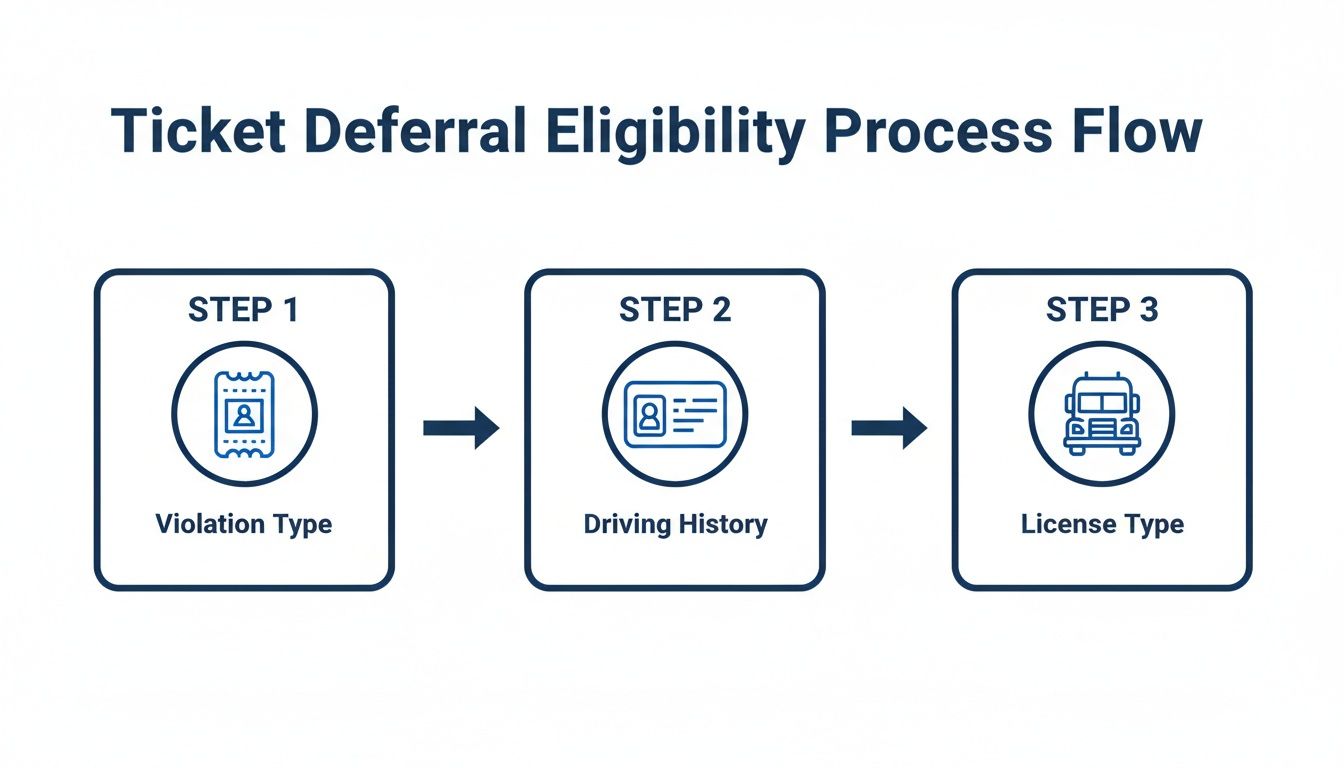
As you can see, it primarily depends on the type of violation, your past driving record, and whether you have a commercial license. Once you successfully complete the deferral period, the court officially dismisses the ticket. That means no points on your license and nothing on your public driving record—which is the entire purpose of seeking a traffic ticket deferral in the first place.
The True Costs and Benefits of a Ticket Deferral
A traffic ticket deferral can be an excellent tool for protecting your driving record from points and preventing your insurance rates from increasing. But it's not without cost. Agreeing to a deferral means paying some upfront fees, and you need to weigh those against the potential long-term financial consequences of a conviction. Getting this balance right is the key to making an informed decision.
At first glance, the fees for a deferral might seem steep—sometimes even more than the fine on the ticket itself. That can feel counterintuitive, but you have to look at the bigger picture. You aren't just paying to make a single ticket go away; you're investing in keeping your driving record clean, a move that can save you a significant amount of money over the next few years.
Breaking Down the Upfront Costs
When you opt for a deferral, you agree to pay certain fees directly to the court. These are not fines or penalties. Think of them as administrative charges for the court to manage your case and monitor your compliance with the agreement. The exact amounts vary in every Florida county, but they usually fall into a few common categories.
Here’s a realistic look at what you might have to pay:
Court Costs: This is the main fee. It covers the administrative work the clerk of the court performs for your case. Expect this to be anywhere from $150 to $300, and sometimes more depending on the county and the violation.
Administrative Fees: Some courts may add smaller, specific fees for program administration or other services related to your deferral.
Driver Improvement Course Fees: If the court orders you to take a traffic school course as part of the agreement, you are responsible for that cost. These courses generally run between $25 and $60.
These costs must be paid regardless of the outcome. You are paying for the opportunity to have the ticket dismissed, not for a guaranteed result.
The Long-Term Financial Benefits
Now, let's consider the other side. The upfront costs are tangible, but the long-term savings from a successful deferral are almost always much greater. The main benefit here is avoiding a conviction on your record, because a conviction is what triggers the two biggest financial consequences: insurance premium hikes and points on your license.
The single biggest financial benefit from a traffic ticket deferral is sidestepping the significant insurance rate hike that almost always follows a conviction. Just one ticket can increase your premiums by 20% or more for years, costing you hundreds, if not thousands, of dollars.
When you successfully complete the deferral period, the ticket is dismissed. That means it never appears as a conviction on your driving record. Your insurance company will likely never know it happened, and your rates should not be affected. This is where the real value lies.
Cost-Benefit Analysis: Deferral vs. Paying The Fine
To make an informed choice, it helps to put the numbers side-by-side. The initial cost of paying the fine might look appealing, but it can be a costly trap in the long run. This table breaks down the immediate expenses of a deferral compared to the potential long-term damage of simply paying the ticket and accepting a conviction.
Factor | Traffic Ticket Deferral | Paying Ticket (Conviction) |
|---|---|---|
Upfront Cost | Court costs and potential course fees (e.g., $175 - $350) | Original ticket fine (e.g., $150 - $250) |
Points on Record | None, if successful. | Yes, points are added immediately. |
Insurance Impact | None, as there is no conviction to report. | High likelihood of a significant rate increase for 3-5 years. |
Long-Term Cost | Limited to the initial fees. | Fine + hundreds or thousands in increased insurance premiums. |
As the table clearly shows, paying the fine might seem like the cheaper, easier option initially, but it can quickly become the most expensive choice once your insurance company learns of the conviction and adjusts your rates. The initial investment in a deferral is often a small price to pay for years of financial stability and a clean record. Our goal is to protect your license and record. Past results do not guarantee future outcomes.
How an Attorney Can Help with Your Deferral Case
Deciding whether to handle a traffic ticket deferral on your own or retain a professional is a critical choice. While you can navigate the process yourself, partnering with an attorney who focuses on traffic defense can strengthen your position and make the experience less stressful. Our role is to protect your driving record by managing the legal details on your behalf.
Think of an attorney as your advocate and guide through the court system. We handle crucial tasks—from filing the right paperwork on time to negotiating directly with the prosecutor. For the vast majority of our clients, this means they never have to appear in a courtroom, saving them time, stress, and a day of missed work.

Strategic Case Assessment
One of the biggest advantages an attorney provides is a strategic legal assessment of your case. A deferral is an excellent option, but it's not always the only possible outcome. An experienced lawyer can analyze the specifics of your citation, your driving history, and the details of the traffic stop to see if a better path exists.
For instance, there might be technical errors on the ticket or weaknesses in the evidence that could lead to a complete dismissal.
An attorney's objective is to secure the most favorable result for you. Sometimes that means negotiating a deferral; other times, it means fighting for an outright dismissal of the charges.
This kind of strategic insight prevents you from accepting a deferral when a more favorable outcome might be achievable. Figuring out when to get legal help can be tricky, but our guide on whether you need a lawyer for a traffic ticket can offer more clarity.
Navigating Court Procedures and Negotiations
The legal system has its own language and procedures that can be confusing for those who do not deal with them daily. An attorney who handles traffic cases across Florida is fluent in these procedures. That knowledge is a significant advantage during negotiations.
We know what prosecutors in different counties are looking for and how to frame your case in the most compelling way. This familiarity helps in a few key ways:
Efficient Communication: We know who to talk to and how to present a deferral request effectively.
Stronger Negotiations: We can often negotiate better terms, like lower court costs or even getting a required driving course waived.
Error Prevention: We ensure all deadlines are met and paperwork is filed correctly, avoiding common missteps that could compromise your case.
This professional representation lifts the burden from your shoulders and places it in the hands of someone who handles these situations daily. As you weigh your legal options, it's worth noting that modern law firms are often supported by advanced systems designed to improve the client experience. You can learn more about how AI receptionists transforming client experience in law firms to see how technology helps legal professionals stay on top of their game.
Our firm handles everything for our clients, giving you peace of mind from start to finish. Call us for a free consultation to discuss your specific case. Past results do not guarantee future outcomes.
Attorney Advertisement. Office in Broward.
Frequently Asked Questions About Florida Ticket Deferrals
It's natural to have questions when you hear the term "traffic ticket deferral." To help you get a clearer picture, we've answered some of the most common inquiries we receive. Consider this a way to reinforce what we've covered and address specific concerns.
Please remember, this information is for educational purposes. Nothing here constitutes legal advice for your unique situation. For that, you should speak with a licensed attorney about the details of your case.
Can I Get a Deferral for Any Traffic Ticket?
No, a deferral in Florida is not available for every type of ticket. It is an option typically reserved for non-criminal moving violations, but the final decision depends on the specific county court and your driving history.
Serious violations are almost always ineligible. Offenses like DUI, reckless driving, or leaving the scene of an accident will not qualify for a deferral program. Additionally, tickets for excessive speeding (often 30 mph or more over the limit) or violations in a school or construction zone are frequently disqualified. Drivers with a Commercial Driver's License (CDL) also face strict restrictions and generally cannot obtain a deferral, even if the violation occurred in their personal vehicle. An attorney can review your ticket and provide a realistic assessment of your eligibility.
What Happens If I Get Another Ticket During the Deferral Period?
Receiving another ticket while in a deferral period is a serious issue. It almost always violates the agreement you made with the court. Think of it as a probationary period where you have promised to maintain a clean record.
If you get another violation, the court will most likely revoke the deferral. When that happens, you will likely receive an immediate conviction for the original ticket. That means you are back at square one, facing the original penalties—the full fine, points on your license, and a conviction on your permanent driving record. That outcome can lead to an increase in your insurance rates, which defeats the purpose of the deferral. It is crucial to drive carefully and remain ticket-free for the entire term.
Is a Deferral the Same as Electing Traffic School?
While both a traffic ticket deferral and electing traffic school can help you avoid points on your license, they are two distinct legal options. Understanding the difference is key to choosing the right strategy for your situation.
Electing traffic school is a right given to eligible drivers by Florida law. You are allowed to choose this option a limited number of times (once every 12 months and no more than five times in your lifetime). A deferral, on the other hand, is a discretionary agreement that must be negotiated with the court or prosecutor—it’s not something you are automatically entitled to.
The terms of a deferral can also vary significantly. The agreement might require you to take a driving course, but it could also simply involve paying court costs and staying out of trouble. An attorney can provide a professional opinion on which path makes the most sense for your case. Past results do not guarantee future outcomes.
Does Using Your Website Form Create an Attorney-Client Relationship?
No, it does not. Submitting your information to our firm through a contact form on this website does not create an attorney-client relationship. This initial step is primarily for two purposes: it allows us to gather the basic details of your situation and enables us to perform a conflict check to ensure we can represent you.
An official attorney-client relationship only begins after you have had a consultation with one of our attorneys and have signed a formal engagement agreement with our firm. We treat all information you send us with strict confidentiality, but the legal protections of an attorney-client relationship do not apply until that formal agreement is in place.
Attorney Advertisement. Office in Broward.
Dealing with a traffic ticket can be confusing and stressful, but you don't have to handle it alone. The experienced team at Ticket Shield, PLLC is here to help you understand your options and work to protect your driving record. We handle everything from start to finish, so you can have peace of mind. For a free, no-obligation consultation, visit us at https://www.ticketshield.com or call us 24/7.