Florida's Violation of Traffic Control Device Law Explained
Facing a violation of traffic control device ticket in Florida? Understand the law, penalties, and defense options to protect your driving record.

Attorney Advertisement. Office in Broward.
Getting a ticket for “violation of a traffic control device” can feel a little vague. What does that even mean? Simply put, it's a catch-all legal term for not obeying any sign, signal, or road marking designed to keep traffic moving safely. Think of it as an umbrella that covers everything from running a red light to not fully stopping at a stop sign.
What a Traffic Control Device Violation Really Means
When an officer hands you a citation for this, it means they believe you failed to follow the rules of the road laid out by official signs or signals. These devices are the silent conductors of our roadways, and ignoring them—even for a split second—can lead to a ticket.
This type of infraction is covered by Florida Statute § 316.074. The law requires all drivers to obey the instructions of any official traffic control device unless a police officer directs them to do otherwise. The language is intentionally broad to cover the hundreds of different signs, signals, and markings that ensure traffic flows in an orderly, predictable way.
A single moment of distraction or a simple misjudgment is all it takes to get this citation. It’s one of the most common tickets issued in Florida for the simple reason that it applies to so many different driving scenarios.
Understanding the Broad Scope of the Law
The term "traffic control device" goes way beyond just red lights and stop signs. It includes a whole array of directives that guide your every move on the road. Knowing what qualifies is the first step to understanding why you might have been ticketed.
Common examples include:
Traffic Signals: Your standard red, yellow, and green lights at intersections.
Regulatory Signs: Stop signs, yield signs, speed limit signs, and "No Turn on Red" signs.
Pavement Markings: Solid yellow or white lines telling you not to pass, as well as the arrows in turn lanes directing where you can and can't go.
Warning Signs: Signs that give you a heads-up about curves, crosswalks, or school zones.
Because the definition is so inclusive, you can be cited for things that might not seem like obvious violations. For example, changing lanes over a solid white line as you approach an intersection can be classified as a violation of a traffic control device. The same goes for failing to yield at a flashing yellow arrow—that can also trigger a ticket under this statute.
Why This Ticket Matters
Here’s the bottom line: simply paying the fine is the same as pleading guilty. That admission kicks off a chain reaction, starting with points being added to your driving record. Those points, in turn, can cause your insurance premiums to jump significantly. For many drivers, the long-term financial hit from higher insurance costs is far worse than the initial cost of the ticket.
Our goal is to protect your license and record from the lasting consequences of a traffic citation. Past results do not guarantee future outcomes, but a thorough review of your case is a critical first step.
To help you get a clearer picture of what you might be facing, we've put together a quick overview of common violations under this statute and the potential impact on your license.
Florida Traffic Control Violations at a Glance
This table breaks down some of the most common traffic control device violations, the points they carry, and what they mean for Florida drivers.
Violation Type | Florida Statute | Points on License | Common Examples |
|---|---|---|---|
Failure to Obey Device | § 316.074 | 3 | Running a stop sign, improper lane change over a solid line |
Red Light Violation | § 316.075 | 3 | Driving through an intersection after the light has turned red |
Red Light Camera | § 316.0083 | 0 (if paid on time) | Failing to come to a complete stop before turning right on red |
Keep in mind that while a red light camera ticket might not add points initially, failing to handle it properly can lead to bigger problems. No matter the specifics, understanding the stakes is the first step toward making a smart decision about how to handle your ticket.
This content is for informational purposes only and does not constitute legal advice. Submitting information via any form on this website does not create an attorney-client relationship.
Common Scenarios That Lead to a Citation

The legal term "violation of a traffic control device" can feel a bit abstract until an officer is handing you a ticket. In reality, these citations almost always come from everyday driving situations—often the result of a split-second decision, a moment of distraction, or just plain confusion.
Understanding these common scenarios is the first step in figuring out why you got the ticket. From busy city intersections to quiet neighborhood streets, the opportunities for these infractions are everywhere. Let's connect the law to the real world so you can see exactly what the officer saw.
Red Light Violations
This is one of the most recognized traffic control violations. Whether you're caught by an officer at an intersection or a red-light camera, failing to stop for a red signal is a clear-cut infraction.
But it’s not always as simple as blowing through a red light. Many tickets come from more nuanced situations:
Improper Right on Red: Many drivers get cited for this. You might have slowed down, but Florida law requires a complete stop before you make that right turn on red. A "rolling stop" does not suffice.
Entering on Yellow: This is a classic judgment call. If you enter the intersection just as the light flips from yellow to red, an officer can ticket you if they believe you had plenty of time to stop safely.
Blocking the Box: You might have entered on a green light, but if traffic ahead prevents you from clearing the intersection and you're stuck there when the light turns red, you can still get a ticket.
The Infamous Rolling Stop
The rolling stop happens thousands of times a day across Florida. While it might feel harmless—especially on a quiet street with no one around—the law is crystal clear: a stop sign means your car's movement must completely cease.
Legally speaking, a "rolling stop" is no different from running the stop sign entirely. Your wheels have to stop moving completely behind the white line before you proceed.
An officer who sees a driver slow down but never fully stop has all the justification they need to write a citation. It's one of the most common tickets we see, and also one of the most avoidable.
Improper Lane Changes and Pavement Markings
Those lines painted on the road aren't just suggestions; they're traffic control devices, too. Solid white or yellow lines are legally enforceable commands, and ignoring them can lead to a ticket.
Some of the most common violations here include:
Crossing Solid Lines: This often happens near intersections or in tunnels. Changing lanes over a solid white line is a citable offense.
Illegal Turns: Using a "straight only" lane to make a turn, or turning left from a lane that isn't marked for it, is a direct violation of the arrows painted on the pavement.
Ignoring a Double Yellow Line: This is a major one. Passing another car by crossing a solid double yellow line is a serious and dangerous violation that comes with stiff penalties.
Yield Signs and Rights of Way
Yield signs are another frequent source of citations. The rule is simple: you have to slow down and give the right-of-way to any vehicle or pedestrian already in or approaching the intersection. A violation happens when you fail to yield and force someone else to brake or swerve to avoid a collision.
This isn't just a minor rule of the road; it's a critical safety measure. Failure to obey traffic control devices consistently ranks as one of the top driver violations in the country.
Of course, a lot of driving comes down to being prepared. A proactive approach to vehicle care can help you avoid unexpected mechanical issues that might contribute to a violation. Following an essential car maintenance checklist for safe driving ensures your car is ready to respond when you need it to.
Understanding the Penalties and Long-Term Costs
The sticker shock from the fine on your traffic ticket is just the beginning. The real cost of a violation of a traffic control device isn't paid at the courthouse window; it unfolds over months and even years, hitting your wallet and your driving privileges in ways you might not see coming.
Think of it as a domino effect. Simply paying the fine feels like the easiest way out, but doing so is an admission of guilt. That single decision triggers a chain reaction: points land on your license, and your auto insurance company gets ready to hike your rates. Before you do anything, you need to understand exactly what you’re up against.
Fines and Court Costs
The first hit is the fine itself. While the base penalty for a moving violation like failing to obey a traffic control device is standardized across Florida, the final amount you’ll owe can be wildly different from one county to the next.
Why? Because each county tacks on its own surcharges and court costs. A ticket for the same exact violation in Miami-Dade County could cost you more or less than one in Hillsborough County. These extra fees can quickly inflate that initial fine, making the ticket far more expensive than it first appeared.
The Florida Driver's License Point System
Beyond the immediate financial sting, a conviction adds points to your Florida driver's license—and this is where the long-term trouble really starts. Most moving violations, from running a stop sign to an improper lane change, will add three points to your record. Running a red light? That’s another three points.
These points aren’t just numbers; they're black marks that Florida’s Department of Highway Safety and Motor Vehicles (DHSMV) tracks to identify risky drivers. If you want to dive deeper, you can explore the full breakdown in our guide to the Florida traffic ticket point system in our guide.
When points pile up too quickly, the state steps in with automatic license suspensions:
12 points within a 12-month period leads to a 30-day suspension.
18 points within an 18-month period triggers a 3-month suspension.
24 points within a 36-month period results in a 1-year suspension.
One ticket might not seem like a huge deal, but it pushes you that much closer to the edge. Another citation within the year could be all it takes to put your license on the line.
The Hidden Cost of Insurance Premium Hikes
This is the penalty that hurts the most and lasts the longest. As soon as you're convicted of a moving violation, your insurance provider flags you as a higher-risk driver. To them, risk equals cost, so they raise your rates to compensate.
A single violation of a traffic control device can increase your insurance rates by 15-20% or more, depending on your provider and driving history. And this isn't a one-time fee—that rate hike can stick around for three to five years.
Let’s run the numbers. A seemingly small increase of $30 per month adds up to an extra $360 per year. Over three years, you’re looking at paying over $1,000 extra—all from one ticket. This long-term financial hit almost always dwarfs the original fine. Our goal is to protect your license and record from these extended costs. Past results do not guarantee future outcomes.
How Red-Light Cameras Are Changing the Game in Florida

Technology is playing a much bigger role in traffic enforcement, and you see it most clearly at intersections with red-light cameras. These automated systems are everywhere across Florida now, and they have changed how a violation of a traffic control device gets issued and handled.
Unlike a traditional traffic stop where an officer pulls you over, a camera-based violation starts with a flash and a letter in the mail. That's more than just a different process; it creates a whole new legal framework with its own set of rules, deadlines, and consequences.
Notice of Violation vs. Uniform Traffic Citation
When a camera catches a vehicle running a red light, the first thing the registered owner gets is a Notice of Violation. This is a critical distinction—it is not a normal traffic ticket.
Think of the Notice of Violation as a preliminary warning. It claims your vehicle was involved in an infraction and gives you a choice:
Pay the fine: Usually $158, if paid within the first 30 days.
Dispute it: You can submit an affidavit to name the actual driver or to challenge the violation on other grounds.
Ignore it: This is the absolute worst option. If you don't respond, the notice escalates into a Uniform Traffic Citation (UTC).
A UTC is a formal ticket, the same kind a police officer would hand you. Once a UTC is issued, the stakes get much higher. Fines go up, and the violation gets reported to the DHSMV, which can lead to serious problems for your driving record.
Do Camera Tickets Add Points to Your License?
This is the number one question we get from drivers, and the answer all comes down to how you handle it. A red-light camera violation issued as a Notice of Violation does not add points to your Florida driver's license. It's treated like a civil penalty, similar to a parking ticket.
However, if you ignore that initial notice and it turns into a Uniform Traffic Citation, everything changes. At that point, a conviction can lead to points being added to your license. That can trigger the same insurance rate hikes and potential suspensions as a regular, officer-issued ticket. To really get into the weeds on this, check out our guide on how to handle a red-light camera ticket in Florida.
The explosion of automated enforcement is increasing these violations globally. With over 20,000 red-light cameras in use worldwide, and advanced AI systems improving accuracy, drivers in cities like Miami and Orlando are seeing more of these notices every day. Learn more about the growth of intelligent traffic management systems.
Ultimately, a camera-issued notice demands a strategic response. It might seem like a small issue at first, but the path you choose will determine the final impact on your record and your wallet. Past results do not guarantee future outcomes, but carefully reviewing your options is always the smartest move.
Exploring Your Options to Defend Against a Ticket
Getting a ticket for a violation of a traffic control device is frustrating, but it's not the end of the road. Your first instinct might be to just pay it and move on, but that can be a mistake. Paying the fine is an admission of guilt, which locks in points on your license and almost guarantees your insurance rates will go up.
The good news is you have the right to challenge the citation. There are several defense strategies that could apply to your situation, and understanding them is the first step toward protecting your driving record. Every case is unique, and the specifics of your stop will determine the most effective approach.
Common Arguments in Traffic Violation Cases
When you contest a ticket, the burden of proof is on the state to show you actually committed the violation. A solid defense strategy often involves showing they simply can't meet that burden. Most arguments focus on the conditions surrounding the incident—questioning whether you could have safely avoided a violation or if the traffic device itself was even legal.
Here are a few common defenses we see.
1. Obstructed or Unclear Signage For a traffic control device to be enforceable, you have to be able to see it. It sounds simple, but you'd be surprised how often this comes into play. A valid defense might exist if:
A stop sign or traffic light was hidden by overgrown tree branches, a badly placed utility pole, or even a parked truck.
The sign itself was so faded, vandalized, or covered in grime that it was impossible to read.
Pavement markings like a stop line were so worn down they were practically invisible.
The logic is simple: if you couldn't reasonably see the device, how could you be expected to obey it? Photos or video showing the obstruction are crucial for this kind of defense.
2. Malfunctioning Traffic Signal Traffic lights are machines, and machines fail. If a signal was on the fritz when you got your ticket, you could have a strong defense. For example, the ticket might be contestable if the lights were cycling incorrectly, showing conflicting signals (like green for both directions at once), or the yellow light was way too short for the speed limit.
A key element of any traffic violation is the driver's intent or negligence. If a malfunctioning device made it impossible to comply with the law safely, it challenges the core of the state's argument against you.
3. Necessity to Avoid an Accident Sometimes, you have to make a split-second choice to break a traffic rule to prevent something much worse from happening. This is known as the "necessity" defense. For instance, maybe you had to swerve over a solid line to avoid a pedestrian who darted into the road or another driver who blew their own stop sign.
While this can be a powerful argument, you have to show that your action was the lesser of two evils and was absolutely necessary to prevent immediate harm.
Defenses Specific to Red-Light Camera Tickets
Automated enforcement brings its own set of challenges and potential defenses. Unlike a ticket from an officer, a camera citation is based entirely on technology—and technology isn't foolproof.
Common defenses for camera tickets include:
Incorrect Vehicle Identification: The camera might have captured the wrong license plate, or the image could be too blurry to definitively identify your car.
You Weren't the Driver: In Florida, the notice goes to the registered owner. If you lent your car to a friend or family member, you can submit an affidavit naming the person who was actually driving.
Improper Yellow-Light Timing: State law sets minimum times for yellow lights based on an intersection's speed limit. If the yellow light is illegally short, it can't be a valid basis for a ticket.
Successfully challenging a traffic ticket comes down to a careful look at the facts. For more ideas, you can review our comprehensive article on how to beat a traffic ticket in Florida. Our goal is to protect your license and record. Remember, past results do not guarantee future outcomes, and a professional case review is the best way to understand your options.
Your Next Steps After Getting a Citation
So, you’ve been handed a ticket for a violation of a traffic control device. That piece of paper officially starts a 30-day clock. What you do in that month is critical, with consequences that can stick to your driving record and insurance bills for years.
Ignoring it isn't an option. That path only leads to bigger problems, like a potential license suspension. Your first move is simple: read the citation carefully and find the deadline. Florida law gives you three ways to handle this, but rushing into a decision—especially just paying the fine to make it go away—is often the most expensive mistake you can make.
The Three Paths You Can Take
Once you're holding that ticket, you have to choose a path. Your decision directly impacts whether you end up with points, fines, or a clean slate.
Pay the Fine: This is the fastest way to deal with it, but it’s a full admission of guilt. When you pay, you’re accepting the conviction. Points will be added to your license, and your insurance company will almost certainly raise your premiums for the next few years.
Elect Traffic School: If you’re eligible, you can attend a driver improvement course. This move keeps the points off your license, but you still have to pay the full fine plus the cost of the school. There are limits, though—you can only use this option five times in your life and only once in any 12-month period.
Contest the Citation: This means pleading not guilty and fighting the ticket in court. This option presents an opportunity for a full dismissal, which means no fine, no points, and no hit to your insurance. Our goal is to protect your license and record by fighting on your behalf.
This decision tree infographic breaks down the fundamental choice every driver faces after getting a citation.
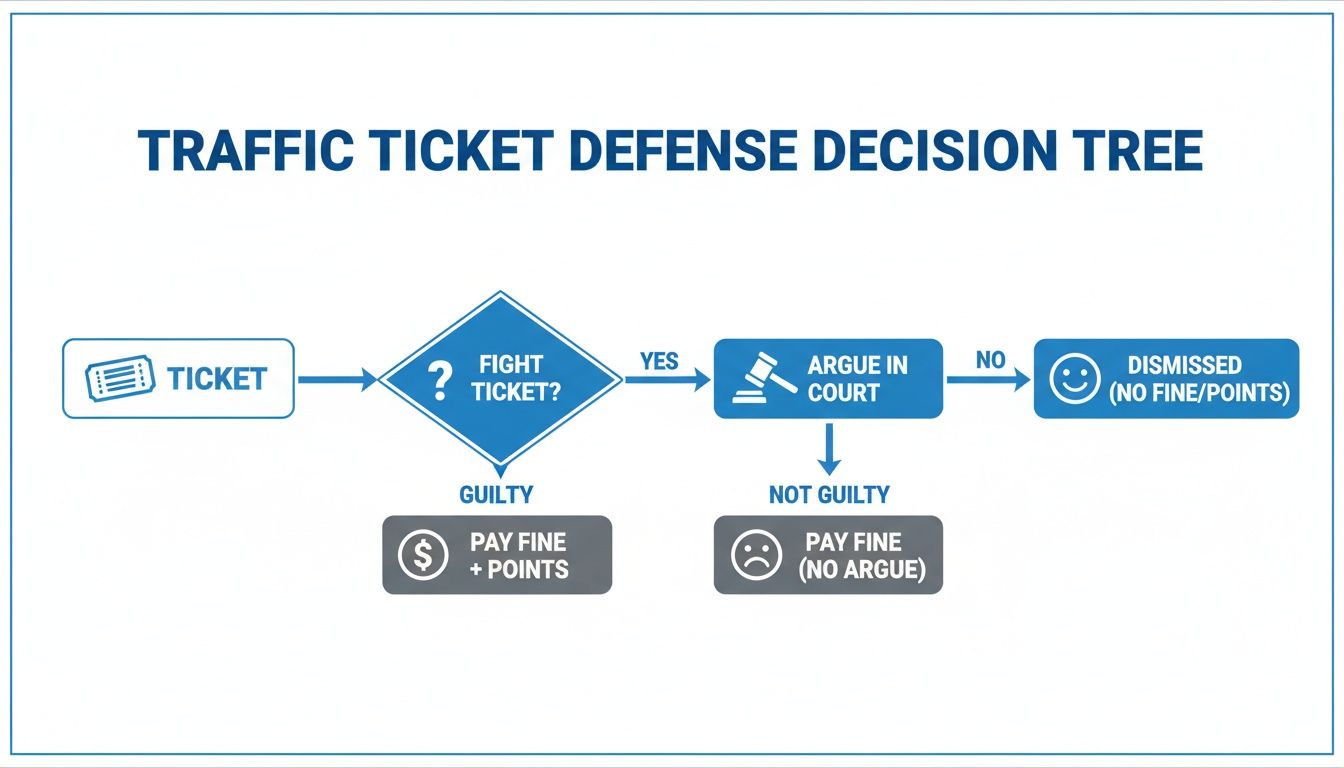
As you can see, your journey splits into two main routes—arguing the charge or not arguing it. Each leads to a very different destination.
Special Considerations for CDL Holders
For commercial drivers, the stakes are so much higher. A ticket for a violation of a traffic control device isn't just an inconvenience; it can threaten your entire career.
CDL holders cannot simply elect traffic school to get rid of points from a ticket received in their commercial vehicle. A conviction stains both their personal and professional driving records, which can easily lead to getting fired or finding it impossible to get another driving job.
Because the consequences are so severe, contesting the ticket is almost always the most logical move for a commercial driver. The number one priority is avoiding a conviction to protect their livelihood.
Before you make your choice, you need to understand exactly what you're up against. An informed decision is your best defense. To get a clear look at your options, you can submit your case online for a free consultation.
This content is provided for informational purposes as an attorney advertisement from our office in Broward. Past results do not guarantee future outcomes. Submitting information does not create an attorney-client relationship.
Common Questions About Traffic Device Tickets
Let’s wrap things up by tackling some of the most common questions Florida drivers have after getting cited for a traffic control device violation. Getting clear on the facts is the first step toward making a smart decision.
Will I Get Points for a Red-Light Camera Ticket?
It really depends on how you handle it. If you pay that initial $158 fine from the Notice of Violation before its deadline, you're in the clear—no points will be added to your license.
The trouble starts if you ignore that first notice. It will eventually escalate into a formal Uniform Traffic Citation, and at that point, a conviction can add points to your license along with much higher fines.
Is It Really Worth Fighting a Simple Stop Sign Ticket?
In almost every case, yes. Here’s why: simply paying the fine for a stop sign ticket is an admission of guilt. That means you're accepting a conviction and three points on your driving record.
A conviction almost always triggers an increase in your auto insurance premiums that can stick around for years, easily costing you far more than the original fine. Contesting the ticket is the only way to work toward a dismissal and dodge those long-term financial hits. Our goal is to protect your license and your record.
How Will a Florida Ticket Affect My Out-of-State License?
Florida doesn't keep secrets from other states. Thanks to interstate agreements, driver information is shared freely. If you get a ticket here, the conviction will almost certainly be reported back to your home state's DMV.
From there, your home state will apply its own set of rules, which often means adding points to your license according to their system. So, a Florida ticket can definitely follow you home.
Prospective clients may not obtain the same or similar results. The information on this page is for informational purposes and does not create an attorney-client relationship.
Fighting a violation of a traffic control device is often a sound financial decision.
Don't let a simple ticket disrupt your life. At Ticket Shield, PLLC, our practice is focused on traffic and DUI defense. We handle criminal traffic matters across Florida, so you may not have to set foot in a courtroom. For a free, no-obligation consultation from our Broward office, reach out to us online.