Understanding a Florida Traffic Control Device Violation
A Florida traffic control device violation usually brings 3 points and a fine around $160-$260. See the statute, examples, defenses, and next steps.
A traffic control device violation in Florida usually means a driver allegedly failed to obey an official sign, signal, or roadway marking. The governing rule is Fla. Stat. § 316.074, and the category is broader than many drivers expect: it can include running a red light, rolling a stop sign, ignoring a lane-use arrow, turning where a sign prohibits it, or crossing pavement markings that control movement.
How We Evaluated the Law, Penalties, and Defense Options
This article is based on Florida-specific sources rather than generic traffic advice. We built it from the text of Fla. Stat. § 316.074, Florida’s statutory definition of official traffic control devices, the FLHSMV point system summary, and county clerk fine schedules used in ordinary civil traffic cases. We also compared the most common fact patterns that lead to these citations in practice: stop-sign cases, signal cases, improper turns, lane-control violations, and pavement-marking disputes.
We also considered what changes the analysis. A crash can increase the point impact. CDL status can raise the professional stakes even when the citation is issued in a personal vehicle. And a mailed red-light-camera notice is procedurally different from an officer-issued citation, even if both involve obedience to a traffic signal. That matters because the best response depends on the type of ticket, the deadline on the citation, the county, and whether the allegation is based on live officer observation, camera evidence, or a collision report.
What a Traffic Control Device Violation Really Means
In Florida, the legal term is narrower and more useful than the vague phrase “rules of the road.” Fla. Stat. § 316.074 requires drivers, pedestrians, and others to obey the instructions of any official traffic control device that applies to them, unless a police officer is directing traffic differently. In plain English: if a device placed by lawful authority tells you to stop, turn, merge, yield, stay out, or use a lane a certain way, disobeying that instruction can support this citation.

Florida also defines what counts as an official device. Under Fla. Stat. § 316.003, official traffic control devices are signs, signals, markings, and similar devices placed or erected by authority of a public body or official having jurisdiction for the purpose of regulating, warning, or guiding traffic. That definition matters in contested cases. A homemade sign in a parking lot is not the same as a county-installed regulatory sign, and a faded marking can raise different proof issues than a clearly visible signal head at an intersection.
In day-to-day enforcement, officers usually do not use this statute as an abstract catch-all. They use it to cite concrete conduct they say they observed: a driver who rolled through a stop sign, turned right where a “No Turn on Red” sign was posted, crossed a solid lane line into a turn-only lane, ignored a “Do Not Enter” sign, or failed to follow a traffic-control arrow. If an officer is manually directing traffic after a storm, crash, or signal outage, the officer’s direction overrides the device for that moment. A green light does not authorize a move against an officer’s hand signal.
A few Florida examples make the category clearer:
Failing to stop at a stop sign before the marked stop bar or crosswalk.
Driving straight from a lane marked “right turn only.”
Turning left where a posted sign prohibits the turn during certain hours.
Entering a school zone and ignoring a flashing reduced-speed signal.
Crossing pavement markings that separate traffic movements or prohibit a lane change.
This is one reason the category shows up so often in ordinary ticket practice. It covers classic intersection behavior, lane-control issues, and sign-based movement restrictions. Nationally, the safety stakes are real: stop-sign crashes remain common, and one study found nearly 700,000 police-reported crashes annually at stop signs in four U.S. cities, with about one-third involving injuries, according to this PubMed summary. The point for Florida drivers is simple: the label may sound technical, but the allegation usually comes down to one claimed failure to obey a visible, official instruction on the roadway.
The Real Cost of a Traffic Control Device Ticket
The amount printed on the citation is only part of the decision. In Florida, a standard moving violation in this category often totals roughly $160 to $260 once the base fine, county assessments, and court costs are combined, but the exact amount varies by county and by the type of citation. That is why two drivers charged under the same general bucket can see different totals depending on where the ticket was issued and whether additional local costs apply.
The more important issue for many drivers is what happens to the record. The FLHSMV point system generally assigns 3 points for moving violations of this type, and 4 points if the violation contributed to a crash. Those points matter because Florida can suspend a license for accumulating too many within a set period: 12 points in 12 months can lead to a 30-day suspension, 18 points in 18 months to a 3-month suspension, and 24 points in 36 months to a 1-year suspension, as summarized by FLHSMV.
Typical Florida outcomes at a glance
Situation | Usual fine range | Points | Practical consequence |
|---|---|---|---|
Standard officer-issued moving citation for disobeying a sign, signal, or marking | $160-$260+ depending on county | 3 | Paying is a conviction; points post to the record |
Same type of violation tied to a crash | Higher total in many cases | 4 | Greater point impact and a stronger insurance risk signal |
Mailed red-light camera notice paid on time | Varies by notice type | 0 at notice stage | Not the same as an officer-issued moving conviction |
Citation contested and reduced or dismissed | Varies | May avoid points | Outcome depends on evidence, procedure, and negotiation |
Paying versus contesting
For most drivers, the key fork in the road is procedural, not emotional. If you pay the ticket, you are typically resolving it as a conviction. That usually means the points attach and the violation appears on the driving record. If you contest it, you preserve the chance to challenge the officer’s observations, the condition of the device, the legal sufficiency of the citation, or to seek a reduction that avoids points.
Florida also allows some drivers, in some situations, to elect an approved course option instead of paying the ticket as-is. Eligibility depends on the offense, your recent history, and the county process. That option can change the record impact, but it is not available in every circumstance and should be reviewed before the response deadline expires.
Insurance is the hidden multiplier. Even one moving conviction can affect premiums, especially where the carrier views the event as signaling intersection risk or poor traffic compliance. If you want a local example of how that can play out over time, you can learn more about how a ticket impacts your insurance rates in Miami-Dade. For drivers already carrying points, the licensing consequences can be even more urgent, which is why our guide on Florida points on license is often the next place to look.
How a Single Ticket Impacts Your Insurance and Driving Record
That ticket you just got? The worst part isn't the fine you pay to the court. Most drivers think that once they pay up, the whole ordeal is over. But that payment is just the first domino to fall.
When you pay a fine for a traffic control device violation, you’re legally admitting guilt. This action immediately triggers a conviction on your permanent Florida driving record. It's a financial echo that can follow you for years, visible to insurance companies, employers, and law enforcement.
The Long-Term Mark on Your Driving Record
Your driving record is exactly what it sounds like: a running history of your performance behind the wheel. Every time you're convicted of a moving violation, it’s a new black mark on that history. A single ticket for blowing past a stop sign might seem minor, but it's part of a pattern that insurers scrutinize.
This is the official record insurance companies use to decide how much of a risk you are. To them, a violation isn't just a mistake—it's cold, hard data suggesting you're more likely to get into an accident. Their entire business is built on pricing risk, and a conviction on your record tells them you're a more expensive client to cover.
A conviction for a traffic violation stays on your record for a minimum of three to five years. For more serious offenses, it can linger much longer, all while being used to justify higher insurance premiums.
That quick decision to just pay the ticket and "get it over with" can have financial consequences that sting for a long, long time. To see how these marks add up, check out our detailed guide on the Florida points on license system.
How Insurance Companies React to a Conviction
Once that conviction hits your record, your insurance provider will almost certainly hike your premiums at your next renewal. The exact amount varies, but even a small violation can trigger an unpleasant surprise. Industry data shows a single moving violation can inflate your annual insurance costs by 20% to 25% or more.
Let's do the math. If you're currently paying $2,000 a year for car insurance, a 20% increase adds an extra $400 to your bill annually. Since that rate hike can stick around for three years, that one ticket could ultimately cost you an extra $1,200 in insurance premiums alone—often way more than the original fine.
From the insurer's perspective, their logic is straightforward:
You're a Higher Risk: A violation shows you’ve broken traffic laws, which they believe makes you more likely to file a claim down the road.
The Numbers Don't Lie: They use complex algorithms that tie specific violations to accident statistics. A traffic control device conviction puts you squarely in a higher-risk category.
It's Just Business: To offset the risk you now represent, they charge you more. It's how they stay profitable.
Ultimately, contesting a ticket isn't just about sidestepping a fine. It’s a strategic financial move. The goal is to keep the conviction off your record entirely, shielding yourself from the costly and long-lasting hit to your insurance rates.
Why CDL Holders Face Stricter Consequences

For the average driver, a ticket is a headache and an unexpected expense. For a Commercial Driver's License (CDL) holder, a traffic control device violation is a direct threat to their livelihood. The standards are higher, the penalties are harsher, and the margin for error is razor-thin.
Unlike a standard driver’s license, a CDL is a professional credential. It’s governed by both Florida state law and strict federal regulations from the Federal Motor Carrier Safety Administration (FMCSA). These rules are in place for a good reason—to keep our roads safe by holding professional drivers to a much higher standard, both on and off the clock.
This means a ticket you get in your personal car on a Saturday can hit your CDL just as hard as one you receive while operating a big rig. The law makes no distinction between your professional and personal driving time for certain violations.
The Concept of a 'Serious Violation'
Federal law singles out certain traffic offenses as "serious violations." If you accumulate too many of these within a three-year window, you’re looking at a mandatory CDL disqualification. It can take you right off the road.
Unfortunately, many common traffic control device violations fall squarely into this category. The list of serious violations includes:
Excessive speeding, which is usually defined as going 15 mph or more over the posted limit.
Reckless driving, a broad term that covers a wide range of dangerous driving behaviors.
Improper lane changes, one of the most frequent types of traffic control infractions.
Following too closely, better known as tailgating.
Any traffic violation connected to a fatal accident.
Getting a second conviction for any of these serious violations within three years triggers a minimum 60-day CDL disqualification. A third conviction in that same period means a minimum 120-day disqualification.
No Second Chances for CDL Drivers
For CDL holders, many of the options available to regular drivers don't exist. You can't just elect traffic school to keep the points off your record. A conviction is a conviction, and it gets reported straight to the FMCSA.
This is exactly why just paying the ticket is one of the worst mistakes a professional driver can make.
Paying the fine for a traffic control device violation is the same as pleading guilty. For a CDL holder, that action puts a permanent stain on your professional record, pushing you one step closer to disqualification and potentially ending your career.
This reality turns every single ticket into a high-stakes event. Just one conviction can make you uninsurable in your employer's eyes, leading to termination even if your CDL is still valid. A pattern of violations can make it nearly impossible to find a new job. Learning more about how even a CDL speeding ticket can threaten your professional license is critical.
The stakes are too high to leave to chance. Our practice focuses on traffic and DUI defense, and we handle criminal traffic matters across Florida. Our goal is to protect your license and record because we know that for a professional driver, a clean record isn’t a luxury—it’s your career. Past results do not guarantee future outcomes.
Your Options for Contesting the Citation
A citation under Fla. Stat. § 316.074 is still only an allegation. The state has to prove that an official traffic control device applied to your movement, that the device was lawfully placed and sufficiently visible, and that you failed to obey it. In Florida court, good defenses usually come from facts, visibility, timing, and procedure—not from broad claims that the ticket “isn’t fair.”
Florida defense theories that often matter
Obstructed, missing, or noncompliant signage. If a stop sign was hidden by vegetation, a turn restriction sign was placed where a reasonable driver could not see it before the intersection, or pavement markings were so worn that the lane command was unclear, those facts can weaken the state’s case. The issue is not whether a sign exists somewhere; it is whether the device gave legally adequate notice at the time of the alleged violation.
Signal malfunction or timing problems. Some cases turn on whether the signal was functioning properly. A too-short yellow phase, conflicting signal display, outage, or irregular cycling pattern can become central evidence. Nationally, red-light compliance remains a major safety issue, with reporting summarized by ABC Action News on AAA data, but that does not relieve the state of proving that the device at your intersection was working correctly in your case.
Officer observation limits. Many tickets are written from angles that do not show the stop bar, the driver’s line of sight, or the precise lane marking at issue. If the officer was positioned across the intersection, moving in traffic, or relying on a brief glance during a busy sequence, that can affect how persuasive the testimony is. A stop-sign case may hinge on whether the officer could see your front tires at the stop line. A lane-control case may hinge on whether the officer could see the pavement arrow before you entered the lane.
Necessity or emergency facts. Florida cases are fact-specific. A driver who entered an intersection to avoid being rear-ended, moved contrary to a device because an emergency vehicle forced the maneuver, or followed an officer’s hand signal despite what the light showed may have a real defense narrative. These are not automatic wins, but they can matter if supported by evidence.
Burden of proof and procedural defects. Paperwork and filing should be examined. Wrong location details, an incorrect statute reference, missing identifiers, or failures in how the citation was issued or filed may provide grounds for challenge. Not every clerical error gets a case dismissed, but some defects materially affect notice or proof.
What evidence actually helps
The best evidence is usually gathered fast. Helpful documentation can include:
Photos showing the driver’s approach to the intersection, not just a close-up of the sign.
Dashcam footage showing signal timing, lane markings, traffic flow, or an officer’s direction.
Witness names and short written summaries while memories are still fresh.
Public-record requests for signal timing, maintenance logs, or roadway work orders where available.
Weather, lighting, and obstruction evidence, including overgrowth, construction barrels, or faded markings.
In our experience, the strongest ticket defenses are usually visual and location-specific. We look for what the officer could see, what the driver could see, and whether the roadway communicated a clear legal instruction. Those details often matter more than general arguments about being careful or having a clean record.
How We Defend Your Traffic Ticket
Getting cited is stressful, but the next step in Florida is usually straightforward if you act before the deadline on the ticket. In most standard traffic cases, you have a limited time to respond. From there, the path splits: you can pay, request a hearing, hire counsel to contest it, or in some eligible situations elect a permitted course option. The right move depends on the charge, your record, whether a crash happened, and whether avoiding points matters more than closing the case quickly.
What usually happens after a Florida ticket
Review the citation immediately. Confirm the statute listed, the county, the hearing information, and the response deadline.
Decide whether paying is acceptable. Paying is often the fastest route, but it usually means a conviction and points for an officer-issued moving violation.
Check eligibility for a course option. Some drivers may be able to elect an approved course instead of taking the points in the ordinary way, subject to limits and court rules.
Request a hearing or retain counsel. If the goal is dismissal, reduction, or avoiding points, this is the point to preserve that option.
Gather evidence early. Photos, video, witnesses, and roadway-condition proof are far more useful when collected right away.
Our case-handling workflow
We start with the citation itself and the practical question most drivers care about: is this a case where paying is likely to cost more in the long run than fighting it? We review the alleged device, the officer’s description, the county process, your driving history, and whether the citation appears vulnerable on visibility, procedure, or proof.
If you hire us, we handle the filing and court process, identify available defenses, and assess the most realistic target outcome. In one case, the goal may be a dismissal. In another, it may be reducing the charge to avoid points. In another, especially where the evidence is strong, the best value may come from minimizing damage rather than forcing a weak trial position.
This decision tree gives you a glimpse into some of the common defense angles we explore.
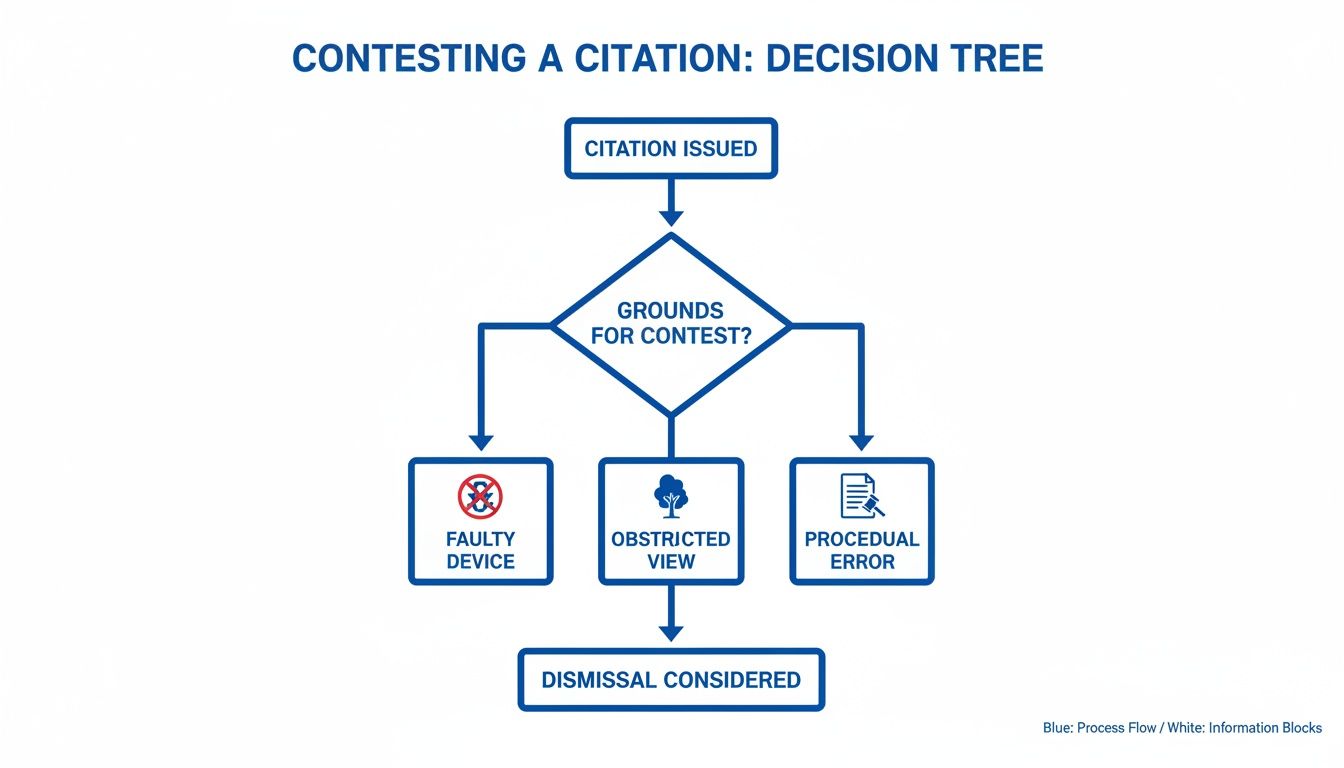
You can learn more about how we handle a traffic control device violation in Florida right on our website.
Every case turns on its facts, timing, county practice, and record impact. Past results do not guarantee future outcomes.
If you want help evaluating the ticket before you choose a response, our firm can review the citation, explain the likely consequences, and take over the court process where appropriate.
Submitting information through our website does not create an attorney-client relationship. Attorney Advertisement. Office in Broward.
Common Questions About Traffic Control Device Tickets
Getting a ticket for a traffic control device violation can be confusing. Let's clear up some of the most common questions we hear from drivers, building on what we've already covered.
If you're comparing representation, it can also help to review a neutral checklist before you hire anyone. This short HeyAtty guide covers useful questions to ask a lawyer about fees, communication, and case handling.
Will I Have to Go to Court if I Hire an Attorney?
Probably not. For most non-criminal traffic tickets in Florida, hiring an attorney means we go to court for you. You can go about your day without taking off work or making a trip to the courthouse. We handle all the legal footwork and negotiations.
Of course, every case has its own quirks, so we’ll always confirm the plan with you. But in the vast majority of these situations, your presence isn't needed.
How Do Red Light Camera Tickets Work?
Red light camera tickets, which arrive in the mail as a 'Notice of Violation,' are a different animal from officer-issued tickets. At first, it's just a fine. If you pay it on time, you get zero points on your license.
But if you ignore that notice, it can morph into a real Uniform Traffic Citation. At that point, you're looking at a bigger fine and license points. These can often be contested by challenging things like the clarity of the photo, the length of the yellow light, or whether the camera warning signs were even posted correctly. An attorney can spot these issues right away.
Is It Worth Fighting a Ticket if I Think I'm Guilty?
Even if you’re pretty sure you made the mistake, it can still be a smart move to contest the ticket. The goal isn't always about proving you're innocent. Often, we aim to get the case dismissed on a technicality, or perhaps get the charge reduced to a non-moving violation to avoid points and keep your insurance from going up.
Remember, the prosecutor has to prove their case against you. A good lawyer knows exactly where to look for weaknesses. A quick chat with us can help you figure out if contesting it makes sense. While past results do not guarantee future outcomes, our primary goal is always to protect your record.
What’s the Difference Between a Stop Sign and a Failure to Yield Ticket?
Both are common traffic control violations, but they're about different actions. A stop sign ticket is simple: the officer says you didn't come to a complete stop.
A 'failure to yield' ticket is a bit more subjective. It happens when you don't give the right-of-way to another car or pedestrian at a yield sign, an unmarked intersection, or while making a turn. Both are moving violations that carry points, but how we defend them can be completely different.
Knowing the rules for specific devices is important, but a general awareness of vehicle safety is just as key. For example, you can find helpful details on things like RV Seat Belt Laws and Compliance.
Don't let one ticket mess up your driving record. At Ticket Shield, PLLC, our practice focuses on traffic and DUI defense in Florida. We take care of the court dates and the paperwork so you can get on with your life.
For a free, no-pressure consultation to see how we can help, visit us at https://www.ticketshield.com.
Attorney Advertisement. Office in Broward. Submitting information does not create an attorney-client relationship.
Device Type | Common Violation Example | Potential Points on License |
|---|---|---|
Traffic Signals | Running a red light or making an improper turn on red. | 3-4 |
Stop Signs | Failing to come to a complete stop before the white line. | 3 |
Yield Signs | Not giving the right-of-way to oncoming traffic. | 3 |
Lane Markings | Crossing a solid double yellow line to pass another car. | 3 |
School Zone Signals | Exceeding the reduced speed limit when lights are flashing. | 3+ |
Regulatory Signs | Making a U-turn where a "No U-Turn" sign is posted. | 3 |