CDL Speeding Tickets: Protecting Your Commercial License
cdl speeding tickets can trigger FMCSA serious-violation rules at 15+ over. See Florida steps, personal-vehicle risks, and CDL impact.
For a professional truck driver, a speeding ticket isn't just an annoyance—it's a direct threat to your livelihood. A simple piece of paper from a traffic stop can quickly escalate into a career-ending event. That's because, for CDL holders, many speeding violations are classified as a Serious Traffic Violation, triggering a whole different set of rules and much harsher penalties than what a regular driver faces.
Just paying the fine is the same as pleading guilty. It's an admission that can set off a domino effect of consequences that can put you out of the driver's seat for good.
How We Evaluated the Rules and Risks in This Guide
This guide was updated by reviewing the federal CDL disqualification framework from the FMCSA serious traffic violations rule together with Florida procedures and driver-record consequences from the Florida Highway Safety and Motor Vehicles points schedule. We also compared those rules against common defense issues that arise in real speeding cases, including speed-measurement challenges, reporting duties, and whether the citation was issued in a commercial vehicle or a personal vehicle.
In our review, four facts change the analysis more than anything else: the alleged speed, whether the ticket is 15 mph or more over the limit, whether there is already a prior serious violation within three years, and whether the case ends in a conviction. That last point matters because a stop alone does not disqualify a CDL holder; convictions and reportable outcomes do.
We also want to be clear about scope. The 15-over serious-violation rule is federal and follows CDL holders nationwide. Florida-specific issues in this article include points, court handling, and state record consequences. When we look at CDL ticket matters, the biggest misunderstanding is that personal-vehicle tickets somehow do not count. They can, and this guide explains exactly when.
The True Cost of a CDL Speeding Ticket
If your friend with a standard license gets a speeding ticket, they're likely just annoyed about the fine. But for you, holding a CDL, that same ticket is a major professional crisis. Your employment, your insurance rates, and your very ability to earn a living are all on the line.
The stakes are so much higher because both Florida and the Federal Motor Carrier Safety Administration (FMCSA) hold commercial drivers to a completely different, much stricter, standard.
Simply paying the fine without a fight is often the worst thing you can do. It locks in the conviction and all the problems that come with it.
CDL Holder vs Standard Driver Speeding Ticket Consequences
To really understand the difference, let's break down how the consequences stack up side-by-side. It quickly becomes clear that a CDL completely changes the game.
Consequence | CDL Holder | Standard Driver |
|---|---|---|
Violation Type | Can be a "Serious Traffic Violation" | Typically a minor infraction |
Disqualification Risk | High; 2 serious violations in 3 years = 60-day disqualification | Very low; requires multiple serious offenses |
Employer Notification | Mandatory self-reporting within 30 days | Not required |
Career Impact | Severe; can lead to termination and hiring difficulties | Minimal; usually doesn't affect employment |
Insurance Premiums | Significant increase for both personal and commercial policies | Moderate increase for personal policy |
Fine Amounts | Often higher due to commercial vehicle regulations | Standard state-mandated fines |
As you can see, the professional fallout for a CDL holder is in a league of its own. What's a minor headache for a regular driver can be a career-ending blow for you.
Immediate Risks and Penalties
The moment you get that ticket, the clock starts ticking on several immediate threats that go far beyond just paying a fine.
Here’s what you’re up against right away:
Hefty Fines: Commercial vehicle fines are almost always steeper, reflecting the greater responsibility you carry on the road.
License Points: In Florida, a conviction will add points to your license. Rack up too many, and you’re facing a suspension—which means you can’t work.
Serious Violation Classification: This is the big one. Going just 15 mph or more over the speed limit automatically flags the ticket as a "Serious Traffic Violation," which brings the feds and their disqualification rules into the picture.
It's a sobering thought, but a single ticket for going 15 over is the first step toward losing your CDL. A second one within three years triggers a mandatory 60-day disqualification. A third means you're sidelined for 120 days.
Why Paying the Ticket is a Costly Mistake
Here’s the part many drivers miss: paying the ticket is a guilty plea. It’s you, telling the court you did it. The conviction immediately goes on your driving record, and the damage is locked in.
Once you pay, you lose all rights to fight the charge. The points, the violation, everything becomes a permanent mark on your professional history. You can learn more about just how long traffic tickets stay on your record in our detailed guide.
This conviction isn’t a secret, either. You’re required to report it to your employer, and every future employer will see it during background checks. For a CDL holder, a clean driving record isn’t a bonus—it’s the most important tool you own. Protecting it starts with how you handle that very first ticket.
If you spend long stretches on the road, staying organized after a stop matters too. Even practical tools like reliable connectivity can help you pull your citation, court date, and carrier reporting instructions together quickly; this overview of SwiftNet Wifi's page is one example aimed at truckers working remotely from the cab.
Attorney Advertisement. Office in Broward. Past results do not guarantee future outcomes.
Understanding Serious Traffic Violations
For CDL holders, the question is not just "Did I get a ticket?" It is "Does this ticket count as a serious traffic violation under federal law, and if so, what does it start?" Under the FMCSA CDL disqualification framework, speeding 15 mph or more above the posted limit is a serious traffic violation. Two serious traffic violations within three years can trigger a 60-day CDL disqualification, and three within three years can trigger 120 days.
In our review of FMCSA and Florida rules, this is the rule readers most often underestimate: the vehicle type matters less than many people think. If the speeding offense qualifies as a serious traffic violation, a conviction in a personal vehicle can still count against a CDL holder for disqualification purposes.
The Rule That Matters Most: Speed, Vehicle Type, and Consequences
The easiest way to analyze a speeding citation is to separate it into three questions:
Was the alleged speed under 15 mph over or 15 mph or more over?
Did it happen in a commercial motor vehicle or a personal vehicle?
Did it end in a conviction or other reportable outcome?
Here is the practical breakdown:
Scenario | FMCSA serious-violation count? | Florida points risk if convicted? | Employer reporting after conviction? | CDL disqualification risk |
|---|---|---|---|---|
Under 15 mph over in CMV | Usually no serious-violation count based on speed alone | Yes, Florida points can still apply | Yes, conviction generally must be reported within 30 days | Not from the serious-speeding rule alone |
Under 15 mph over in personal vehicle | Usually no serious-violation count based on speed alone | Yes, Florida points can still apply | Yes, conviction generally must be reported within 30 days | Not from the serious-speeding rule alone |
15+ mph over in CMV | Yes | Yes | Yes | One conviction is a serious violation; a second within 3 years can disqualify |
15+ mph over in personal vehicle | Yes | Yes | Yes | One conviction is a serious violation; a second within 3 years can disqualify |
The Florida points piece is state-specific, but the serious-violation threshold is federal and applies nationwide. Florida’s point consequences are outlined by the DHSMV points system, while the 15-over serious-violation standard comes from FMCSA.
Under 15 Over vs. 15+ Over
That 15-mph line is not a technicality. It is the dividing line between a ticket that may still be damaging and a ticket that can count toward federal CDL disqualification. If the citation says 14 over, you may still face fines, points, insurance problems, and employer discipline. If it says 15 over or more, the case takes on a different weight because FMCSA can treat it as a serious traffic violation if convicted.
A trucking-industry summary of the rule puts the stakes plainly: once the speed reaches the federal threshold, the citation stops acting like an ordinary ticket and starts feeding a disqualification system with 60-day and 120-day consequences for repeat serious violations, as explained in this CDL speeding impact overview.
Personal Vehicle Tickets Still Matter
One of the costliest mistakes a CDL holder can make is assuming a weekend ticket in a personal car is somehow outside CDL rules. It is not. FMCSA’s serious-violation framework is what matters, not whether you were on dispatch that day.
A direct example: if a CDL holder is cited for 15 mph over the limit in a personal vehicle and is convicted, that can still count as a serious traffic violation toward the federal two-in-three-years and three-in-three-years disqualification thresholds. The personal-vehicle context does not shield the driver from the serious-violation count, a point also discussed in the impact of speeding tickets on commercial drivers licenses (CDLs).
When we look at these cases, that misunderstanding causes more damage than almost anything else because it leads drivers to pay a ticket they would have fought if they understood the risk.
Why Enforcement Is So Aggressive
Speeding is a major commercial-driving enforcement focus, not a minor paperwork issue. During Operation Safe Driver Week in 2023, commercial motor vehicle drivers received 1,575 warnings and 715 tickets or citations, according to the CVSA enforcement results. That does not change your legal options, but it does explain why officers, carriers, and safety departments take speeding so seriously.
How Speeding Tickets Lead to CDL Disqualification
The first thing to get straight is that a speeding ticket for 15 mph or more over the limit isn't just a ticket—it's a "Serious Traffic Violation." Once you understand that, you can see how quickly these violations can stack up and put you on a direct path to a mandatory CDL disqualification.
Both the Federal Motor Carrier Safety Administration (FMCSA) and Florida law use a strict, unforgiving system. Think of it as a "two strikes, three strikes" rule for your career. And it makes no difference whether you got the ticket in your big rig or your personal car; a serious violation is a serious violation.
This system can escalate a simple traffic stop into a career-threatening event faster than you might think.
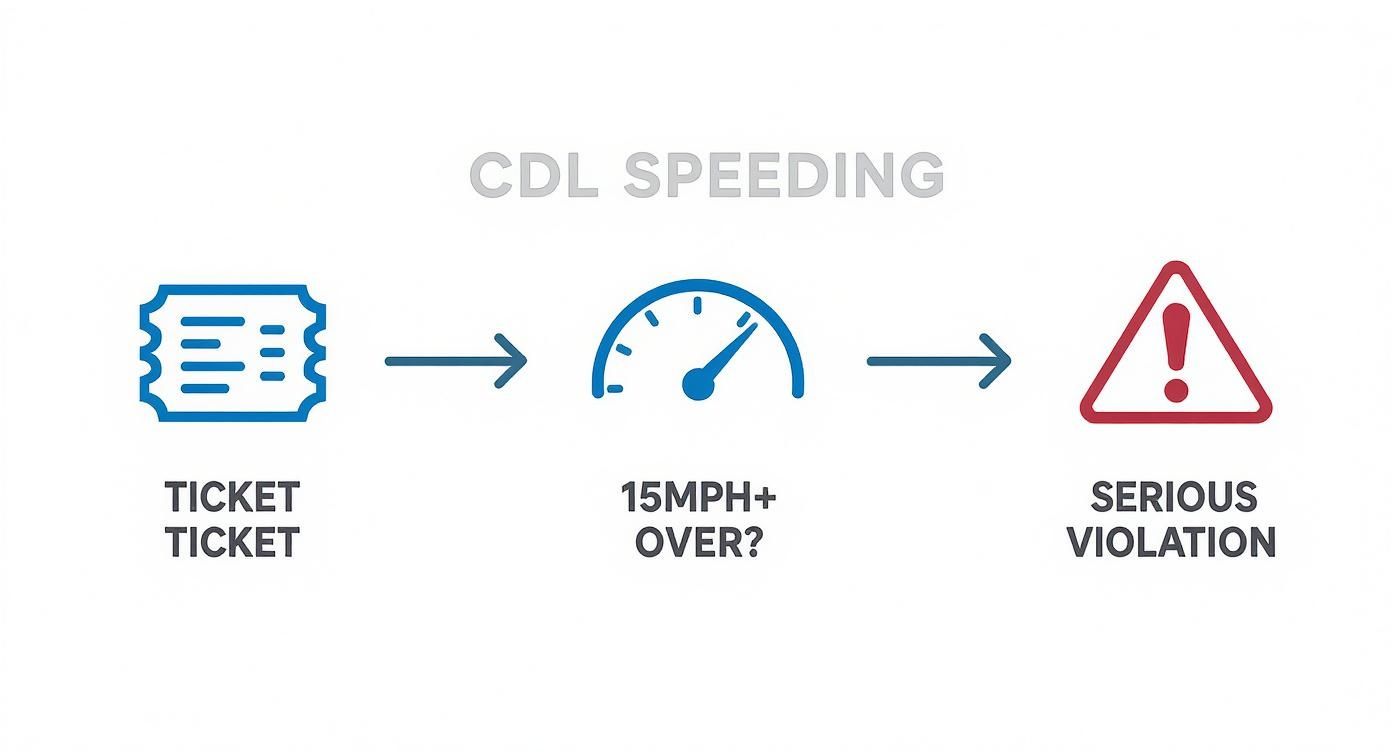
The path is dangerously clear: a ticket for going 15 mph over isn't just a fine. It’s a direct threat to the CDL you worked so hard to earn.
The Two Strikes Rule: 60-Day Disqualification
The first major cliff you can fall off is triggered by your second Serious Traffic Violation within a three-year window. This isn't a slap on the wrist or a warning. It's a mandatory penalty.
If you're convicted of a second serious violation (like two cdl speeding tickets for 16 mph over the limit) within three years, you're facing an automatic 60-day disqualification from commercial driving.
Here’s a real-world example of how it plays out:
January 2024: You get popped for going 72 in a 55 mph zone (17 mph over). You just pay the fine, which counts as a conviction. That’s your first strike.
May 2025: You're cited for doing 41 in a 25 mph zone in your personal car on the weekend (16 mph over). If you get convicted of this one, the game is over.
Those two convictions within three years have just triggered the 60-day disqualification. For two solid months, you are legally forbidden from operating any commercial vehicle. That means two months with zero income from driving—a situation that can put anyone in a serious financial hole.
It's crucial to know that a disqualification is not the same as a regular license suspension. This is a federal-level action aimed squarely at your ability to work as a professional driver. You can get a better sense of how suspensions work by reading our guide on the administrative license suspension hearing process.
The Three Strikes Rule: 120-Day Disqualification
If a third violation happens, the consequences get even more drastic. The entire system is built to take drivers who repeatedly commit serious offenses off the road for good.
Get convicted of a third Serious Traffic Violation in that same three-year period, and the disqualification period doubles. You will be hit with a mandatory 120-day disqualification of your CDL. That's four long months—a third of the year—with no way to earn a living in your profession.
Let's pick up our last scenario:
Your 60-day disqualification is over, and you're finally back on the road.
October 2026: You get another speeding ticket, this time for 80 in a 65 mph zone (15 mph over). A conviction here is your third serious violation since that first one back in January 2024.
That third strike triggers a 120-day disqualification. The financial and professional damage of being sidelined for four months can be catastrophic. It makes it difficult to pay bills and can permanently wreck your relationship with your employer.
This snowball effect is exactly why every single ticket has to be taken seriously. One conviction might not seem like a big deal, but it's the one that sets the stage for much bigger problems down the road. Our goal is to protect your license and record. While past results don't guarantee future outcomes, being proactive is the only way to play the game.
Attorney Advertisement. Office in Broward. Prospective clients may not obtain the same or similar results.
Can You Get or Keep a CDL With Speeding Tickets?
Usually, yes—but the answer depends on what is already on the record and how serious the speeding offense is.
A routine speeding conviction does not automatically mean you are barred from getting a CDL. Many applicants still qualify if the record shows a single ordinary speeding ticket, especially if it did not involve 15+ mph over the limit and did not create a disqualifying history. The more difficult cases are the ones involving repeat serious traffic violations, unresolved suspensions, recent disqualifications, or a record that shows the driver has already crossed a federal threshold.
Keeping a CDL follows the same logic. One conviction can hurt your record, your insurance profile, and your job options without automatically taking the license away that day. The greater danger is accumulation. Under FMCSA rules, a second serious traffic violation within three years can trigger a 60-day disqualification, and a third can trigger 120 days. That is why a driver with one prior serious violation needs to treat the next speeding case very differently from a driver with an otherwise clean history.
In our view, the right question is not just "Can I still get or keep the license?" It is "What exactly is on my record, and does this citation push me into federal disqualification territory?" Severity, timing, prior history, and the final court result all matter.
The Career-Wide Impact of a Conviction

The pain of a CDL speeding conviction doesn’t stop when you pay the fine. In fact, that's often just the first domino to fall in a long-term professional crisis. A conviction sends shockwaves through your entire career, threatening your current job, future opportunities, and your family's financial security.
For any professional driver, a clean record isn't just a "nice-to-have"—it's the foundation of your livelihood. The moment a serious traffic violation lands on your record, you’re no longer seen as a reliable asset. Instead, you become a potential liability in the eyes of employers and insurance companies.
You Have to Tell Your Employer
The first and most immediate hit comes from a rule you can't sidestep: you are legally required to report the conviction to your employer. The Federal Motor Carrier Safety Administration (FMCSA) is crystal clear on this.
You have exactly 30 days from the conviction date to notify your employer of any traffic violation. It doesn't matter if you were in your personal car or where the ticket happened. This isn't optional, and failing to report it is a separate violation that can lead to even more trouble, including getting your CDL suspended.
This single conversation puts your job on the line. Many trucking companies have zero-tolerance policies for serious violations, and a CDL speeding ticket can be more than enough to get you fired.
Job Security and Finding Future Work
Once a conviction is on your driving record, it acts like a permanent red flag for both current and future employers. The entire transportation industry is built on managing risk, and companies can't afford to keep drivers who are statistically more likely to cause an accident.
Here’s a breakdown of how one conviction can derail your career:
Your Current Job: Your employer’s insurance company might jack up the rates on their fleet policy because of your conviction. In some cases, they may even refuse to insure you at all. This forces your employer’s hand, and they may have to let you go, even if they don't want to.
Your Next Job: When you look for a new driving position, a thorough background check of your driving history is guaranteed. That serious violation makes it difficult to compete against a stack of other applicants who have clean records.
Your driving record is your professional resume. A speeding conviction is a major blemish that can lock you out of better-paying jobs and more desirable routes for years.
Historical safety commentary also helps explain why employers react so strongly. One trucking-focused report noted that truck drivers ticketed for speeding were substantially more likely to be involved in a crash, discussed in this crash-risk analysis. Broader industry discussion of recurring truck-driver fines and violations also reinforces why carriers treat these cases as a hiring and retention issue, as summarized by the most common fines and violations for truck drivers: types and description. Whether or not a particular employer cites that number, the insurance and safety logic behind these decisions is easy to see.
The Insurance Rate Explosion
If the employment risks aren't enough, a speeding conviction also delivers a direct hit to your wallet—and your employer's—through skyrocketing insurance premiums. Insurers set their rates based on risk, and a conviction for serious speeding immediately labels you a high-risk driver.
For an independent owner-operator, this could mean a personal insurance hike so big it becomes impossible to turn a profit. For company drivers, the hit is absorbed by the employer, whose fleet insurance costs climb. This makes you a more expensive employee, putting your job in even greater danger.
When you add it all up—the risk of disqualification, the trouble finding work, and the financial squeeze from higher insurance rates—you start to see the true, long-term cost of a single ticket. Our goal is to defend your license and your record to help you avoid this disastrous chain reaction.
Attorney Advertisement. Office in Broward. Past results do not guarantee future outcomes. Prospective clients may not obtain the same or similar results.
Your Strategic Options for Responding to a Ticket
A useful response starts with timing. The goal is not just to avoid paying too quickly; it is to preserve facts, verify whether the allegation crosses the 15-mph threshold, and put yourself in the best position for dismissal, reduction, or damage control.
In our experience, drivers do best when they treat the case in four stages: the first 24 hours, the period before the citation deadline, court preparation, and what to do after the case is resolved.
First 24 Hours: Preserve Facts Before They Fade
Right after the stop, write down everything you can still remember while it is fresh:
exact location, lane, and direction of travel
posted speed limit and where the last visible sign was located
weather, traffic density, road grade, and lighting
what the officer said your speed was and what device was used, if mentioned
whether the officer claimed radar, lidar, pacing, or visual estimation
where the patrol vehicle was positioned and whether your line of sight was blocked by curves, hills, trucks, or merging traffic
Also keep the citation, any warning paperwork, your log of events, and photos of the roadway if they can be taken safely later. If this happened in Florida, confirm the hearing deadline on the ticket immediately. Missing it can eliminate options before the defense even starts.
Before the Citation Deadline: Verify the Real Exposure
Before deciding whether to contest or resolve the case, pin down the facts that control CDL risk.
First, compare the posted limit with the alleged speed on the citation. A lot turns on whether the allegation is 14 over or 15 over. If the officer wrote 80 in a 65, that is not just another speeding ticket for a CDL holder; it may be a serious traffic violation if convicted.
Second, pull your driving history if you are unsure whether you already have a prior serious violation inside the three-year window. One new conviction means something very different to a driver with a clean record than to a driver already carrying one prior strike.
Third, do not assume a personal vehicle case is harmless. A 15-over conviction in your own car can still count under the federal serious-violation framework.
Before Court: Build the Defense File
If you fight the citation, gather the documents that matter:
the citation and any court notice
your CDL and regular license information
employer safety-policy documents if they affect reporting or job status
photos or video of the road, signage, and sight lines
dashcam data, ELD records, or GPS timestamps if they help place you
maintenance, dispatch, or delivery timing documents if they rebut the officer's assumptions
An attorney reviewing the file will usually look for several technical and factual issues:
Calibration records: Was the radar or lidar device tested and maintained as required?
Officer notes and training: Do the notes match the citation, and was the officer qualified to use the device?
Pacing problems: If pacing was used, was the patrol car at a stable distance long enough to support the estimate?
Signage issues: Was the posted limit clearly established, visible, and applicable to that stretch of road?
Line-of-sight issues: Could traffic, terrain, or weather have interfered with identifying the correct vehicle?
Clerical errors: Wrong vehicle details, impossible times, or inconsistent location descriptions may weaken the case.
That does not mean every ticket is beatable. It does mean a CDL holder should know whether the state can prove the speed it charged.
Likely Outcomes: What a Good Resolution Can Look Like
Drivers often ask whether a speeding ticket can be removed from a CDL. The honest answer is: sometimes the result can be improved, but not every case disappears.
Common outcomes include:
Dismissal: possible when the evidence is weak, the officer does not appear, or procedural defects are significant
Reduction to a lower speed: especially important if the allegation can be amended from 15+ over to below the serious-violation threshold
Reduction to a non-moving violation where available: this may help avoid points or lessen record damage, depending on the court and prosecutor
Conviction as charged: still a real possibility if the evidence is solid and no negotiated resolution is available
When we review Florida speeding matters, one of the most valuable shifts is not always a full dismissal. Sometimes the critical win is getting the alleged speed amended below 15 over so the case no longer counts as a serious traffic violation for FMCSA purposes.
After Resolution: Do Not Stop at the Court Result
Once the case is over, confirm exactly how the court recorded it, whether points were assessed, and whether employer reporting is required. Keep copies of the final disposition. If there is a conviction, calendar the 30-day employer-reporting deadline and watch how it interacts with any prior serious violations on your record.
If you want a clearer sense of the practical odds and weaknesses that can matter in these cases, our related guide on the chances of getting a speeding ticket dismissed is a useful next step.
Attorney Advertisement. Office in Broward. Prospective clients may not obtain the same or similar results.
When to Consider Professional Legal Counsel
Getting a CDL speeding ticket can feel like you’ve been thrown into a legal maze with no map. The rules are confusing, the stakes are sky-high, and one wrong turn could jeopardize your entire career. This is precisely when hiring a lawyer stops being an expense and starts being an important investment in your future.
Trying to fight a serious violation yourself is a huge gamble. You’re up against prosecutors and judges who handle these cases day in and day out. Bringing in a professional who focuses on Florida’s CDL regulations levels the playing field.
The Value of a Professional Advocate
A traffic defense attorney knows the system inside and out—the court procedures, the legal arguments that work, and how to negotiate. Their focus is on protecting your license and your record by digging into every last detail of the citation.
Here is what that looks like:
Handling the Headaches: An attorney takes care of all the complex legal work, from filing the right motions on time to showing up in court on your behalf. This lets you stay on the road, focused on your job.
Negotiating with Prosecutors: Many cases are resolved outside the courtroom. A lawyer who handles these matters can often negotiate with the prosecutor to get charges reduced or find other solutions that keep a conviction off your record entirely.
Spotting Weaknesses in the Case: Was the radar gun calibrated correctly? Did the officer follow proper protocol when they pulled you over? An attorney knows exactly what to look for to challenge faulty evidence.
You are a professional at maneuvering an 80,000-pound rig—a skill that took years to perfect. A traffic defense attorney is a professional at navigating the legal system. When your livelihood is on the line, you bring in the right person for the job.
Demystifying the Consultation Process
The thought of calling a law firm can feel intimidating, but the first step is pretty simple. A consultation is just a conversation. You tell us what happened, and an attorney gives you a straightforward assessment of your case and what your options are.
Just submitting your information for a consultation doesn’t lock you into anything. It’s a confidential, no-obligation way to get some clarity. Our practice focuses on traffic matters all over Florida, and our goal is to give you a clear path forward. Fighting a ticket is about so much more than one fine; it’s about protecting your career. To understand more about the process, check out our guide on hiring a Florida speeding ticket lawyer.
Attorney Advertisement. Office in Broward. Past results do not guarantee future outcomes. Prospective clients may not obtain the same or similar results.
Your Top Questions About CDL Speeding Tickets, Answered
When you're a professional driver, the questions usually come down to eligibility, disqualification risk, and whether the damage can be limited. Here are the answers that matter most.
Can You Get a CDL With an Existing Speeding Ticket?
Often, yes. A single ordinary speeding conviction does not automatically prevent someone from getting a CDL. The harder cases involve repeat serious traffic violations, current suspensions, unresolved licensing issues, or a record showing conduct that creates a disqualification under federal or state rules.
The key distinctions are severity, timing, and history. A routine speeding ticket from years ago is very different from a recent 15+ over conviction next to another serious violation within the same three-year period. If you are applying for a CDL and already have tickets on your record, the smart move is to check the exact disposition and whether any offense qualifies as a serious traffic violation rather than assuming all speeding cases are treated the same.
Will One Speeding Ticket Make Me Lose My CDL?
Usually not by itself. One speeding conviction can still be expensive and damaging, but a single serious speeding violation typically does not trigger disqualification on its own. The major federal threshold is the second serious traffic violation within three years, which can lead to a 60-day disqualification. The third within three years can lead to 120 days.
That is why one 15+ over conviction matters so much even when it does not immediately take the license away: it can become the first strike that puts the next case in a much more dangerous position.
What If the Ticket Happened in My Personal Vehicle?
It can still affect your CDL. If the speeding offense is serious enough to qualify under FMCSA rules, such as 15 mph or more over the limit, a conviction in a personal vehicle can count toward the serious-violation disqualification framework. That is a federal rule, not a Florida-only quirk.
Can a Speeding Ticket Be Removed From a CDL Record?
Not automatically, and no attorney should promise that. What can sometimes happen is a better court result: dismissal, reduction to a non-moving violation where available, or amendment to a lower speed that avoids the serious-violation threshold. If the case already ended in a conviction, your options depend on the exact court result, deadlines, and whether there is any legal basis to reopen or correct it.
What Happens If I Get Ticketed in Another State?
That conviction can still follow you home. States share driver-record information, and Florida can receive out-of-state conviction data through interstate reporting systems. For a CDL holder, the practical takeaway is simple: do not assume an out-of-state ticket stays out of your Florida record or outside FMCSA consequences. If it is serious enough and ends in conviction, it can still affect your CDL history. Federal crash-reporting context also helps explain why interstate data-sharing matters; see the NHTSA publication.
A Quick Note on Legal Representation: Submitting information through a contact form on our website does not create an attorney-client relationship. We keep all your details confidential, but we are not officially your lawyers until a formal agreement is signed.
Your CDL isn't just a license; it’s your key to providing for yourself and your family. Paying a speeding ticket is a gamble you can't afford to take. At Ticket Shield, PLLC, we get it. We understand what's at stake for professional drivers, and our practice focuses on navigating the system to protect your record and your career.
Don't let one mistake derail everything you've worked for. Get a free, no-obligation consultation with our attorneys who handle these matters. Our goal is to protect your license and record. You can submit your ticket to us 24/7 at https://www.ticketshield.com.
Action Taken | Potential Positive Outcomes | Potential Negative Outcomes |
|---|---|---|
Pay the Fine | Quick resolution, no court appearance. | Guaranteed conviction, points on your license, potential "Serious Violation" strike, must notify employer, insurance rate increase. |
Fight the Ticket Yourself | You save on legal fees, potential to win if the case is simple. | High risk of conviction without legal expertise, you could miss key procedural steps, may not know how to challenge evidence effectively. |
Hire an Attorney | A lawyer can navigate the legal system for you, increasing the chance of dismissal or reduced charge, protecting your driving record, and potentially avoiding points or conviction. | Upfront cost for legal representation. |