
Traffic Laws in Florida What Every Driver Must Know
Understand traffic laws in Florida, from Chapter 316 statutes and points to penalties and defenses. Protect your license with Ticket Shield guidance.

You're driving home when the lights come on behind you. The citation looks routine, and paying it seems faster than fighting it. That decision can become a license problem, an insurance problem, and a court-compliance problem long after the roadside stop is over.
Florida's traffic laws work as a license-protection system, not merely a schedule of fines. A civil infraction can add points, increase suspension risk, and create consequences that don't appear on the payment screen. Before you pay, understand what the citation means, what Florida's Chapter 316 requires, and whether a lawyer should review the facts.
Table of Contents
Why Florida Traffic Laws Cost More Than the Fine
A ticket's face value is only one part of the exposure. When you pay a Florida traffic citation, you generally resolve it by accepting responsibility rather than creating a defense record. The immediate payment may feel efficient, but the administrative consequences can follow through points, licensing history, and insurance exposure.
That matters because many Florida traffic violations are civil infractions, not crimes. Civil status doesn't make a citation harmless. The Florida Department of Highway Safety and Motor Vehicles explains that Florida's graduated point system can suspend a license when accumulated points reach specified thresholds, even when the underlying conduct never becomes a criminal case. See the state's Florida point suspension guidance for the framework.
Consider a driver who receives a routine moving citation, pays it without reviewing the record, and later receives another citation. The driver may focus on each separate fine while the state tracks the combined point history. The insurer may also evaluate the driving record independently from the court's fine.
Protective rule: Never judge a Florida ticket only by the amount printed on the citation. Judge it by its potential effect on your license and driving record.
The same principle applies after a crash or roadside incident. If you're trying to understand vehicle damage, repair decisions, or documentation after a collision, the Safety Restore collision repair FAQ can help with practical repair questions. That resource doesn't replace legal advice about a citation, but it can help separate the vehicle issue from the traffic-defense issue.
Before you decide whether to pay, review the Florida traffic ticket cost guide. A lawyer-led review gives you a chance to identify point exposure, procedural problems, and defenses that an automated payment app won't investigate. Ticket Shield, PLLC offers direct communication with an attorney by phone or text, rather than forcing you through middlemen, corporate answering services, or automated chatbots.
How Florida Chapter 316 Organizes Traffic Laws
Florida Statutes Chapter 316 is the state's Uniform Traffic Control framework. It organizes roadway rules covering speed, intersections, occupant protection, and driving conduct. You need to classify the citation before choosing a response.

Start with the violation category
A civil traffic infraction is generally handled through a citation, fine, and administrative consequences such as points. Routine speeding commonly falls into this category. It may not expose you to jail, but it can still affect your license and insurance position.
A criminal traffic offense requires a different response. Florida Statute § 316.192 addresses reckless driving, which can become a misdemeanor when the required conduct is proven. Criminal exposure changes the stakes because the case involves more than an administrative driving record.
That distinction also affects how you should communicate with the court and evaluate evidence. A civil citation may involve speed measurement, signage, officer observations, or intersection facts. A criminal allegation requires careful attention to the statutory elements and the prosecution's proof.
County procedures still matter
Florida traffic laws apply statewide, but your citation moves through a local system. Enforcement and courthouse administration operate across all 67 Florida counties, and filing practices, hearing logistics, deadlines, and clerk procedures can vary by location. A citation connected to Miami-Dade is handled through a different local courthouse system than one connected to Duval or another county.
You should also separate moving violations from non-moving or equipment-related matters. A moving violation can create point exposure because it concerns driving behavior, while an equipment or compliance issue may follow a different path. The citation language, statute number, and disposition control the analysis.
For a practical overview of the governing framework, review Florida state traffic laws and statutes. Don't assume that a non-criminal label means you can safely pay without consequences. Florida's administrative system can affect your driving privilege even when the courtroom never discusses jail.
Speeding and Reckless Driving Under Florida Law
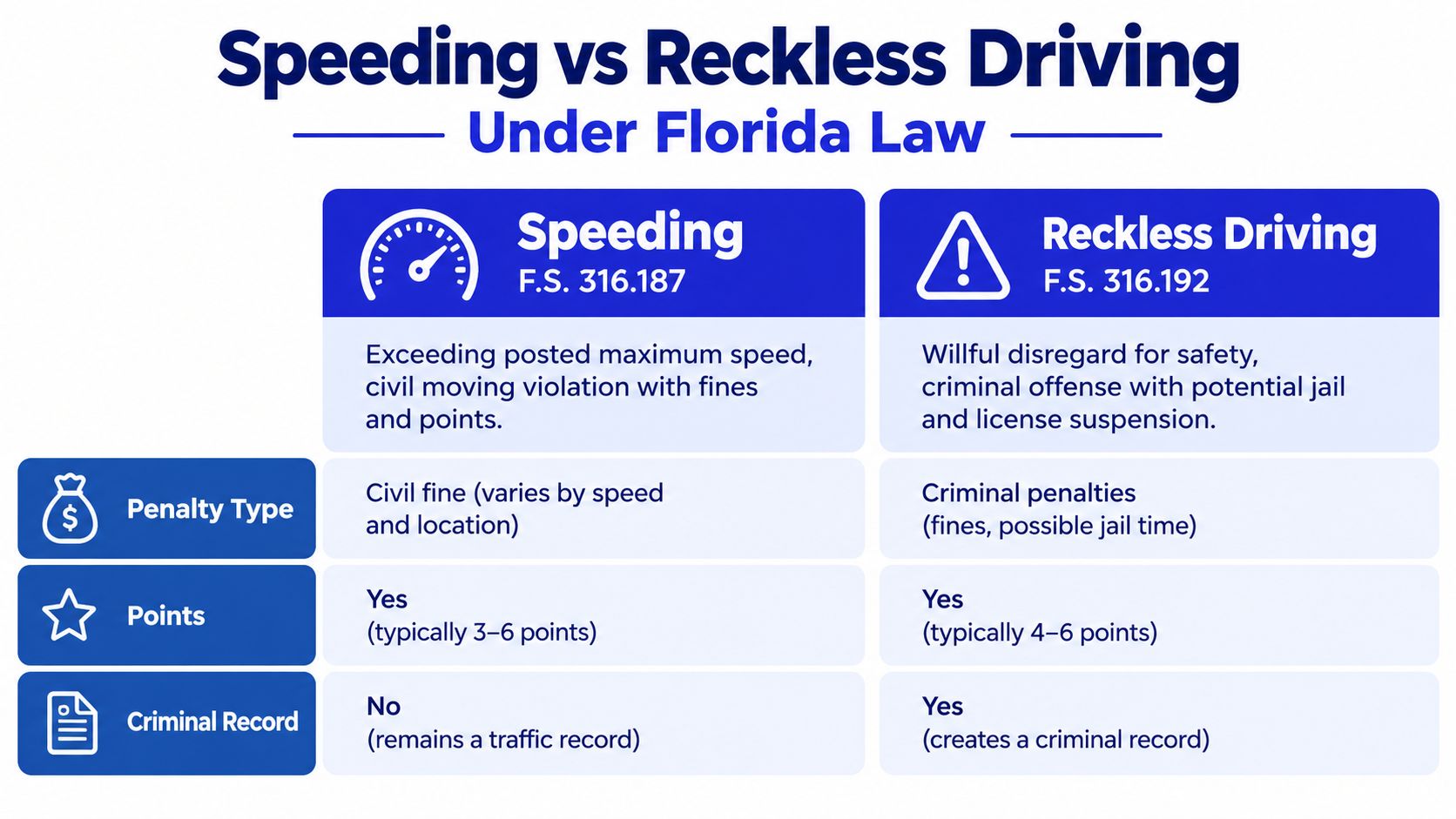
A high-speed stop can begin as a civil ticket and endanger your license before criminal charges appear. Florida separates ordinary speeding from reckless driving, and the difference affects points, court exposure, insurance consequences, and your driving privilege. Reckless driving creates criminal exposure under Florida Statute § 316.192.
Florida Statute § 316.187 sets maximum lawful roadway speeds. If an officer says you exceeded the posted limit, the citation usually proceeds as a civil moving violation, with financial and point consequences. Review the alleged speed, posted limit, measurement method, roadway conditions, and whether the citation correctly identifies the location and conduct before choosing a disposition.
Why the classification matters
Reckless driving requires more than a claim that you drove fast. Section 316.192 addresses driving with willful or wanton disregard for the safety of people or property. A first conviction can carry up to 90 days in jail and a fine of up to $500, under the statutory framework in Florida Statute § 316.192.
The criminal classification can affect your record, court obligations, and license status. Do not treat a high-speed stop as an automatic payment decision. Prosecutors and courts may consider speed with traffic, roadway conditions, evasive actions, and the officer's account of your driving.
News reporting identified 4,964 Super Speeder citations issued by August 24, 2026, showing active enforcement of high-speed allegations. The figure is tied to that reported date, so treat a Super Speeder citation as a matter for prompt legal review, not a ticket to pay without analysis.
If your citation raises criminal-speed questions, read what criminal speeding can mean in Florida. Then give a Florida traffic lawyer the citation, measurement details, and court deadline before admitting the violation.
Florida Point System and License Suspension Risks
A routine moving citation can threaten your license long before a criminal case begins. Florida adds points for qualifying violations, tracks them across rolling time windows, and can suspend your driving privilege when the total reaches a statutory threshold.
Points and Window | Suspension Period | Practical Impact |
|---|---|---|
12 points within 12 months | 30 days | A routine moving-violation pattern can temporarily remove your driving privilege. |
18 points within 18 months | 3 months | Continued accumulation creates a longer interruption and greater administrative pressure. |
24 points within 36 months | 1 year | Repeated violations can produce a significant license-suspension problem. |
Florida's point-suspension framework is also reflected in local clerk guidance at the Miami-Dade suspended license page. The timing controls the risk. A ticket that appears manageable alone can trigger suspension after it is added to earlier moving violations that remain within the applicable window.
Count the risk before you respond
Check your current driving record and list every unresolved citation. Confirm whether the new ticket is a moving violation, whether it carries points, and whether the proposed resolution affects your license. A payment portal, clerk, or automated app will not assess your complete record or protect your driving privilege.
Act before the deadline.
Insurance costs can rise before you reach a suspension threshold. Insurers may review reported violations and adjust coverage even when the state has not suspended your license. Point avoidance therefore protects both your license and your finances.
Use this Florida license points explanation to review how violations can affect your record. If the citation could bring you near a rolling threshold, have a Florida traffic lawyer examine the ticket and available options before you admit the violation. Direct legal review gives you a record-focused assessment instead of the impersonal guidance offered by a ticket mill.
School Zones Stop Signs and Seat Belt Rules You Must Follow
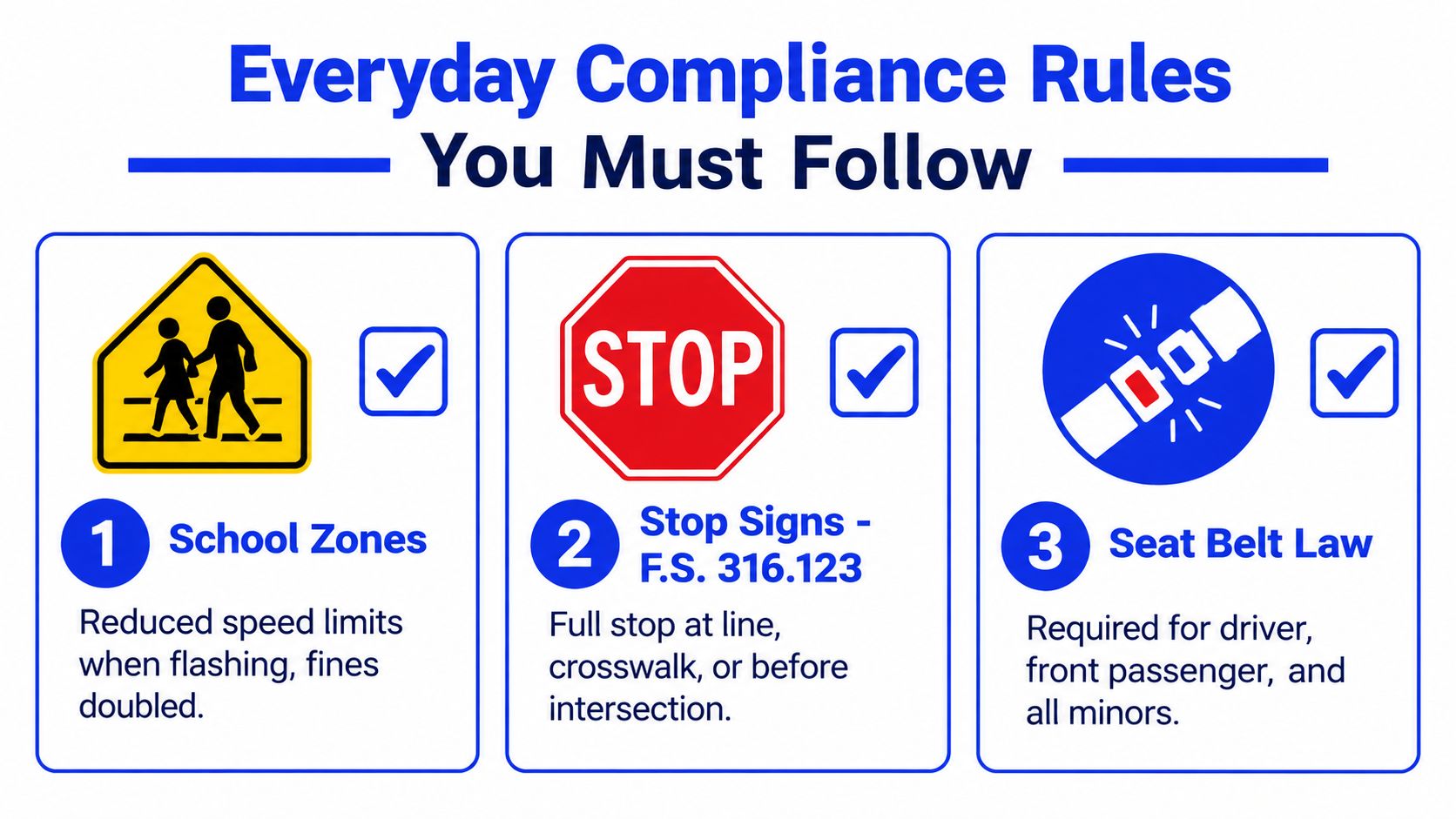
Everyday compliance rules generate serious exposure because drivers often underestimate how precisely Florida writes them. School-zone timing, stop-sign positioning, and seat-belt requirements all sit inside Chapter 316's traffic-control structure.
Stop signs require a complete stop
Florida Statute § 316.123 requires you to stop at the marked stop line. If there isn't a line, stop before entering the crosswalk. If there's no crosswalk, stop at the nearest point where you can see approaching traffic before entering the intersection.
After stopping, yield to a vehicle already in the intersection or to one approaching closely enough to create an immediate hazard. At a four-way stop, the first vehicle to stop proceeds first. If two vehicles arrive at the same time, the driver on the left yields to the driver on the right. Read the statutory rule in Florida Statute § 316.123.
School zones demand attention to timing
Florida Statute § 316.1895 authorizes school-zone enforcement during the regularly scheduled school session and within 30 minutes before and 30 minutes after the start and end of the school session. Florida Statute § 316.1896 treats school-zone speeding as a moving violation and doubles the base fine for speeding in a school zone or designated school crossing.
The statute also specifically targets speeds more than 10 mph over the school-zone limit during the defined school-time window. Sign placement, active timing, measured speed, and the applicable limit can therefore become central defense issues. Keep the citation, note the exact location, and document what signs were visible if you believe the allegation is inaccurate.
Seat belts remain a core Chapter 316 rule
Florida Statute § 316.614, the Florida Safety Belt Law, establishes seat-belt requirements within Chapter 316. The statute reflects Florida's broader approach, which treats occupant protection and equipment compliance as part of the uniform traffic code alongside speed and intersection rules. Review the Florida Chapter 316 statutory index for the placement of the Safety Belt Law within that framework.
How to Defend a Florida Traffic Ticket and Protect Your Record
You have two broad paths after receiving a Florida traffic ticket. You can pay and accept the resulting disposition, or you can seek a defense that may pursue dismissal, reduced consequences, or avoidance of points when the facts and law support it.
Paying is simple, but simplicity isn't the same as protection. Before choosing that route, ask:
Point Exposure: Will the disposition place points on your license?
Record Effect: Will the citation remain relevant to future licensing or insurance decisions?
Deadline Control: What happens if you miss a response date or hearing?
Evidence Review: Can the speed measurement, signage, officer observations, or citation details be challenged?
License Status: Could the matter combine with prior violations or an existing suspension issue?
Failure to appear or comply can create a separate administrative problem. Florida law allows suspension for failing to appear or comply with a traffic violation, and reinstatement may require clearing court obligations plus paying a $60 service charge. The broader reinstatement framework appears in Florida Chapter 318, alongside requirements tied to Chapter 322.

Choose direct legal communication
Ticket Shield, PLLC is a lawyer-led Florida traffic defense firm serving all 67 Florida counties. Clients can communicate directly with their attorney by phone or text, rather than relying on a ticket mill's middleman, corporate answering service, or automated chatbot. The firm handles matters through major courthouses including Miami-Dade, Broward, Palm Beach, Hillsborough, Orange, and Duval.
The firm states that over 99% of its clients avoid court appearances, while its attorneys pursue outcomes such as reduced fines, point avoidance, and dismissals when available. Services start at $39.99, according to the publisher information, and the practical value is early legal review before a payment or missed deadline limits your options.
For a broader explanation of response choices, review how to handle a Florida traffic ticket. You shouldn't surrender control of your license to an automated workflow that doesn't know your driving history or communicate with you like a lawyer.
Protect Your License Today With Ticket Shield
Florida traffic laws punish delay in practical ways. A citation can add to an existing point history, create a missed-compliance suspension, or complicate reinstatement before you realize the original ticket has become a larger problem.
Review the citation now. Confirm the statute, deadline, county, alleged speed or conduct, and any facts that may support a defense. If the matter involves a school zone, stop sign, high-speed allegation, or prior points, don't make a payment decision without understanding the administrative consequences.
Ticket Shield, PLLC provides lawyer-led Florida traffic defense, direct attorney communication by phone or text, and coverage across all 67 counties. The service is designed to be cost-effective and value-driven, with representation starting at $39.99, while the strategic objective is clear, protect your license and pursue No Points when the law and facts allow it.
Visit Ticket Shield, PLLC for a free consultation about your Florida traffic ticket. Speak directly with a lawyer by phone or text, and take immediate action toward the ultimate goal of achieving “No Points” on your license.

