Traffic Ticket in Florida: Your Complete Defense Guide
Got a traffic ticket in Florida? Learn your options, fines, points, and how to protect your license and insurance rates with strategic legal defense.

You got pulled over in Florida, the lights flashed behind you, and now the citation is sitting in your hand. Maybe the officer said it was “just a ticket.” It isn't. In Florida, a traffic ticket in Florida can turn into points, insurance pain, and a suspension problem if you ignore the decision in front of you.
You have to treat the next move like a legal decision, not a convenience decision. Paying it fast can feel clean, but that choice can lock in a conviction, and Florida's point system is built to punish the wrong move for years. If you want to protect your license and keep your record from carrying unnecessary damage, you need to read the ticket, know the deadline, and act with a plan.
Table of Contents
The Moment You See Those Red and Blue Lights
The stop starts the same way for a lot of people. You're driving home, the officer walks up, and within minutes you're holding a citation that demands a response. That paper is not the end of it. It's the start of a clock that can affect your driving record, your insurance, and your license.
A traffic ticket in Florida is never just about the amount printed on the notice. The state's own guidance says drivers generally have 30 days to respond, and that deadline forces a choice that many drivers don't make carefully enough. Florida traffic citation guidance makes the timing clear, and that timing is where people lose advantage.
Practical rule: Do not treat the citation like a parking receipt. Treat it like a legal deadline.
If you want a plain-English walk-through of what happens during a stop, read this Florida traffic-stop guide. It helps you understand why the citation you got on the roadside can carry consequences that show up later in court records and insurance underwriting.
The immediate question is simple, but the answer isn't. Do you pay, request school, or fight it? Each choice has different fallout, and the wrong one can be more expensive than the ticket itself. The smart move is to stop thinking about the fine and start thinking about the conviction record.
Florida traffic enforcement is built for volume, not sympathy. More than 3 million traffic citations were issued statewide in 2024, and that was a 5.6% increase over 2023, according to the Florida Highway Safety and Motor Vehicles' numbers summary. FHSMV citation data shows how routine enforcement is across the state, which is exactly why your case deserves a serious response.
Florida Traffic Citations by the Numbers

Florida is a high-citation state. The point isn't just that tickets happen, it's that they happen everywhere, in every county, all the time. When more than 3 million traffic citations are issued in one year, as FHSMV reported for 2024, you're looking at a statewide enforcement system that touches ordinary drivers, commuters, and commercial operators alike. FHSMV citation data
Speeding drives the system
Speeding is the offense that keeps showing up. In 2024, Florida drivers received about 744,082 speeding citations, which made speeding the largest single violation category and roughly one-quarter of all traffic citations that year. Florida speeding citation reporting also tied that category to a major enforcement spike in 2025, when speeding tickets rose by 29% from 2024 and reached nearly 1 million citations.
That matters because speeding tickets are the gateway to points, insurance trouble, and repeat stops. Miami-Dade alone issued 93,891 speeding tickets in 2024, up from 77,482 in 2023 and 71,381 in 2022, which the reporting described as a 32% increase over two years. Florida speeding citation reporting shows that this isn't some abstract statewide trend. It's a daily reality for drivers in major counties.
Florida Statute Chapter 316 gives the legal backbone for many of these tickets. Section 316.074(1) requires obedience to traffic control devices unless a police officer directs otherwise, and Section 316.123(2)(a) requires a driver approaching a stop sign to stop at the marked stop line, or before entering the crosswalk or intersection if no stop line is marked. Chapter 316 text is the rulebook behind many common stop-sign and signal cases.
The fine depends on speed, not excuses
Florida's statutory base fines are set by speed bracket. That means the exact speed alleged matters. The law sets $25 for 6 to 9 mph over, $100 for 10 to 14 mph, $150 for 15 to 19 mph, $175 for 20 to 29 mph, and $250 for 30 mph and above. Going 1 to 5 mph over is only a warning, and speeding up to 5 mph in a legally posted school zone is a $50 fine. Florida speeding statute
Bottom line: The speed number on the citation is not trivia. It changes the financial exposure and, in many cases, the legal strategy.
If your ticket involves a traffic-control device issue, the statute matters just as much as the officer's narrative. Don't let a stop-sign or red-light citation get treated like a harmless paperwork problem. The law says exactly what conduct is required, and that precision is what a defense lawyer uses to challenge a weak case.
For a closer look at how points work after a citation, use this Florida point-system guide. It connects the citation to the record consequences people usually miss at the roadside.
Your 30-Day Window and Three Legal Options
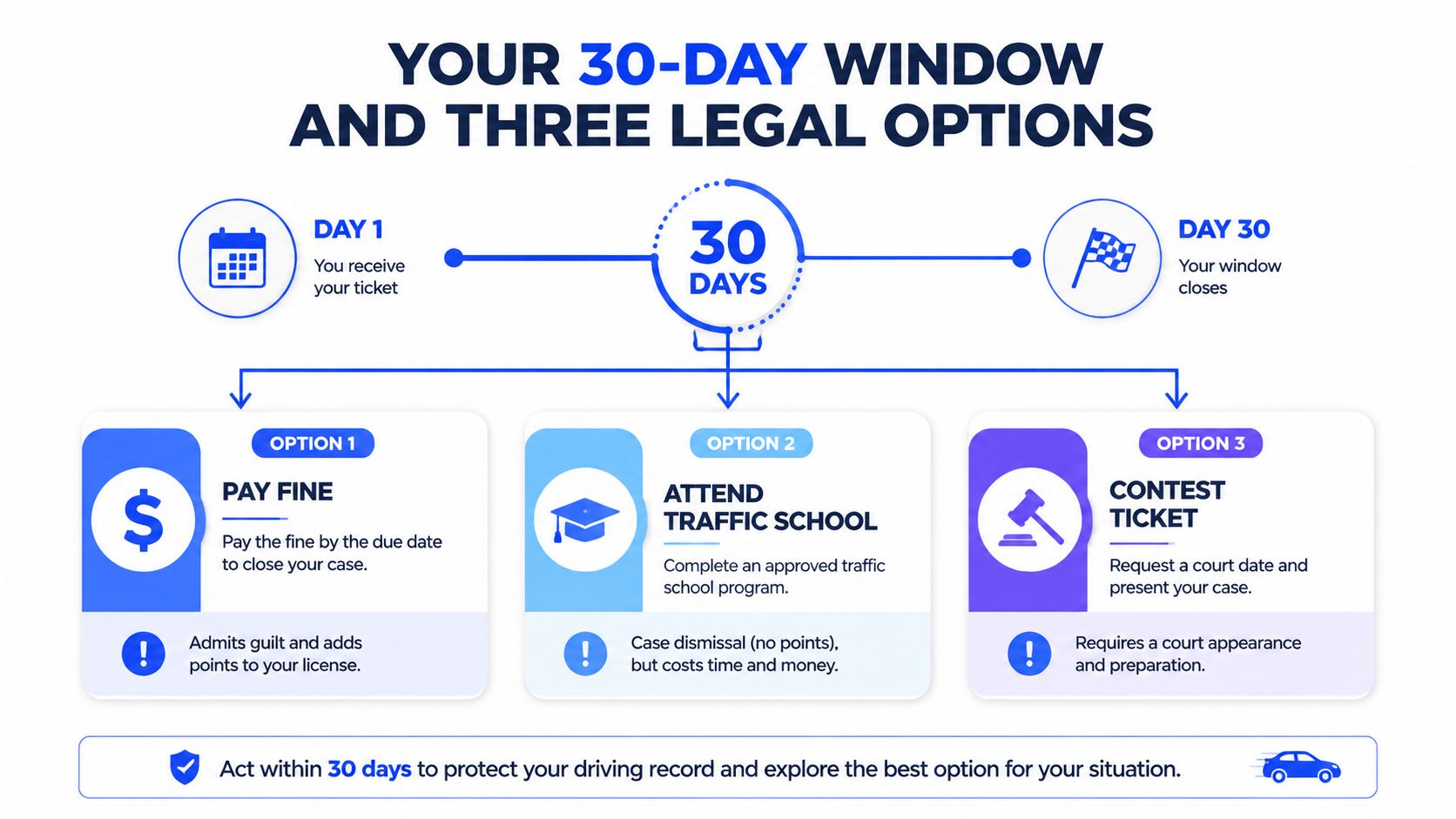
The day the citation is issued, the clock starts. Florida guidance confirms the 30-day window to respond, and that window is where people either protect themselves or accidentally admit liability. Florida traffic citation guidance is blunt about the deadline. You should be, too.
Pay, school, or fight
You only have three real paths.
Pay the ticket. That usually means accepting the violation and moving on with a conviction record.
Elect a Basic Driver Improvement Course. Florida guidance says that route can reduce the fine by 18%, and clerks say it can lead to adjudication being withheld so points aren't assessed if the course is completed properly. Florida traffic citation guidance and Miami-Dade Clerk traffic infractions page explain the mechanics.
Request a hearing and contest the ticket. That takes more effort, but it's the only path that can fully attack the citation itself.
If you choose traffic school, Florida clerks also say you can get an additional 30 to 60 days to complete the course after the affidavit and payment are filed. Miami-Dade Clerk traffic infractions page also notes that some counties offer payment plans and different submission methods, which can matter if cash flow is tight.
Practical rule: Don't choose the easiest option. Choose the option that causes the least long-term damage.
Some drivers need more time, not less. That's why this Florida ticket-response guide is worth reading before you send money or click a checkbox. The wrong election can narrow your options and lock in consequences you could have avoided.
Use the deadline as leverage, not panic
The deadline matters because it forces a strategic decision. If you already have points, a commercial license, or a history of tickets, a quick payment can be the worst possible move. If your record is clean and the allegation is minor, the right answer might be different. That's why the choice has to be based on your whole record, not the citation alone.
County procedures can vary on filing and payment logistics, but the legal effect of your response is what matters most. You're not just clearing a court date. You're deciding whether the matter becomes part of your driver history. That's a legal fork in the road, and it should be handled like one.
The Real Cost Is Points and Insurance Spikes
Most drivers obsess over the fine. That's a mistake. The fine is often the smallest part of the bill. The bigger hit comes from points, suspension thresholds, and the way an insurer prices your risk after a conviction.
Florida's point system is built to escalate
Common moving violations such as speeding carry 3 points, reckless driving carries 4 points, and leaving the scene of a crash with property damage can carry 6 points. Once the points stack up to 12 in 12 months, the state can impose a 30-day suspension. At 18 points in 18 months, that becomes 3 months. At 24 points in 36 months, it becomes 1 year. Florida points and suspension rules
Florida also keeps points on the driving record for at least five years from the disposition date. Florida points and suspension rules means the ticket doesn't vanish after the fine clears. It sits there long enough to matter when you renew insurance, apply for jobs, or get stopped again.
Florida Point System and Suspension Thresholds | |||
|---|---|---|---|
Violation Type | Points Assessed | Accumulation Threshold | Suspension Length |
Common moving violation, including speeding | 3 | 12 points in 12 months | 30 days |
Reckless driving | 4 | 18 points in 18 months | 3 months |
Leaving the scene of a crash with property damage | 6 | 24 points in 36 months | 1 year |
If you're trying to understand how a ticket can snowball into a money problem, the conversation around the cost of insurance increases after a Florida speeding ticket is the right one to have. Insurance carriers don't care that the citation felt minor. They care that the conviction signals risk.
Insurance follows the conviction, not the excuse
A lot of drivers try to explain the ticket away as bad luck or a one-time lapse. Insurers don't underwrite on feelings. They underwrite on records. Once points hit the file, the premium conversation changes at renewal, and that change can last well beyond the day you paid the citation.
There's a useful analogy in a completely different context. The DME Superstore installation insights show how a base purchase price can mislead buyers when the actual cost includes setup, labor, and follow-on expenses. Traffic tickets work the same way. The fine is the purchase price. The actual cost is the downstream burden.
Practical rule: If the ticket creates points, you're not comparing fines anymore. You're comparing long-term cost.
That's why a strategic defense matters. A clean outcome can keep the record cleaner, reduce the insurance fallout, and preserve your license position before the points ever harden into a suspension threat. A quick payment does the opposite.
Why a Dedicated Attorney Beats Automated Apps
A ticket mill can process paperwork. It can't think like a lawyer. If your goal is to minimize damage, you need someone who can read the citation, look at the officer's version, and decide whether the case should be challenged, negotiated, or narrowed. That takes judgment, not automation.
Direct lawyer contact changes the case
Ticket Shield, PLLC is a lawyer-led Florida traffic defense firm where clients speak directly with their attorney by phone or text. That matters because a real attorney can spot a procedural issue, map the case to the driver's record, and push for the outcome that protects the license instead of just closing the file. Automated apps can't do that. They can only move forms through a pipeline.
Florida traffic cases are handled statewide, and the firm serves all 67 counties, including major jurisdictions like Miami-Dade, Broward, Palm Beach, Hillsborough, Orange, and Duval. That broad coverage matters because local practice still matters. A case in one county can feel very different from a case in another courtroom.
Court strategy beats generic processing
A dedicated lawyer can negotiate with the prosecutor, attack weak evidence, and tailor the approach to the driver's history. That's the difference between a faceless intake system and actual legal strategy. In traffic cases, that difference often determines whether the record gets points or stays cleaner.
Watch the comparison here.
If you want a quick way to compare your options before you commit to a path, read this speeding-ticket defense resource. It reinforces the basic point. A one-size-fits-all app can't adapt to your record, your county, or the consequences hanging over your license.
My advice: If the outcome affects your driving privilege, don't hand the file to a chatbot.
The Domino Effect of Simply Paying Your Ticket
Paying the ticket feels efficient because it ends the conversation. It also ends your chance to fight the conviction. That's the part most drivers miss. The moment you pay, you can trigger points, insurance consequences, and a record that follows you much longer than the citation date.
The record problem doesn't stop at the cashier
A paid citation can become a conviction record, and that record doesn't stay quiet. It can surface when insurance renews, when employers review driving history, or when another citation lands and your prior record starts to matter more. If you drive for work, that risk gets real fast.
Commercial drivers and professional drivers feel this harder because a clean record isn't optional for them. Out-of-state visitors feel it too because they can't always come back to Florida and deal with the ticket casually. A remote or rushed payment can be the least thoughtful option on the table.
The smarter comparison is not fine versus no fine
The smarter comparison is today's payment versus tomorrow's fallout. That fallout can include points, insurance increases, and, if the record keeps stacking, the suspension thresholds listed above. Once you see the chain reaction, paying blindly stops looking like a shortcut.
For a separate example of how a formal claim process can protect value when an initial offer falls short, the idea of invoking the appraisal clause for a fair result is a useful analogy. You don't accept the first number just because it's easiest. You test it when the long-term stakes are high.
Bottom line: A ticket paid too fast can cost far more than the citation amount.
The same is true for any driver who already has points. One more moving violation can push the record into suspension territory, and then the problem becomes much bigger than a single ticket. That's why fighting it, when the facts support it, is often the right move.
Protect Your License and Record Today
You do not need to guess your way through a Florida traffic citation. You need a plan that protects your record, your license, and your insurance position before the 30-day window closes. The threat is not the paper in your hand. It's the long-term damage that follows a bad decision.
Ticket Shield, PLLC handles Florida traffic cases with direct attorney communication, transparent pricing starting at $39.99, and a focus on keeping drivers out of the point trap. The firm's goal is straightforward, No Points on your license whenever the facts and the law support that result. If you're staring at a citation right now, stop waiting and get the ticket reviewed before you lock in the wrong outcome.
Visit Ticket Shield, PLLC now for a free consultation and get a lawyer-led plan aimed at No Points on your Florida license. The 30-day clock is already running, and the sooner you act, the stronger your defense can be.