What Is a Traffic Stop? A Florida Driver's Guide
What is a traffic stop in Florida? Learn your rights, the officer's powers, and the steps to take to protect your record. Ticket Shield offers expert defense.

TL;DR: A traffic stop is a legal seizure, not a casual roadside chat. In Florida, you must provide your license, registration, and insurance. You should not volunteer answers, consent to searches, or guess your way through it. Protect yourself early.
Blue and red lights hit your mirror. Your chest tightens. Your mind starts racing through everything you might have done wrong.
That reaction is normal. What matters next is whether you treat the stop like the legal event it is.
A lot of drivers don't. They talk too much. They apologize. They explain. They agree to things they didn't have to agree to. Then they find out later that a “routine” stop turned into a citation, a criminal charge, a license problem, or evidence for a bigger case.
That's why this matters. What is a traffic stop? It's one of the most common police-citizen encounters in the country. In 2020, an estimated 7% of U.S. residents age 16 or older experienced a traffic stop, according to the Bureau of Justice Statistics report on police contacts in 2020. Common does not mean harmless.
In Florida, the consequences can move fast. A simple stop can lead to points, higher insurance, a suspension issue, a court date, or a criminal allegation if the officer claims to see or smell something. If the officer hands you a citation and asks for a signature, understand what that does and does not mean before you act. We address that directly in our guide on whether you have to sign traffic tickets.
You need a plan for the moments after the officer says, “license and registration.”
Not a guess. Not advice from a friend. Not a chatbot.
Table of Contents
The Moment Blue and Red Lights Fill Your Mirror
The stop starts before the officer reaches your window. It starts the second you realize you're being pulled over.
Your first job is simple. Get off the road safely. Don't slam on the brakes. Don't keep driving as if nothing happened. Signal, pull over when it's safe, and act like every movement will be watched and interpreted.
That's because it will be.
An officer approaching your car is assessing risk immediately. Your hands, your posture, your tone, your speed in reaching for documents, whether passengers are moving around, whether you're digging under a seat, whether you're arguing before the first question is even finished. Drivers hurt themselves legally in these first seconds all the time.
Why the first minute matters
Most drivers think the dangerous part is the ticket itself. It isn't. The dangerous part is the gap between panic and impulse. That's where people start talking.
Practical rule: Give the officer what Florida law requires. Give nothing extra unless your lawyer tells you to.
If you drive in Florida, you should know the name of the game under Chapter 316. The stop often starts with an alleged moving violation or equipment issue. One common example is failure to obey a traffic control device under Florida Statute 316.074. Another is speed under Chapter 316. Once the officer claims a lawful basis for the stop, every word that follows can matter.
This is why I tell drivers the same thing every time. Be cooperative. Be calm. Be disciplined. Don't confuse politeness with self-exposure.
What panic makes drivers do
Panic makes drivers say things like:
“I know I was speeding.” You just handed the officer an admission.
“I only had two drinks.” You just made a DUI stop worse.
“Go ahead and search. I've got nothing to hide.” You just gave away a major protection.
“I'm late and I didn't see the sign.” You just supplied facts the state can use.
Silence is not disrespect. Control is not resistance. You can be courteous without helping build the case against you.
What Legally Defines a Traffic Stop in Florida
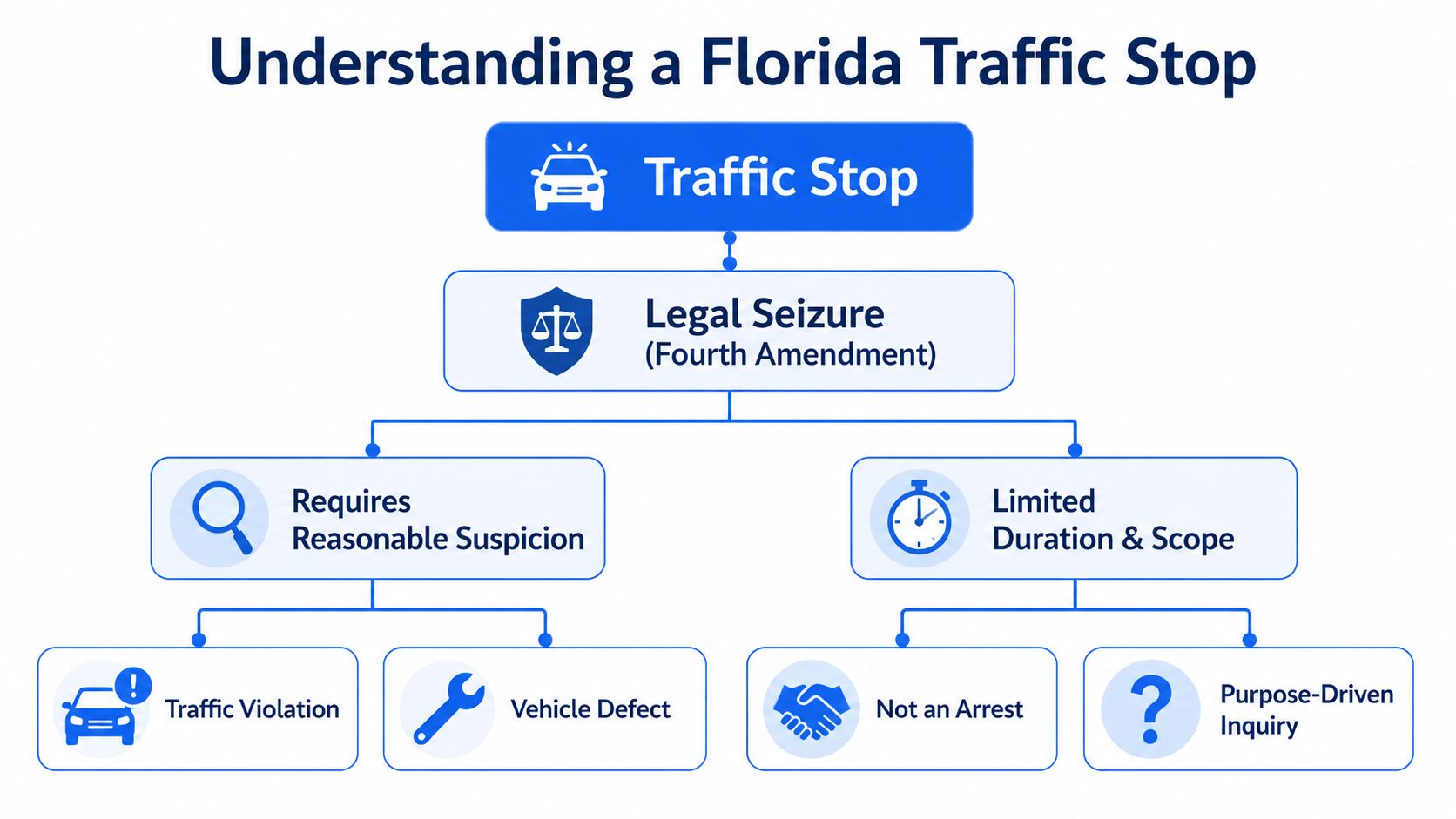
A traffic stop is not small talk on the shoulder. It is a Fourth Amendment seizure of you and your vehicle, and it must be supported by at least reasonable suspicion that a traffic or administrative violation occurred, as explained in the Cornell Legal Information Institute entry on traffic stops.
That legal definition changes everything. It tells you this encounter has rules, limits, and consequences.
Why this is a seizure
Once the officer activates emergency lights and detains your vehicle, you are not free to ignore the encounter and drive off. The law treats that restraint seriously. The officer can request identification and driving documents as part of the stop's administrative purpose.
That is why your roadside behavior has to be measured. You are inside a formal law-enforcement event, even if the officer sounds relaxed.
A calm tone from the officer doesn't make the stop informal. It only makes it easier for drivers to talk themselves into trouble.
What gives an officer legal cause
The standard is lower than an arrest. The officer doesn't need proof of a separate crime to initiate the stop. The officer needs a lawful basis tied to a traffic or vehicle issue.
In Florida, that often means an alleged Chapter 316 violation. A simple example is Florida Statute 316.074, which requires obedience to traffic control devices. If an officer says you rolled through a stop sign, ran a red light, or ignored a posted instruction, the officer will claim legal cause for the stop based on that observation.
Here is the practical breakdown:
Issue | What it means for you |
|---|---|
Observed traffic violation | The officer will claim the stop started lawfully |
Equipment or vehicle defect | The officer may use the defect as the basis for contact |
Administrative issue | Registration, licensing, or similar matters can justify the stop |
If you hold a commercial license or you're training for one, a stop can carry extra professional consequences. Drivers in that position should understand both the legal exposure and the employment risk. For that reason, resources like Patriot CDL's Florida programs can help drivers understand the commercial side while counsel handles the citation side.
And if you want the Florida-specific difference between a standard citation and a civil violation, review our explanation of what is a traffic infraction.
Your Rights Versus an Officer's Powers
Drivers often get confused. They assume every question is mandatory and every request must be accepted. That's wrong.
There is a hard line between what you must do and what the officer may ask you to do.
A public-safety rights guide from Notre Dame explains the core rule clearly. You must provide documents and identify yourself, but you are not required to answer incriminating questions or consent to a search without a warrant or probable cause, as outlined in this guide to your rights and responsibilities during traffic stops.
What you must do
These are the basics. Handle them cleanly and without attitude.
Provide identification: If you're driving, expect to hand over your driver's license.
Provide vehicle documents: Registration and proof of insurance are part of the standard request.
Follow lawful safety commands: If the officer directs you about where to keep your hands or whether to stay in the car, comply physically and calmly.
Speak respectfully: You don't need to be chatty. You do need to be controlled.
What you should never volunteer
You are under no obligation to help the officer investigate beyond what the law requires.
Do not volunteer:
Travel details: Where you're coming from or where you're headed.
Admissions: Speeding, drinking, texting, being distracted, being tired, or “not seeing” the sign.
Consent to search: If the officer asks, “You don't mind if I take a look, right?” that is not a command. It is a request.
Nervous filler: Drivers talk to fill silence. That silence is safer than your explanation.
Use short, respectful language instead.
“Officer, I'll provide my documents. I'm choosing not to answer questions.”
“I do not consent to any searches.”
Those two sentences can protect you from a lot of damage.
A useful way to think about it
Use this comparison:
Officer says | Your legal position |
|---|---|
License and registration | You should comply |
Where are you coming from | You can decline to answer |
Have you had anything to drink | You can decline to answer |
Mind if I search the car | You can refuse consent |
This issue matters in other enforcement settings too, including checkpoint stops. If you want a related Florida-specific read, review our guide on DUI checkpoint legality.
The Traffic Stop Protocol You Must Follow
Good roadside behavior protects two things at once. It protects your safety and it protects your legal position.
The officer is watching for threats, sudden movements, and signs of impairment. You should assume every reach, glance, or interruption can be misread. That is why your protocol needs to be deliberate, not improvised.
A general law-enforcement overview explains that keeping your hands visible, avoiding sudden movements, and staying in the vehicle unless directed lowers officer uncertainty and reduces the probability of escalation during first contact, as described in this traffic stop guidance overview.
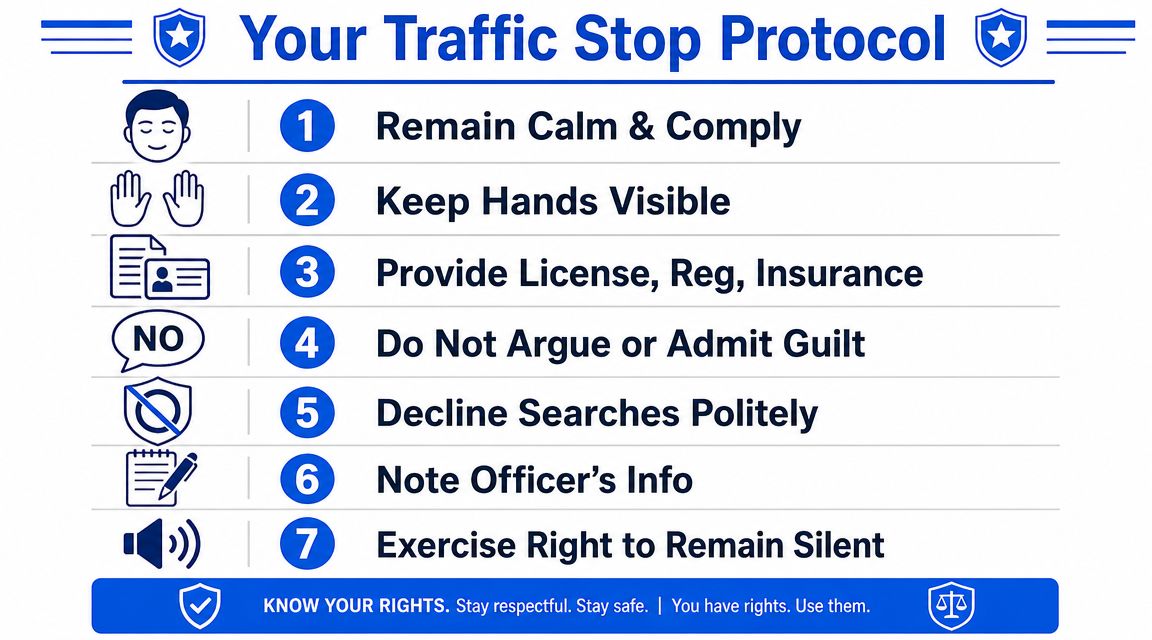
Here is the checklist I want Florida drivers to follow.
Immediate steps to take
Pull over safely: Use your signal. Stop where the officer can approach without stepping into traffic.
Turn on interior lights at night: Help the officer see inside the car.
Place your hands where they can be seen: On the wheel is usually the safest choice.
Wait before reaching: Don't dig for papers while the officer is still walking up.
Tell the officer before moving: If your registration is in the glove box, say that before you reach.
Keep passengers calm: Passenger movement raises tension fast.
Stay in the vehicle unless told otherwise: Don't create unnecessary friction.
This video gives a quick visual reminder of how a stop typically unfolds.
How to speak without hurting your case
Your tone should be calm. Your answers should be minimal.
Use this script:
Greeting: “Good evening, officer.”
Documents: “My license is in my wallet. My registration is in the glove box.”
Question boundary: “I'm choosing not to answer questions.”
Search boundary: “I do not consent to a search.”
End of contact: Take the paperwork. Leave argument for court, not the shoulder.
If you receive a citation, read it carefully before you leave. Small details matter later. Our guide on how to read a traffic citation can help you spot issues that deserve immediate review.
The Four Paths a Traffic Stop Can Take
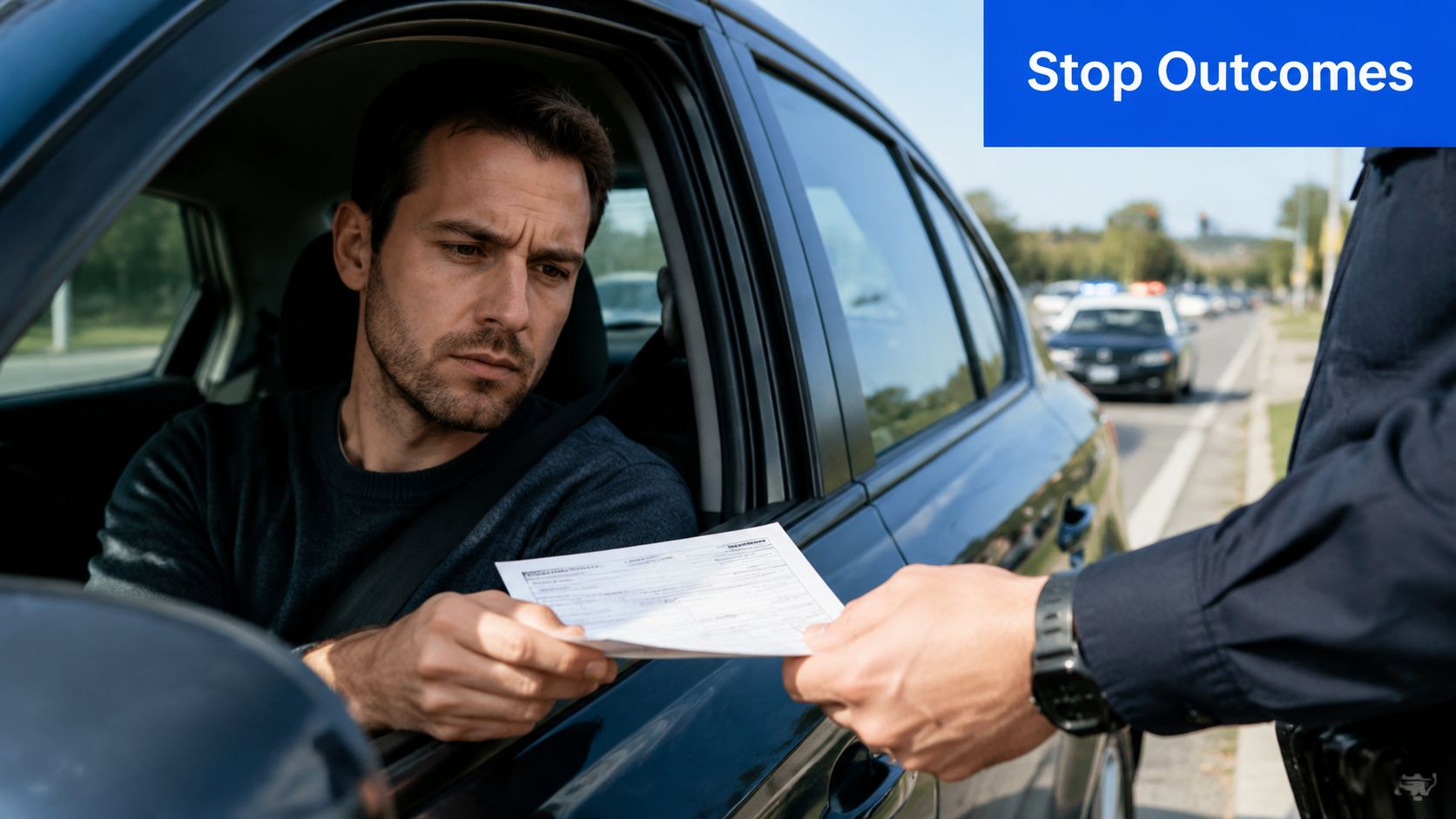
The stop usually ends in one of four ways. Only one of them is harmless.
What each outcome means for you
First path: a warning.
This is the cleanest outcome. It still means the stop occurred, and it still means the officer made observations and asked questions. A warning is better than a ticket, but it is not a reason to get careless.
Second path: a non-criminal traffic citation.
Many drivers make a costly mistake, treating it like a bill and just paying it. In Florida, paying a ticket can carry consequences for your record and your insurance. For gig drivers, professional drivers, and people whose jobs depend on clean records, that shortcut can be expensive.
Third path: a criminal traffic citation.
Now the case is no longer a simple driving annoyance. It can involve mandatory court handling and much higher stakes. If your case is in Orlando, for example, you may end up dealing with proceedings at the Orange County Courthouse. At that point, this is not a paperwork problem. It is a defense problem.
Fourth path: arrest.
This changes your day instantly. DUI allegations, suspended license allegations, reckless driving allegations, or evidence supposedly found during the stop can turn a roadside contact into custody.
Why the stop isn't over when the officer walks away
The downstream damage can be worse than the roadside stress. A public-safety explanation from King County notes the larger reality: even a minor citation can affect insurance, job access, rideshare account standing, and security clearances, which is why the after-the-stop consequences deserve serious attention.
That is exactly right.
If the officer asks to search your vehicle, remember the distinction that matters most. Consent gives the officer one path. Probable cause is something else entirely. You should almost never supply the first voluntarily. If the officer claims the second exists, your roadside argument won't fix it. Your lawyer might.
The side of the road is not where you win a traffic case. It's where you avoid making it worse.
And if the stop involved allegations under Chapter 316 that move beyond a standard infraction, the need for immediate legal review goes up fast.
After the Stop How Ticket Shield Protects You
Once the officer leaves, the legal work starts. That is when drivers make their second major mistake. They delay.
They set the ticket down. They assume it's minor. They use an automated app that treats the case like data entry. Or they hire a volume operation where they never speak to the lawyer handling the file.
That is the wrong approach when your license, insurance cost, and driving record are on the line.
Why direct attorney access matters
Florida traffic defense works best when someone reviews the citation early, checks the charging language, looks for court requirements, and decides whether the primary goal is dismissal, amendment, or a result aimed at avoiding points. That requires judgment.
Ticket Shield, PLLC is a Florida law firm, not a chatbot, and clients can communicate directly with their attorney by phone or text. If you need to move quickly, you can submit your case for review and get the citation into a lawyer's hands.
That matters even more when the stop involved signs of a larger problem, such as DUI allegations, a criminal traffic charge, or a search issue.
What to do the same day
Handle it like this:
Save the paperwork: Citation, complaint, bond papers, tow documents, and any notes.
Write down what happened: Time, location, what the officer said, what you said, and whether there were witnesses.
Do not post about it: Social media turns bad facts into preserved evidence.
Act before deadlines control you: Waiting usually limits your options.
Focus on the main objective: In many Florida traffic cases, that objective is keeping points off your license.
You do not need a middleman. You need legal judgment early, before a manageable problem becomes a record problem.
If you were just stopped, or you're holding a Florida citation right now, don't guess. Visit Ticket Shield, PLLC for a free consultation and fight for the result that matters most: no points on your license.