What Is a Traffic Infraction in Florida?
Learn what is a traffic infraction and how it impacts your Florida license, insurance, and finances. Discover why fighting your ticket is critical.
A traffic infraction is a non-criminal violation of Florida's traffic laws. Paying the ticket is an admission of guilt that puts points on your license and raises your insurance rates. You must fight it to protect your driving record and avoid long-term financial penalties.
A traffic infraction is a legal summons. It demands your immediate attention. While it’s not a crime, treating it like a simple fine is the biggest mistake you can make.
You must take it seriously from the moment that ticket hits your hand. Paying it is an admission of guilt. That single act can set off a chain reaction: points on your license, hikes in your insurance rates, and a potential license suspension.
What an Infraction Really Means for You?
Paying the fine is the same as pleading guilty in court. That one decision triggers a host of problems. When you pay that ticket, you are not just closing the book on the incident. You are adding points to your driving record and giving your insurance company a clear reason to raise your rates for years.
Suddenly, you are one step closer to a license suspension.
This process is handled in a civil traffic court, like the Richard E. Gerstein Justice Building in Miami where we regularly fight for our clients. The second that officer hands you a citation, a legal clock starts ticking. What you do next is the most critical decision you will make.

What is More Than Just a Fine?
A traffic infraction is a direct challenge to your driving privileges and your finances. The state takes these laws, like those found in Florida Statute Chapter 316, very seriously.
Just look at how aggressively the state pursues even minor violations. In one city's automated camera program, officials sent out over 500,000 warnings in just a few months before they even started issuing real tickets. That shows you the level of enforcement you're up against.
Your ticket will fall into one of two main categories:
Moving Violations: These are actions that happen while your car is in motion, like speeding or running a red light. These violations almost always come with points.
Non-Moving Violations: These tickets relate to equipment or parking, like having an expired tag. We have a detailed guide explaining what a non-moving traffic violation is and how it can still cause major headaches.
When you're trying to make sense of what's allowed on the road, questions come up all the time. For instance, drivers often wonder if they can drink non-alcoholic beer while driving, as even actions that seem harmless can lead to a traffic stop.
At Ticket Shield, PLLC, you are not just another case number fed into an automated app. You speak directly with your attorney by phone or text. We build a strategic, lawyer-led defense designed to protect your record from the start.
What is the Difference Between an Infraction and a Criminal Offense?
You must understand the line Florida law draws between a non-criminal traffic infraction and a criminal traffic offense. The stakes are worlds apart. Failing to grasp this difference can lead to devastating legal and personal consequences.
A criminal offense puts your freedom on the line. Charges like DUI or Reckless Driving can mean jail time and a permanent criminal record. An infraction, while still very serious, is a direct attack on your finances and your legal ability to drive.
What Are the Two Different Legal Worlds?
The legal path you are forced down depends entirely on the charge written on that ticket. This isn't just a minor detail—it dictates the court you'll be in and the punishment you face.
Infractions: These are non-criminal and handled in county civil traffic divisions. Think of the Broward County Judicial Complex in Fort Lauderdale, where we defend clients against these exact citations. The main goal here is to avoid points on your license and crushing insurance hikes.
Criminal Offenses: These are prosecuted in the full criminal justice system. You face a state prosecutor, the threat of probation, and the very real possibility of incarceration.
The process is vastly different for each. You need a defense that recognizes what is truly at stake. You can get a deeper understanding of how Florida classifies these offenses in our guide on whether traffic violations are misdemeanors. This knowledge is your first line of defense.
When your liberty is at risk, direct and confidential communication with an experienced attorney is non-negotiable. You cannot afford to have your case filtered through a chatbot or a paralegal.
Why Does Direct Attorney Access Matter?
At Ticket Shield, PLLC, we are a lawyer-led firm. This means when you call or text us, you communicate directly with your attorney. We provide this direct line for any traffic matter, from a simple speeding ticket to a serious criminal charge.
Automated apps and high-volume "ticket mills" cannot offer this level of protection. They often use middlemen and treat your case like just another data point. We treat you as a client whose rights and future need a powerful shield. Your defense must be strategic and personal—never automated.
This table breaks down the critical differences you need to know.
Florida Traffic Infraction vs. Criminal Traffic Offense
Factor | Traffic Infraction (Non-Criminal) | Traffic Offense (Criminal) |
|---|---|---|
Primary Penalty | Fines, license points, insurance increases | Potential jail/prison time, probation, criminal record |
Legal Process | Civil traffic court, no right to a jury trial | Full criminal court, right to a jury trial |
Long-Term Impact | Higher insurance rates, potential license suspension | Permanent criminal record, affects jobs & housing |
Your Status | You are a "defendant" in a civil case | You are an "accused" in a criminal prosecution |
As you can see, the path you're on changes everything, from the language used in court to the long-term impact on your life.
What Are the Most Common Florida Traffic Infractions?
Every day, drivers across Florida see those flashing lights in their rearview mirror. The tickets that follow are often the first step toward serious problems for your driving record. From the halls of the Edgecomb Courthouse in Tampa to every other traffic court in the state, these cases are heard in staggering numbers.
Knowing what you are really up against is the first step in defending yourself. Every conviction brings points that threaten your license and insurance hikes that hit your wallet for years. A strategic defense stops that domino effect before it starts.
What About Speeding and Red Lights?
If a driver has a ticket, it is often for one of these two violations. They account for a huge percentage of all citations in Florida. They are processed in such high volume that drivers often feel like they are on a conveyor belt to a conviction.
Speeding (Florida Statute 316.187): This is the most common ticket we see. The penalties are not one-size-fits-all. The number of points added to your license is tied directly to how fast the officer claims you were going.
Running a Red Light (Florida Statute 316.075): A dangerous and common violation, this one carries serious points and a hefty fine. To make matters worse, these are frequently caught by red-light cameras, which can feel like undeniable evidence stacked against you.
What Are Other Frequent Citations?
Beyond the obvious, officers write many tickets for violations that are much more subjective. These citations often come down to an officer's judgment call. That judgment can and should be challenged in court.
Failure to Yield Right-of-Way: These tickets usually happen at confusing intersections. It is not always clear who had the right to go first. Because they can lead to accidents, the penalties are stiff, making them a serious threat to your record.
Improper Lane Change: This is another classic example of a subjective call. What one officer sees as an "improper" change, another might not. But if you are convicted, you still get points on your license.
This diagram helps break down how Florida law looks at traffic offenses, showing the crucial split between a non-criminal infraction and a more serious criminal charge.
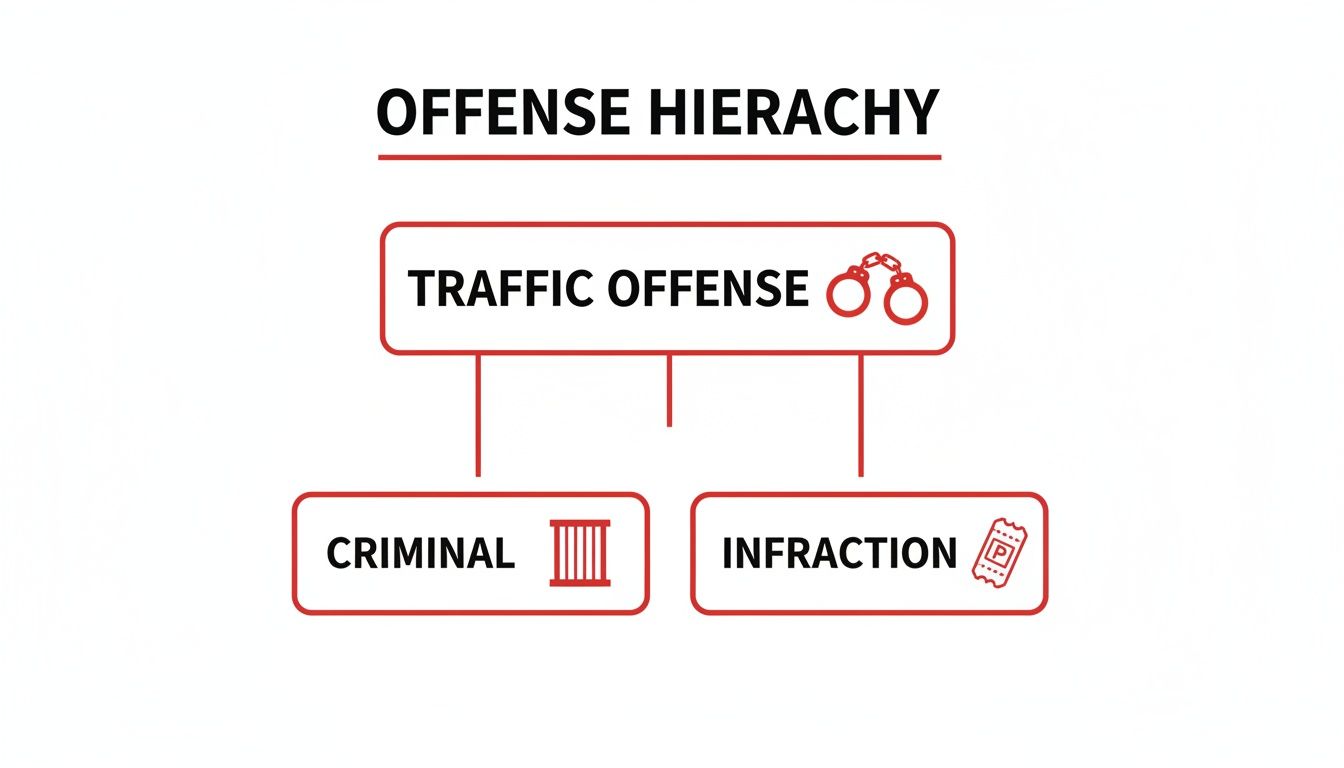
The key takeaway is that while an infraction isn't a crime, it is still a legal offense. It has real consequences that can impact your life for years.
The sheer volume of tickets being written is staggering. One police department, for example, issued 1,701 infraction tickets on top of thousands of other warnings and criminal citations in a single year. You can dig into just how common these are in a recent traffic report. It is no wonder so many drivers decide to get professional legal help.
You are not just fighting a single ticket. You are fighting to protect your driving record, prevent insurance hikes, and keep your license safe from suspension.
At Ticket Shield, PLLC, you speak directly with your attorney—no apps, no call centers. We are a real law firm providing a cost-effective, lawyer-led defense designed to shield you from points and the long-term financial penalties that follow.
How Do Infractions Impact Your License and Insurance?
That ticket in your hand is more than just a fine. It is the start of a chain reaction that can seriously affect your license, your insurance rates, and even your job. Simply paying it is an admission of guilt. That guilty plea has consequences that start immediately and can stick with you for years.
Florida keeps score with a points system to track every moving violation conviction. These are not bonus points. They are black marks on your official driving record that directly measure your risk as a driver.
What is the Downward Spiral of License Points?
Racking up points on your license is a dangerous game. The Florida DHSMV has very clear rules. It does not take many tickets to find yourself on the fast track to a license suspension.
These penalties are mandatory. Once you hit a certain number of points within a set timeframe, the state will take action:
12 points in 12 months: Results in a 30-day license suspension.
18 points in 18 months: Leads to a 3-month license suspension.
24 points in 36 months: Triggers a 1-year license suspension.
Even one conviction starts the clock. That is why our primary goal is always to keep points off your record in the first place. For a full breakdown, you can learn more about Florida's license points system in our detailed guide.
Worse, if you get too many convictions, the state can declare you a Habitual Traffic Offender (HTO). This is a devastating label that comes with a five-year license revocation. Fighting a ticket is about stopping this downward spiral before it starts.
How Does This Affect Your Insurance?
Your insurance provider is watching. Every time a moving violation conviction hits your record, they see you as a bigger risk. That gives them justification to raise your premiums.
A single guilty plea for speeding or running a red light can cause your rates to spike and stay high for years. Over a three-to-five-year period, this can cost you thousands of dollars—far more than the original fine or our cost-effective fee for a real legal defense.
Your driving record is a financial asset. A conviction for a seemingly simple infraction is a direct attack on that asset, giving insurers a reason to charge you more for years to come.
Traffic enforcement is only getting more aggressive. For example, some jurisdictions are using new technology to bring in more cash from fines. One country's traffic fine revenue jumped by 50% in a single year, from €22.52 million to €33.74 million, thanks to mobile speed cameras. Read more about the increasing costs of traffic enforcement and see why a professional defense is more critical than ever.
At Ticket Shield, PLLC, our entire focus is on achieving 'No Points' for our clients. We are a lawyer-led firm. You talk directly with your attorney by phone or text. You will not get stuck with a chatbot or passed off to a paralegal like with automated apps. We provide a dedicated, strategic defense to protect your license and your finances.
What Are Your Immediate Steps After Getting a Ticket?
The moments after an officer hands you that ticket are critical. What you do next can either set you up for a successful defense or cause serious, lasting damage. We see it every day in courtrooms like the Orange County Courthouse in Orlando—drivers making costly mistakes because they don't know the rules.
Your defense starts the second that ticket is in your hand.
When an officer hands you that paper, they are kicking off a legal process with strict rules and stricter deadlines. Follow these steps precisely to protect yourself.
What Should You Do Immediately?
Do Not Pay the Ticket. This is the single most important rule. Paying the fine is a legal admission of guilt. It guarantees points on your record and opens the door for your insurance company to hike your rates for years.
Document Everything. As soon as you can, write down every detail you remember about the stop. Note the location, weather, traffic conditions, and exactly what was said between you and the officer. Memories fade, but these details are vital for a strong defense.
This immediate documentation is your first act of defense. It preserves evidence that could be used to challenge the officer's version of events later.
What Should You Do in the Following Days?
Contact an Attorney Immediately. You have a very limited window to act. Your citation has a strict deadline—usually just 30 days—to respond. Failure to act will result in an automatic suspension of your driver's license. The state does not give extensions.
Understand the Deadline. For a full breakdown of the process, check out our guide on what to do when you get a ticket.
Your absolute top priority is to contact a traffic defense attorney before you make any decision. An experienced lawyer can review the citation, explain your real options, and start building a strategic defense.
This is where Ticket Shield, PLLC, gives you a powerful advantage. We are not an automated app or a ticket mill that uses middlemen. We are a real law firm. When you call, you speak directly with your attorney to get immediate, professional advice. Your defense should never be delegated to a chatbot.
Why Should You Hire a Lawyer for a Simple Infraction?
You might be looking at that ticket and wondering if hiring a lawyer is overkill. It’s a fair question. It comes down to simple math: our one-time fee versus years of inflated insurance premiums, points on your license, and the risk of suspension.
An experienced defense is an investment in protecting your driving record.
Unlike automated "ticket apps" that treat you like a case number, Ticket Shield, PLLC is a real Florida law firm. We build a personalized, strategic defense for every single client. Your case is never passed off to a third-party service or filtered through a chatbot.
You communicate directly with your attorney by phone or text. That direct line to an experienced lawyer is the shield you need, saving you from the stress of court appearances and the crushing long-term costs of a conviction.
How Does a Strategic Defense Help?
Even a "simple" infraction is treated seriously by the state. Take speeding, for example. It is not just about a fine. In 2023, crashes involving speeding killed 11,775 people nationwide. As crash data highlights these dangers, you can see why courts are not just letting things slide. You can learn more in a recent NHTSA report on traffic fatalities.
Hiring an attorney is about much more than just fighting a single ticket. Our goal is to get your case dismissed or, at a minimum, avoid points on your license. We handle everything. This allows you to sidestep the headache of navigating the complex court system yourself. Understanding if you need a lawyer for your traffic ticket is the first move toward protecting your future.
Our dedicated service provides a powerful legal shield designed to protect your license and your finances from the moment you hire us.
Protect your record. Visit TicketShield.com for a free consultation to learn how we fight for "No Points" on your license.