Are Traffic Violations Misdemeanors in Florida?
Are traffic violations misdemeanors in Florida? Usually no—most tickets are civil, but 30+ mph speeding, DUI, and DWLS can be criminal.
Monday, January 12, 2026
Are traffic violations misdemeanors? In Florida, usually no. Most traffic tickets are civil infractions, but some driving offenses are charged as criminal misdemeanors, and a smaller group can rise to felonies depending on injury, prior history, or what the driver knew.
Attorney Advertisement. Office in Broward.
That distinction matters immediately. A routine citation is often payable and handled like a civil case; a criminal traffic charge can require a court appearance, expose you to jail, and create a record that shows up well beyond traffic court. This guide is informational only and is not legal advice.
How We Classified Florida Traffic Offenses for This Guide
We wrote this guide by separating Florida traffic matters into three buckets: civil infractions, criminal traffic misdemeanors, and felonies. To do that, we reviewed the offense language in the Florida Statutes, looked at whether the law authorizes jail or only a civil penalty, checked whether the charge typically requires a court appearance, and considered record consequences such as criminal history reporting and license effects. Florida’s own court and agency materials reinforce that those are the practical dividing lines for drivers.
In our experience, the mistake drivers make most often is assuming every moving violation is just a ticket. It is not. A citation usually stops being a simple civil matter when the statute itself creates a criminal offense, when the allegation includes willful or knowing conduct, or when the facts involve impairment, a suspended license, leaving a crash, or speed that crosses a criminal threshold. For license consequences, Florida Highway Safety and Motor Vehicles explains the state point system and related sanctions in its point system overview.
That classification approach also explains why one national answer does not work. States label traffic offenses differently. A 2026 Minnesota legislative analysis, for example, reported that speeding there is generally treated as a petty misdemeanor and that disposed speeding cases heavily skewed to that lower category from 2017 to 2022, as shown in this legislative analysis. This article, by contrast, answers the Florida rule directly.
Understanding When a Traffic Violation Becomes a Misdemeanor
In Florida, most traffic tickets are not misdemeanors. Ordinary speeding, many lane-change violations, and many red-light or stop-sign citations are civil infractions. The answer changes when the statute makes the conduct a crime rather than a payable traffic violation.
Here is the fastest way to classify a Florida traffic case:
Ordinary speeding ticket: usually a civil infraction.
30+ mph over the speed limit: criminal speeding under section 318.14(1), which requires a mandatory court appearance.
DUI: a criminal offense under section 316.193, even on a first offense.
Reckless driving: a criminal offense under section 316.192.
DWLS with knowledge: criminal under section 322.34; without knowledge can be treated differently.
Some crash-related conduct: leaving the scene can be a misdemeanor or a felony depending on whether there was only property damage or an injury.
I’ll put it plainly: drivers get tripped up because the word "ticket" does not tell you whether the case is civil or criminal. In our office, we regularly see people assume that if an officer handed them paper at roadside instead of making a full custodial arrest, the case must be minor. Florida law does not work that way.
Before we go further, it helps to understand how specialized traffic classifications can be. For commercial drivers, even the first question may be what constitutes a DOT violation. For most drivers, though, the deciding issues are simpler: Is jail legally possible? Is court mandatory? And will the outcome create a criminal record?
Terminology also affects real-life consequences. Civil infractions generally sit in traffic history and licensing records. Criminal misdemeanors can appear in clerk files, criminal history reporting, and employment screening depending on the case and its disposition. Florida’s statewide traffic-offense data underscores why this distinction matters in practice: from 2023 to 2025, statewide reporting showed 403,226 traffic offense cases across 66 counties, with many ending in guilty findings or withheld adjudication, according to this Florida traffic offense dataset.
Civil vs. Criminal at a Glance
The easiest comparison is a standard speeding citation versus a charge like reckless driving or DUI.
Civil Infractions: These are non-criminal violations. The usual result is a fine, possible points, and sometimes traffic school. For a standard civil infraction, you are not being prosecuted for a crime.
Criminal Misdemeanors: These are criminal charges. A conviction can mean jail, probation, higher fines, and a criminal record. The Bureau of Justice Statistics uses a broad misdemeanor definition of offenses punishable by more than a day and up to a year in jail, and national research estimates roughly 13.2 million misdemeanor cases are filed each year, as summarized by the Bureau of Justice Statistics.
A criminal traffic charge is not just a more expensive ticket—it's an accusation that can follow you for the rest of your life, affecting employment, housing, and professional licenses. Our goal is to protect your license and record from these lasting consequences. Past results do not guarantee future outcomes.
Grasping the seriousness of a criminal charge is the first step. If you want to dive deeper into specific offenses, you can learn about our practice area of criminal traffic defense in Florida.
To make this clear, here’s a quick table breaking down the key differences between a standard ticket and a criminal charge in Florida.
Civil Infraction vs. Criminal Misdemeanor at a Glance
This table offers a quick comparison of the key differences between a standard traffic ticket and a criminal traffic violation in Florida.
Characteristic | Civil Traffic Infraction (e.g., Speeding) | Criminal Traffic Misdemeanor (e.g., Reckless Driving) |
|---|---|---|
Legal Status | Non-criminal violation | Criminal offense |
Potential Penalty | Fines, points on license, traffic school | Jail time, probation, large fines, criminal record |
Court Process | Traffic court or online payment | Mandatory appearance in criminal court |
Long-Term Impact | Increased insurance rates | Permanent criminal record, employment issues |
As you can see, the stakes are worlds apart. One is an administrative issue, while the other is a serious legal battle with life-altering potential.
Navigating Florida's Three Tiers of Traffic Offenses
To understand if your ticket is a misdemeanor, you must first know that Florida doesn't treat all traffic offenses the same. The law sorts them into categories based on severity. Think of it as a ladder—each rung you climb represents a bigger deal with tougher consequences. This system helps drivers in places like Miami-Dade County and across the state know exactly what they’re up against.
Many people use terms like "infraction" and "misdemeanor" interchangeably, but that's a significant mistake. They represent completely different legal problems. National data shows just how big this category is: traffic-related charges make up an incredible 88% of all Class C misdemeanors. But that same statistic also tells you that most traffic tickets aren't misdemeanors at all—they're the less severe civil infractions.
The Foundation: Civil Infractions
At the bottom of the ladder, you'll find civil traffic infractions. These are by far the most common tickets issued, and the key thing to know is that they are non-criminal. If you are cited for speeding, running a red light, or making an improper lane change in Miami-Dade, you have almost certainly received a civil infraction.
The consequences here are mostly financial. You will be looking at a fine, and you might get points added to your driving record, which can make your insurance premiums go up. What a civil infraction won’t do is give you a criminal record. And if you're curious about tickets that don't even involve a moving car, you can learn more about what a non-moving violation is in our other guide.
This chart breaks down the basic hierarchy of traffic offenses.
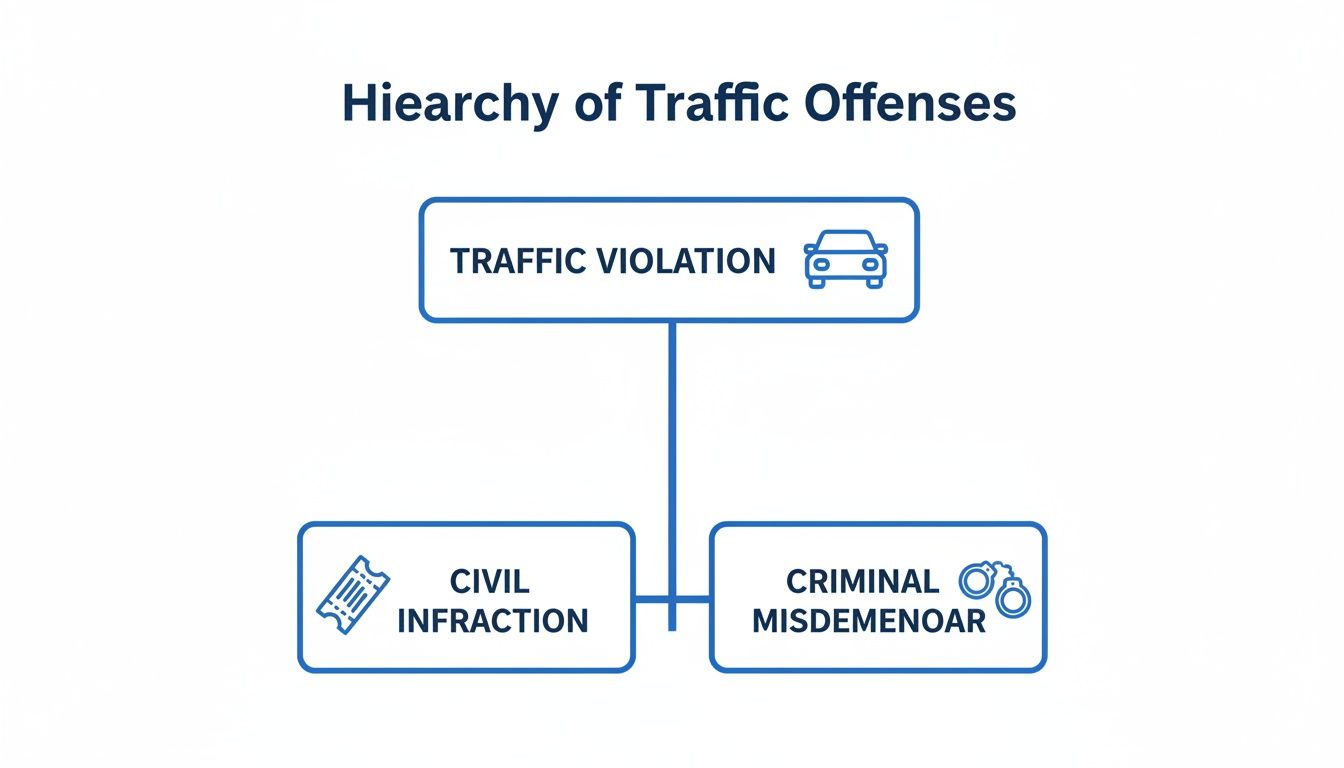
As you can see, there’s a clear line separating non-criminal civil matters from criminal misdemeanors, which shows how differently Florida law treats various driving mistakes.
The Next Level: Criminal Misdemeanors
Take a step up the ladder and you land on criminal traffic misdemeanors, a driving mistake that crosses the line into a criminal offense. Offenses like Driving Under the Influence (DUI), Reckless Driving, or Driving While License Suspended fall squarely into this serious category.
Unlike a civil infraction, a misdemeanor charge can lead to an arrest. A conviction means you will have a permanent criminal record that can create roadblocks to getting a job, finding housing, or securing a professional license. The penalties are also far more severe, including large fines, probation, and even potential jail time.
A criminal traffic misdemeanor isn't just a pricey ticket—it's a formal criminal charge that the state prosecutes. The objective of a strong defense is to protect your record from a permanent conviction.
The Highest Tier: Felonies
Finally, at the top of the ladder are felonies. Some traffic-related offenses can be elevated to felony status, usually due to other serious factors. For example, a fourth DUI can be charged as a felony. Leaving the scene of an accident that caused a serious injury or death is another. These are the most severe charges a driver can face, carrying the risk of long prison sentences.
Real-World Examples of Criminal Traffic Misdemeanors in Miami-Dade
The cleanest Florida example is speeding, because it shows exactly where an ordinary ticket stops being civil and starts becoming criminal. We see this confusion constantly: a driver thinks “it was only speeding,” but the alleged speed pushes the case into mandatory court.
For anyone driving in Miami-Dade, the comparison looks like this:
Ordinary speeding ticket: usually a civil citation with a fine, possible points, and options that may include school or payment.
30+ mph over the limit: mandatory court under section 318.14, with the possibility of misdemeanor-level consequences rather than a mail-it-in resolution.
Speeding plus reckless facts: when the facts suggest willful or wanton disregard—high speed combined with weaving, racing, tailgating, or blasting through traffic—the state may charge reckless driving under section 316.192 instead of treating the case like a routine ticket.
That consequence gap is the central issue. A basic speeding citation is usually payable. A criminal-speed or reckless-driving allegation can require you to appear in court and defend against a charge that carries criminal penalties. In our practice, the 30-mph threshold is one of the most common places drivers misclassify their case.

Speeding: Civil Ticket vs. Criminal Charge
Florida law treats most speeding as a non-criminal moving violation. But once the allegation reaches 30 mph or more above the posted limit, section 318.14 requires a mandatory court appearance rather than a simple payment option. That alone should tell a driver the case is no longer business as usual.
If the same stop also includes facts suggesting conscious disregard for safety, prosecutors may look to reckless driving instead. That statute focuses less on the number on the radar and more on the manner of driving. So 96 in a 65 on an open road is one issue; 96 in a 65 while darting through dense traffic is a very different case. I’ve found that drivers usually focus on the speed number, while prosecutors and judges often focus just as much on the surrounding conduct.
Driving Under the Influence (DUI)
A DUI is one of Florida’s clearest criminal traffic offenses. Under section 316.193, driving or being in actual physical control of a vehicle while impaired by alcohol or drugs is criminal even for a first offense.
A first DUI can bring fines, probation, jail exposure, license consequences, DUI school, and other conditions. The offense becomes even more serious with aggravating facts such as a high breath result, property damage, injury, or prior history. Florida Highway Safety and Motor Vehicles also outlines related administrative consequences in its driver license sanctions materials.
Reckless Driving
Reckless driving is not ordinary negligence. Florida defines it as driving with a willful or wanton disregard for the safety of persons or property under section 316.192. That wording matters because it explains why some dangerous driving is prosecuted criminally while other bad driving remains a civil infraction.
You can get a deeper look into the specifics in our guide that explains what reckless driving in Florida entails. In practical terms, what changes the charge level is the state’s claim that the driver knowingly engaged in dangerous conduct, not merely that the driver made a mistake.
Driving While License Suspended or Revoked (DWLS)
DWLS is another offense where the details control everything. Under section 322.34, driving while suspended with knowledge is a criminal offense. By contrast, lack of knowledge can change how the matter is charged and defended.
That knowledge element is not a technicality. We often see cases turn on notice issues, prior citations, or whether the state can prove the driver knew about the suspension. An initial review of the paperwork can matter a lot.
Leaving the Scene of an Accident
Leaving the scene also shows how Florida traffic law escalates by result. If a crash involves property damage only, failure to stop and exchange information can be charged as a misdemeanor under section 316.061. If the crash involves injury or death, the offense moves into felony territory under section 316.027.
That is why two crashes may both be called “leaving the scene” in casual conversation while carrying completely different legal exposure.
The Hidden Costs of a Misdemeanor Conviction

A misdemeanor conviction for a traffic violation leaves a mark that goes far beyond the courtroom. While the fines and court costs are immediate, it's the hidden, long-term consequences that can impact your life for years to come. It is important to understand this ripple effect.
The single biggest consequence is getting a permanent criminal record. This isn't like a civil ticket. A criminal conviction appears on background checks, creating serious roadblocks when you're applying for a job, seeking a professional license, or even trying to rent an apartment in Miami.
The Financial Aftermath
The financial impact of a misdemeanor is much more than the initial fine. You may also face court costs, mandatory classes, and probation fees that can easily add up to thousands of dollars. On top of that, your auto insurance premiums will likely increase. Insurance companies view a criminal traffic conviction as a major indicator of a "high-risk driver."
For a deeper dive, you can learn more about how even a basic speeding ticket in Miami can affect your insurance rates — and a misdemeanor conviction is on another level. It's also worth noting the potential for license suspension due to unpaid debts that can stem from these fines and court costs.
Lasting Social and Professional Barriers
The impact from a criminal traffic misdemeanor isn't just about money. It can create social and professional hurdles that are tough to overcome.
Employment: Many employers may hesitate to hire an applicant with a criminal record, especially for jobs that require driving or a position of trust.
Licensing: Certain professional licenses for careers in nursing, real estate, or commercial driving (CDL) can be denied or even revoked after a conviction.
Educational Opportunities: Some colleges and financial aid applications require you to disclose any criminal convictions.
A misdemeanor traffic conviction isn't a one-time event. It's a lasting record that can systematically close doors to future opportunities. Our goal is to protect your license and record from these far-reaching consequences. Past results do not guarantee future outcomes.
Furthermore, research shows these penalties are not always applied equally. A major scientific study found that minority drivers are not only cited more often but also end up paying 23% to 34% more in fines for the exact same violations, pointing to systemic inequalities in how traffic laws are enforced.
How a Traffic Defense Attorney Can Protect Your Interests
Handling a criminal traffic charge on your own is a significant risk. When the prosecutor in court asks if you understand your rights, they are asking whether you are prepared to handle a complex legal system, since one misstep can result in a permanent criminal record. Having an experienced legal professional on your side becomes essential.
An attorney whose practice focuses on Florida traffic and DUI defense knows the system, the local court procedures in Miami-Dade, the key players, and the legal arguments that can be critical to your case. Our single focus is to protect your license and your record by challenging the state's evidence against you.
Navigating the Court System on Your Behalf
The process for a criminal traffic misdemeanor is very different from paying a simple ticket online. It involves mandatory court appearances, filing specific legal motions on strict deadlines, and negotiating with prosecutors. Defendants often find the process intimidating and confusing.
One of the primary benefits of hiring an attorney is that we handle all of that for you. We will represent you in court—often without you ever needing to be present—saving you from stress and the time you'd have to take away from work or family. We manage the paperwork, the deadlines, and all communication, ensuring your case is handled professionally from start to finish.
Strategic Negotiation and Defense
An experienced attorney does more than just show up for a court date. They meticulously analyze every detail of your traffic stop, from questioning the legality of the initial pull-over to scrutinizing the accuracy of the officer's report. This detailed review often uncovers weaknesses in the prosecution's case that can be used to your advantage.
Our primary objective is to seek the best possible outcome. That could mean a full dismissal of the charges, a reduction from a criminal misdemeanor down to a civil infraction, or an alternative sentence that keeps a conviction off your record. Past results do not guarantee future outcomes, but a strong defense is critical.
When so much is on the line, having a knowledgeable advocate in your corner is vital. To get a better feel for when legal help is a necessity, take a look at our guide on whether you need a lawyer for a traffic ticket. Protecting your future is always the top priority.
Your First Steps After a Criminal Traffic Citation
That piece of paper the officer hands you isn't a simple ticket. It’s a "Notice to Appear," and it’s a jarring experience that can leave you feeling overwhelmed. Unlike a basic ticket you can pay online, this document means you are being formally charged with a crime. You now have a mandatory date in criminal court.
The moments right after that traffic stop are critical. The steps you take now can seriously influence how your case plays out.
First, stay calm and get organized. Your immediate priority is to write down everything you can remember about the stop. Document the time, the exact location in Miami-Dade, the weather, and what the traffic was like. Write down what the officer said to you. Details that seem small now can become very important later.
Understand the Citation and Your Court Date
Read that citation carefully. It will list the specific law you're accused of breaking and a date for your mandatory court appearance. Missing this date is not an option.
Failure to appear in court for a criminal charge will result in the judge issuing a bench warrant for your arrest. This takes a bad situation and makes it much worse, adding a new charge and making your defense more complicated.
That court date is a hard deadline. It initiates the legal process, and it’s the signal that you need to seek professional legal help promptly. If someone has already missed a court date and wants a plain-language overview of what usually happens next, there is a useful explainer over at Cherokee Bail Bonds, though Florida drivers should still get Florida-specific advice for a Florida case.
Prepare for a Legal Consultation
The next logical step is to speak with a traffic defense attorney. To get the most out of that conversation, you will want to have a few things ready.
Gather these items before you call:
Your Citation: Have the actual ticket or a clear picture of it handy.
Your Driving Record: If you can, get a copy of your Florida driving history.
Your Notes: Bring those detailed notes you took about the traffic stop.
During a free consultation, an attorney can review these documents, explain the charges in plain English, and start outlining potential defense strategies. Our goal is always to protect your license and your record.
Please be aware that submitting information via our website or participating in a consultation does not create an attorney-client relationship. Taking these organized first steps is the best way to move from a state of panic to a position of strength.
Frequently Asked Questions
Will a traffic misdemeanor show up on a background check?
Often, yes. A criminal traffic misdemeanor can appear in criminal court records and may be reported in employment or housing background screenings, depending on the reporting system and the case outcome. That is one of the biggest practical differences between a civil citation and a criminal conviction.
Is a speeding ticket a misdemeanor in Florida?
Usually no. A standard speeding citation is generally a civil infraction, not a misdemeanor. The issue becomes much more serious when the allegation is 30 mph or more over the limit or when the facts support a separate criminal charge such as reckless driving.
Do all traffic tickets require court in Florida?
No. Many civil tickets can be paid or otherwise resolved without a criminal court appearance. Criminal traffic charges are different, and some offenses—such as the 30-plus-mph speeding category under Florida law—trigger mandatory appearance rules.
Can a misdemeanor be removed from a Florida record?
Sometimes, but not always, and the details matter. Florida is restrictive about sealing and expunging criminal records, and some convictions are not removable; DUI is a common example of an offense with especially harsh record consequences. In our experience, the best chance to protect the future record is often at the front end of the case, before a conviction happens.
Will a first misdemeanor permanently ruin my job prospects?
Not automatically. A first misdemeanor can create real employment problems, especially for positions involving driving, trust, or professional licensing, but it does not mean every employer will reject you forever. What matters most is the exact charge, the outcome, whether adjudication was withheld, and what appears when the employer runs a background check.
Is a traffic ticket the same as a criminal case in Miami-Dade?
No. A civil ticket is usually a traffic-court matter with fines and points, while a criminal traffic case is prosecuted in criminal court and can carry probation, jail exposure, and a criminal record. That split is why the same roadside stop can feel routine to one driver and life-changing to another.
Facing a criminal traffic charge is a stressful experience, but you do not have to face it alone. The team at Ticket Shield, PLLC is dedicated to defending drivers in all 67 Florida counties. Our practice focuses on traffic and DUI defense, and our goal is to protect your license and your record. For a free consultation to discuss your case, visit us at https://www.ticketshield.com.