What is a Non Moving Violation? How It Affects Your Florida Driving Record
What is a non moving violation? In Florida, it usually means no points, but it can still affect your record, fines, and insurance if ignored.
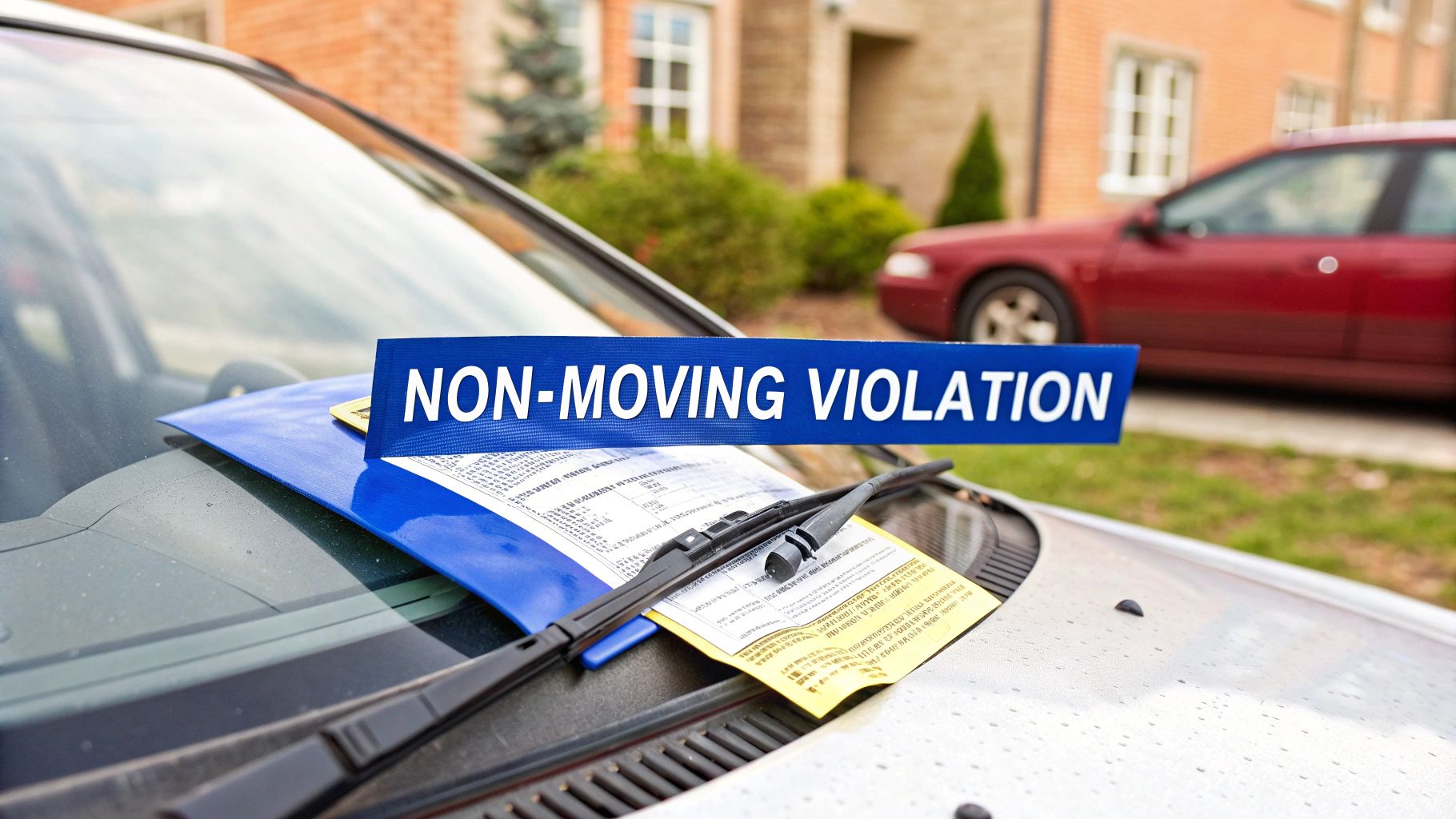
A non moving violation is a traffic ticket tied to your vehicle’s status, equipment, paperwork, or parking position rather than the way you were driving. In Florida, that usually means issues like expired registration, improper parking, illegal tint, or defective lights. By contrast, a moving violation comes from conduct while the vehicle is being operated—speeding, running a stop sign, or careless driving.
How We Evaluated Florida Non-Moving Violations for This Guide
This guide is written from a Florida traffic-practice perspective. We based it on the kinds of citations Florida drivers most often ask about, the way Florida courts and agencies separate point-bearing driving conduct from administrative or equipment issues, and the practical consequences that matter most after a ticket: points, record visibility, payment deadlines, and suspension risk.
We also distinguished tickets by what triggered the citation. If the violation is about the vehicle being parked, the registration being current, required equipment working, or the car complying with state and local rules, it usually falls in the non-moving category. If the ticket is based on how the car was being driven while in motion, it falls outside this category and is treated as a moving violation. For Florida licensing and driver history rules, we checked the Florida Department of Highway Safety and Motor Vehicles and county clerk procedures for paying or contesting citations.
In our experience, readers are usually not confused by the label alone—they want to know what the label changes. That is why this article focuses less on jargon and more on the practical differences in points, record impact, insurance attention, and what to do next.
Understanding the Core Concept of a Non Moving Violation
A non-moving traffic violation usually means the ticket is for parking, registration, equipment, or vehicle compliance—not for unsafe operation of the vehicle. That is the clearest answer to what is a non moving violation. The law is not mainly concerned with your driving behavior in that moment; it is concerned with whether the vehicle and its paperwork meet legal requirements.
A moving violation is the opposite. It comes from conduct while the vehicle is being operated, such as speeding, following too closely, failing to yield, or making an improper turn. If you want a deeper look at that category, see our guide on what constitutes a moving violation.
In plain terms, non-moving means the problem is usually administrative or equipment-based. Moving means the problem is how the driver handled the car on the road. That distinction matters because moving violations are far more likely to carry points and insurance consequences, while non-moving violations often center on fines, compliance, and whether the issue gets corrected. The public-safety gap between the two categories is real; the WHO fact sheet on road traffic injuries notes that dangerous driving behavior is tied to severe crash outcomes worldwide, which is one reason moving violations are generally treated more harshly.
Non Moving vs Moving Violations at a Glance
To make the distinction crystal clear, here’s a quick comparison of the key differences between non moving and moving violations here in Florida.
Characteristic | Non Moving Violation | Moving Violation |
|---|---|---|
When It Occurs | Typically when the vehicle is stationary or parked. | When the vehicle is in motion. |
Focus of Violation | Vehicle's condition, compliance, or parking status. | Driver's actions and operation of the vehicle. |
Common Examples | Expired tags, broken taillight, parking tickets. | Speeding, running a stop sign, reckless driving. |
Typical Penalties | Fines, "fix-it" tickets. | Fines, points on license, potential suspension. |
Insurance Impact | Usually none or very minimal. | Often leads to significant premium increases. |
That chart is a useful shortcut, but Florida treatment can still vary by statute, county procedure, and even by whether the ticket is handled under state law or a local parking ordinance. In other words, the label helps, but the exact consequences depend on where the citation was issued and what code section appears on the ticket. In Florida, common non-moving examples include expired registration, parking in a fire lane, illegal window tint, and defective equipment such as a tag light or taillight. Common moving examples include speeding, running a red light, improper lane change, and failure to yield.
One edge case confuses a lot of drivers: a broken taillight ticket issued during a traffic stop. Even though the officer noticed it while you were driving, the citation is still typically treated as non-moving because the violation concerns the vehicle’s equipment, not your manner of driving. I see that misunderstanding all the time—drivers assume that if the car was moving when they were stopped, the ticket must be moving too. Usually, that is not how the category is determined.
The Purpose Behind These Citations
So, why do these rules even exist? They're in place to make sure every vehicle on the road meets basic safety and administrative standards. An officer can write a ticket for issues that, while not as immediately dangerous as speeding, still break the law and could create problems down the road.

A broken taillight might seem like a small thing, but it keeps other drivers from knowing when you’re about to brake, creating a real hazard.
Likewise, driving with an expired registration means your vehicle isn't properly documented with the state. These regulations are all about maintaining a baseline of order and safety for everyone sharing the road.
At its heart, a non moving violation is a civil infraction focused on the vehicle's compliance rather than the driver's actions at that moment. It's about maintaining standards, not punishing reckless driving.
This chart helps visualize the three core elements of a non moving violation: its connection to a stationary vehicle, compliance-based issues, and the civil penalties that follow.
As the summary shows, these tickets are about administrative or equipment-related problems found on a parked car, leading to penalties like fines rather than points on your license.
Common Non-Moving Violations You Might Encounter in Florida
In Florida, non-moving violations are a lot more common than most drivers think. They’re the kind of citations that can pop up when you least expect them, often for issues that seem minor until a ticket is sitting on your windshield.
These infractions generally fall into two buckets: problems with how or where your car is parked, and issues with your vehicle's equipment or paperwork. Getting a handle on what they are is the first step to keeping your record clean.
Parking, Equipment, and Paperwork Violations
The most frequent type of non-moving violation is, without a doubt, the parking ticket. It’s a citation tied exclusively to a stationary vehicle. Maybe you parked in a designated fire lane, blocked a sidewalk, or used a handicapped spot without a valid permit. Other classic examples include parking too close to a fire hydrant or leaving your car in a clearly marked no-parking zone.
Many drivers ask, is a parking ticket a moving violation? The answer is a firm no. These tickets are all about the car itself, not how it was being driven.

Beyond parking, a whole host of non-moving violations are tied to your car’s condition and its official documents. These are all about making sure every vehicle on the road meets basic safety and legal standards, even when it’s just sitting there. An officer can write you up for these issues during a stop for something else or even if they just spot the problem on your parked car.
Some of the most common ones include:
Expired Registration: Forgetting to renew your vehicle's registration and display a current tag is an easy way to get a ticket.
Faulty Equipment: This covers a wide range of problems, like a broken headlight, a busted taillight, or a cracked windshield that messes with the driver's view.
Improperly Mounted License Plate: Your plate needs to be securely fastened in its proper place and be easy to read.
Illegal Window Tint: Florida has very specific laws about how dark your window tint can be. Go over the limit, and you’ve got a non-moving violation.
Even though these violations don’t add points to your license, they still demand your immediate attention. Ignoring them can lead to bigger fines and more serious administrative penalties down the road.
The best defense is a good offense. Performing regular checks on your car and keeping your paperwork up to date is the easiest way to prevent a simple oversight from turning into a costly problem. Our goal is to protect your license and record from every type of citation.
The True Cost of a Non-Moving Violation
The actual cost of a non-moving ticket is not just the fine on day one. In Florida, the bigger question is what kind of record it creates, who can see it, and what happens if you do nothing. I regularly find that drivers focus on points first and ask about the rest later, but points are only one part of the picture.
Does a Non-Moving Violation Go on Your Record?
Usually, a non-moving violation does not add points to a Florida license. For many drivers, that is the first and most important distinction from a moving violation. But “no points” does not mean “no record at all.” These are different things.
Here is the practical breakdown:
Points: Most Florida non-moving violations do not carry points.
Court or clerk record: If you pay or are adjudicated guilty, there may still be a public case record showing the citation and how it was resolved.
DHSMV history: Depending on the ticket type and reporting, the event may still be visible in state driving-history systems even if it is not a point offense. Florida provides driver history information through the DHSMV traffic citations page.
Employer or insurer visibility: A background check, motor vehicle record pull, or underwriting review may reveal more than just points, especially for jobs that involve driving.
So, does a non moving violation go on your record? Often, yes in some form—but not usually as a point-bearing offense. That distinction matters. A parking ticket handled under a local ordinance may live mostly in local records. An expired registration or equipment citation tied to a traffic stop may be more visible in a driving-history context. For a fuller look at timing and visibility, see our guide on how long traffic tickets stay on your record.
Does a Non-Moving Violation Affect Insurance?
Usually not in the same direct way that speeding or reckless driving does. For a one-off parking ticket or simple administrative citation, many insurers do not treat it as a premium-changing event because it does not reflect dangerous operation of the vehicle.
That said, there are situations where an insurer may still care:
Repeated violations: A pattern can suggest inattention to legal compliance.
Equipment-related citations: Faulty lights, unreadable plates, or other defects can be viewed as signs of elevated risk.
Escalated nonpayment: If the ticket is ignored and leads to a suspension or other administrative action, the insurance consequences can become much more serious.
Commercial or fleet underwriting: Employers and fleet carriers tend to look at the whole record, not just points.
In my view, the most common mistake is assuming “non-moving” means “invisible.” It often means “less serious,” not “irrelevant.”
Four Florida-Style Scenarios
Parking ticket: Usually a fine issue first, not a points issue. Often little to no insurance impact unless it goes unpaid and creates larger administrative trouble.
Expired registration: Usually no points, but it can still appear in records and can become expensive if left unresolved.
Faulty equipment: Often treated as a correctable or non-point matter, but insurers or employers may view repeated equipment tickets as a maintenance red flag.
Unpaid citation: A minor matter can become major. Missed deadlines can trigger extra fees, collections, and license consequences. County clerks generally provide payment and case-status procedures online, such as the Miami-Dade Clerk traffic payments information. Also, if an unpaid matter contributes to a suspension and you are trying to sort out coverage afterward, a practical resource is Select Insurance Group, Inc.'s page.
Research on traffic citation systems also suggests that lower-level citations are increasingly handled administratively rather than through full court litigation, which helps explain why many drivers treat them casually; the broader data on citation and crash-reporting limits is discussed in this NIH-cited study. The danger is not usually the first ticket—it is the neglect that follows.
Your Options After Receiving a Ticket
Once you receive a non-moving ticket, the right response depends on the kind of violation, your record, and whether you can correct the underlying issue. This is the point where a practical decision matters more than a sales pitch.
First, Check These Florida Basics
Before you respond, look at the ticket for:
the citation number
the statute or ordinance listed
the county or city handling the case
the response deadline
whether proof of correction may help
whether a hearing must be requested by a specific date
Before taking any action, gather:
citation number
registration proof
repair receipts or proof of correction
photos of the vehicle, signs, curb markings, meter, placard, or tag issue
permit or disability placard, if relevant
county deadline and payment or hearing instructions
I have seen strong defenses weakened because the driver threw away the envelope, forgot the deadline, or fixed the issue without keeping proof.
When Paying the Ticket Makes Sense
Paying may be the most sensible option when the fine is low, the violation is clear, and you are not especially concerned about a conviction record from that ticket. It can also make sense when the citation is local parking-related and the cost of contesting would outweigh the likely benefit.
But understand the tradeoff: paying usually closes the case as an admission or resolution against you. It is convenient, not consequence-free.
When Fixing the Problem May Help
Some non-moving tickets involve a correctable problem, such as registration proof, a broken lamp, or another equipment defect. In those situations, check whether the court, clerk, or agency allows proof of correction, reduced penalties, or dismissal after compliance. Florida procedures can differ by county, so it is worth reading the instructions on the citation and checking the local clerk’s website before assuming you only have two choices.
Examples where correction may matter:
you renewed an expired registration immediately after the stop
you repaired the light and kept the invoice
you had a valid permit or placard but failed to display it properly
the plate issue was fixed before the deadline
When Contesting Is Worth the Effort
Contesting is often worth it when the ticket is mistaken, the signage or curb markings were unclear, the equipment issue was wrongly described, or the record impact matters more than the fine. It can also make sense when you hold a CDL, drive for work, or already have prior citations that make another conviction more costly.
You still have the right to contest the citation and require the government to prove the violation. If that is the route you want to take, our guide on how to beat a traffic ticket in Florida covers the process in more detail.
What Deadlines and Documents Matter Most
The most important items are usually the response deadline, proof of compliance, and any hearing request requirement. Missing the deadline can matter more than the original violation. Under Florida law, failing to comply with traffic citation obligations can trigger license consequences and additional fees, which is why the state and clerk instructions should be read carefully from the start.
Why Contesting Your Ticket Is a Strategic Move
For some drivers, the bigger issue is not the fine at all—it is the conviction record. Even a non-point ticket can matter if your job, license class, or background screening puts extra weight on any traffic history.

Who Should Care Most About a Non-Point Conviction?
CDL holders: Commercial drivers should take even minor convictions seriously. Employers, regulators, and fleet managers often review the full driving history, not just points.
Delivery and fleet drivers: If you drive a company vehicle or apply for jobs that require regular driving, a pattern of citations can become an employability problem even when the tickets are non-moving.
Applicants facing background checks: Some employers pull court or motor vehicle records and may ask about any traffic matters, especially for positions involving trust, transportation, or company insurance.
Drivers with multiple prior citations: One low-level ticket may not matter much. Several start to tell a story, and that story is not always favorable.
This is the part many people miss: a non-moving ticket can be minor in isolation but still meaningful in context. I do not tell drivers that every parking or equipment citation is a crisis, because that would not be true. But if your livelihood depends on a clean record, “just pay it” is often too simplistic.
Contesting may help you avoid a conviction, obtain a dismissal, or reduce the consequences, but no outcome is automatic. Results depend on the county, the judge or hearing officer, the ticket language, the officer’s testimony, and the underlying facts. If you want background on how Florida legal procedures work more broadly, this overview of filing a lawsuit in Florida provides general context.
Got Questions About Non Moving Violations? We Have Answers.
When you get a ticket, a flood of questions usually follows. To help you get some clarity, we've put together answers to the most common questions Florida drivers ask us about non-moving violations.
Can My License Be Suspended for a Non Moving Violation in Florida?
While a single non-moving violation won't add points that lead to suspension, failing to respond to the ticket absolutely can.
If you ignore the citation and don't pay the fine by the deadline, the court can notify the Florida DHSMV. At that point more serious trouble begins. The state can then suspend your driver's license until you've completely resolved the ticket. It’s a serious consequence for what might seem like a minor issue, which is why you have to deal with every ticket right away.
Will an Out-of-State Non Moving Violation Affect My Florida Record?
It's a common mistake to think an out-of-state ticket won't follow you home. Florida is part of the Driver License Compact, an agreement among states to share driver information. While some very minor non-moving violations might not get transferred, there’s no guarantee.
More importantly, if you fail to pay that out-of-state ticket, the issuing state can put a hold on your license that Florida will enforce. Ignoring a ticket from anywhere is always a bad idea if you want to protect your driving privileges.
The bottom line is that an unpaid ticket, no matter where you got it, creates a real risk. Those administrative penalties, like a license hold, can follow you right back to Florida.
Do I Have to Go to Court for a Non Moving Violation?
In most cases, if your plan is to pay the fine, you will not need to appear in court. However, once you decide to contest the ticket, a court hearing is scheduled.
Hiring a law firm that focuses on traffic defense can be very useful. An attorney can almost always appear in court on your behalf, saving you the time off work and the stress of facing a judge. Our goal is to handle the entire legal process for you. Past results do not guarantee future outcomes.
Is a Parking Ticket a Non Moving Violation?
Yes, parking tickets are the most classic example of what is a non moving violation. They’re handed out for infractions that happen when a vehicle is parked and not in motion.
Some of the usual suspects include:
Parking in a no-go zone, like a fire lane.
Letting the parking meter expire.
Forgetting to display a required permit in a designated area.
Just like other non-moving violations in Florida, they don’t add points to your license. But they do come with fines that you need to pay to avoid bigger headaches down the road.
How Bad Is a Non-Moving Violation?
Usually, it is less serious than a moving violation because it often does not add points and may not raise insurance by itself. But it becomes much more serious when ignored. Unpaid tickets can lead to added fees, collections, license suspension, towing issues, and a record problem that lasts longer than most drivers expect.
Attorney Advertisement. This article is for informational purposes only and does not constitute legal advice. Submitting information via forms on this website does not create an attorney-client relationship. Our office is located in Broward, and our practice focuses on traffic and DUI defense across Florida. Past results do not guarantee future outcomes.
Dealing with a traffic ticket can be confusing, but you don't have to handle it alone. For a free consultation to discuss your case, contact Ticket Shield, PLLC today. Our goal is to protect your license and record.