What Is a Moving Violation in Florida
What is a moving violation in Florida? Get a clear definition, common examples, non-examples, points, and what a ticket can cost you.
A moving violation is usually a traffic offense tied to how a vehicle was being operated on the road. In Florida, the practical question is not just the label. It is whether the citation can add points, affect insurance, or put your license at risk under the state's driver-record rules.
A fast way to classify a ticket is this: if the alleged conduct happened while you were driving or controlling the vehicle in traffic, it is usually moving; if it involves parking, paperwork, or a vehicle condition without active driving behavior, it is often non-moving or statute-specific. That distinction matters because Florida assigns points to many moving offenses under section 322.27.
How We Evaluated What Counts as a Moving Violation in Florida
This article is based on four things: Florida traffic statutes, Florida Department of Highway Safety and Motor Vehicles materials, court-process realities, and the recurring fact patterns we review in driver consultations. Where Florida law gives a direct answer, we use that. Where practice depends on the exact citation or statute number, we say so instead of overgeneralizing.
We also separate three issues that often get blurred together:
the everyday meaning of a moving violation,
whether Florida treats the offense as point-bearing on a driving record, and
whether the ticket can be handled through payment, traffic school, or a court challenge.
From our review of common citations, one of the biggest sources of confusion is that drivers use “moving” to mean “anything that happened during a stop,” while the legal consequences often turn on the specific offense charged. That is why some edge cases below are marked as offense-dependent rather than yes-or-no.
Moving vs. Non-Moving Violations in Florida
In plain terms, a moving violation in Florida is a traffic offense based on how a vehicle was operated in motion or in the flow of traffic. Speeding, running a stop sign, following too closely, and unsafe lane changes fit that model because the alleged violation comes from driving conduct. By contrast, parking tickets, many paperwork violations, and some equipment issues are usually treated differently because they do not depend on unsafe operation of a moving vehicle.
A practical test works well for most tickets:
Was the vehicle being operated, driven, or controlled in traffic?
Did the alleged violation arise from what the driver did while driving, rather than from a parked condition or missing documentation?
If the answer to both is yes, the ticket is usually moving. If not, it is often non-moving or at least not a classic point-bearing driving offense.
Why the Distinction Matters
Florida's point system is built around moving conduct. Under Florida's driver-record schedule, many routine convictions fall into the “all other moving violations” category at 3 points, while moving violations resulting in a crash can carry 4 points, and some more serious offenses carry more under Florida's point statute. Repeated convictions matter even more than one isolated ticket. Florida also treats habitual repeat traffic behavior seriously under section 322.264.
In our review of client questions, people usually focus on the fine first and the record second. That is often backwards. For many drivers, the long-term cost comes from points and insurance consequences, not the face amount printed on the citation.
Want to dig a little deeper? We've broken down the specifics of whether a parking ticket is a moving violation.
Borderline Examples That Confuse Drivers
Some tickets do not fit neatly into a simple moving/non-moving box, so here is the practical breakdown Florida drivers usually need:
Equipment problems noticed during a stop: A broken taillight or similar defect is often treated as an equipment or non-moving issue, even if an officer noticed it while you were driving. The reason for the stop does not automatically make the citation a moving violation.
Seat belt and child restraint violations: These can arise while the vehicle is moving, but the consequences depend on the specific statute and charge. Florida's point schedule specifically includes certain child restraint violations, so these are not safely treated as “always non-moving.”
Expired registration: Usually administrative rather than moving. The vehicle may have been on the road, but the violation is about registration status, not driving conduct.
No proof of insurance: Often treated as a paperwork or compliance issue, not a classic moving offense, though it can still create serious separate penalties if coverage was not in force.
Camera-based citations: A red-light camera notice may involve movement through an intersection, but the procedure and available defenses can differ from an officer-issued moving citation. The label drivers use colloquially and the court treatment are not always identical.
From what we see, expired tags and no-proof-of-insurance tickets are especially misunderstood. Drivers assume that because they were pulled over while driving, every charge on the ticket must be moving. That is not how courts and licensing consequences always work.
Moving vs. Non-Moving Violations at a Glance
Characteristic | Moving Violation | Non-Moving Violation | Depends on Offense/Statute |
|---|---|---|---|
Common Examples | Speeding, running a red light, failure to yield, improper lane change | Expired registration, parking tickets, many equipment violations | Child restraint, seat belt, camera-enforced citations, insurance-related charges |
Core Test | Based on how the vehicle was driven or controlled in traffic | Based on parking, paperwork, or vehicle condition | Must read the exact charge, statute, and county handling |
Impact on License | Often adds points after conviction | Typically does not add points | Some do, some do not |
Insurance Impact | More likely to affect premiums because it signals driving risk | Usually less direct | Varies by insurer and record coding |
Best Next Step | Review points, traffic school eligibility, and defense options | Confirm whether proof or correction resolves it | Do not assume; check the citation details |
Characteristic | Moving Violation | Non-Moving Violation |
|---|---|---|
Common Examples | Speeding, running a red light, failure to yield, improper lane change | Expired registration, parking tickets, broken taillight, no proof of insurance |
Impact on License | Adds points to your license, can lead to suspension or revocation | Typically does not add points to your license |
Insurance Impact | Almost always increases insurance premiums, often significantly | Usually has no impact on insurance rates |
Associated Fines | Fines are often higher due to the safety risk involved | Fines are generally lower and more administrative in nature |
Common Moving Violations on Florida Roads
The most common example is speeding, but the broader category includes many everyday driving mistakes that happen in normal traffic flow. What makes them moving violations is not that they are dramatic; it is that they arise from the operation of the vehicle.
Speeding
Speeding is the violation most drivers think of first, and it is the most common representative example because it directly concerns how fast the vehicle was being driven. Florida's point schedule assigns 3 points for many lower-speed convictions and 4 points for higher-speed categories under section 322.27.
Florida also recognizes that lawful driving is not only about the posted number. The state's basic speed rule appears in section 316.183, which is why drivers can still be cited for traveling too fast for conditions.
Red Lights and Stop Signs
These count as moving violations because the alleged offense is failing to obey a traffic control device while driving through an intersection. Florida's point schedule includes violations of traffic control devices and stop-sign or signal-related conduct in point-bearing categories under the FLHSMV point system overview.
A full stop means the vehicle's movement ceases. In case reviews, the “rolling stop” remains one of the most common facts behind otherwise avoidable tickets.
Failure to Yield
Failure to yield is moving because it turns on right-of-way decisions made in active traffic: entering from a driveway, turning left across oncoming traffic, or failing to yield to a pedestrian when required. The violation is about vehicle operation and conflict with another road user, not paperwork or parking.
Improper Lane Changes
Improper lane changes are moving violations because they involve how a driver shifts position on the roadway. The issue may be no signal, cutting off another driver, or moving without first making sure the lane is clear. These tickets are common after crashes because officers often infer unsafe movement from vehicle positions and witness statements.
Following Too Closely
Tailgating qualifies as a moving violation because safe following distance is part of active vehicle operation. Florida law frames this around what is reasonable and prudent for the conditions rather than a fixed car-length formula, so enforcement can be fact-specific.
Reckless Driving
Reckless driving is also a moving violation, but it is more serious than routine infractions because it alleges a willful or wanton disregard for safety. In Florida, reckless driving appears in section 316.192, and it can carry criminal consequences in addition to licensing consequences.
Violations That Cause a Crash
Some offenses become more serious when they result in a crash. Florida's point schedule specifically lists moving violations resulting in a crash at 4 points under section 322.27. That is one reason the same underlying driving behavior can have very different consequences depending on what happened afterward.
Common Does Not Mean Minor
A routine ticket and a serious traffic offense can both be moving violations. Speeding and an unsafe lane change are common. Reckless driving or a violation tied to a crash may be much more serious, and in some cases criminal. We regularly see drivers underestimate this distinction because the paperwork can look similar at first glance even when the stakes are not.
How Florida's Point System Affects Your License
Getting a moving violation in Florida isn't just about paying a fine. It’s a blemish on your driving record that adds points to your license. The best way to think about it is like a running tally—every time you're convicted of a moving violation, the state adds points. Rack up too many in a short time, and you could lose your driving privileges altogether.
This system is how Florida keeps track of driver behavior and flags those who might be a higher risk on the road. A single ticket for a minor slip-up might not seem like a big deal, but those points can accumulate surprisingly fast, leading to serious headaches that can throw your entire life off track.
The most common mistakes are often the ones that get drivers into trouble.
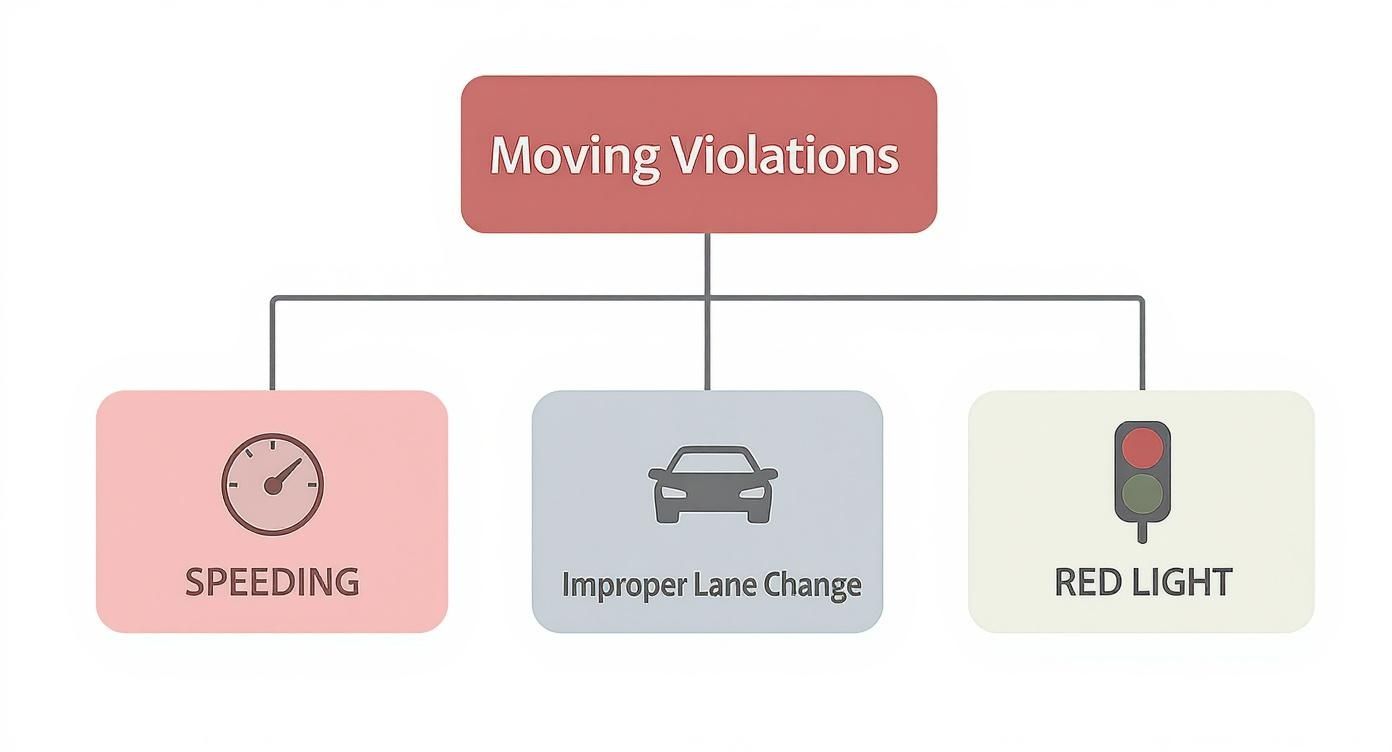
As you can see, simple things like speeding, making a sloppy lane change, or pushing a yellow light are the fast track to accumulating points and putting your license in jeopardy.
Understanding Point Values for Common Offenses
Not all violations are created equal. The number of points you get depends on how serious the offense is. A minor speeding ticket, for instance, carries fewer points than a more reckless move, but every single point matters. The Florida Department of Highway Safety and Motor Vehicles (FLHSMV) sets these values, and they're applied consistently across the state after a conviction.
For example, getting caught going 15 MPH or less over the speed limit will land you 3 points. But if you're clocked at 16 MPH or more over, that jumps to 4 points. And as you can imagine, violations that cause a crash come with even steeper point penalties.
It's critical to remember these points don't just disappear. They stick to your record for a long time, impacting everything from your insurance premiums to your simple ability to get behind the wheel. For a deeper dive into the specifics, check out our complete guide to the Florida traffic ticket point system.
To give you a clearer picture, here’s a quick look at the points tied to some of the most frequent moving violations in Florida.
Florida Traffic Violation Point Values
This table breaks down common traffic offenses and shows exactly how many points a conviction will add to your Florida driver's license.
Violation Type | Points Assigned |
|---|---|
Speeding (15 MPH or less over the limit) | 3 Points |
Speeding (16 MPH or more over the limit) | 4 Points |
Speeding resulting in a crash | 6 Points |
Running a red light or stop sign | 4 Points |
Moving violation resulting in a crash | 4 Points |
Reckless driving | 4 Points |
Leaving the scene of an accident with property damage > $50 | 6 Points |
Improper lane change | 3 Points |
Violation of a traffic control device | 4 Points |
Open container of alcohol | 3 Points |
Child restraint violation | 3 Points |
As you can see, even seemingly minor tickets add up, pushing you closer to a potential suspension.
The Thresholds for License Suspension
The point system really flexes its muscle. The FLHSMV doesn’t just log points; it actively watches how many you collect within specific windows of time. If you hit a certain number, it triggers an automatic license suspension, taking you right off the road.
Key Takeaway: It’s not about one single ticket. It’s the cumulative effect of multiple moving violations over time that poses the biggest threat to your license.
Here are Florida's suspension tripwires:
12 points within 12 months will get you a 30-day suspension.
18 points within 18 months leads to a 3-month suspension.
24 points within 36 months means a painful 1-year suspension.
These aren't just warnings; they're mandatory. The moment you cross that line, your driving privileges are revoked. That's why addressing every ticket matters. A simple 3-point violation could be the very one that pushes you over the edge, leaving you unable to drive to work, school, or take care of your family. Our goal is to protect your license and record. Past results do not guarantee future outcomes.
The Financial Impact of a Moving Violation
The cost of a moving violation in Florida is usually a stack of separate consequences, not one number. There is the ticket itself, possible court costs, potential traffic school expenses, points on your record, and the insurance effect that can outlast the fine by several policy periods.

What You May Pay Up Front
Ticket amounts vary by county, speed, and charge level. In practice, the same category of citation can cost more in one situation than another once mandatory assessments and local costs are added. If you elect a driver improvement course, Florida also allows clerks to charge an election fee and you still pay for the course itself through an approved provider, as outlined by FLHSMV's driver improvement information.
The Point Cost Can Become a License Cost
The larger issue is often not the fine but what the conviction does to your record. Florida's point system assigns many ordinary traffic convictions 3 points, more serious moving convictions 4 points, and some severe or crash-related violations 6 points under section 322.27. Once points accumulate, a driver can reach suspension thresholds much faster than expected.
Florida also separately identifies repeat moving-offense patterns in its habitual traffic offender law, section 322.264. That matters because a “small” ticket is not always small when it lands on top of an already active record.
Insurance Usually Outlasts the Fine
Insurers care about convictions because they use driving history to price risk. A moving violation can affect premiums well after the court case ends, and for many drivers that is the most expensive part of the ticket. We regularly see people focus on saving time by paying immediately, then get frustrated when the insurance renewal reveals the impact months later.
Traffic School Has a Cost and a Limit
Traffic school can be useful, but it is not free and it is not unlimited. Florida's election rules are set out by FLHSMV and local clerk procedures: eligibility depends on the offense and your prior elections, and electing school does not erase the event from every possible record in the way many drivers assume.
Why This Matters in Real Dollars
Take a realistic example. A driver with a clean record gets a 3-point ticket and pays it. The immediate hit is the fine and related costs. The less visible hit may be years of higher insurance pricing. Now compare that with a driver who already has prior points: another 3-point conviction may move that person meaningfully closer to a suspension window, which can create work, family, and transportation problems far beyond the court payment.
That is the practical answer to “how bad is a moving violation?” For some drivers it is inconvenient. For others, especially repeat-ticket drivers or people who depend on driving for work, it can become a record and income problem very quickly.
Your Options After Getting a Florida Traffic Ticket
Florida traffic tickets come with a decision deadline. In most standard cases, you have 30 days to choose a response through the clerk or court process. The three usual paths are to pay the ticket, elect traffic school if eligible, or contest the citation. Florida's uniform traffic citation information from FLHSMV and county clerk procedures control the mechanics, but the strategic question is simpler: which option best protects your record at a reasonable cost?
From our review of common driver mistakes, two assumptions cause the most regret: people assume paying is harmless because the fine looks manageable, and they assume traffic school wipes everything clean. Neither is reliably true.
Option 1: Pay the Ticket
Paying is the fastest option administratively, but it is also the one many drivers misunderstand. In ordinary traffic cases, payment functions as an admission and resolves the citation as a conviction or equivalent disposition for licensing purposes. That usually means the case ends quickly, but the points and insurance consequences begin.
Paying can make sense when the violation is minor, the driver is not point-sensitive, and the long-term record impact is acceptable. It is a riskier choice when the driver already has points, drives for work, holds a commercial license, or has reason to think the citation is factually weak.
Option 2: Elect Traffic School if Eligible
Florida permits eligible drivers to elect a basic driver improvement course in many non-criminal cases, subject to limits described by FLHSMV's traffic school rules. The benefit is usually that points are withheld for that ticket if the election is properly made and completed.
What traffic school does not do is make the ticket cost-free or universally invisible. You still pay the underlying obligation and course-related costs, and the election is limited by prior use. In client consultations, we often hear some version of “I thought school erased the record.” That is too broad. It can protect against points in the right case, but it is not the same as a dismissal.
Traffic school is often worth considering for drivers who are eligible, have a straightforward citation, and mainly want to avoid points from a one-off infraction.
Option 3: Contest the Citation
Contesting means pleading not guilty and requiring the state to prove the case. This path is often worth considering when the record stakes are high or the facts are questionable. Common reasons include:
you already have prior points,
you are highly sensitive to insurance increases,
you hold a commercial license,
the officer's account may be incomplete or mistaken,
the stop, identification, or equipment basis looks questionable,
you live out of state and do not want an avoidable Florida conviction reported home.
This is also the only path that can lead to outcomes such as dismissal, amendment to a lesser charge, or another negotiated resolution that better protects the record. Learn more about how violations influence insurance risk.
A Simple Decision Framework
Use this quick framework before you choose:
Pay if convenience matters most and you can absorb the record impact.
Elect school if you are eligible and your priority is avoiding points on a routine non-criminal ticket.
Contest if the facts are debatable or the downstream consequences are too expensive to accept casually.
We frequently see drivers underestimate the out-of-state and insurance angles. A ticket that feels routine in the moment can matter much more if your employer checks your record, your insurer reprices aggressively, or your home state takes action after Florida reports the disposition.
How a Traffic Attorney Can Help Protect Your Record
Let's be honest, navigating Florida's traffic court system by yourself is a confusing and often intimidating experience. When you see those flashing lights and get a ticket, the easiest thing seems to be just paying the fine to make it go away. But many drivers do not realize that paying the fine is the same as pleading guilty, and that’s when serious consequences kick in.
A law firm that focuses on traffic defense can make a world of difference.

Hiring an attorney completely changes the game. Suddenly, the burden of court dates, legal paperwork, and talking to the judge is no longer on your shoulders. A professional takes over the entire process for you. Our goal is to protect your license and driving record by fighting for the best possible outcome in your specific case. Of course, past results don't guarantee future outcomes, but we bring our experience to every case.
Handling the Legal Process for You
One of the biggest reliefs of working with a traffic attorney is having someone in your corner who understands the system inside and out. We immediately get to work scrutinizing every last detail of your citation, looking for procedural mistakes, technical errors, or weak spots in the evidence.
An experienced lawyer can spot issues you would almost certainly miss, such as:
The officer writing down incorrect information on the ticket.
The speed detection equipment (radar or laser) not being properly calibrated.
A simple lack of solid evidence to back up the officer's claim.
From filing the right documents to speaking directly with the court and the state, your attorney handles all the administrative headaches. For the vast majority of our clients, this means they never have to set foot in a courtroom. Think about that—no time off work, no lost wages, and a lot less stress.
Our Goal: To protect your license and record. We handle criminal traffic matters across Florida, aiming to minimize penalties such as points and insurance increases, so you can keep moving forward.
Working Toward a Better Outcome
A good attorney isn't there to make empty promises; they're there to secure a much better result than you could likely get on your own. By using their legal know-how and courtroom experience, they can effectively challenge the ticket from multiple angles.
Depending on the facts of your case, a "better outcome" could look like a few different things:
Seeking a Dismissal: Finding a strong legal reason to have the ticket thrown out completely.
Negotiating Reduced Charges: Arguing to get the violation knocked down to a lesser offense, often a non-moving violation that carries zero points.
Minimizing Penalties: Fighting to keep points off your license and prevent the painful insurance rate hikes that almost always follow a conviction.
Deciding whether to hire legal help is a big step. If you're on the fence, our guide on whether you need a lawyer for a traffic ticket offers some more helpful perspective.
Our practice is focused on traffic and DUI defense throughout Florida. We invite you to contact us for a Free Consultation to talk about your case. Please know that submitting information through our website contact form does not create an attorney-client relationship.
Attorney Advertisement. Office in Broward.
Frequently Asked Questions
What is the most common moving violation?
Speeding is the clearest and most common example. It is a moving violation because the offense is based on how the vehicle was being driven, and Florida assigns points to speeding convictions depending on severity.
What is not a moving violation?
Parking tickets are the classic non-moving example. Other common non-moving or administrative examples include expired registration and many equipment-related citations. But some edge cases depend on the exact charge, so the safest approach is to read the statute number on the ticket rather than rely on the officer's roadside shorthand.
How bad is a moving violation?
It depends on the offense and your record. A first routine ticket may mean a fine, possible points, and a later insurance increase. A repeat citation can move you toward suspension thresholds under Florida's point system, which is why the same type of ticket can be minor for one driver and disruptive for another.
What is considered a moving violation in Florida?
In Florida, the practical answer is any traffic offense based on operating the vehicle in motion or in traffic, such as speeding, running a red light, failing to yield, following too closely, or making an improper lane change. The point consequences are set by Florida's licensing laws, especially section 322.27.
Does a moving violation always add points?
No. Many do, but not every outcome leads to points. The exact offense matters, and so does how the ticket is resolved. Eligible drivers who elect traffic school in the right case may avoid points, and some contested tickets are reduced or dismissed.
What happens if I have an out-of-state license?
Do not assume a Florida ticket stays in Florida. Florida participates in interstate reporting, and the state recognizes the Driver License Compact. A Florida conviction or unresolved citation can still affect your home-state driving status depending on that state's rules.
For many drivers, the practical risk is not just the Florida court date; it is the possibility that the result follows them home. That is one of the most common reasons out-of-state drivers choose to address the citation carefully rather than ignore it.
For a free consultation to discuss your situation, visit Ticket Shield.
Attorney Advertisement. Office in Broward. Past results do not guarantee future outcomes. Submitting information via our website does not create an attorney-client relationship.