Florida Traffic Stops: Do You Have to Sign Traffic Tickets and What Are Your Rights?
Find out if do you have to sign traffic tickets in Florida and learn what signing means, the risks of refusal, and protecting your rights.
Getting pulled over in Florida is stressful enough without the added confusion of what to do with that pen and ticket the officer is handing you. Let's clear one thing up right away: in almost every situation, you are required to sign a traffic ticket.
But here's the part that trips everyone up. Your signature is not an admission of guilt. Signing doesn't mean you agree with the officer; it's simply your promise that you'll deal with the citation by the deadline.
Understanding What Your Signature Means

When an officer asks for your signature after a stop in Miami-Dade or anywhere else in Florida, it can feel like a high-pressure trap. A lot of drivers make the mistake of thinking that signing the ticket is the same as pleading guilty. This is a common and incredibly costly myth.
Think of it like signing for a package. Your signature doesn't mean you love what's inside; it just proves you received it. Signing a traffic ticket works the same way. It's a formal acknowledgment that you have the citation in hand and you promise to take action.
The Legal Purpose of a Signature
The legal system needs a way to make sure drivers don't just toss tickets in the glove box and forget about them. Your signature serves as a formal agreement—a promise to appear—that you will handle the ticket within the required timeframe, which is usually 30 days in Florida.
By signing, you're just agreeing to do one of three things later:
Pay the fine.
Elect to attend a driver improvement course (traffic school).
Plead not guilty and set a date for a hearing in traffic court.
This whole process is about holding you accountable for responding to the ticket, not for the violation itself at that moment. You can get a better sense of how different citations are handled by checking out the broader Florida state traffic laws that govern these procedures.
Signing Is Not a Confession
This is worth repeating: an officer cannot use your signature against you in court as evidence of guilt. It's a purely procedural step.
By signing the ticket, you are keeping all of your options on the table. It preserves your right to fight the citation later, giving you time to cool off and decide on your best course of action after the stress of the traffic stop is over.
To make this crystal clear, here’s a quick breakdown of what your signature really means compared to the alternatives.
Your Signature on a Florida Ticket: A Quick Guide
This table clarifies what your signature on a traffic ticket means versus the potential outcomes of refusing to sign or choosing to fight the citation.
Action | What It Means Legally | Immediate Consequence | Your Next Steps |
|---|---|---|---|
Signing the Ticket | Acknowledging receipt and promising to respond within 30 days. | The traffic stop ends, and you can drive away. | Decide whether to pay, elect traffic school, or hire an attorney to assist with the ticket. |
Refusing to Sign | A first-degree misdemeanor criminal offense under Florida law. | Immediate arrest, potential jail time, and a separate criminal charge. | You'll need to post bail and seek legal counsel for the new charge. |
Fighting the Ticket | Pleading not guilty to the violation listed on the citation. | You preserve your rights and avoid admitting guilt. | Hire a traffic law firm to represent you in court and work toward a favorable outcome. |
As you can see, the simple act of signing is the standard, required step that keeps a minor traffic stop from blowing up into a much more serious legal headache. Refusing to sign, on the other hand, instantly escalates the situation and introduces severe, immediate consequences. It’s a crucial part of navigating the traffic stop while protecting your rights for the road ahead.
Attorney Advertisement. Office in Broward. Past results do not guarantee future outcomes.
The Serious Consequences of Refusing to Sign
While signing a ticket is a simple, routine step, refusing to do so instantly transforms a roadside stop into a serious legal problem. In Florida, this isn't seen as a simple disagreement with the officer—it's a direct violation of state law. The act of declining to sign escalates a civil traffic infraction into a second-degree criminal misdemeanor.
This gives the officer the legal authority to arrest you right then and there. The logic behind this strict rule is to make sure every driver formally acknowledges their responsibility to respond to a citation one way or another. It’s not about the traffic violation itself; it’s about your failure to comply with a lawful order and the established legal process.
From a Civil Infraction to a Criminal Charge
It's critical to understand the difference between civil and criminal offenses. A standard speeding ticket is a civil infraction, something typically handled with fines and points. A second-degree misdemeanor, however, is a criminal charge that creates a permanent criminal record if you are convicted.
This escalation brings a whole new set of problems to the table:
Immediate Arrest: You can be taken into custody directly from the roadside.
Criminal Record: A conviction means you will have a criminal history, which can seriously impact future employment and housing opportunities.
Separate Penalties: You will face penalties for the misdemeanor charge in addition to any penalties for the original traffic violation.
A decision to refuse a signature is often made in a moment of frustration, but it carries lasting consequences that far outweigh the initial traffic offense. It's a choice that hands law enforcement the immediate power to escalate the situation significantly.
The Myth of Making the Ticket Disappear
A common but dangerous myth is that refusing to sign makes the ticket invalid. This is completely false. The ticket remains valid, but now you have a much bigger problem on your hands. This misconception has become more notable as traffic enforcement patterns have shifted. While one might think fewer tickets are being issued, that doesn't change the rules of a traffic stop.
In fact, recent research analyzing court records from January 2019 to January 2023 shows traffic citations have actually dropped 13% nationally, a trend observed across Florida's 67 counties, including Miami-Dade. You can discover more insights about this traffic enforcement research and its surprising link to driving fatalities.
Ultimately, signing is the only safe and legally sound choice. It protects you from immediate arrest and preserves your right to challenge the ticket later. By signing, you keep the issue a simple traffic matter, which is far easier—and less damaging—to resolve than a criminal charge.
Navigating Your Options After You Get a Ticket
Once you’ve signed and received your traffic ticket, a crucial 30-day clock starts ticking. This is your window to make a decision that can have lasting effects on your driving record and insurance rates. Many drivers in Florida feel pressured to just pay the fine to get it over with, but that is rarely your best move.
You have three distinct paths you can take, and the one you choose matters. Understanding the pros and cons of each is the first step toward protecting your record. Rushing into a decision can lead to points on your license and years of higher insurance premiums.
Understanding the Three Main Choices
After getting a ticket, whether you're in a busy place like Miami-Dade County or on a quiet rural road, every Florida driver has the same set of options. Your signature on that ticket was your promise to pick one of these paths within that 30-day period.
Pay the Fine: This is the fastest option, but it's also a direct admission of guilt. Paying the fine closes the case but will add points to your driver's license for most moving violations.
Elect Traffic School: If you're eligible, you can opt to attend a driver improvement course. Completing the course lets you avoid points on your license, though you still have to pay the ticket fine and the school's fee.
Plead Not Guilty: This means you choose to contest the ticket in court. It’s the only option that gives you a chance at getting the ticket dismissed entirely, which means avoiding both the fine and the points.
The following flowchart breaks down how that initial choice to sign or refuse a ticket leads down these very different roads.
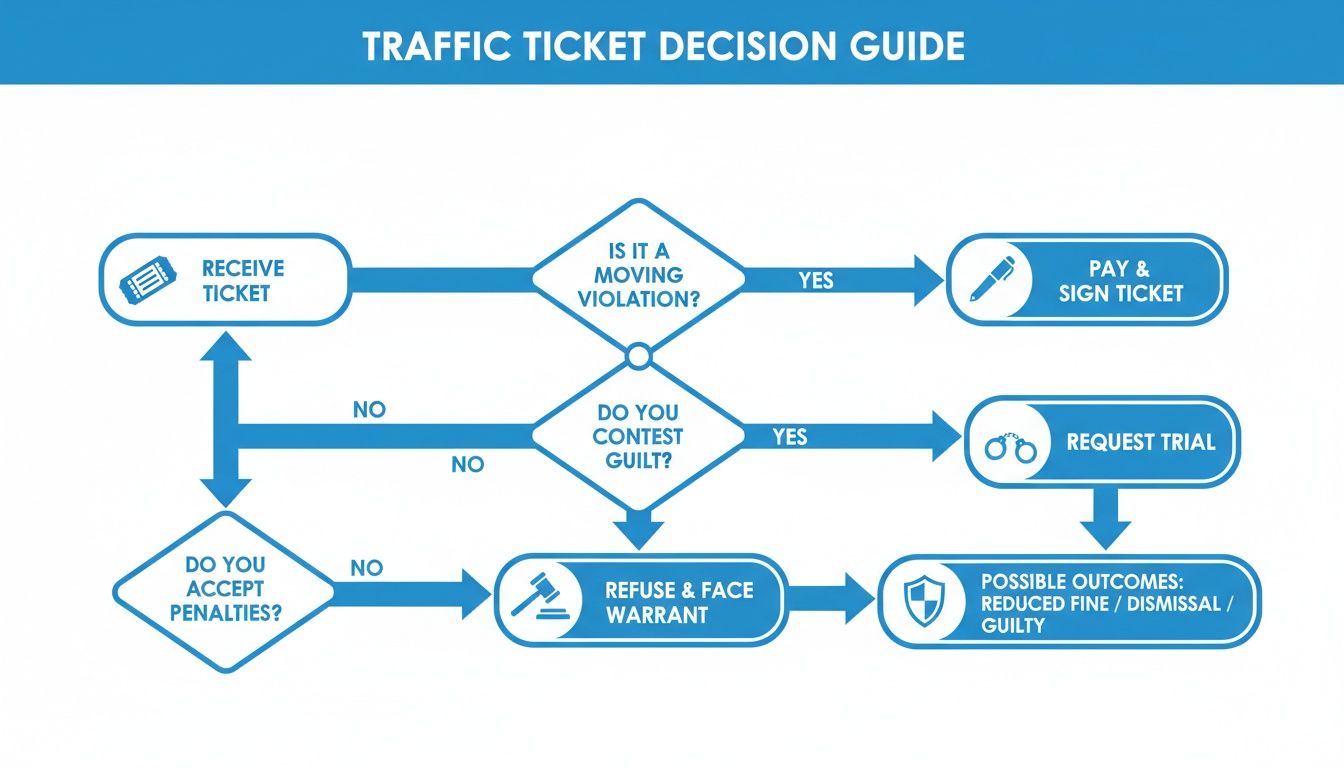
As you can see, signing the ticket keeps your options open. Refusing to sign, on the other hand, leads straight to a negative outcome.
Weighing the Long-Term Consequences
The most important factor to consider here is the long-term cost. While paying a $150 fine might not seem like a big deal, the points that come with it can trigger an insurance rate increase that costs you hundreds—or even thousands—of dollars over the next three to five years. This "ticket tax" is where the real financial penalty hits.
Choosing to fight your ticket is not just about avoiding a single fine; it's a strategic decision to protect your long-term financial health and maintain a clean driving record.
Contesting the ticket is often the most effective way to pursue a dismissal and head off these cascading consequences. Before you make a final choice, it's smart to learn more about whether you should fight your traffic ticket, as the benefits frequently outweigh the initial costs. An attorney can handle the entire court process for you, working toward the best possible outcome for your specific situation.
How a Ticket Impacts Different Florida Drivers
A traffic ticket is never just a piece of paper, but its impact varies dramatically depending on who’s behind the wheel. For some Florida drivers, the consequences of a single citation can spiral far beyond a simple fine, threatening their livelihood or their very privilege to drive.
While every driver has to decide what to do after signing their ticket, the stakes are far higher for certain groups. What might be a minor headache for a daily commuter could be a career-ending event for a commercial truck driver. Understanding these unique risks is the first step toward a smart defense.
Commercial Drivers (CDL Holders)
For anyone holding a Commercial Driver's License in Florida, the rules of the game are completely different. CDL holders are the lifeblood of our economy, moving goods through major hubs like Miami-Dade, but they are held to a much stricter standard under both state and federal law.
A conviction for a serious traffic violation can lead to a CDL disqualification, making it impossible to work. Even seemingly minor infractions, like a simple speeding ticket, pose a huge threat. Unlike regular drivers, CDL holders often can't just elect traffic school to keep points off their record, making every single ticket a direct hit to their professional license.
Young and Teen Drivers
Florida's Graduated Driver Licensing (GDL) program keeps a very tight leash on drivers under 18. The state uses a near-zero-tolerance approach to points for young drivers, meaning even one ticket can have surprisingly severe consequences.
A driver under 18 who racks up just six points in a 12-month period will have their license automatically restricted to "Business Purposes Only" for an entire year.
If they accumulate any more points, a full suspension is right around the corner.
This system is designed to correct risky behavior early on, but it also means one mistake can quickly sideline a young driver, complicating school, work, and family life.
Out-of-State Drivers
If you get a ticket while visiting the Sunshine State, you can't just leave it behind when you cross the state line. Florida is a member of the Driver's License Compact, an agreement between states to share driver information and traffic violations.
This means a ticket you receive in Florida will almost certainly be reported back to your home state's DMV. Your home state will then apply its own penalties, often adding points to your license just as if the violation happened on your own street.
Ignoring a Florida ticket is simply not an option. It will follow you home and will very likely lead to your license being suspended in your own state. To get a better sense of how these violations can haunt your record, read our guide on how Florida points on a license can have long-lasting effects. Because of these heightened risks, seeking legal guidance is often a critical step for these specific groups of drivers.
How a Traffic Attorney Can Defend Your Rights
Trying to navigate Florida's complex traffic court system on your own can feel like a confusing, time-consuming nightmare. When you're facing a citation, bringing in a law firm that focuses its practice on traffic defense can shift the situation in your favor. It's about more than just showing up to court; it's about strategic legal work designed to protect your driving record.
An attorney from a firm that handles traffic matters can manage the entire process for you. That includes filing the right legal documents, dealing with the court, and handling all the necessary appearances. In fact, more than 99% of our clients never have to set foot in a courtroom.
Protecting Your License and Record
Our goal is to protect your license and record. A clean record is the key to keeping your insurance rates from skyrocketing and ensuring your driving privileges stay intact. We work to achieve a favorable result for your specific situation.
We get this done through several key strategies:
Seeking a Dismissal: We meticulously review every detail of your ticket, looking for technical errors, procedural mistakes, or weak evidence that could lead to the charges being thrown out completely.
Negotiating Reduced Penalties: When a dismissal isn't an option, our focus shifts to negotiating a better outcome. This could mean a reduced fine or getting the ticket amended to a non-moving violation that carries zero points.
Avoiding Points: We explore every single avenue to help you avoid points on your license. Those points are the trigger that sends your insurance premiums through the roof.
This proactive approach is essential whether you got your ticket in a busy area like Miami-Dade County or a quieter part of the state.
Our goal is to protect your license and record. While every case is unique, professional legal representation ensures your rights are defended at every stage, providing peace of mind and working towards a more favorable outcome.
A Smarter Path Forward
Hiring a traffic attorney is an investment in protecting your long-term financial health and driving privileges. The cost of legal help is often far less than the combined hit of the ticket fine and the multi-year insurance rate hikes that usually follow a conviction.
Instead of trying to navigate the legal maze alone, you can have a dedicated professional fighting for you. If you're still on the fence, our firm provides detailed information on why you might want to explore whether you need a lawyer for a traffic ticket. Taking that step can be the difference between a minor headache and a problem that follows you for years.
Attorney Advertisement. Office in Broward. Past results do not guarantee future outcomes.
Frequently Asked Questions About Florida Tickets
Getting a traffic ticket can be confusing, and it's easy to make a mistake if you don't know the rules. We hear the same questions from drivers all the time. Here are some straightforward answers to help you figure out your next move.
If I Sign a Ticket in Miami-Dade Can I Still Fight It?
Yes, you absolutely can. Signing a ticket in Miami-Dade, or anywhere else in Florida, is not an admission of guilt. This is one of the most common myths out there.
Think of your signature as just a receipt. You are simply acknowledging that you received the citation and promising to deal with it within the required 30-day timeframe. It does nothing to waive your rights. You can still plead not guilty and challenge the ticket in court. An attorney can handle this entire process for you, so you never have to worry about missing a deadline.
What Happens If I Miss the 30-Day Deadline to Respond?
Ignoring the 30-day deadline is a serious mistake with very real consequences. If you fail to respond in time, the court will likely find you guilty by default. This means you'll be on the hook for the full fine, plus some hefty late fees.
But it gets worse. The court will then tell the Florida Department of Highway Safety and Motor Vehicles (DHSMV) to suspend your driver's license. Driving on a suspended license is a criminal offense. If you've already missed the deadline, you should contact a traffic attorney immediately to see what can be done to resolve the ticket and restore your driving privileges.
Your signature on a ticket starts a 30-day clock that must be respected. Missing this deadline complicates the situation immensely, often leading to a suspended license and additional financial penalties that are far more severe than the original ticket.
Is It Worth Hiring an Attorney for a Minor Speeding Ticket?
Even a ticket that seems "minor" can end up costing you a lot more than you think. The biggest mistake people make is just paying the fine to get it over with. Paying the fine is pleading guilty, which usually means points get added to your license.
Those points are exactly what your insurance company looks for. Once they see a conviction, your rates are likely to go up—and stay up for several years. When you do the math, that multi-year insurance hike can easily cost you more than the original fine. To get a better feel for the timeline, you can learn more about how long traffic tickets stay on your record in our detailed guide.
The fee for hiring an attorney is often less than the total cost of the fine and the insurance premium increases combined. An attorney's goal is to protect your record from points, which keeps your driving history clean and saves you a significant amount of money in the long run. Our firm's practice focuses on traffic and DUI defense across Florida, and our goal is to achieve a more favorable outcome for our clients. Past results do not guarantee future outcomes.
At Ticket Shield, PLLC, our goal is to protect your license and record. We handle the entire process so you don't have to, with over 99% of our clients never needing to appear in court. Submitting information via our forms does not create an attorney-client relationship. For a free consultation to discuss your case, visit https://www.ticketshield.com.