Florida Traffic Ticket Cost: Fines, Fees, and Real Numbers
Learn the real Florida traffic ticket cost, from base fines and court fees to surcharges and insurance hikes, plus strategies to reduce what you actually pay.

A Florida traffic ticket can cost roughly $1,100 to $2,500 or more over three years after insurance increases, court costs, surcharges, and related fees. The statutory fine printed on the citation may look closer to $25 to $250, but that amount is only the starting point.
Florida traffic ticket cost depends on the violation, the county, whether you resolve it on time, and what happens to your license record. A speeding citation that appears manageable today can create years of higher insurance premiums, points, administrative fees, and suspension risk. You should evaluate the ticket as a financial and licensing problem, not just a bill.
Table of Contents
What a Florida Traffic Ticket Really Costs You
The amount on the citation is usually the smallest part of the financial exposure. Neutral consumer reporting places the potential three-year ownership cost of a typical speeding ticket at roughly $1,100 to $2,500 or more once insurance increases are included, while the initial payable amount may sit in the roughly $113 to $303 range depending on the speed and county fee schedule. Florida traffic ticket cost information illustrates why drivers who focus only on the printed fine often underestimate the final bill.
Florida insurance carriers can treat a moving violation as a risk signal for several renewal cycles. The exact premium effect depends on the insurer, the policy, and the driver's record, so you shouldn't assume that paying quickly will prevent an insurance consequence. The ticket can still affect the motor-vehicle record that insurers review.
Cost Component | Typical Amount | Time Frame |
|---|---|---|
Statutory fine | $25 to $250 for common speeding tiers | Immediate |
County court costs and surcharges | Varies by county and citation | When the citation is paid |
Insurance impact | Roughly $1,100 to $2,500 or more in documented three-year ownership cost | About three years |
License administration | Varies with points, suspension, and compliance status | Until the record is resolved |
Your driving behavior also matters. Resources such as Fleetalyse behaviour analytics can help drivers and fleet managers understand how driving patterns create enforcement and risk exposure, but it can't resolve a citation or protect your Florida license.
Practical rule: Before you pay, find out whether the ticket adds points and whether you're eligible for a resolution that protects your record.
The better question isn't “How much is the ticket?” It's “What will this citation cost me after the county collects its fees and my insurer reviews the conviction?” For a focused breakdown of common citation amounts, review Florida speeding ticket prices before choosing a response.
The Florida Statutes That Set the Fine Schedule
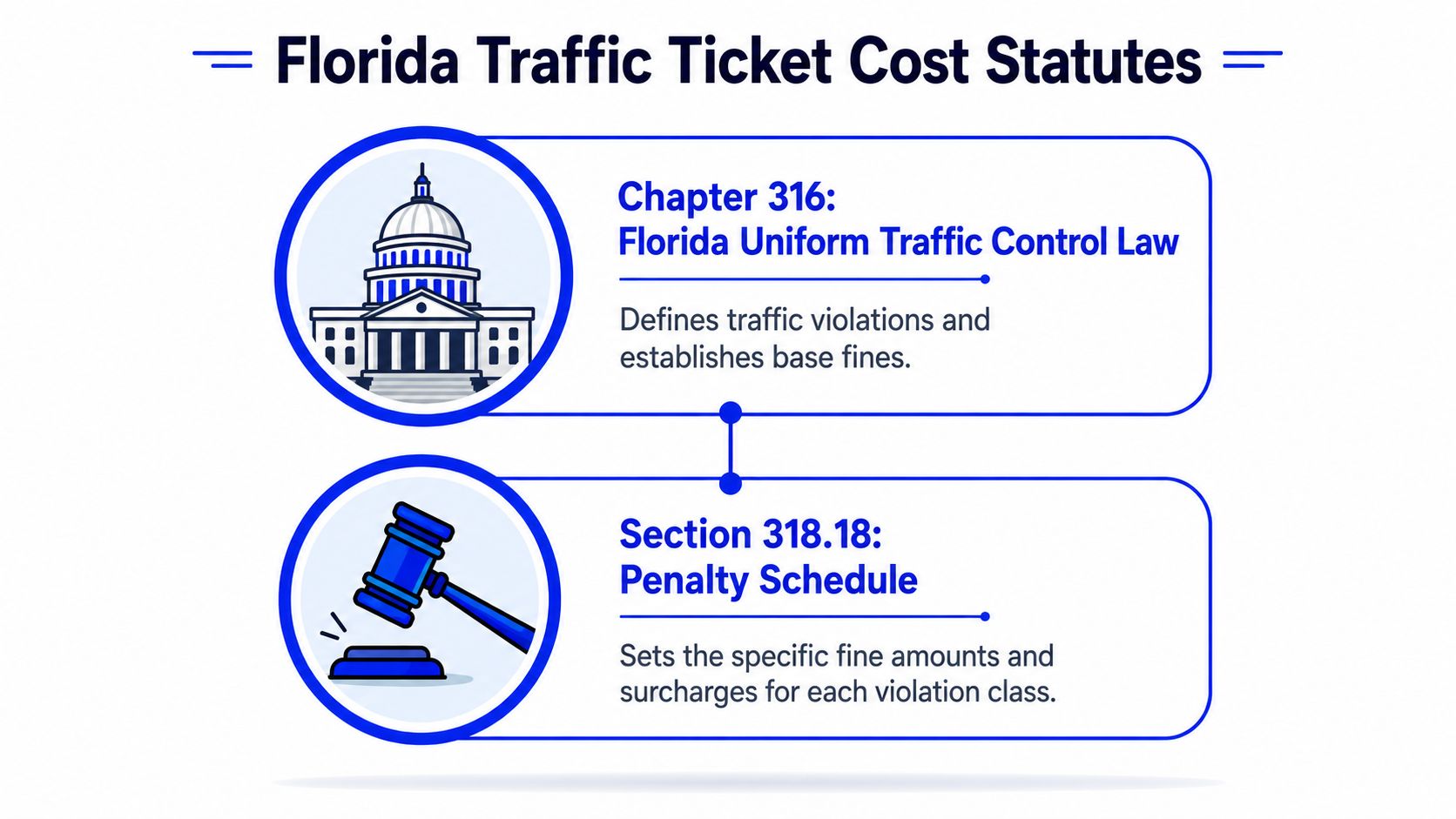
Florida traffic offenses begin with Chapter 316 of the Florida Statutes, the State Uniform Traffic Control chapter. It defines the conduct that can result in a citation, including speeding and reckless driving. The governing chapter is available through the Florida Statutes Chapter 316 contents.
Chapter 318 controls the disposition of traffic infractions, including the penalty schedule in Section 318.18. That distinction matters. Chapter 316 tells you what conduct is prohibited. Section 318.18 helps determine the base civil penalty attached to the violation class.
For speeding, Section 318.18 lists base fines of:
$25: Six to nine miles per hour over the limit.
$100: Ten to fourteen miles per hour over.
$150: Fifteen to nineteen miles per hour over.
$175: Twenty to twenty-nine miles per hour over.
$250: Thirty miles per hour or more over.
$50: Speeding in a school zone up to five miles per hour over the limit.
The statute also permits courts to impose civil penalties after a hearing, including up to $500 for most civil infractions and up to $1,000 for school-zone or construction-zone speeding. A mandatory-appearance case carries a different level of exposure from an ordinary prepaid citation.
Reckless driving is governed by Florida Statute Section 316.192. It isn't just another speeding tier. The classification and possible consequences can be more serious, which is why you should treat a citation alleging reckless driving as a legal matter rather than a routine payment decision. For an accessible overview, see Florida state traffic laws.
Speeding Fine Tiers and Mandatory Court Appearances
Florida's statutory schedule creates different base penalties based on how far above the posted limit the allegation falls. The amount payable can be higher because the clerk collects authorized court costs, service charges, and assessments along with the civil penalty.
MPH Over Limit | Base Fine Range | Court Appearance Required? |
|---|---|---|
Six to nine | $25 statutory base, local schedules may show higher payable totals | Usually no, if otherwise eligible for payment |
Ten to fourteen | $100 statutory base, local schedules may show higher payable totals | Usually no, if otherwise eligible for payment |
Fifteen to nineteen | $150 statutory base, local schedules may show higher payable totals | Usually no, if otherwise eligible for payment |
Twenty to twenty-nine | $175 statutory base, local schedules may show higher payable totals | Usually no, if otherwise eligible for payment |
Thirty or more | $250 statutory base, with separate court exposure | Mandatory court appearance |
A Florida clerk schedule, for example, lists speeding at $128 for six to nine miles per hour over, $203 for ten to fourteen, $253 for fifteen to nineteen, and $278 for twenty to twenty-nine. Those figures show why a driver shouldn't confuse the statutory base fine with the amount required to close the citation. The schedule also identifies thirty miles per hour over the limit as a mandatory court-appearance situation rather than a simple prepaid amount. Florida speeding fine guidance provides another practical reference for reviewing the tiers.
School-zone and construction-zone allegations deserve immediate attention because Florida law allows enhanced civil penalties in those settings. The location, posted signs, and facts on the citation can affect how the case proceeds.
Don't assume that a larger speeding allegation can be handled by mailing a check. If the citation requires a hearing, missing that appearance can create a separate compliance problem. Have the ticket reviewed before selecting a payment option.
Court Costs, Surcharges, and Late-Payment Penalties
Florida's payable amount can exceed the headline fine because the clerk of court collects more than the statutory civil penalty. The Florida Department of Highway Safety and Motor Vehicles explains that elected payment goes to the clerk in the county where the violation occurred, and Florida law authorizes collection of fines, fees, service charges, and court costs through that process. Review the state's Florida traffic citation payment information before sending payment.
For moving violations that don't require a mandatory court appearance, Section 318.18 sets a $60 penalty in the statute's moving-violation schedule and creates a separate $3 surcharge for noncriminal moving traffic violations under Chapter 316. Other citation categories can involve different statutory amounts and county-level charges.
Citation Class | Base Fine | $3 Surcharge | $50 Driver Ed Surcharge | Clerk Service Fee | Late Payment Penalty | Real Total |
|---|---|---|---|---|---|---|
Nonmoving violation | $30 | May apply by citation class | Varies by case | County-specific | $16 if applicable | Higher than base |
Noncriminal moving violation | $60 statutory schedule | $3 | Varies by case | County-specific | $16 if late | Higher than base |
Speeding six to nine over | $25 statutory base | Applicable moving surcharge | County or case dependent | County-specific | $16 if late | County payable amount |
Speeding thirty or more over | $250 statutory base | Case dependent | Case dependent | County-specific | Depends on compliance | Hearing-determined exposure |
Florida law adds $16 when a person fails to comply with court requirements or pay the civil penalties within the statutory thirty-day period. Don't wait until a notice arrives to discover that the amount has changed. The payment deadline is part of the legal problem.
The precise total depends on the county and citation type. A clerk's published schedule may show a speeding amount in the low hundreds even though the statutory base is lower. For a practical discussion of the added charges, see Florida traffic ticket court costs.
Nonmoving Violations and Lower-Cost Citation Classes
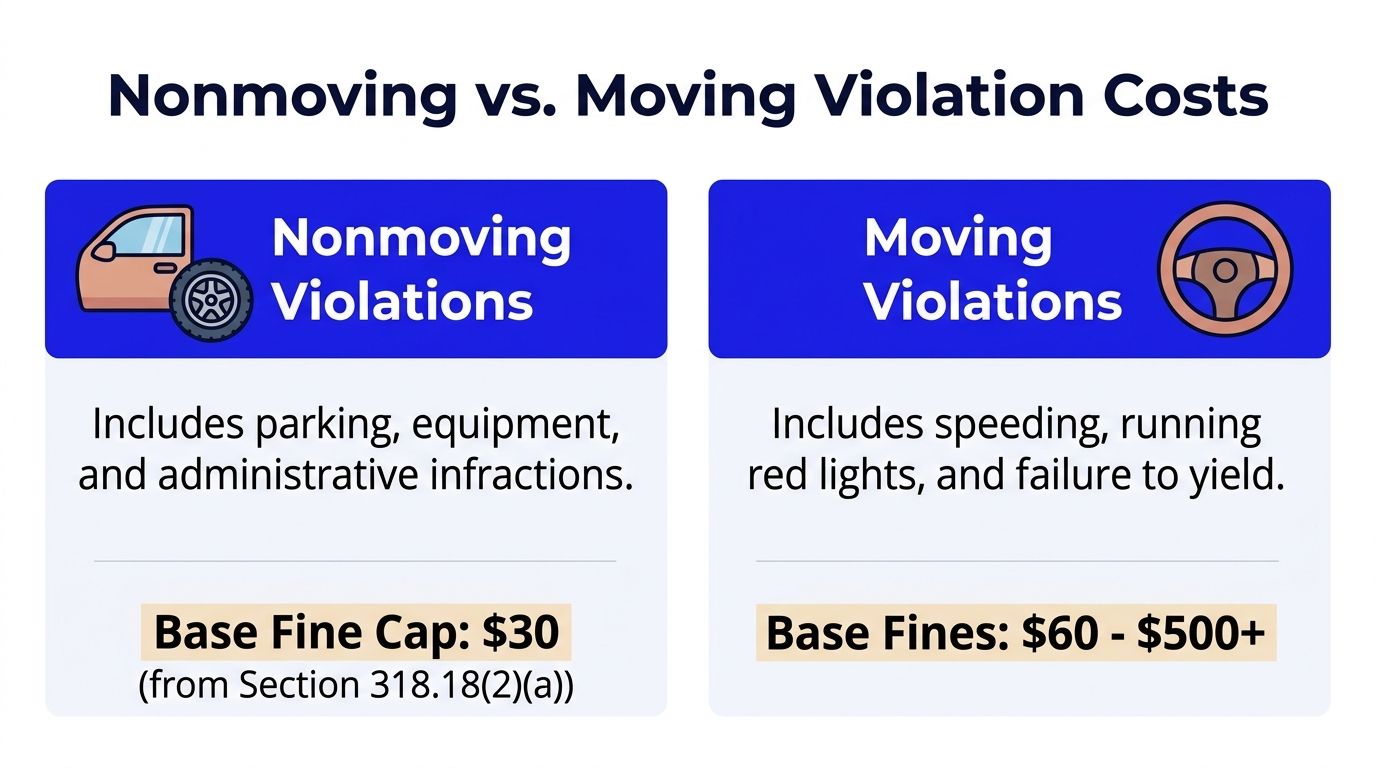
Not every Florida traffic ticket is a moving violation. Section 318.18 sets a $30 base penalty for nonmoving violations, while the statute separately sets $15 for pedestrian-regulation infractions and certain bicycle-related Chapter 316 violations. Those classifications can avoid the moving-violation point structure, but the payable total may still include authorized fees.
A county schedule may also show fixed amounts for administrative problems. Palm Beach County, for example, lists $116 for an expired driver license, registration, or insurance issue and $60 for reinstatement in its traffic violation fee schedule. These are county-published examples, not a single statewide total. Palm Beach traffic violation fees shows why you need to check the clerk for the county involved.
The important distinction is compliance. If your registration, insurance, or license has lapsed, paying the citation may not fix the underlying status. You may need proof, renewal, reinstatement, or another administrative step before you can legally drive.
Review the citation for:
Violation classification: Moving, nonmoving, or administrative.
Compliance requirement: Whether you must renew, provide proof, or correct equipment.
County total: The amount listed by the clerk may exceed the statutory base.
License effect: A low fine doesn't automatically mean low risk.
For a plain-language explanation of the category, see what a nonmoving traffic violation means. Never assume a lower base fine makes an unresolved compliance issue safe to ignore.
Florida Driver Points and Suspension Triggers
Florida's point system turns a citation into a license-management issue. The Florida Department of Highway Safety and Motor Vehicles lists three points for reckless driving and six points for leaving the scene of a crash involving more than $50 in damage. Those examples show how quickly serious moving violations can increase suspension risk. The official Florida point and suspension rules should be your reference for your specific record.
Florida suspension thresholds include:
Twelve points in twelve months: Thirty-day suspension.
Eighteen points in eighteen months: Three-month suspension.
The conviction and the citation aren't interchangeable dates. The way a case is resolved determines what enters the driving record, so you should check your eligibility and options before treating payment as harmless.
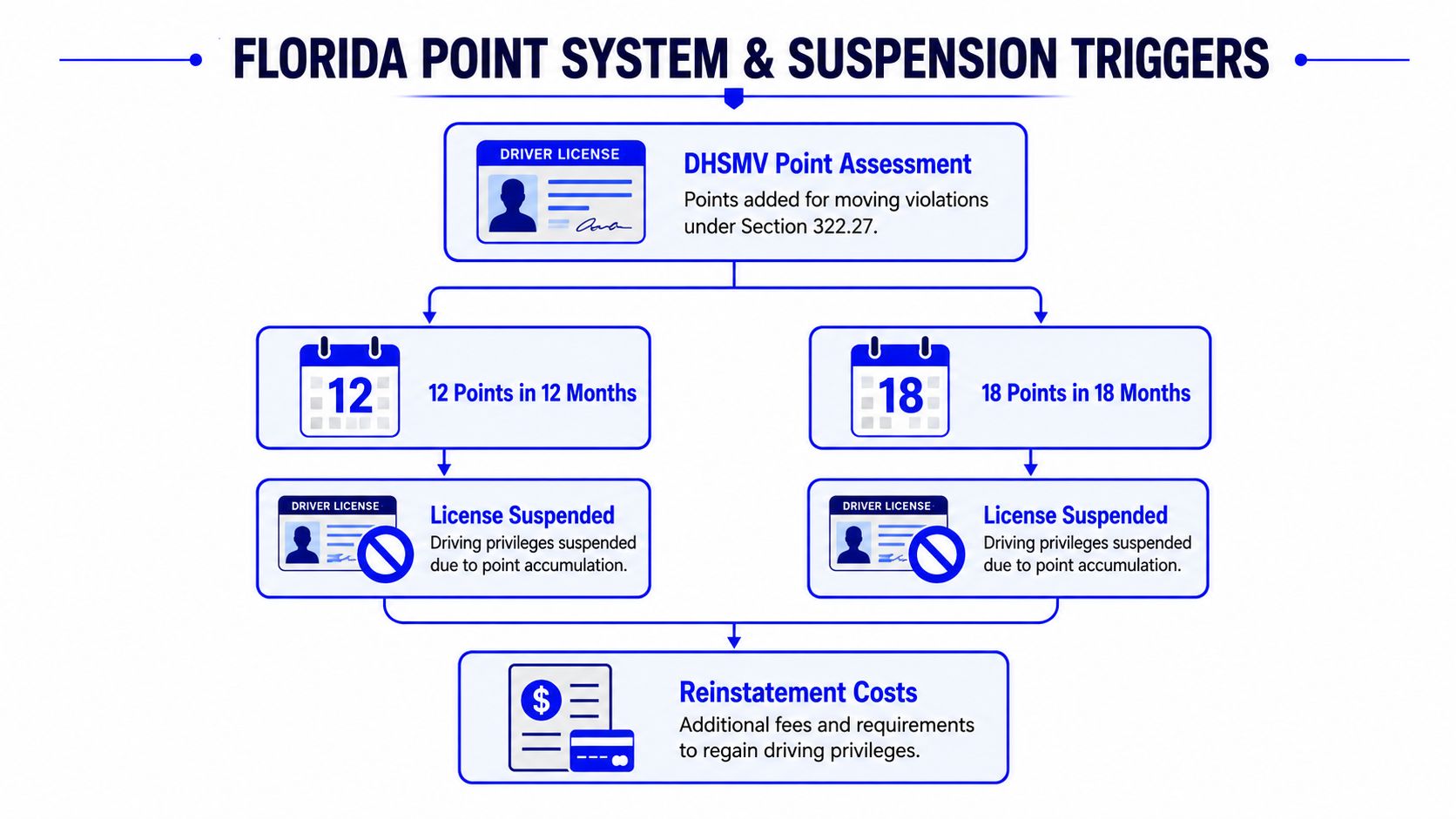
A suspension creates costs beyond the original fine. You may face reinstatement requirements, transportation problems, missed work, and insurance consequences. If your job or family responsibilities depend on driving, the administrative impact can exceed the citation amount.
A ticket near a suspension threshold deserves a record strategy, not an automatic payment.
Check your current point total before choosing a resolution. One new conviction may matter far more to a driver with an existing record than to someone with no recent points.
Insurance Increases That Outlive the Ticket
The insurance bill often becomes the largest part of the Florida traffic ticket cost. Neutral consumer reporting describes a potential three-year cost of roughly $1,100 to $2,500 or more after insurance increases are included. The exact result depends on your carrier, driving history, policy, and violation.
A paid citation can still be reported through the driving record. Paying the clerk doesn't erase the underlying conviction, and it doesn't guarantee that an insurer will overlook it at renewal.
Violation Type | Avg. Surcharge % | 3-Year Extra Cost | 5-Year Extra Cost |
|---|---|---|---|
Routine moving violation | Varies by insurer | Roughly $1,100 to $2,500 or more | May continue beyond three years |
Serious moving violation | Varies by insurer and record | Can be materially higher | Can remain financially significant |
Nonmoving violation | Often no moving-violation surcharge | Depends on the issue | Depends on compliance and insurer |
Don't build your decision around an insurer's assumed percentage. Florida insurers price risk differently, and a precise premium estimate requires your policy information. The reliable point is that a moving conviction can affect multiple renewals, while a nonmoving classification may avoid that particular insurance effect.
At renewal, compare available carriers and ask your insurer how the conviction is being rated. You can also request a review of the driving information used for underwriting. The earlier you protect the record, the more control you retain over the future bill.
Paying the Fine vs Traffic School vs Hiring a Lawyer
You have three practical paths after a Florida traffic citation. The cheapest immediate action isn't always the lowest-total-cost action.
Option | Typical Cost | Time Commitment | Points / Insurance Impact |
|---|---|---|---|
Pay the fine | Citation total plus fees | Limited immediate effort | May create points and future insurance impact |
Traffic school | Course cost and court costs | Course completion before deadline | May prevent points if eligible |
Lawyer-led defense | Firm fee plus applicable court charges | Usually limited client involvement | May seek dismissal, reduction, or a no-points resolution |
Florida law allows eligible drivers to elect a driver-improvement course in appropriate cases. Eligibility depends on the violation, the driver's record, and prior elections, so don't assume traffic school is available just because the citation is civil. Confirm the option and deadline with the clerk or counsel before paying.
Traffic school can be sensible when the driver is eligible and the ticket is otherwise straightforward. It may not be the right choice if the citation carries mandatory court exposure, if your record is already near a suspension threshold, or if you need a strategic challenge to the allegation.
Hiring a lawyer changes the process from a payment decision to a defense evaluation. Counsel may review the citation, identify evidentiary problems, negotiate a reduction, or appear for you when permitted. Ticket Shield, PLLC describes its model as lawyer-led, with clients communicating directly with their attorney by phone or text rather than through automated apps, middlemen, or corporate answering services.
My recommendation: If the ticket threatens points, requires court, or could affect your ability to work, compare the legal fee with the possible multi-year record and insurance cost before you pay.
Reinstatement and Compliance Costs Beyond the Ticket
A suspended or out-of-compliance driver must solve the administrative problem separately from the citation. Paying a fine doesn't automatically restore driving privileges, renew insurance, or correct registration.
Start by confirming the exact status with the Florida Department of Highway Safety and Motor Vehicles. Then identify the reason for the suspension, complete the required compliance step, pay the applicable clerk or reinstatement amount, and verify that the license is active before driving.
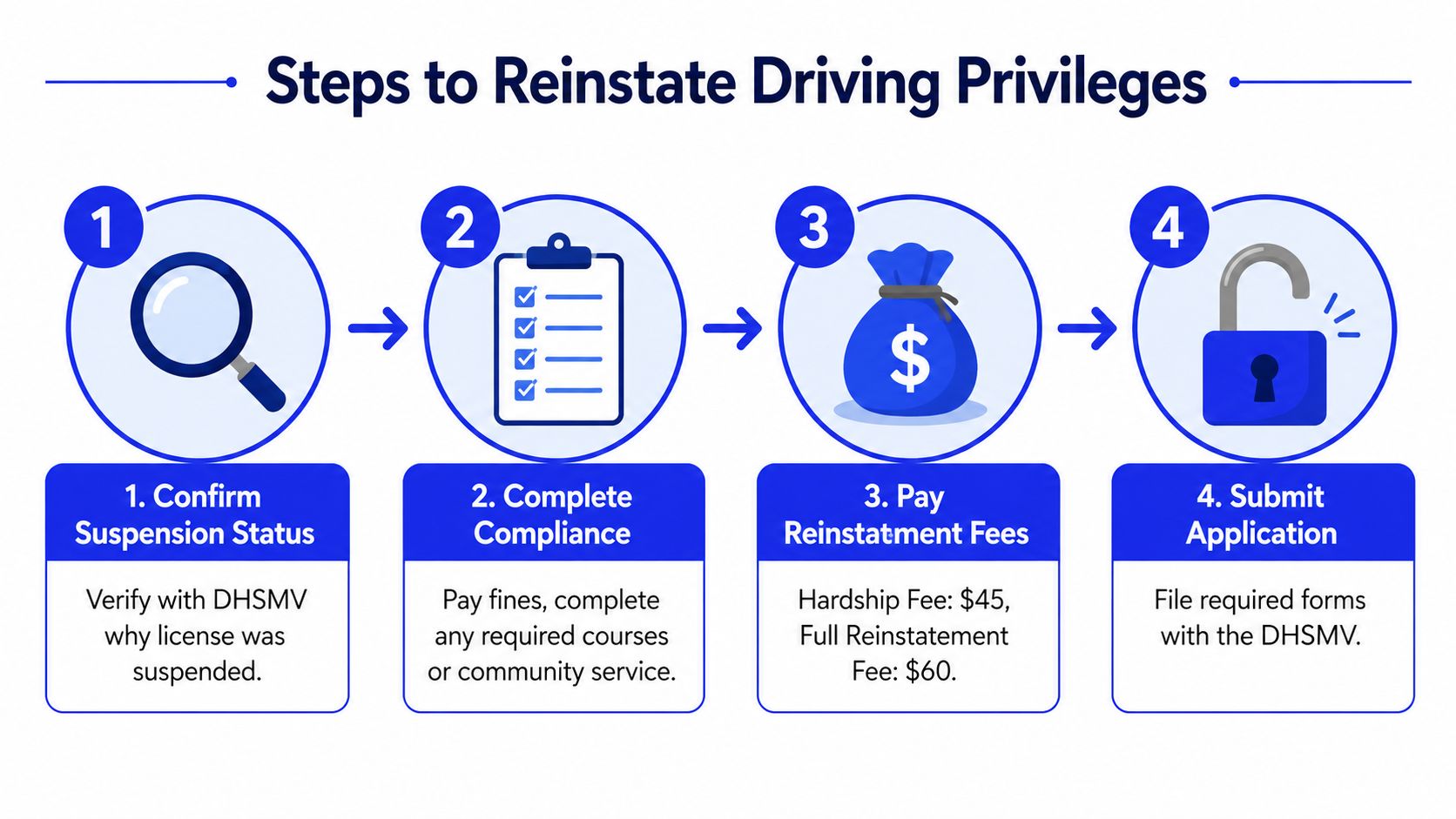
The fees aren't always contained in one invoice. A county clerk schedule may list a separate reinstatement charge, while the state may require proof of insurance, updated registration, or another compliance document. Those obligations can continue even after the citation's civil penalty is paid.
Use this sequence:
Confirm status: Find out whether the issue is a point suspension, unpaid citation, insurance lapse, registration problem, or another hold.
Correct the cause: Renew documents, provide proof, or complete the requirement identified by the state or clerk.
Resolve the citation: Pay or contest the underlying ticket according to its deadline and classification.
Verify activation: Confirm that the driving privilege has been restored before operating a vehicle.
Watch this overview for a visual explanation of the reinstatement process:
If you already have a suspension or lapsed insurance, don't rely on a general article's estimate. Ask the clerk or a Florida traffic attorney which amount resolves the ticket and which amount restores compliance.
Why a Lawyer-Led Defense Changes the Outcome
A lawyer can change the economics of a Florida traffic ticket by changing the resolution, not just by helping you submit payment. Paying the printed amount accepts the citation's consequences. An automated service may handle paperwork, but it may not give you direct access to the attorney evaluating the evidence. A licensed Florida traffic attorney can assess the allegation, negotiate with the appropriate office, and appear when the case requires a hearing.
The defense questions are concrete:
Device records: Was radar or laser equipment properly maintained and documented?
Officer foundation: Can the citing officer explain training, observation angle, and the basis for the speed estimate?
Road conditions: Were the signs visible, accurate, and applicable at the alleged time?
Charge reduction: Can the allegation be resolved as a nonmoving offense or another disposition that protects the license?
Record exposure: How will the proposed outcome affect points, insurance, and suspension risk?
The value isn't guaranteed, and no lawyer can promise a particular result. The decision should compare the legal fee with the potential financial exposure. A few hundred dollars paid for strategic defense may be cost-effective when the alternative includes the roughly $1,100 to $2,500 or more multi-year insurance cost described earlier.
Factor | Pay the Fine | Traffic School | Lawyer-Led Defense |
|---|---|---|---|
Immediate simplicity | Highest | Moderate | Requires attorney intake |
Evidence review | None | None | Attorney evaluates the case |
Court involvement | Usually limited | Usually limited | Attorney may appear when permitted |
Record strategy | Accepts citation consequences | Available only if eligible | Seeks dismissal, reduction, or other protection |
Best fit | Low-risk record and no meaningful point concern | Eligible driver with a suitable citation | Point exposure, mandatory appearance, or disputed facts |
Direct communication matters. Ticket Shield, PLLC offers Florida traffic defense with direct attorney contact by phone or text and presents itself as an alternative to automated apps and ticket mills that route clients through middlemen or chatbots. If your ticket carries meaningful record risk, speak with counsel before you lock in the conviction.
The cases that most clearly justify a legal review involve more than three points, a mandatory court appearance, disputed speed evidence, or a realistic possibility of reducing the charge to a nonmoving violation. You shouldn't choose a resolution based only on today's payable amount.
Visit Ticket Shield, PLLC for a free consultation before you pay your Florida traffic ticket. You'll communicate directly with a lawyer by phone or text, with the goal of protecting your record and achieving “No Points” on your license.