How Much Are Speeding Tickets? Florida Costs Explained
Wondering how much are speeding tickets in Florida? Fines are just the start. Discover the true cost of points, insurance hikes, and how to protect your record.
A Florida speeding ticket costs far more than the fine. Under Florida Statute 318.18, base fines start low, but court costs, points, and insurance hikes can turn one ticket into a long, expensive problem.
Most drivers ask the wrong question. They ask, how much are speeding tickets, as if the number on the citation is the whole problem.
It isn't.
The fine is the bait. The actual damage starts after you pay. In Florida, a speeding ticket can trigger points, insurance increases, and long-term record problems that cost far more than the amount printed on the citation. If your case lands in a courthouse like the Orange County Courthouse in Orlando, the court sees tickets every day. Your insurance company may treat yours like a pricing event that follows you for years.
Table of Contents
What Does a Florida Speeding Ticket Really Cost You?
If you only look at the face-value fine, you're looking at the smallest part of the problem.
Florida doesn't treat speeding as a flat-fee inconvenience. Under Chapter 316, the underlying speeding rules come from laws like Florida Statute 316.187, and the financial penalties get processed through the traffic system under Florida law. Once you respond the wrong way, the case can become more expensive than most drivers expect.
A lot of people make the same mistake. They see a ticket, assume it's routine, and pay it online to get it over with. That's often the worst move you can make.
Protective rule: The amount on the citation is rarely the true cost. It is usually the entry point.
If you're trying to understand the numbers before you act, review this breakdown of Florida speeding fines and what they can lead to. Then stop treating the case like a bill and start treating it like a record-protection problem.
The trap is simple. Paying feels fast. But fast doesn't mean smart. A paid ticket can become a guilty resolution that affects your license and your insurance profile.
That matters even more if you drive for work, carry a commercial responsibility, commute daily, or already have something on your record. A single traffic mistake can create a much larger financial problem than the court ever warns you about up front.
You also need to be careful about who helps you. Lawyer-led representation isn't the same as an automated app or a ticket mill that routes you through middlemen, intake staff, or chatbots. When your goal is no points, you need actual legal judgment, not canned updates and generic processing.
Why Are the Hidden Costs So Much Higher Than the Fine?
The court fine is the bait. The expensive part hits after the case closes.
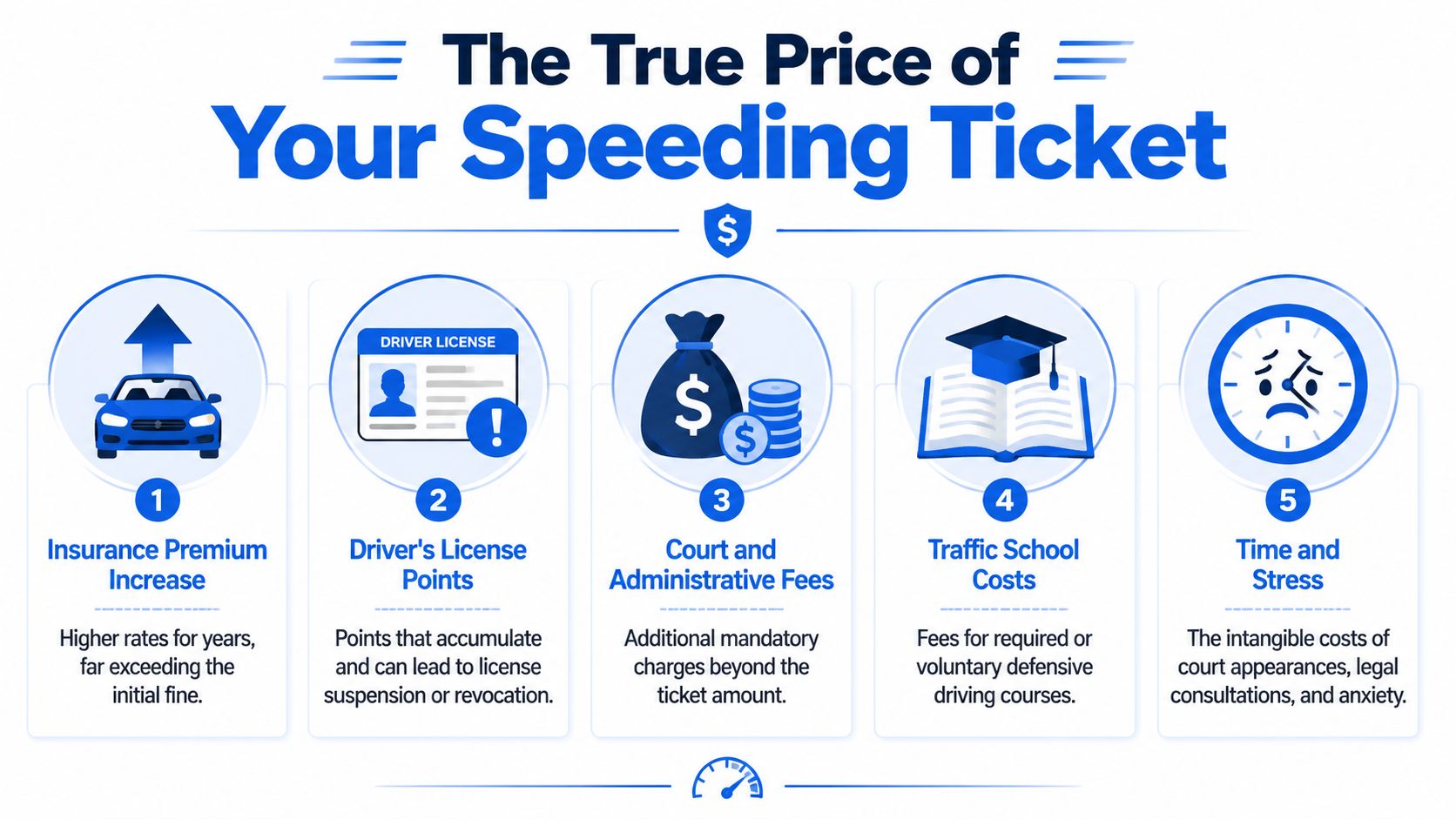
What hurts drivers is not the payment they make today. It is the record they create by resolving the ticket the wrong way. Once a speeding ticket puts points on your license, the financial damage can follow you for years through higher insurance premiums, lost discounts, employer scrutiny, and added risk if you already have prior tickets.
What sets off the financial fallout
A speeding ticket becomes expensive when it turns into a record problem.
If you pay the ticket, plead, or close it without protecting your driving record, you may trigger points. Points are what insurers care about. They can also matter to employers, commercial drivers, rideshare platforms, and anyone whose job depends on staying insurable.
The pattern is simple:
You resolve the ticket without a defense strategy: Fast payment often creates a guilty outcome.
Points go on the license: That changes how insurers and other decision-makers view your risk.
Insurance pricing changes: The increase may last for multiple policy periods.
Your losses spread beyond court: The fine becomes one small part of a much larger bill.
Why insurance costs are the biggest financial threat
Drivers fixate on the number printed on the citation because it is immediate. Insurance companies focus on your risk profile, and that is where the larger financial hit usually shows up.
According to Insurify's breakdown of the true cost of speeding tickets, a modest speeding fine can grow once fees are added, and a single speeding ticket can raise auto insurance premiums for years. That is the part many drivers miss. The court takes your money once. Your insurer can keep charging you more every renewal cycle.
This is why paying the fine is often a bad financial decision. You are not buying closure. You may be buying years of higher premiums.
If you want a Florida-focused explanation of how those premium increases can snowball, read this guide on the cost of insurance increases after a Florida speeding ticket before you decide how to handle the case.
A lawyer fee should be measured against that larger risk. If legal help keeps points off your record, it is not an extra expense. It is an investment that can prevent far more costly losses later.
How Are Florida Speeding Fines Actually Calculated?
Florida speeding fines are built to look smaller than they are. The number tied to your speed is only the starting point. By the time court costs and local assessments are added, the amount due is much higher, and that still does not include what a conviction can do to your insurance bill.
What Florida law uses as the starting point
The controlling penalty law is Florida Statute 318.18. It sets the base fine by speed range:
6 to 9 mph over: $25
10 to 14 mph over: $100
15 to 19 mph over: $150
20 to 29 mph over: $175
30+ mph over: $250
Up to 5 mph over in a legally posted school zone: $50
That base number misleads drivers every day.
A driver sees $25 or $100 and assumes the problem is minor. It is not. As noted in Florida Statute 318.18, the statute gives you the base fine. The clerk adds the rest.
Why the amount due is higher than the base fine
Florida counties add mandatory court costs and surcharges on top of the statutory fine. That is why the amount on the payment screen can be far above the number associated with your speed bracket.
In other words, the state sets the floor. The system builds upward from there.
Tickets handled through a county court are not simple bills. They carry stacked charges, and those charges can make a low-level speeding allegation look deceptively cheap at first glance. Before you click pay, make sure you understand what a plea of no contest means in Florida traffic court, because the fine you see is only one part of the decision.
Florida Speeding Ticket Cost Breakdown Effective 2026
MPH Over Limit | Statutory Base Fine (F.S. 318.18) | Estimated County Costs & Fees | Typical Total Payable Fine |
|---|---|---|---|
6 to 9 mph over | $25 | Mandatory local court costs and surcharges apply | Roughly $129+ |
10 to 14 mph over | $100 | Mandatory local court costs and surcharges apply | Higher than base fine |
15 to 19 mph over | $150 | Mandatory local court costs and surcharges apply | Higher than base fine |
20 to 29 mph over | $175 | Mandatory local court costs and surcharges apply | Higher than base fine |
30+ mph over | $250 | Mandatory local court costs and surcharges apply | Roughly $354+ |
School zone up to 5 mph over | $50 | Mandatory local court costs and surcharges may apply | Higher than base fine |
The takeaway is simple. Every higher speed bracket raises your exposure in two ways. You face a larger payable amount in court, and you increase the odds of expensive downstream consequences tied to a conviction.
That is why paying the fine is usually the wrong way to measure the cost of a ticket. The fine is the entry fee. The actual financial danger starts after that.
Is Paying the Ticket an Admission of Guilt?
Yes. In practice, paying the ticket is treating the charge like you accept it.
That is why the online payment button is dangerous. It looks administrative. It feels harmless. Legally and financially, it often isn't.
Why paying online feels easy and goes badly
When you pay, you usually give up your advantage. You stop contesting the stop, the officer's observations, and any legal weakness in the charge. You also make it easier for the record consequences to move forward.
That matters because the issue isn't just the ticket itself. It's what follows from a guilty resolution on your driving history.
If you need a plain-language explanation of plea options before you act, read this guide on what a plea of no contest means in Florida traffic court.
Paying a ticket for convenience can become one of the more expensive convenience decisions you make.
What a guilty plea can quietly cost you
Liberty Mutual says car insurance typically goes up about 25% after a speeding ticket, and gives the example that a driver paying $2,000 per year could owe about $500 more per year after one ticket, according to Liberty Mutual's explanation of speeding tickets and insurance costs.
And there is another problem drivers miss. A guilty plea can also wipe out discounts you already earned. As noted earlier in the article, insurers may not only raise your rate, they may also remove pricing benefits tied to a clean record.
This short video gives context on why a traffic response matters more than many drivers think:
If your record matters for work, security clearances, rideshare eligibility, delivery-platform access, or keeping your premium under control, paying first and asking questions later is backwards. You need the legal analysis first.
How Can a Lawyer Protect Your Record and Wallet?
A Florida traffic lawyer protects you by attacking the part of the case that costs the most later. The record.
That means looking past the ticket amount and focusing on the outcome that matters most: avoiding points when possible. If the record stays cleaner, the insurance damage is less likely to follow.
What a defense lawyer actually does
A real traffic defense review isn't just "show up in court." It usually includes things like:
Reviewing the stop itself: Was the allegation described clearly? Did the paperwork create issues? Did the charging facts line up with the statute?
Testing the proof: An attorney can examine what the officer claims happened and whether the evidence supports the citation.
Pursuing a better resolution: Depending on the case, that may mean dismissal, amendment, or another outcome designed to protect the record.
Lawyer-led representation matters in these situations. You need someone making legal judgments, not a processing pipeline.
Why direct attorney access matters
Ticket matters move fast. Questions come up fast too. You may need to know whether to elect a hearing, whether a school option helps or hurts, or how a prior ticket changes risk. That is not a chatbot conversation.
Ticket Shield, PLLC is one Florida option for drivers who want a lawyer-led defense with direct attorney communication by phone or text rather than an automated app or a ticket mill using middlemen. If you're comparing approaches, start with a Florida speeding ticket lawyer service that focuses on protecting your record.
Hiring counsel isn't about making the ticket disappear by magic. It's about making a smart financial decision before a minor citation becomes a multi-year expense.
The strongest reason to act is simple. The question isn't what the court wants this month. It's what this ticket could cost you over time if no one steps in early and strategically.
What Are Your Immediate Next Steps After Getting a Ticket?
You need to move quickly and calmly. Delay helps the system, not you.
Immediate steps to take
Don't pay the ticket online first: Paying may close off defenses and move you toward a guilty result before you understand the consequences.
Keep every document: Save the citation, envelope, any officer notes, and any photos or dashcam material you have.
Write down what happened: Do it while you still remember the stop, the location, traffic conditions, and what the officer said.
Watch the deadline: Florida traffic tickets come with a limited window to respond. Missing it can make your situation worse.
Get legal guidance before choosing an option: Review practical next steps in this guide on what to do when you get a Florida traffic ticket.
Think beyond the fine: If your job, insurance, or license matters, treat the ticket like a record issue, not a payment issue.
If your case is in a major court location such as the Broward County Judicial Complex, the process may feel routine to the court. It isn't routine to your wallet. Every speeding case deserves an early review because the wrong response can lock in costs that continue long after the fine is gone.
You don't need to panic. You do need to act with purpose.
If you want a No Points strategy, get legal advice before you pay anything. Ticket Shield, PLLC offers a free consultation so you can understand your options, protect your license, and try to stop a single ticket from becoming years of higher costs.