A Florida Driver's Guide to Help With Speeding Fines
Stressed about a Florida speeding fine? Discover your real options, potential hidden costs, and how strategic help with speeding fines can protect your record.
Getting hit with a speeding ticket is a stressful moment, but your next move is what really counts. In Florida, you have 30 days to decide how to handle it—and just paying the fine is rarely your best play.
What To Do Immediately After Getting a Speeding Ticket in Broward County
That initial feeling of anxiety and confusion when an officer hands you a citation is normal, but what you do in the next few minutes and days sets the stage for everything that follows. A speeding ticket isn't just a minor annoyance; it’s a legal issue that can have a long-lasting impact on your driving record and insurance premiums.
Many drivers, especially in busy areas like Broward County, feel pressured to just pay the ticket and get it over with. But doing that is the same as pleading guilty, which guarantees points on your license.
Taking a deep breath and using a calm, methodical approach right from the start can make a huge difference. Your first job is to hang onto all your paperwork and review the citation with a critical eye. Don't let the pressure force you into a quick decision.
Carefully Review Your Citation for Errors
Before you even pull away from the traffic stop, take a second to actually read the ticket. Officers are human, and they make mistakes. Simple clerical errors or missing information can sometimes become a key part of your defense.
Go over these details with a fine-tooth comb:
Your Info: Is your name, address, and driver’s license number 100% correct?
Your Car's Details: Does the ticket list the right make, model, color, and tag number?
The Violation: Is the date, time, and location of the stop accurate? Check the specific statute number they cited you for.
The Officer's Notes: Can you read the officer's signature? Is all the information filled out completely?
Even something that seems minor, like a misspelled street name or the wrong statute, could be important down the road. Documenting these little things immediately is a crucial first step. You can get a fuller picture of the entire process in our guide on what happens when you get a speeding ticket.
Understand Your Three Core Options
In Florida, the clock starts ticking the moment you get that ticket. You have a 30-day window to respond, and missing that deadline can lead to your driver's license being suspended. It really boils down to three fundamental choices: pay the fine, elect traffic school, or contest the ticket in court.
Within 30 days, you must choose one of these paths. Here's a quick breakdown of what each option means for your license and wallet.
Your Three Core Choices for a Florida Speeding Ticket
Your Option | What It Entails | Immediate Outcome | Potential Long-Term Impact |
|---|---|---|---|
Pay the Fine | Pleading guilty and paying the full amount online, by mail, or in person. | Quickest resolution, but guarantees a conviction. | Points added to your license; almost certain insurance premium increase for 3-5 years. |
Elect Traffic School | Paying the fine and completing a state-approved driver improvement course. | No points are added to your license upon completion. | Prevents immediate insurance hikes, but you can only use this option 5 times in your life. |
Contest the Ticket | Pleading not guilty and requesting a court hearing to challenge the citation. | Requires a court appearance (or a lawyer appears for you). | Potential for dismissal, reduced charges, or a withhold of adjudication (no points, no conviction). |
Each path has its own pros and cons, making it essential to weigh them carefully before that 30-day deadline is up.
Your initial decision is the most important one. Rushing to pay the fine closes the door on opportunities to protect your record, avoid points, and prevent insurance hikes. Taking a moment to consider all paths is an investment in your financial future.
This flowchart breaks down the initial decision-making process after receiving a ticket.
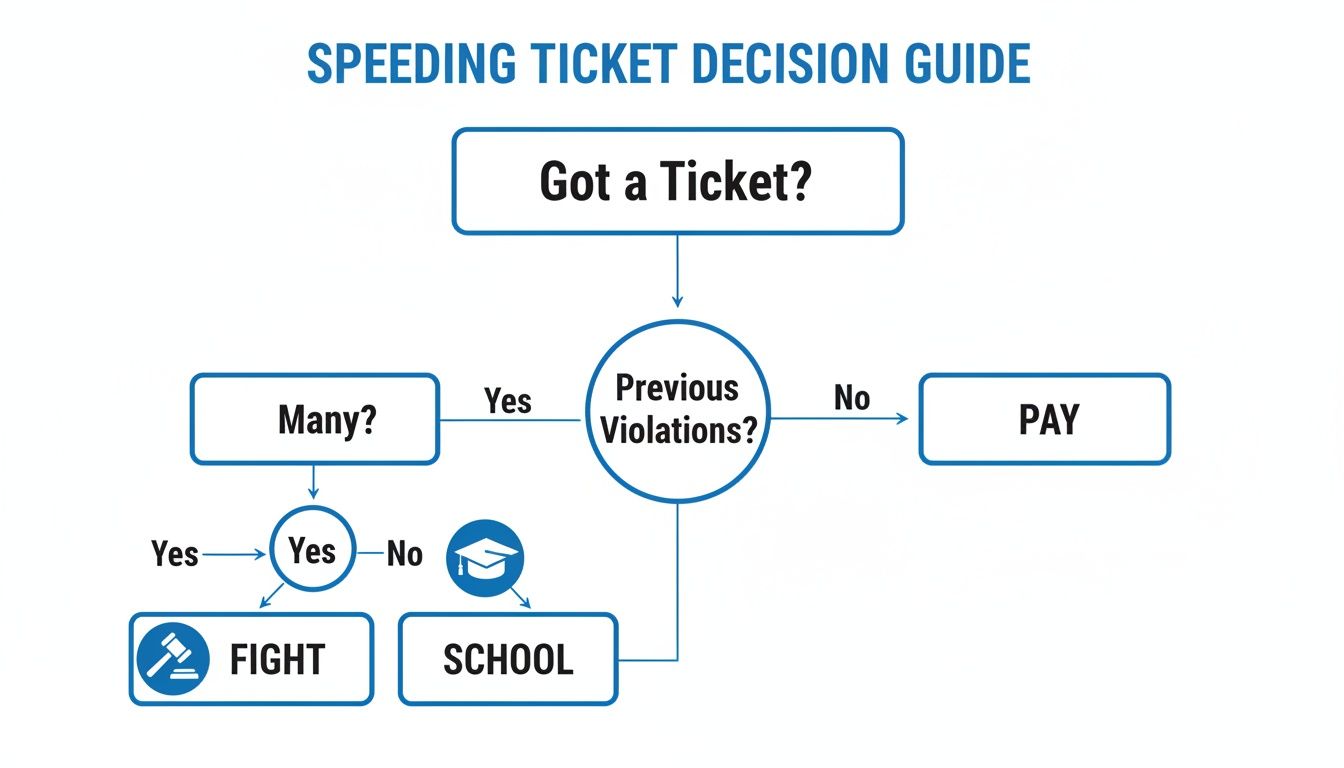
As you can see, each choice leads to a very different outcome. It’s vital to pick the one that best protects your long-term driving privileges.
The Financial Reality of a Speeding Ticket
It’s way too easy to underestimate the true cost of a speeding ticket. Across the United States, police hand out about 41 million speeding tickets every single year, so it’s an incredibly common headache for drivers.
That initial fine, which might be around $150, is just the tip of the iceberg. The real financial damage comes from the points on your license, court costs, and, worst of all, the massive spike in your car insurance premiums that can haunt you for years. For drivers on busy Broward County routes like I-95, those hidden costs can easily balloon to over $1,000. This is why getting help with speeding fines isn’t just about dodging a one-time payment—it's about protecting yourself from years of inflated expenses.
Paying the Fine vs. Contesting the Ticket: What's the Smart Move?
The moment you get a speeding ticket, you’re at a crossroads. The choice you make next can echo for years, impacting your wallet and your driving record. For a lot of drivers, the path of least resistance seems obvious: just pay the fine and get on with your life.
But here’s the reality: paying that fine is the same as pleading guilty. It’s a guaranteed conviction, and that single decision kicks off a chain reaction that almost always costs far more than the original ticket.
When you pay a speeding ticket in Florida, you’re not just closing the book on the incident. You’re ensuring points get added to your license. Those points are a bright red flag to your insurance company, signaling that you’re a higher-risk driver. The result? Your premiums are almost guaranteed to jump, and that increase can stick around for three to five years.
This is exactly why you have to weigh the other option: contesting the citation. This isn't about being difficult; it's about challenging the evidence and protecting your driving record for the long haul.
A Real-World Broward County Scenario
Let's put this in a real-world context. Picture yourself on the Sawgrass Expressway (SR 869) in Broward County. You’re just trying to keep pace with the flow of traffic when you see the flashing lights. The officer pulls you over and hands you a ticket for going 18 mph over the limit.
Your first thought might be to just pay it. It feels easier than dealing with court dates and legal headaches. But let’s unpack why that quick fix is a costly mistake.
By paying that ticket online, you’ve just accepted a conviction and the points that go with it. That short-term convenience will likely lead to years of inflated insurance bills.
Contesting the ticket, however, opens the door to a much better outcome. An experienced legal team will dig into every detail of the traffic stop.
Was the officer’s radar or laser gun properly calibrated and certified?
Did the officer have a clear, unobstructed line of sight to your vehicle?
Are there any mistakes or inconsistencies on the citation itself?
Could road conditions or the surrounding traffic pattern have been a factor?
These aren't just random questions; they’re the foundation of a strong legal defense. Our practice focuses on traffic and DUI defense, and our goal is to protect your license. By challenging the ticket, you create the opportunity for a dismissal or a reduction to a non-moving violation with zero points.
The choice isn't really about a one-time fine. It's about weighing the short-term convenience of paying against the long-term financial and legal benefits of building a defense. While past results do not guarantee future outcomes, a proactive approach is always smarter than just accepting guilt.
The True Cost of Pleading Guilty
The fine printed on that ticket is just the down payment. The real cost comes out of your pocket over the next several years. When you pay the fine, you're agreeing to a lot more than you think.
Here’s what you’re really signing up for:
Guaranteed Points: These are the primary trigger for insurance rate hikes.
Increased Insurance Premiums: Your insurer will likely raise your rates at your next renewal, an increase that can last for years.
Risk of License Suspension: Rack up too many points in a set period, and Florida law mandates a license suspension.
Loss of Future Options: Once you pay a ticket, it’s a done deal. You can't go back and decide to contest it later.
When you realize that professional legal help is often more affordable than the years of insurance hikes, the decision to fight becomes a lot clearer. Of course, it's always smart to understand the potential costs. For a general overview of legal fees, you can explore the typical cost of a lawyer consultation.
To make the right call for your specific situation, you need all the facts. For a deeper dive into this topic, check out our comprehensive guide on whether you should fight your traffic ticket. This resource gives you even more insight to help you make an informed choice.
The True Cost of a Speeding Conviction
That fine printed on your speeding ticket? Think of it as just the opening act. So many Florida drivers make the mistake of paying it just to get it over with, thinking that closes the book. The hard truth is, the real financial damage is just getting started.
A speeding conviction kicks off a chain reaction of hidden costs that can haunt your budget for years, making that initial payment feel tiny in comparison.
The biggest hit comes directly from the points added to your driving record. Insurance companies see those points as a giant red flag—a clear sign of increased risk. They don't hesitate to adjust your premiums, and the spike can be severe. A single conviction can easily tack on hundreds or even thousands of dollars to your annual insurance bill, an expense that usually sticks around for three to five years.
Beyond the Ticket Fine: The Ripple Effect on Your Finances
The financial pain of a conviction doesn’t stop with insurance hikes. The Florida court system has its own way of adding layers of expenses that can dramatically inflate what you end up owing.
These extra costs often include things like:
Court Fees: Even if you never step foot in a courtroom, you'll likely get hit with administrative and processing fees that are tacked onto the base fine.
County Surcharges: Many counties, especially larger ones like Broward, add their own surcharges to traffic tickets to help fund local programs. These can vary a lot from one place to the next.
License Reinstatement Fees: If that ticket contributes to a license suspension, you’re looking at a hefty fee paid directly to the Florida DHSMV just to get your driving privileges back.
It’s not uncommon for this pile of fees to double or even triple the original amount printed on your citation. When you're looking for help with speeding fines, you're not just fighting a single charge—you're trying to stop a whole cascade of financial penalties. You can get a deeper look at this in our article on navigating Florida's points system.
A speeding ticket conviction isn't a one-time event; it's a long-term financial liability. The most effective way to protect your wallet is to protect your driving record from the conviction in the first place.
The Career-Altering Stakes for CDL Holders
For professional drivers with a Commercial Driver's License (CDL), the stakes are exponentially higher. A simple speeding ticket isn't just a personal hassle; it's a direct threat to your job and your ability to earn a living. Both the Federal Motor Carrier Safety Administration (FMCSA) and the state of Florida hold CDL holders to a much stricter standard.
A conviction for what's considered a "serious traffic violation," like speeding 15 mph or more over the limit, can have immediate and severe career consequences.
Impact of a Conviction on a CDL:
Violation Type | First Offense | Second Offense (within 3 years) |
|---|---|---|
Serious Violations | No immediate disqualification, but it counts toward future suspensions. | 60-day license disqualification. |
Major Offenses | 1-year license disqualification. | Potential for a lifetime disqualification. |
Even what seems like a minor speeding ticket can put a CDL holder's job in jeopardy. Many trucking companies have zero-tolerance policies and might fire a driver after just one moving violation. That conviction then stays on your record, making it incredibly difficult to find another job in the industry.
For a CDL holder, getting professional help with speeding fines isn't just about saving a few bucks. It's an investment in protecting your entire career.
The Wider Societal Impact of Speeding
Beyond the personal financial and legal mess, it's important to remember why these laws are so strict in the first place. Speeding's deadly toll remains alarmingly high. In 2023, it was a factor in 29% of all U.S. traffic fatalities—a staggering 11,775 lives lost.
For more than two decades, speeding has been involved in roughly one-third of all motor vehicle deaths. These aren't just numbers; they're a stark reminder of how speeding dramatically reduces a driver's control, increases the severity of a crash, and requires much longer stopping distances. That's a reality that hits Florida drivers especially hard on a rain-slicked Turnpike or a congested I-4. You can explore more data and learn about the risks associated with speeding on the NHTSA website.
How to Navigate The Florida Traffic Court System
The idea of standing in front of a judge, even for something as common as a speeding ticket, can be seriously intimidating. Most people picture a tense courtroom drama, which is why the thought of just paying the fine is so tempting.
But the reality of Florida's traffic court system, especially for non-criminal tickets, is a lot more straightforward. It’s less about dramatic speeches and more about procedure, evidence, and deadlines. Understanding how the system actually works is the first step toward getting a better outcome for yourself.
When you decide to contest a ticket, you're basically telling the state, "Prove it." The burden is on them, not you, to show you actually committed the violation.
This is where having experienced legal help becomes so valuable. Our practice focuses on traffic and DUI defense, so we're in these courtrooms every single day. For the vast majority of our clients—over 99%—they never have to set foot in court. We handle everything for them.
Key Players in the Courtroom
When your case is called, there are three main people involved. Knowing who they are and what they do helps take a lot of the mystery out of the process.
The Judge or Hearing Officer: This is the person in charge. Their job is to listen to the evidence from both the officer and your defense, apply the traffic laws, and make the final decision.
The Law Enforcement Officer: The officer who wrote you the ticket acts as the state's one and only witness. They will testify about why they pulled you over, what they observed, and how they determined your speed.
Your Attorney: Your lawyer is your advocate. Their job is to cross-examine the officer, challenge the state's evidence, make legal arguments on your behalf, and work to get the best possible outcome—whether that’s a full dismissal or a reduced charge.
Having a skilled attorney means you have someone who speaks the court's language and understands the small procedural details that can make or break a case. To get a better feel for the hearing itself, check out our guide on what to expect in traffic court.
Common Defense Strategies Your Attorney May Use
Contesting a speeding ticket isn't about coming up with a good excuse; it's about methodically examining the state's evidence for weaknesses. An attorney will scrutinize every detail of the traffic stop to build a solid defense.
One of the most effective strategies is to challenge the device the officer used to clock your speed.
Radar/Lidar Calibration: Florida law is incredibly strict about the calibration and maintenance of speed measurement devices. An attorney can request the device's maintenance logs and calibration certificates. If those records are missing, outdated, or show a history of problems, the speed reading can be ruled unreliable.
Officer Training and Certification: The officer using the radar or lidar gun has to be properly trained and certified on that specific piece of equipment. We can verify that the officer’s certification was valid at the time they issued your ticket.
Beyond the equipment itself, procedural mistakes made during the stop can create a powerful defense. This could be anything from the officer not having a clear line of sight to your car, misidentifying your vehicle in heavy traffic, or making critical errors on the citation itself.
The goal is to introduce reasonable doubt. By methodically questioning the evidence and procedures, an attorney creates opportunities for a dismissal or a negotiated reduction that keeps points off your record. Past results do not guarantee future outcomes, but a strategic defense is always better than simply accepting guilt.
Ultimately, navigating the court system is all about leveraging deep knowledge of the law and local court procedures. A simple mistake by the officer can become the key to protecting your license. This is the real, tangible value an experienced attorney brings to your case—turning a stressful legal problem into a manageable process aimed at protecting your driving record and your finances.
Why a Focused Legal Strategy Is Your Best Defense
When you're looking for help with speeding fines, the type of law firm you choose really matters. Not all legal help is created equal. While a general practice firm might take on a wide range of cases, a firm that dedicates its entire practice to traffic and DUI defense gives you a powerful, built-in advantage.
This focused approach means the legal team lives and breathes Florida's traffic laws day in and day out. They know the specific procedures, the local court nuances, and the key players from Broward County all the way to the Panhandle. It's that deep, practical familiarity that can make all the difference in how your case turns out.
The Advantage of Niche Experience
A firm with a laser focus on traffic defense brings a specialized skill set you just won't find anywhere else. Our team includes former prosecutors who have stood on the other side of these exact cases. That firsthand experience gives us invaluable insight into how the state builds its case against a driver—and, more importantly, where the weak spots are.
We know the local judges, the prosecutors, and the unwritten rules of different county courthouses. This lets us build a legal strategy tailored specifically to your citation and the jurisdiction where you got the ticket.
Our approach is methodical, and it’s all aimed at getting the best possible result for you.
Scrutinizing the Details: We start by tearing apart every detail of your citation and the officer's report, hunting for procedural errors, factual mistakes, or any inconsistencies we can use.
Strategic Negotiation: Armed with that information, we often negotiate directly with the prosecutor. The goal might be to get the ticket dismissed entirely or have it reduced to a non-moving violation that carries no points.
Courtroom Advocacy: If a fair negotiation isn't on the table, we are always ready to fight for you in court. We’ll challenge the evidence and force the state to meet its high burden of proof.
Our goal is to protect your license and your record. We know every case is unique, and while we fight for the best outcome in every situation, it's important to remember that past results do not guarantee future outcomes.
Bias in Traffic Enforcement
A strategic defense is also your best shield against potential biases baked into the system. Shocking new research based on 19.3 million location pings from Lyft drivers in Florida has uncovered a stark racial disparity in who gets ticketed for speeding.
The study found that minority drivers are 24-33% more likely to be ticketed and pay 23-34% higher fines than white drivers—even when traveling at the exact same speeds. This objective data shows the problem isn't different driving habits; it's potential policing disparities. It highlights exactly why having fair and aggressive legal representation is so critical. You can read the full research about these Florida traffic stop findings on Science.org for all the details.
This is where a dedicated defense becomes your most important tool. A knowledgeable attorney makes sure your rights are protected and that your case is judged on its own merits, not on outside factors. For drivers looking for help with speeding fines, having a team that gets these systemic issues is a powerful asset. You can explore how our speeding ticket lawyers build a defense designed for your specific situation.
A Modern and Convenient Process
We think getting top-tier legal help should be simple and stress-free. Our entire process is designed for your convenience, letting you handle everything without taking time off work or disrupting your life. You can submit your ticket to us online in just a few minutes.
From that point on, you’ll talk directly with your attorney. No middlemen, no paralegals passing messages back and forth. You get clear, straight answers to your questions by phone, text, or email. While our main office is in Broward, we handle cases in all 67 counties across Florida. When you start building your defense, you might consider using an AI Legal Traffic Ticket Analyzer to help process the information and pinpoint key legal arguments for your case.
This direct line of communication and modern approach means you're always in the loop and confident in the strategy. It’s all about making professional legal defense accessible and effective, giving you peace of mind while we get to work protecting your driving record.
Common Questions About Florida Speeding Tickets
When an officer hands you a speeding ticket, your mind starts racing with questions. The answers aren't always simple, and bad information can send you down a path that ends up costing you a lot more than just the fine. Let's clear up some of the most common questions we get from drivers all over Florida.
Keep in mind, this is for general information and should be seen as attorney advertising, not direct legal advice. Every case is unique, and the right move for you depends on the exact details of your ticket.
Can I Just Use Traffic School To Avoid Points?
While traffic school is an option, it's not a get-out-of-jail-free card. Florida law is very strict about its use. You can only elect to take a driver improvement course once every 12 months and a maximum of five times in your entire life.
It’s also completely off the table for more serious violations, like driving 30 mph or more over the limit. And here's the kicker for professional drivers: CDL holders are not eligible to take traffic school to keep points off their record.
An attorney can often negotiate a deal that saves your precious traffic school election. Think of it as a long-term strategy—preserving one of your five lifetime uses for a future ticket is a huge benefit. We can talk through whether this makes sense for you during a free consultation from our Broward office.
How Long Does a Speeding Ticket Affect My Record?
A speeding conviction doesn't just vanish once the fine is paid. The points from that ticket will sit on your Florida driving record for at least three to five years, and your insurance company will be looking right at them the entire time.
The conviction itself can linger on your record for a decade or even longer, visible to anyone who runs a background check. This is exactly why our goal is to prevent that conviction in the first place, either by getting the ticket dismissed or by negotiating it down to a non-moving violation that carries zero points.
What Happens If I Just Ignore My Broward County Ticket?
Ignoring a ticket—whether it's from Broward or any other Florida county—is one of the worst mistakes you can possibly make. It takes a simple civil infraction and blows it up into a much bigger legal mess.
Once that 30-day deadline to respond passes, the clerk notifies the DHSMV, and your driver's license will be suspended. To get it back, you'll have to pay the original fine plus hefty late fees and a separate license reinstatement fee. Even worse, driving on a suspended license is a criminal offense that can lead to an arrest. It's always, always better to deal with the ticket head-on.
Prospective clients may not obtain the same or similar results. Submitting information through our website does not create an attorney-client relationship. All legal questions should be directed to a licensed attorney.
Is It Worth Hiring an Attorney for a Minor Ticket?
Even a "minor" ticket for going just a few miles over the limit adds points to your license. Those points often trigger multi-year insurance premium hikes that can easily cost you way more than the price of professional legal help.
Hiring an attorney isn't just about fighting the fine; it's an investment in protecting your driving record and avoiding those long-term hidden costs. An experienced lawyer handles the entire headache for you—from filing paperwork to appearing in court—saving you time, stress, and the hassle of trying to figure out the system on your own. When you look at the full financial impact of a conviction, professional defense is often far more affordable than people realize. Our goal is to protect your license and your record.
Don't let a speeding ticket derail your life and your budget. Ticket Shield, PLLC takes care of everything so you don't have to stress about court dates and confusing legal jargon. Get a free consultation and let our experienced team fight to protect your record. You can submit your ticket online in just a few minutes at https://www.ticketshield.com.