What Is a Plea of No Contest? Your Legal Guide
Facing a ticket? Understand what is a plea of no contest, its impact on your record, and if it's your best defense. Get expert legal advice.

You just got a citation. Your stomach dropped. You’re thinking about points, insurance, your job, and whether paying it quickly will make this disappear.
It won’t.
A plea decision is one of the first places drivers make a costly mistake. They assume “no contest” means “no real harm.” In Florida, that’s wrong. A no contest plea can be smart. It can also lock in consequences you didn’t fully understand until it’s too late.
If you’re asking what is a plea of no contest, you need a clear answer now, before you click through an app, mail in payment, or let a ticket mill process your case like a barcode.
Table of Contents
What Does a Plea of No Contest Mean in Florida?
A no contest plea tells the court you accept the conviction without admitting guilt. In Florida, that can protect you in a related civil case, but it still carries penalties for the traffic charge.
If you’re holding a citation for speeding under Florida Statute 316.187 or another Chapter 316 offense, a plea of no contest, also called nolo contendere, is not a casual box to check. It is a formal legal plea. You are telling the court you won’t fight the charge in the usual way, even though you are not making a direct admission of guilt.
Why drivers misunderstand it
Most drivers hear “no contest” and think it means less damage. Sometimes that’s true in a narrow sense. Often it’s not. The plea may help if there’s a risk that someone will later sue you over the same incident, but it does not mean the court treats the ticket like it never happened.
A lot of people confuse no contest with “just paying the ticket” or “not arguing.” That’s dangerous thinking. A plea is strategy. It should follow a review of the citation, the officer’s allegations, the court, and your personal risk. If you guess wrong, you can trade a defensible case for a conviction and penalties.
Practical rule: A no contest plea is not a safe default. It’s a tool. Tools help only when used in the right case.
There is a reason plea decisions matter so much. About 90% of criminal cases nationwide are resolved through plea agreements rather than trial, according to the discussion at Wasser Law on what pleading no contest really means. The same source also notes that when the likely punishment is minor, such as a small fine, probation, or community service, pleading no contest may be substantially cheaper, faster, and less disruptive than trying to win an acquittal at trial.
That doesn’t mean you should rush into it. It means the system pushes people toward fast resolutions. Fast isn’t always smart.
Why timing matters after a citation
Right after a stop, you’re stressed and vulnerable. That’s when people make avoidable mistakes. They talk too much. They pay too fast. They rely on automated apps that treat every case the same. Florida traffic court doesn’t work that way.
A plea can also affect related outcomes such as adjudication and what follows on your record. If you’re trying to understand how courts handle outcomes after a traffic case, this explanation of what adjudication withheld means in Florida is worth reading before you decide anything.
How Does No Contest Compare to Guilty or Not Guilty?
If you want the short version, here it is. Guilty means you admit it. Not guilty means the state has to prove it. No contest means you accept the result without making that admission.
That distinction matters most when the traffic stop or accident could spill into a civil claim.
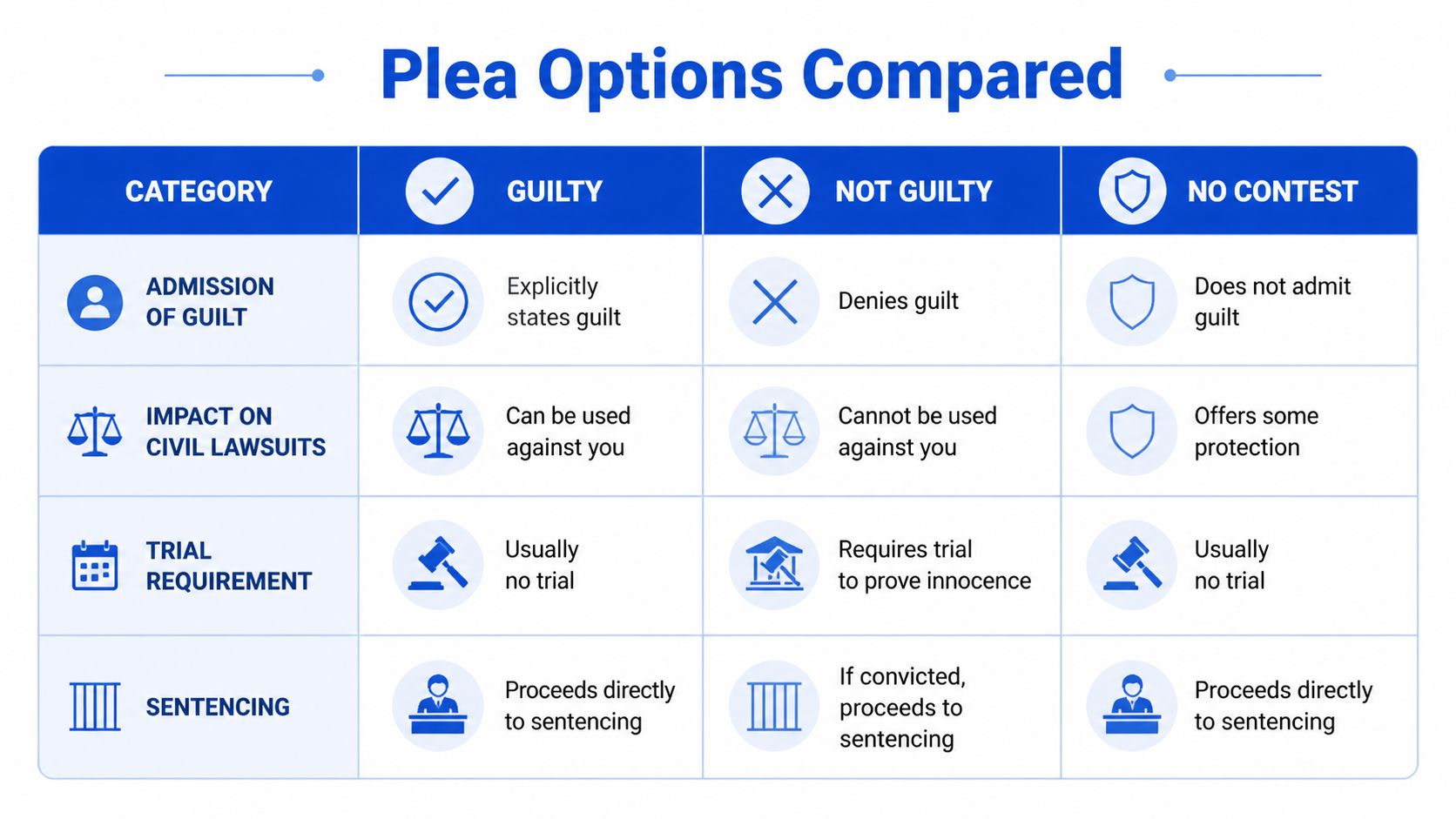
Which difference matters most
Here’s the comparison Florida drivers need:
Factor | Guilty Plea | Not Guilty Plea | No Contest Plea (Nolo Contendere) |
|---|---|---|---|
Admission of guilt | Yes. You admit the charge. | No. You deny the charge and require proof. | No. You do not admit guilt. |
Immediate outcome | Case moves to sentencing or penalties. | Case proceeds toward hearing or trial. | Case moves to sentencing or penalties if accepted by the court. |
Use in a civil lawsuit | A guilty plea can be used as evidence of fault. | No plea admission exists because you are contesting the case. | A no contest plea is used to avoid admitting factual guilt in related civil matters. |
Best fit | Rarely the smart first move in traffic court. | Strong option when the case has factual or legal weaknesses. | Strategic option when resolving the case matters, but an admission could hurt you elsewhere. |
A guilty plea is usually the worst starting point unless the defense has already concluded there is a specific reason to use it. A not guilty plea preserves your strategic advantage. A no contest plea sits in the middle. It resolves the criminal or traffic case without the same admission that comes with guilty.
When the comparison changes your strategy
If the citation followed an accident, the choice becomes more serious. A direct guilty plea can provide the opposing side a clear argument regarding fault. A no contest plea may avoid that admission while still concluding the traffic case.
That’s why drivers should never assume the plea itself is the whole answer. The crucial question is what outcome your lawyer can negotiate before any plea is entered. If you want a separate look at the downside of merely admitting the charge, review what happens if you plead guilty to a Florida traffic ticket.
The strongest plea is often the one entered only after your lawyer has tested whether the state’s case can be reduced, diverted, or dismissed.
What Are the Real-World Consequences of a No Contest Plea?
A no contest plea sounds softer than it is. In the courtroom, it may be strategic. In real life, it can still affect your record, your license, and your money.
At the Richard E. Gerstein Justice Building in Miami, judges see a steady flow of traffic and criminal matters. Drivers often arrive thinking no contest is a harmless compromise. It isn’t. It can be useful, but it still creates consequences.

A no contest plea in a Florida traffic case allows you to accept conviction and penalties without admitting factual guilt. For traffic violations such as speeding under Florida Statute 316.187, that can matter if someone is considering a civil claim arising out of the same event. The discussion at Minick Law about a plea of no contest explains that a guilty plea is admissible as evidence of fault, while nolo contendere is used to avoid that factual admission.
Your criminal record
For court purposes, no contest is not the same as walking away clean. If the plea is accepted and adjudication is not otherwise handled in a favorable way, you may still leave with a conviction or a record consequence that follows you.
That matters for job applications, professional licensing, housing screenings, and background checks. Drivers often focus only on the fine because it’s immediate. The record issue is what causes trouble later.
If your case involves a DUI-related concern and you’re worried about screening issues, review whether a DUI shows up on a background check.
Points on your driver's license
For DMV purposes, a no contest plea can hit you much like a guilty plea. The state cares about the disposition and the underlying offense. It does not treat “I’m not admitting guilt” as a magic shield against license consequences.
That’s especially serious for rideshare drivers, delivery drivers, CDL holders, and anyone who drives for income. A plea that looks efficient in court can trigger problems with work platforms or employer driving standards.
Your car insurance rates
Insurance companies don’t care about the emotional comfort of the words “no contest.” They care about the event, the disposition, and the risk profile they assign to you afterward. If the case resolves against you, your insurer may still treat that as a negative driving event.
That’s why “I’ll just plead no contest and be done with it” is often short-term thinking. The case may end. The cost may not.
Before you decide, watch this overview for added context on how traffic case outcomes can affect your future:
Your immigration status
If you are not a U.S. citizen, do not treat any plea like a routine paperwork decision. Traffic matters vary. Some are minor. Some are not. A plea can interact with immigration history, prior cases, and licensing issues in ways a general app or call center will never analyze correctly.
If immigration status matters in your life, your plea decision needs human legal review before anything is filed.
The same warning applies if you hold a security-sensitive job, a professional license, or a company vehicle role. No contest may solve one problem while creating another. That’s why the plea has to fit your full situation, not just the citation number.
Is Pleading No Contest the Right Strategy for Your Case?
Sometimes yes. Sometimes absolutely not.
If you’re asking what is a plea of no contest because you want the fastest way out, slow down. Speed is not the same as protection. The right plea depends on the facts, the evidence, the county, the judge, and what matters most in your life.
When no contest can help
A no contest plea can make sense when you need to resolve the case but do not want to admit fault. That issue comes up often after an accident. If someone claims they were injured or their property was damaged, you do not want to hand them a guilty plea unless there is a clear legal reason to do so.
It can also be a practical option when the likely outcome is minor and the cost of fighting all the way through outweighs the benefit. That is a real calculation in traffic court. Time off work matters. Repeated court appearances matter. Stress matters.
A lawyer may also use no contest as part of a broader negotiated result, especially when a diversion or alternative resolution is available. If that possibility exists in your case, read about Florida pretrial diversion programs before you accept a standard plea.
When no contest is the wrong move
If the officer made legal errors, the citation is defective, the evidence is weak, or the state may struggle to prove the case, pleading no contest too early is a mistake. You can’t fix a rushed plea after you’ve already given away your advantage.
It’s also risky when your job, license class, immigration status, or background check exposure creates consequences that a generic service won’t evaluate. A rideshare driver may care most about account status. A military member may care about clearance concerns. A commercial driver may care about any entry that threatens work eligibility.
Use this decision filter before you agree to anything:
Was there an accident involved? If yes, civil exposure becomes part of the analysis.
Do you drive for a living? If yes, even a minor result can hurt your income.
Is the state’s case strong? Don’t assume it is just because you got stopped.
Is there a path to dismissal or reduction? That should be explored first.
Will this affect immigration, licensing, or employment? If yes, this is not a DIY choice.
The best plea strategy is the one chosen after your lawyer tries to avoid the plea altogether.
What Is the Courtroom Process for a No Contest Plea?
A no contest plea is not an automatic right you claim by saying the words. In Florida, the court must accept it. That point gets ignored by automated services and high-volume ticket operations that rely on shortcuts.
At courthouses like the Broward County Judicial Complex, presentation matters. Judges expect a proper process. Prosecutors have views. And if the case is handled sloppily, your result can suffer.

What happens before the plea is entered
First, the case has to be evaluated. That includes the citation, any crash report, the officer’s narrative, and the surrounding facts. Then the defense position is shaped. Sometimes the right move is to contest. Sometimes it is to negotiate. Sometimes it is to seek a result that avoids the damage a direct guilty plea could cause.
If no contest becomes the chosen path, the plea is presented to the court. In Florida, nolo contendere pleas require judicial consent, and courts weigh the public interest and the prosecution’s views. The summary at Wikipedia’s nolo contendere entry states that in Florida, acceptance rates often exceed 85% for misdemeanors like many traffic violations, but acceptance is not guaranteed and depends on proper presentation.
What the judge is looking for
The judge wants to know that you understand what you’re doing. That usually means a courtroom exchange where the court confirms you understand the plea, the rights you’re giving up, and the consequences that follow.
A prepared attorney helps with that in several ways:
Identifies whether the plea is appropriate for your actual risk.
Frames the case correctly for the prosecutor and judge.
Protects you from accidental admissions that hurt you later.
Pushes for the best available terms before the plea is accepted.
Some drivers think the process is just paperwork. It isn’t. Courtroom credibility matters. County practice matters. Judges notice when a case is being handled by someone who understands the local process and someone who doesn’t.
A no contest plea works best when it is the end of a legal strategy, not the beginning of a panic response.
Why Do You Need an Attorney to Navigate Your Plea Options?
Because apps don’t analyze risk. They process volume.
If you’re facing a citation under Florida Statute 316.183 for unlawful speed or another Chapter 316 charge, the first question shouldn’t be “Which plea do I click?” It should be “Can this case be beaten, reduced, or resolved without damaging my record, license, or insurance more than necessary?”
What an automated service misses
An automated app or ticket mill can collect your payment and move your file. It can’t study the officer’s wording for a legal weakness. It can’t spot a factual gap that supports dismissal. It can’t weigh whether a no contest plea protects you in one area but creates a serious problem in another.
It also can’t give judgment. That’s the whole issue. Plea strategy is judgment.
Law firms often rely on a support team, and skilled legal staff matter. If you want to understand the kind of behind-the-scenes case support strong legal work can involve, this overview of Paralegal Assistants is a useful reference. But support staff are not your lawyer. Your plea decision still requires attorney analysis.
Why legal strategy starts before any plea
A real defense starts with pressure on the state’s case. That means reviewing whether the stop was proper, whether the facts are consistent, whether the charge fits the conduct alleged, and whether the court may be open to a better outcome.
Only after that work should a plea be discussed.
That’s the difference between legal defense and legal processing. One protects you. The other moves you along. If your job, license, immigration status, or insurance exposure matters, you need the first one.
What Questions Should You Ask Your Attorney?
Before you agree to guilty, not guilty, or no contest, ask harder questions. Good lawyers should welcome them. If the answers are vague, generic, or rushed, that’s a warning sign.
Use this list in your consultation. It will force a real strategy conversation instead of a canned sales script.
Immediate steps to take
Ask about dismissal first: “Based on this citation and the facts, is there a real path to dismissal or a reduction before we talk about a plea?”
Ask why no contest would help: “What specific benefit does a no contest plea give me in my case?”
Ask about license impact: “If I plead no contest, what happens to my driving privileges and any points issues?”
Ask about insurance exposure: “How is this likely to affect my insurance situation if the case is resolved that way?”
Ask about work consequences: “Could this affect my rideshare account, CDL status, employer driving eligibility, or professional license?”
Ask about civil risk: “If this ticket came from an accident, how does each plea option affect fault arguments later?”
Ask about immigration concerns: “Do I need immigration-safe advice before any plea is entered?”
Ask about alternatives: “Are traffic school, diversion, amendment, or another negotiated outcome better than no contest here?”
Ask who handles the case: “Will I speak directly with the attorney handling my case, or am I being routed through staff or software?”
Ask about the courtroom plan: “If no contest is the strategy, how will you present it to the judge and prosecutor?”
Ask what you should avoid doing now: “Do I need to avoid paying, admitting fault, or contacting insurance before the case is reviewed?”
For a fuller consultation checklist, review these questions to ask your attorney in a traffic case.
A strong lawyer won’t push no contest as a default. A strong lawyer will tell you when it helps, when it hurts, and when fighting the charge is the smarter move. That’s the standard you should expect.
If you want a lawyer-led defense focused on the No Points goal, contact Ticket Shield, PLLC for a free consultation. You’ll speak directly with your attorney by phone or text, not a chatbot, not a middleman, and not a ticket mill.