Does a DUI Show Up on a Background Check?
Does a dui show up on a background check - Wondering, does a DUI show up on a background check? A Florida conviction will. Learn how long it stays, what
Yes. In Florida, a DUI can show up on a background check because it’s a criminal charge under Florida law. If you’ve just been arrested, the clock is already running on your license, your record, and your job. Act fast.
You’re probably reading this with your phone in your hand, replaying the stop, the ride to jail, and the moment you realized this wasn’t “just traffic.” That instinct is right. A Florida DUI is serious. It can affect your job search, your professional reputation, your insurance, and your driving privileges.
If you were arrested last night or this weekend, you need a real plan today. Not an app. Not a call center. Not a ticket mill where you never speak to the lawyer handling your case. You need direct legal guidance from an attorney who knows how DUI cases move through Florida courtrooms and what needs to happen immediately to limit the damage.
Table of Contents
What Happens After the Handcuffs Come Off?
The arrest ends. The consequences start.
Often, the first fear isn’t jail. It’s work. It’s the job application you already submitted. It’s the company vehicle. It’s the security badge. It’s whether this will show up when someone runs your name. If you’re asking does a dui show up on a background check, you’re asking the right question, and you should ask it early.

A DUI arrest in Florida quickly becomes more than one problem. There’s the criminal case. There’s the license issue. There’s the employment risk. There’s the question of what your insurer will do next. And if your job depends on driving, the pressure gets worse fast.
Why this moment matters
Florida treats DUI as a criminal offense under Florida Statute 316.193. That single fact changes everything. You are not dealing with the same process as a civil traffic ticket. You are dealing with a criminal allegation that can create a record employers, licensing boards, and screening companies may see.
The early days matter because prosecutors start building their case immediately. Officers write reports. Video gets reviewed. breath test records get logged. Court dates approach. At the same time, your opportunity to protect your license starts shrinking.
Practical rule: The first decisions you make after a DUI arrest usually matter more than the explanations you give later.
What clients usually tell me first
People usually say some version of the same thing.
“I’ve never been in trouble before.” That helps your story, but it doesn’t stop a background check from reporting a criminal case.
“I thought this was just a driving charge.” It isn’t. In Florida, DUI carries criminal consequences.
“I can explain it to my employer.” Maybe. But many employers make decisions based on what the report says before they hear your side.
“I’ll deal with it after my first court date.” That delay can cost you options.
If your case is headed through a place like the Orange County Courthouse in Orlando, the system won’t slow down because you’re overwhelmed. You need a strategy before the paperwork and deadlines start controlling the outcome.
Why a Florida DUI Appears on Your Record
The reason is simple. A DUI in Florida is a criminal charge.
That starts with Florida Statute 316.193, the law that governs DUI offenses. A speeding ticket under Chapter 316 is usually a traffic infraction. A DUI is different. It places you inside the criminal court system, not just the traffic system. That difference is why employers, landlords, licensing boards, and other screeners may find it.
Why this isn’t treated like a normal ticket
A civil citation usually leads to fines, points, or school. A DUI can lead to arrest, booking, prosecution, court appearances, and a criminal disposition. Once the state files the case, you’re dealing with a record that can travel through courthouse databases and screening systems.
That’s the hard answer to does a dui show up on a background check in Florida. It often does because the case is not coded like a minor moving violation. It is processed as a criminal matter.
Here’s the statute framework your lawyer should know cold:
Issue | Florida treatment |
|---|---|
Governing law | |
Type of matter | Criminal case |
Where it proceeds | Criminal court |
Why it appears in screening | Criminal charges and convictions are commonly reported in background checks |
Arrests can matter too
You don’t need a conviction for a case to create immediate problems. An arrest can appear in some searches, depending on the type of screening and how the records are pulled. That means the damage can begin before your case is resolved.
Many people make a costly mistake. They assume they can wait and “see what happens.” That’s passive thinking. A DUI defense has to be active from the start. Your lawyer should be reviewing the stop, the officer’s basis for detention, field sobriety exercises, chemical testing procedures, and every weakness in the state’s proof.
If your goal is to protect your future, the job is not to explain away a DUI later. The job is to attack the case before it hardens into a conviction.
Why legal strategy changes the record outcome
The state’s version of events is not the final version. Prosecutors rely on procedure. If the stop was flawed, the investigation was sloppy, or the evidence doesn’t hold together, the case can weaken. That matters because what finally appears on your record depends on the outcome, not just the arrest paperwork.
This is why experienced DUI defense isn’t optional. It’s the difference between accepting the state’s label and forcing the state to prove every part of its case.
What Kinds of Background Checks Will Reveal a DUI?
You apply for a new job on Monday. By Friday, HR has your file, your driving history, and a criminal case that is still fresh. That is how fast a DUI starts affecting your future in Florida.
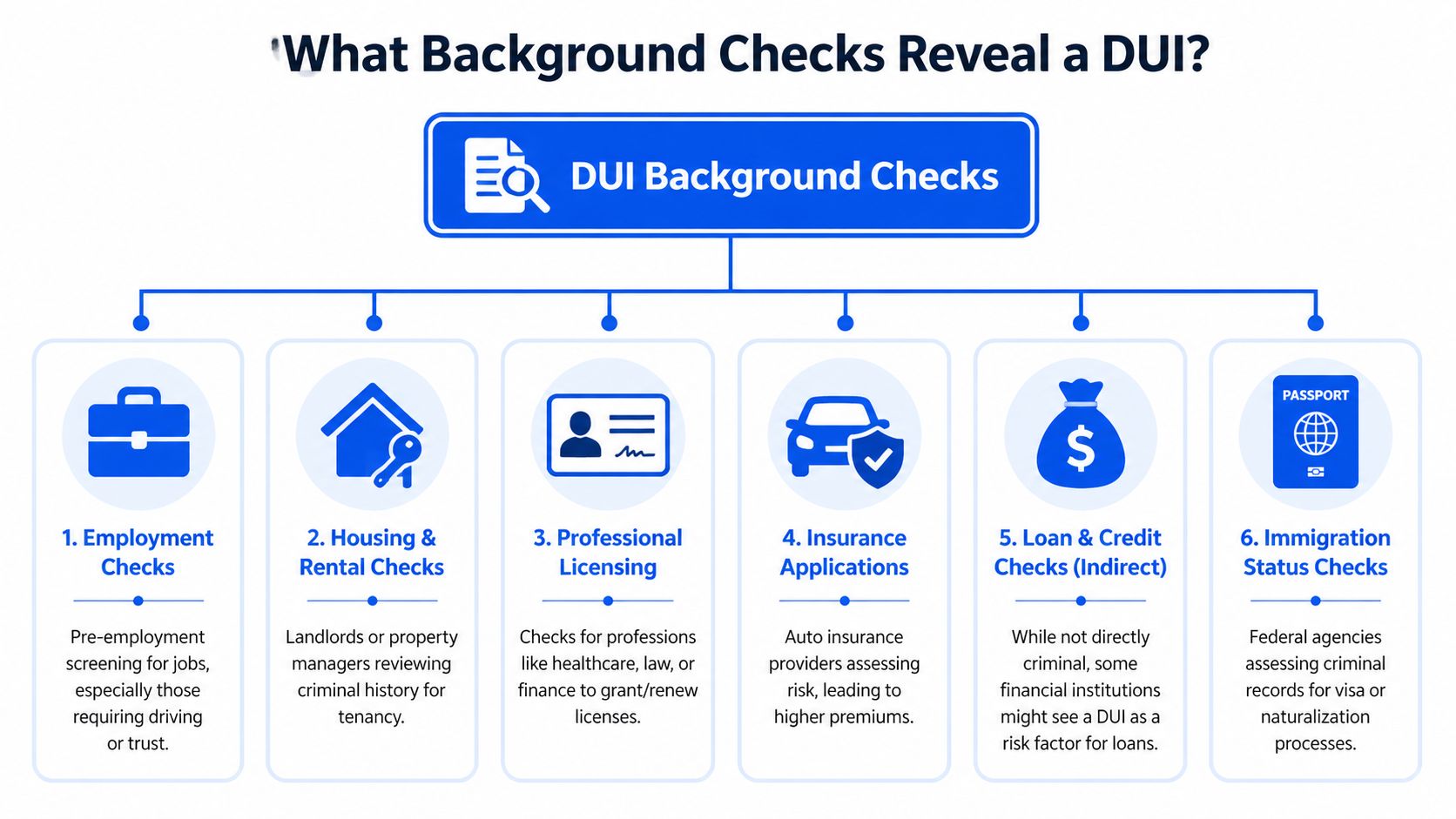
Different screenings pull from different records. Your problem is not just whether a DUI appears. Your problem is where it appears first, who sees it, and whether your lawyer moved fast enough to contain the damage before the case hardens into a conviction. That is why direct attorney access matters. A ticket mill processes volume. A real DUI defense lawyer targets the record problems that can cost you a job, a license, or both.
Will a regular employer screening find it?
In many cases, yes.
A standard employment screening often checks criminal court records. If your DUI arrest led to a filed criminal case, an employer may see the charge, the court where it is pending, and the final result once the case is resolved. Some screenings also pick up arrest information, depending on how the search is run and what reporting rules apply.
That matters immediately for jobs involving money, trust, children, patients, or company vehicles. Employers in those fields do not shrug off a pending DUI case.
If work is your first concern, read how a DUI can affect employment opportunities.
What does a driving record check show?
A Motor Vehicle Record check looks at your driver history, not your criminal court file. For many Florida clients, this is the first screen that causes real trouble.
Employers use MVR checks for delivery work, rideshare, outside sales, field service, commercial driving, and any position that puts you behind the wheel on the company’s insurance. A DUI-related suspension, license issue, or alcohol-related driving entry can create problems even if the criminal case is still pending.
Use this distinction:
Check type | What it looks for | Who uses it |
|---|---|---|
Criminal background check | Court records, charges, case status, convictions | General employers, landlords, licensing boards |
Motor Vehicle Record check | License status, suspensions, DUI-related driving history | Employers with driving duties, fleet operators, insurers |
If you drive for a living, your MVR may hurt you before a recruiter ever reads your resume.
What about fingerprint-based checks and government screening?
These checks go deeper. They are common in healthcare, education, finance, government work, defense-related jobs, and licensed professions.
Fingerprint-based screening can tie your identity to criminal records across multiple systems. Government and licensing applications may also require you to disclose an arrest or pending charge directly, even before a background report comes back. If you hold a professional license or need security-sensitive access, a DUI can trigger questions far beyond a routine HR screening.
At this stage, clients make a serious mistake. They treat the case like a traffic problem instead of a professional threat. That delay gives the state time to build a cleaner record against you.
Which check should concern you most?
The one tied to your paycheck.
If you work in logistics, rideshare, or any job that requires a clean driving history, focus on the MVR exposure. If you are licensed or work in a trust-based profession, focus on criminal screening and disclosure duties. If you need fingerprint clearance or government access, assume a wider review.
Your lawyer should identify that risk on day one and build the defense around it. That is the advantage of direct attorney access through Ticket Shield over a ticket mill model. You are not hiring a call center to push paper. You need a Florida DUI lawyer who can attack the stop, challenge the evidence, and fight for an outcome that does the least damage when someone runs your name.
How Long Does a DUI Stay on Your Record in Florida?
You get arrested on a Saturday night. By Monday morning, you are back at work acting like nothing happened. Florida does not treat it that way, and neither will an employer, insurer, or licensing board once the case turns into a record.

In Florida, a DUI is not something you wait out. If you are convicted, the damage can last for years, and in some settings it can keep resurfacing long after you have paid fines, finished probation, or moved on personally. That is why fast legal action matters. The goal is to stop the record problem from getting worse before it hardens into a conviction that follows you.
A lot of people make the same mistake after an arrest. They assume time will clean this up. It will not. Criminal history, driving history, insurance underwriting, and job applications all run on different timelines. Some may hit you early in the pending case. Others hit later, when you apply for a new job, renew a license, or need to drive for work.
If you want the Florida-specific details, read how long a DUI stays on your record in Florida.
What stays visible, and for how long?
Start with the practical answer. A DUI can keep affecting you in more than one place at the same time.
The arrest can appear while the case is still pending.
A conviction can stay tied to your criminal record long after the court case ends.
Your driving history can keep creating problems for driving jobs, fleet approval, and insurance pricing for years.
Those are different problems, and your lawyer should treat them that way from day one. A direct-access defense lawyer looks at where your exposure is highest and fights there first. A ticket mill usually processes the court date and leaves you to deal with the fallout later.
Does the case still matter after court is over?
Yes.
That is the part people underestimate. They focus on the courtroom and ignore the record. Then the true consequences show up later. A new employer asks questions. An insurer raises rates or cuts coverage options. A licensing application forces a disclosure. A company with driving duties decides you are too expensive or too risky to put behind the wheel.
The court file may close. The record problem does not disappear with it.
This short video gives a useful overview of why record duration matters in practice:
The wrong plea can create a record that keeps costing you after the sentence is over.
Why waiting puts you in a weaker position
Delay helps the prosecution, not you. While you are hoping the issue fades, deadlines pass, evidence gets harder to challenge, and the state gets closer to locking in a result that is much harder to fix later.
Handle this like your future income depends on it, because it often does. If your job involves driving, a professional license, a background check, or any trust-based role, you need a lawyer involved immediately. Direct attorney access matters here. You need someone who can review the stop, examine the testing, protect your license strategy, and push for the outcome that does the least long-term harm. That is very different from handing your case to a high-volume operation built to move files.
Can You Remove a DUI from Your Record in Florida?
If you plead guilty to DUI in Florida because you want this over with, you can trap yourself with a record you cannot clean up later. I see that mistake constantly. People focus on getting out of court fast, then learn too late that Florida gives them very little room to erase the damage.
Can a DUI conviction be sealed or expunged?
Usually, no.
Florida does not treat a DUI conviction like a minor mistake that can be wiped away later. If you are convicted, you should expect that record to stay put. That is why your case has to be handled correctly from the start, by a lawyer who is looking past the first court date and protecting your record, your license, and your future options.
A rushed plea is often the actual long-term penalty.
What should your lawyer try to prevent instead?
Your lawyer’s job is to stop the DUI conviction if the facts support that fight. That means examining whether the stop was legal, whether the officer had a valid basis to investigate, whether field sobriety exercises were handled properly, whether breath or blood testing can be challenged, and whether the state can prove impairment.
That work needs to happen early. A direct-access DUI lawyer will build a defense strategy around the weak points in your case and the long-term effect of every possible outcome. A ticket mill usually does the opposite. It pushes volume, treats your case like another file, and steers you toward the fastest resolution instead of the smartest one.
In some cases, the right result is a reduction to reckless driving, sometimes called a dry reckless. That can put you in a far better position than a DUI conviction when your record is reviewed later. It is not automatic. It has to be earned through case analysis, pressure on the prosecution, and disciplined negotiation.
For a closer Florida-specific explanation, read this guide on whether you can get a DUI off your record in Florida.
If your family is still dealing with release, bond, and immediate logistics, they may also need help after a DUI arrest in Forsyth.
What outcomes are worth fighting for?
A good result is the one that leaves the least damage on your record and the strongest defense if anyone later asks about the case.
Possible objective | Why it matters |
|---|---|
Dismissal | Keeps a conviction off your record |
Reduction to a lesser offense | Can limit how much harm the case does compared with a DUI conviction |
Suppression of evidence | Cuts away part of the state’s proof and improves your bargaining position |
Trial defense | Forces the prosecution to prove the charge instead of assuming you will fold |
If you hold a professional license, drive for work, serve in the military, or need a security clearance, this strategy matters even more. You need a lawyer who treats your case like a threat to your future, not a quick plea opportunity.
What Are Your Immediate Next Steps After a DUI Arrest?
You need to act like this case matters. Because it does.
A DUI arrest creates two urgent tracks at once. One involves the criminal case. The other involves your driving privileges. If you sit back, both tracks move without you.
What should you do in the first few days?
Use this checklist now.
Stay silent about the facts of the stop. Don’t try to “clear things up” with law enforcement, coworkers, or anyone else who could repeat what you said. Your statements can become evidence.
Write down everything you remember. Include where you were, what you drank, when you drank, what the officer said, whether body cam or dash cam may exist, whether you were asked to do field sobriety exercises, and anything unusual about the stop.
Protect your license quickly. In Florida, the deadline pressure after a DUI arrest is immediate. You need to address the administrative suspension issue fast.
Stop guessing about your record. Get legal advice before you make assumptions about what employers or agencies will see.
Preserve documents. Keep your citation, bond paperwork, tow paperwork, temporary permit, and any notice tied to the arrest in one place.
Talk to a DUI lawyer now, not after your first appearance. Early intervention gives your attorney a better chance to shape the case instead of reacting to it.
If your family is also trying to solve the immediate release and logistics side of the arrest, practical support matters. A resource on help after a DUI arrest in Forsyth explains the bond side in plain language and can help people understand what typically happens right after booking.
Why direct access to your lawyer matters right now
Many individuals often face serious drawbacks. They hire a service advertising convenience, then they never speak to the attorney handling the case. A middleman collects the intake. A chatbot answers basic questions. A call center gives vague updates. That model is dangerous in a DUI case.
You need a lawyer who can evaluate facts, not a script reader who forwards messages.
One Florida option is Ticket Shield’s DUI defense team, a lawyer-led firm where clients communicate directly with their attorney by phone or text rather than going through an automated app or ticket-mill middle layer. In a DUI case, that access matters because details change defenses.
Here’s what direct legal access helps with:
Fast factual review. Small details about the stop can become suppression issues.
Consistent strategy. You’re not re-explaining your case to a new person every time.
Fewer mistakes. People make damaging statements when they don’t have clear legal guidance.
Real preparation. Court, DMV-related issues, and negotiation strategy have to line up early.
When you’ve been arrested for DUI, convenience is not the standard. Protection is.
If your case is moving through a courthouse like the Broward County Judicial Complex, you need someone who knows that a DUI file is not self-correcting. It takes pressure, review, and strategic decisions.
Take Control of Your Future with a Dedicated DUI Attorney
Last night ended with handcuffs. The next mistake is waiting to see what happens.
A Florida DUI case does not sit still while you get your bearings. Prosecutors keep working. The arrest record keeps following you. Employers and licensing boards will not pause because you intended to deal with it later. If you want to limit the damage, hire a DUI lawyer now and make sure you can reach that lawyer directly when new facts, deadlines, or problems come up.
That point matters more than people realize. In a ticket-mill model, your case gets filtered through intake staff, call centers, and generic updates. In a real DUI defense, your lawyer reviews the stop, the arrest paperwork, the breath or blood issue, the officer’s timeline, and any weakness that can be used to protect your record. That is the standard you should demand. If you want a clearer sense of what that relationship should look like, read this guide on working with DUI attorneys in Florida.
Good defense also means dealing with the person behind the case file. If alcohol has become a larger problem than this arrest alone, get honest about it and get support. This explanation of what an AA sponsor does is a useful starting point for understanding how accountability works outside court.
Ticket Shield, PLLC is built around direct attorney access, not an app, not a middleman, and not a volume system that treats your arrest like just another file. That matters because DUI cases are won or improved in the details, and details get missed when you cannot reach the lawyer responsible for your defense.
Act today. Protect your license, your record, your job, and your future by getting a lawyer involved before this case hardens against you.