DUI Statutes Florida: Know Your Rights in 2026
Facing DUI in Florida? Understand DUI statutes Florida, penalties, defenses, and steps to protect your license. Get informed now!
TL;DR: Florida DUI statutes let prosecutors pursue you two ways under Florida Statute 316.193, by claiming impairment or a BAC of 0.08% or higher. Your license is in immediate danger. Act fast, stay quiet, and get a real Florida DUI lawyer involved now.
You were arrested. Your car may be impounded. Your phone is full of messages. You are trying to figure out whether this is “just a traffic case.” It is not.
A DUI in Florida is a criminal charge. It can threaten your license, your job, your professional standing, and your future. If your case is filed in a courthouse like the Broward County Judicial Complex in Fort Lauderdale, the process will move whether you feel ready or not. The state starts building its case immediately. You should do the same.
The good news is simple. A DUI arrest is not the same thing as a DUI conviction. Florida prosecutors still have to prove their case. Officers still make mistakes. Machines still produce challengeable results. Procedures still matter.
Table of Contents
You’ve Been Charged with a DUI. What Happens Now?
Why this charge demands a real defense
What to do first
What Does a DUI Mean Under Florida Statute 316.193?
What are the two paths to a conviction
Why the distinction matters immediately
How Does the State Prove Impairment or an Illegal BAC?
What prosecutors use in impairment cases
Why chemical tests are not untouchable
Where lawyers attack the BAC case
Are There Circumstances That Make a DUI More Serious?
Which facts raise the stakes
Why refusal needs immediate attention
Will I Lose My License Right After a DUI Arrest?
Why the first days matter most
What a lawyer does during the deadline window
How Do Florida DUI Penalties Escalate by Offense?
How the statute punishes repeat convictions
Why first-offense strategy matters so much
The financial fallout keeps going
What Immediate Steps Should I Take to Protect Myself?
What to do today
What not to do
You’ve Been Charged with a DUI. What Happens Now?
It is 2 a.m. You are out of jail, your car may be impounded, your phone is full of messages, and the paper the officer handed you already started the clock. That is the moment people make expensive mistakes. They wait for the court date, trust bad advice from friends, or sign up with a ticket mill that treats a DUI like a volume business.
Your case starts on two tracks at once.
One track is the criminal case. That moves through arraignment, motions, negotiations, and, if necessary, trial. In Miami-Dade, that may mean appearances at the Richard E. Gerstein Justice Building.
The other track is your license. It moves through a separate administrative process, and it often moves faster than clients expect. If you miss that deadline window, the damage hits your ability to work, get your kids to school, and keep your life stable.
Why this charge demands a real defense
A DUI is not a routine traffic matter. The state treats it like a public safety case, and the system is built to process arrests quickly. Judges, prosecutors, and hearing officers see these cases every day. You need someone who sees the weaknesses every day too.
That is why your first move matters. A hands-on defense lawyer starts preserving evidence, locking down deadlines, and testing the officer’s version of events right away. An app cannot do that. A high-volume ticket operation usually will not do that. You need a lawyer who takes control early and treats the first week like part of the defense, because it is.
If language is part of the problem, fix that immediately too. Misunderstanding legal instructions can hurt you fast. This guide to legal terminology in Spanish can help you understand key terms while your lawyer handles the case itself.
What to do first
Get clear on the sequence of events after an arrest. This overview of what happens after a DUI arrest in Florida is a good starting point.
Then do these three things today:
Track every deadline: The license deadline can arrive before you feel ready.
Write down everything: The stop, the officer’s questions, roadside exercises, breath testing, witnesses, medical issues, and anything you ate or drank all matter.
Say nothing about the case: Do not explain it to friends, coworkers, insurance adjusters, or on social media. Save it for your lawyer.
Do not try to talk your way out of this after the fact. Build your defense early, with a real attorney who will handle the timeline, protect your license, and challenge the state before the case hardens against you.
What Does a DUI Mean Under Florida Statute 316.193?
Florida Statute 316.193 is the statute that drives almost every DUI case in this state. If you were arrested, you need to understand what the prosecutor seeks to prove, because your defense strategy depends on that answer.
The statute provides two related but distinct paths for a prosecutor to secure a conviction.
What are the two paths to a conviction
First, the state can claim your normal faculties were impaired by alcohol, a controlled substance, or certain chemical substances. In plain English, the prosecutor argues you were affected enough that your ability to see, hear, judge, speak, balance, react, or drive normally was impaired.
Second, the state can pursue a per se DUI based on an unlawful alcohol level. That usually means a breath or blood alcohol concentration of 0.08% or higher.
Those are not the same case.
An impairment case rises or falls on observations, video, roadside exercises, statements, and the officer’s judgment. A per se case rises or falls on the test result and whether law enforcement followed the rules closely enough for that number to hold up in court.
That distinction matters early. A real defense lawyer identifies which theory the state is using, then starts attacking the weak points in that specific theory. A ticket mill usually treats every DUI file the same. An app cannot examine body camera footage, compare the report to the video, question testing procedures, or pin down where the officer cut corners.
If English is not your first language, get help with the wording immediately. Misunderstanding legal instructions hurts people fast in DUI cases. This guide to legal terminology in Spanish can help you follow what is being said around your case more accurately.
Why the distinction matters immediately
You need to know which lane your case is in before you decide how to fight it.
If the state is building an impairment case, your lawyer should focus on the stop, the officer’s claimed observations, the conditions during roadside exercises, your medical history, your footwear, the surface, the lighting, and every instruction you were given. If the state is building a per se case, your lawyer should focus on the breath machine, the testing sequence, maintenance records, observation periods, operator compliance, and whether the result is even admissible.
Many drivers also confuse DUI with DWI terminology from other states. Florida uses DUI. This explanation of the difference between DUI and DWI clears that up quickly.
Do not treat the statute like a technical definition that only matters to lawyers. It tells you where the state thinks its proof is strongest. Your lawyer’s job is to make that proof break under scrutiny.
How Does the State Prove Impairment or an Illegal BAC?
The state does not win because an officer arrested you. The state wins only if it can present evidence that survives challenge.
That sounds obvious. It is not how frightened drivers think after an arrest. Many drivers assume the report, the badge, and the test result end the conversation. They do not.
What prosecutors use in impairment cases
In an impairment case, prosecutors usually build around the officer’s account.
They point to things like:
Driving behavior: weaving, drifting, braking oddly, or other claimed signs of unsafe operation
Personal observations: odor of alcohol, red eyes, slurred speech, delayed responses
Field exercises: balance tests, divided-attention tasks, and other roadside performance claims
Post-arrest conduct: confusion, statements, or behavior described as consistent with impairment
Those cases are often more subjective than drivers realize. “Normal faculties” is broad. Officers interpret it through their own training, memory, and report writing.
That makes detail important. Shoes matter. Road surface matters. Lighting matters. Weather matters. Fatigue matters. Injuries matter. Anxiety matters. Medical conditions matter.
Defense tip: If an officer gave unclear instructions or conducted roadside exercises in poor conditions, that issue may become far more important than you think.
Why chemical tests are not untouchable
Florida also allows a per se DUI theory. Under Florida Statute § 316.193, a BrAC of 0.08 or higher can support the charge. But breath testing is not magic.
According to NCDD’s Florida DUI law discussion, breath tests use a 2100:1 partition ratio assumption and can carry ±15-20% error margins due to individual physiology. That matters because prosecutors often present a machine number as if it were absolute.
It is not absolute. It is contestable.
Where lawyers attack the BAC case
A strong DUI defense often drills into the science and procedure, not just the final number.
Some of the most important questions are these:
Was the machine operating properly?
Was the test administered correctly?
Was the timing favorable to the state, or did your BAC rise after driving?
Did the officer document every required step cleanly and consistently?
The rising or falling BAC issue matters because your test result is taken after driving, not during it. The state still has to connect that later number back to the time you were behind the wheel.
If you want a plain-language refresher on thresholds and test issues, review Florida’s BAC limit in Florida.
Your defense is not about arguing feelings. It is about forcing the state to prove the case with evidence that holds up under scrutiny.
Are There Circumstances That Make a DUI More Serious?
Yes. And if any aggravating fact shows up in your arrest report, you need a lawyer reviewing it right away, not a ticket app pushing canned steps.
Prosecutors use these facts to ask for harsher penalties, tougher bond terms, and less favorable plea offers. A hands-on defense lawyer reads the report early, checks whether the allegation is supported, and starts cutting away the parts of the case the state is trying to use against you. A ticket mill usually just processes the file after the damage is already done.
Which facts raise the stakes
A DUI gets more serious when the state claims one or more of these facts:
A high BAC. Florida increases penalties when the alleged alcohol level is well above the legal limit.
A child passenger. Judges and prosecutors treat that as a major aggravating factor.
Prior DUI convictions. Even one prior changes the negotiation posture and sentencing risk.
Property damage or injury. Once a crash is involved, the case gets harder, more expensive, and more dangerous.
A felony filing risk. Repeated DUI charges or a case involving serious injury can move the case into felony territory.
These factors are primary drivers of penalties. They also affect how quickly your lawyer needs to act.
Florida law increases fines and other penalties as the offense level rises. A first DUI may look manageable on paper. It stops looking manageable fast if the report alleges a high BAC, a child in the car, or a crash victim.
Why refusal needs immediate attention
Refusal is one of the first issues I check.
A breath test refusal can trigger a separate license problem on the administrative side, and that pressure starts long before your criminal case is resolved. If the officer claims you refused, your lawyer needs to examine the warning, the paperwork, the timeline, and whether the refusal was documented correctly. You can read more about that process in this guide to Florida DUI license suspension rules after arrest.
Career fallout can hit just as fast. Military members, commercial drivers, licensed professionals, and law enforcement officers often face employer or licensing consequences before they ever get to court. Waiting to “see what happens” is a mistake.
Get ahead of the aggravating facts early. If the state is claiming refusal, a high BAC, a child passenger, prior DUIs, or crash-related harm, your defense has to be built by someone who handles DUI litigation, deadline by deadline, instead of funneling your case through a volume system.
Will I Lose My License Right After a DUI Arrest?
Possibly. And if you wait too long, “possibly” turns into “yes.”
This is the part of dui statutes florida that catches people off guard. They think the court controls everything. It does not. Florida uses aggressive administrative suspension rules, and they move fast.
Why the first days matter most
Florida’s strict approach is tied to the public safety concerns behind DUI enforcement. According to Drive Sober Florida data, alcohol-impaired driving fatalities represent 23.3% of all Florida traffic deaths, with 874 lives lost in a single recent year. That enforcement mindset is why the state does not wait patiently while you figure things out.
The license problem starts almost immediately after arrest.
Your criminal case may feel like the obvious threat. It is not the only one. The administrative side can remove your ability to drive long before your case is resolved in court.
That matters if you need to get to work, transport your children, reach medical appointments, or function.
What a lawyer does during the deadline window
The first move is not arguing your innocence to strangers. The first move is preserving your rights before deadlines close.
You need a defense strategy that addresses both the court case and the license issue. A lawyer handling the administrative side can evaluate whether the stop, arrest, testing process, and paperwork create an opening to challenge the suspension. This overview of dui license suspension florida is a good primer on how that process works.
Here is the practical reality:
The state has a process ready to go. You need one too.
Administrative action is separate from guilt or innocence. Drivers miss that constantly.
Early mistakes are expensive. Waiting is one of them.
Protective advice: If driving is essential to your life, treat your license as the first emergency.
If your case is pending in a place like the Edgecomb Courthouse in Tampa or the Orange County Courthouse in Orlando, the courtroom process may feel overwhelming. But the fastest damage often happens outside the courtroom, in the administrative system, where silence and delay can reduce your options.
How Do Florida DUI Penalties Escalate by Offense?
One bad night can turn into a long-term sentencing problem.
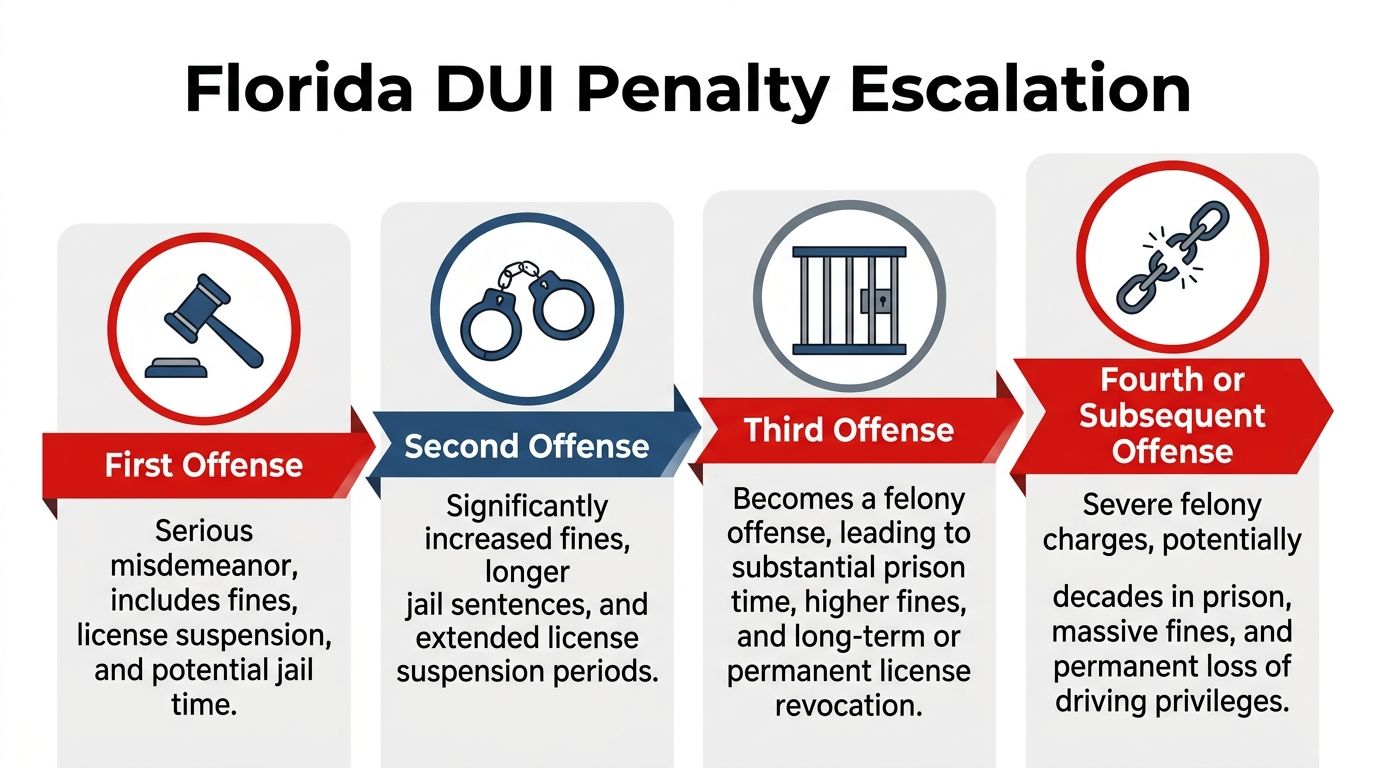
Florida treats a DUI conviction as a marker that follows you. Once it is on your record, the next case is punished more aggressively, prosecutors get less flexible, and the risk level rises fast. That is why a first DUI is never a paperwork event you just “get through.”
How the statute punishes repeat convictions
Florida’s penalty ladder is built to increase pressure with each conviction.
Penalty | First Conviction | Second Conviction (within 5 yrs) | Third Conviction (within 10 yrs) |
|---|---|---|---|
Fine range | $500 to $1,000 | $1,000 to $2,000 | $2,000 to $5,000 |
Classification risk | Criminal conviction | Harsher repeat-offense treatment | Felony exposure |
Long-term consequence | Record damage starts here | Prior record now drives punishment | Felony record can alter your life |
A fourth DUI can bring felony treatment too. The main point is simple. A conviction today creates a future multiplier, making later accusations far more dangerous.
That changes how a defense lawyer looks at your case. A hands-on attorney is not just trying to reduce today’s pain. The lawyer is also trying to stop the State from gaining a conviction it can use against you later.
Why first-offense strategy matters so much
People charged with a first DUI often focus only on the immediate penalties. That is too narrow.
The key question is whether you are about to give the State a permanent advantage. Once a prior conviction exists, every future stop, negotiation, and sentencing discussion gets harder. That is one reason I strongly recommend speaking with a lawyer who handles DUI defense, not a volume practice or app. Start with attorneys who focus on these cases and offer direct lawyer access, such as this guide to Florida DUI defense attorneys.
A ticket mill processes files. A real defense lawyer builds one.
That means reviewing the stop, the arrest decision, the testing process, the video, the officer’s timeline, and the weak points that can be used in negotiation or litigation. If your case can be challenged early and correctly, you may avoid creating the prior conviction that makes the next case much worse.
The financial fallout keeps going
Court fines are only part of the punishment. Insurance rates can become one of the most expensive consequences after the case ends. If you want a plain-English overview of coverage basics and policy issues, read this guide to car insurance in Florida.
A DUI record can also affect employment screenings, professional licensing, housing applications, and reputation. The court date comes and goes. The record stays.
Bottom line: Treat a first DUI like the State is trying to build a case against your future, because that is exactly what a conviction does.
What Immediate Steps Should I Take to Protect Myself?
Start today. Not after your first court date. Not after you “see what happens.” That passive approach costs people options.
The early window after a DUI arrest is when useful facts are still fresh and avoidable damage can still be contained.
What to do today
Write down the stop in detail while you still remember it.
Include where you were, what you drank if anything, what time you last consumed alcohol, what the officer said, whether body camera or dash camera was visible, whether you were asked to do roadside exercises, how those instructions were given, and what happened at the testing site.
Then gather documents. Keep every paper the officer gave you. Save towing paperwork. Save bond paperwork. Save receipts if timing matters.
This short video gives a practical overview of the early response mindset:
If you are looking for counsel, focus on actual DUI defense experience and direct lawyer access. This page on dui attorneys in Florida is a useful place to start your screening process.
What not to do
Do not try to explain the case away to law enforcement.
Do not call the prosecutor’s office.
Do not post about the arrest.
Do not assume a polite attitude alone will fix a legal problem built on paperwork, video, officer testimony, and chemical evidence.
Here are the immediate steps that matter most:
Preserve your driving privilege: Contact a Florida DUI lawyer immediately so the license issue can be addressed before deadlines close.
Document everything: Your memory is evidence. Use it before time strips away detail.
Stay off the record: Conversations with anyone other than your lawyer can become problems.
Choose a lawyer, not a platform: Automated apps and ticket mills are built for volume. DUI defense requires judgment, speed, and accountability.
A DUI charge is serious. It is also defensible. The drivers who protect themselves best are the ones who move first, stay quiet, and force the state to prove its case the hard way.
If you want a lawyer-led defense instead of an app, talk directly with Ticket Shield, PLLC. You can speak with your attorney by phone or text, get immediate guidance on protecting your license, and fight for the result that matters most. No Points. Visit TicketShield.com now for a free consultation.