The Difference Between DUI And DWI In Florida Explained
Confused about the difference between DUI and DWI in Florida? This guide clarifies the legal definitions, penalties, and what these charges mean for you.
If you're trying to figure out the difference between a DUI and a DWI in Florida, the answer is simple: there is no legal difference, because Florida doesn't use the term "DWI."
The only official charge for impaired driving in the Sunshine State is Driving Under the Influence (DUI). While you've probably heard "DWI" thrown around on TV shows or in conversations about other states, that term has zero legal weight in a Florida courtroom.
Understanding Florida's DUI Terminology
When you're facing an impaired driving charge in Florida—whether it's in Broward County or anywhere else in the state—the only acronym that matters is DUI. This isn't just a minor detail; it defines the entire legal framework, from the moment an officer pulls you over to the potential penalties. Understanding this is the first step in navigating the legal process.
Of course, it can be helpful to understand the general difference between DUI and DWI as it applies in other states, but for Florida drivers, the focus must be entirely on our state's specific DUI statute.
Why The Terminology Matters
Knowing that Florida is a "DUI state" is critical because it tells you exactly what the law addresses. A DUI charge isn't just about alcohol. It covers impairment from any chemical or controlled substance that affects your normal faculties, giving the state a very wide net to cast.
Focus on Impairment: The central question in Florida law is whether your ability to drive safely was compromised, not just what your blood alcohol level was.
No Lesser Offenses: Some states have different charges like DWI for lower levels of impairment. Florida has one primary charge: DUI.
Legal Clarity: Using the right term ensures you're researching the correct laws and penalties that apply to your situation right here in Florida.
This table cuts through the noise and shows you exactly how these terms are used, highlighting why Florida's approach is unique.
Florida DUI vs DWI Terminology At A Glance
Aspect | DUI (Driving Under the Influence) | DWI (Driving While Intoxicated) |
|---|---|---|
Legal Status in Florida | The official and only legal charge under Florida Statute 316.193. | Not a legal term used in Florida statutes; it is used in other states. |
Scope of Impairment | Covers impairment by alcohol, chemical substances, or controlled substances. | In other states, it can refer specifically to alcohol or be a separate, lesser charge. |
Relevance in Broward County | All impaired driving arrests in Broward County are prosecuted as DUI. | The term DWI has no legal application or relevance in a Broward County court. |
The bottom line is this: if you're pulled over in Florida on suspicion of impaired driving, the charge will be DUI. That clarity is essential, as the state's statutes, penalties, and defense strategies are all built around this specific legal definition. You can learn more about how impairment is measured by reading our article on the BAC limit in Florida. Our goal is to protect your license and record by addressing the specific DUI charge you face.
Attorney Advertisement. Office in Broward.
The Legal Definition Of DUI Under Florida Law
To build a defense against a Florida DUI charge, you first have to understand the playbook the state uses to prosecute these cases. The entire legal framework for every DUI arrest is built on Florida Statute 316.193. This statute gives prosecutors two different ways to pursue a conviction, and an arrest in any county, including Broward, will be based on one or both of them.
Knowing this statute is the first step in creating a defense strategy. Our practice focuses on traffic and DUI defense, and we’ve found that an informed client is in a much better position to navigate the legal system.
The Two Paths To A DUI Conviction
Florida law doesn't hang its hat on just one piece of evidence. Instead, it allows the prosecution to build its case on either what an officer observes or what a chemical test shows. This two-pronged approach means a defense must be ready to address multiple fronts.
The state has two primary ways to prove a DUI:
Impairment of "Normal Faculties": The prosecutor can argue that you were under the influence of alcohol or a controlled substance to the point that your everyday abilities were impaired.
Unlawful Blood or Breath Alcohol Level: Or, the state can simply prove your Blood Alcohol Concentration (BAC) was 0.08 or higher. It doesn't matter if you appeared impaired or not—this is what’s known as a "per se" violation.
This legal structure has evolved over time. The significant increase in DUI arrests between 1970 and 1986, which grew by nearly 223%, marked a turning point. Growing public concern and advocacy reshaped how these laws were written and enforced, leading to the strict standards we see today.
What Are Normal Faculties?
The term "normal faculties" is intentionally broad in Florida law. It’s not a tricky legal term; it just refers to the everyday abilities we all need to function safely—things like seeing, hearing, walking, talking, making sound judgments, and, of course, operating a vehicle.
When an officer pulls someone over on suspicion of DUI, they’re looking for signs that these faculties are impaired. They’re trained to spot clues like:
Slurred speech
Bloodshot or watery eyes
Struggling with balance or coordination
The smell of alcohol
Fumbling to get a driver's license and registration
These observations, often noted during field sobriety exercises, become the foundation of the prosecution's case if they're arguing the impairment theory.
The 0.08 Per Se Rule
The second path to a conviction is much more direct—it’s all about the number. If a chemical test, usually from a breath or blood sample, shows a BAC of 0.08 or higher, the law automatically presumes you were impaired. This is the "per se" rule, which literally means "by itself."
Under the per se rule, the prosecutor doesn't need to prove your driving was erratic or that you were stumbling. The number itself is considered sufficient evidence to charge you with DUI.
This makes challenging the chemical test results a cornerstone of many DUI defenses. Issues with the breathalyzer's calibration, the officer's training, or the protocol used to collect the sample can all be used to question whether that 0.08 reading is valid. Our goal is to scrutinize every piece of evidence to protect your license and your record.
How Other States Approach DWI And Impaired Driving
While Florida law uses a single DUI charge, crossing state lines means entering a new world of traffic laws and terminology. It's a patchwork quilt of rules, and understanding the differences is key to realizing why a defense must be built specifically for the state where you were pulled over. What might be a lesser offense in one state could carry serious consequences in another.
Many states use both DUI and DWI, but they often don't mean the same thing. This can create a tiered system of offenses that depends on how impaired you are or what substance was involved. For drivers, this means an action that leads to one charge in Texas could result in a completely different one in New York.
Distinctions Based On Impairment Level
One of the most common ways other states separate DUI and DWI is by tying them to specific levels of impairment. In this setup, one charge is almost always considered more serious than the other.
A typical tiered system looks something like this:
Driving While Impaired (DWI): This is often a lesser charge. It might be used for drivers with a BAC below the standard 0.08 limit but still high enough to suggest impairment (say, 0.07). It’s the law’s way of saying, “You might not be legally intoxicated, but you’re not sober either.”
Driving Under the Influence (DUI): This is usually the more serious charge, reserved for drivers with a BAC of 0.08 or higher. It works a lot like Florida's per se DUI law, where that number alone is enough for a charge.
This distinction gives prosecutors in those states a way to press charges even when a driver blows under the 0.08 threshold—a legal gray area that doesn't really exist in Florida's main DUI law.
Distinctions Based On The Intoxicating Substance
Another way states draw a line between these terms is by looking at what caused the impairment. This approach separates alcohol offenses from those involving other drugs.
In some jurisdictions, a DWI charge specifically refers to intoxication from alcohol ("Driving While Intoxicated"). In contrast, a DUI charge might be used more broadly to cover impairment from any substance, including prescription medications, marijuana, or other controlled substances ("Driving Under the Influence").
This strategy can change everything, from the kind of evidence police gather to the penalties a judge imposes. For instance, a DWI case might depend entirely on breathalyzer results. A DUI case involving drugs, on the other hand, would lean heavily on blood tests and the testimony of a Drug Recognition Expert (DRE).
Again, this is a sharp contrast to Florida, where a single DUI charge covers impairment from alcohol, chemical substances, or controlled substances. A traffic stop for suspected impairment in Broward County will lead to a DUI charge, regardless of the substance involved.
The main takeaway here is that impaired driving laws are not uniform across the country. When you're traveling, you’re playing by the local rules, and that state's definitions and penalties are the only ones that matter. This can get complicated, especially when figuring out how a violation from another state might follow you home to Florida. You can learn more in our guide on how out-of-state tickets affect insurance and your driving record.
Navigating The Penalties For A DUI In Broward County
A DUI charge in Florida, especially in a place like Broward County, is far more serious than a simple traffic ticket. It's a criminal offense, and a conviction can impact every part of your life—from your freedom and finances to your ability to drive to work. Understanding the specific penalties is critical, because these aren't just suggestions; they're mandatory minimums established by state law.
The penalties for a DUI conviction in Florida are tiered, getting progressively tougher with each offense. Even a first-time conviction comes with significant sanctions designed to be a powerful deterrent. Florida takes impaired driving very seriously, and the penalties reflect that.
First-Time DUI Conviction Penalties
For a standard first-offense DUI with no aggravating factors, a driver faces a baseline of consequences that anyone convicted will face.
Fines: A minimum fine of $500, up to a maximum of $1,000.
Jail Time: Up to six months in county jail.
Probation: The total period of jail and probation combined cannot exceed one year.
Driver's License Revocation: A mandatory revocation for 180 days to one year.
Community Service: A required 50 hours of community service is mandatory.
Vehicle Impoundment: Your vehicle will be impounded for 10 days.
These penalties can escalate if certain aggravating factors are involved. For instance, having a Blood Alcohol Concentration (BAC) of 0.15 or higher, or if there was a minor in the vehicle during the offense, will trigger enhanced penalties. This means higher fines and potentially longer jail sentences. You can get more details in our complete guide on first-time DUI penalties in Florida.
This flowchart shows why understanding local law is the most critical first step in any DUI case.
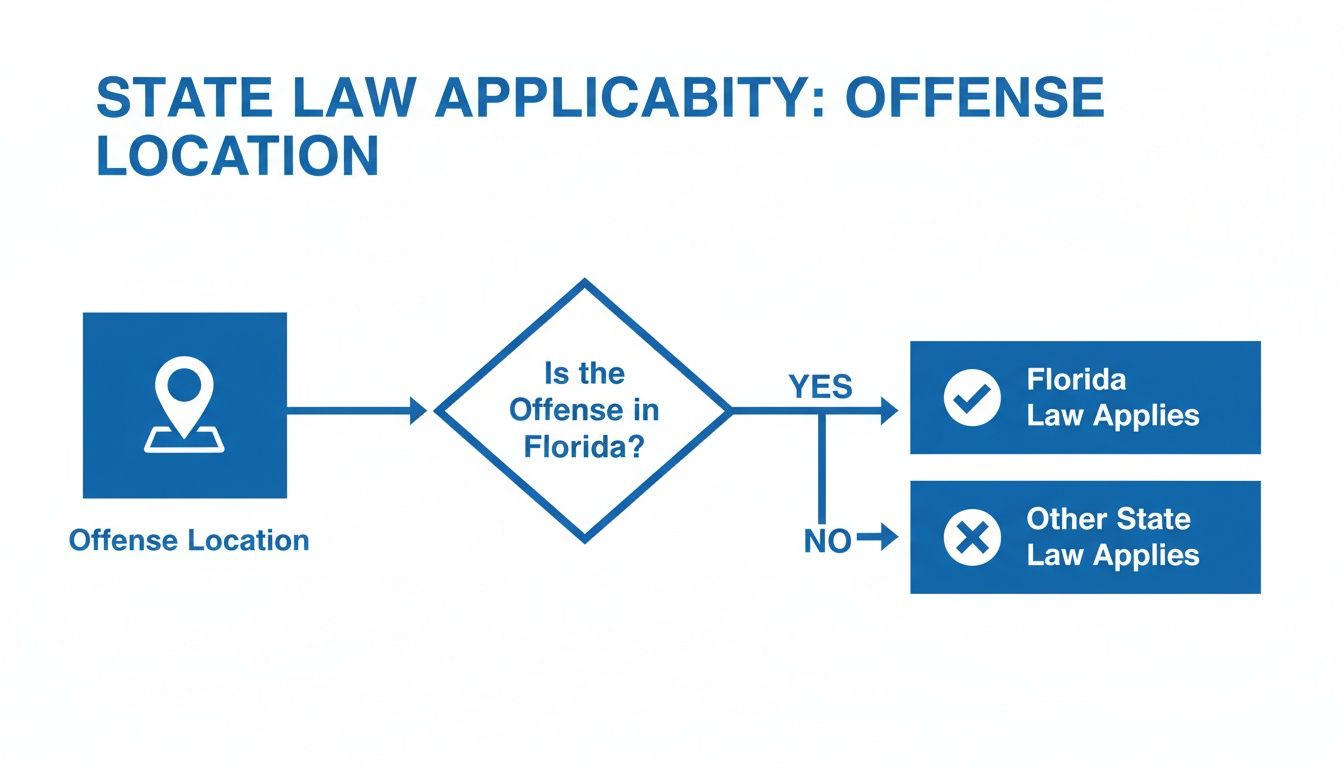
As you can see, if the offense happens in Florida, only Florida's DUI laws matter. That’s why knowing the local penalties inside and out is so essential.
Escalating Penalties For Subsequent Offenses
The state reserves its harshest penalties for repeat offenders. A second DUI conviction within five years of the first one triggers much tougher mandatory minimums, leaving judges very little room for leniency.
A second conviction within five years includes mandatory jail time of at least 10 days, fines up to $2,000, and a minimum five-year license revocation. The stakes increase dramatically with each subsequent charge.
This strict stance is supported by public safety data. According to the National Highway Traffic Safety Administration, about one-third of all drivers arrested for DUI have at least one prior conviction. Furthermore, drivers with a BAC of .08 g/dL or higher involved in fatal crashes were at least four times more likely to have a prior DUI conviction than sober drivers.
To give you a clearer picture, here’s a breakdown of the minimum and maximum penalties for first and second DUI convictions in Florida.
Florida DUI Penalties For First And Second Offenses
This table summarizes the statutory penalties for standard first and second DUI convictions. Note that penalties for a second offense are significantly enhanced if it occurs within five years of the first.
Penalty | First DUI Conviction | Second DUI Conviction (within 5 years) |
|---|---|---|
Fine | $500 - $1,000 | $1,000 - $2,000 |
Jail Time | Up to 6 months | 10 days mandatory, up to 9 months |
License Revocation | 180 days - 1 year | 5 years minimum |
Vehicle Impoundment | 10 days | 30 days |
Ignition Interlock Device | At least 6 months (if BAC 0.15+) | At least 1 year |
As you can see, the consequences climb steeply for a second offense, reflecting the state's approach to repeat impaired driving.
The Ignition Interlock Device Requirement
One of the most impactful penalties for many drivers is the mandatory installation of an Ignition Interlock Device (IID). This device is a breathalyzer wired into your car’s ignition. It requires the driver to provide an alcohol-free breath sample before the vehicle will start.
First Conviction (with BAC 0.15+): Mandatory IID for at least six continuous months.
Second Conviction: Mandatory IID for at least one year.
Third Conviction: Mandatory IID for at least two years.
The driver is responsible for all costs tied to the IID—installation, monthly monitoring, and eventual removal. This financial burden comes on top of court fines, probation fees, and DUI school tuition. Navigating these penalties requires an understanding of the law and a strategic plan. Our practice, with its office in Broward, handles these complex traffic matters across Florida. Our goal is to protect your license and record.
Attorney Advertisement. Office in Broward. Past results do not guarantee future outcomes. Prospective clients may not obtain the same or similar results.
Special Considerations for Under-21 and Commercial Drivers
While any DUI charge in Florida is serious, the law places two groups of drivers under an even bigger microscope: commercial drivers and anyone under 21. For these individuals, the rules are tougher, the legal limits are lower, and a single mistake can derail a career or change the course of a young life.
The logic behind these stricter standards is public safety. Professional drivers command heavy, potentially dangerous vehicles, while younger drivers are statistically more likely to be involved in alcohol-related incidents. The very definition of what’s illegal changes for these drivers, making a specialized defense essential.
The Zero Tolerance Law For Drivers Under 21
Florida has a "Zero Tolerance" policy for underage drinking and driving. If you're under the legal drinking age of 21, the standard 0.08 BAC limit does not apply to you.
Instead, if you get behind the wheel and an officer finds you have a breath or blood alcohol level of just 0.02 or higher, your license will be suspended. It’s an immediate, six-month administrative suspension for a first offense.
A 0.02 BAC is an incredibly low threshold that can be reached with even a small amount of alcohol. This strict rule leaves no room for error. This suspension is an administrative penalty, completely separate from any criminal DUI charges you might face if your BAC hits 0.08 or your normal faculties are considered impaired.
There's a reason for this aggressive stance. Age-specific data shows that young drivers, especially those between 21 and 24, are the highest-risk group for fatal alcohol-impaired crashes. This trend is why Congress raised the national drinking age to 21 in 1984. The National Highway Traffic Safety Administration estimates that change has saved approximately 32,000 lives. You can explore more on the NHTSA's drunk driving data.
Career-Ending Risks For CDL Holders
For professional drivers who depend on a Commercial Driver's License (CDL), a DUI allegation is a nightmare scenario—even if it happens in their personal car. Florida law holds CDL holders to a much higher standard because of the enormous responsibility they have on our roads.
The key differences are stark:
A Lower BAC Limit: While driving a commercial vehicle, a CDL holder is considered impaired with a BAC of 0.04 or higher—half the standard legal limit.
Implied Consent for CDL: Refusing a breath, blood, or urine test while operating a commercial vehicle means an instant one-year disqualification of your CDL.
Personal Vehicle DUIs Still Disqualify: A DUI conviction in your own car will still trigger a one-year disqualification of your CDL for a first offense. A second conviction means a lifetime disqualification.
A professional driver can lose their career for a year or more because of something that happened on their own time, in their own vehicle. When it comes to disqualifying a CDL, the law makes no distinction.
This unforgiving penalty structure exists because the judgment needed to safely operate a commercial vehicle is held to a higher standard. Losing a CDL, even for a year, often means losing a job, which can trigger a massive financial crisis. Our firm understands the unique pressure CDL holders are under, and our focus is on protecting your license and livelihood.
How A Focused DUI Defense Can Protect Your Future
Being charged with a DUI in Florida can feel overwhelming, but an arrest is not the end of the road. It's the beginning of a legal process, and it’s critical to remember that the state has to prove its case beyond a reasonable doubt. A proactive, focused defense strategy involves scrutinizing every piece of evidence and every step the officer took.
The foundation of any defense starts with the traffic stop itself. An officer needs a valid legal reason, known as reasonable suspicion, to pull you over. If the stop was unlawful, any evidence they collected afterward—from field sobriety tests to breathalyzer results—could be excluded from court. Our practice focuses on traffic and DUI defense, and we meticulously examine the details of every stop.

Questioning The Evidence Against You
Beyond the initial stop, the state's evidence is often less solid than it appears. Take Field Sobriety Exercises (FSEs), for example. They are notoriously subjective and can be influenced by anything from weather conditions in Broward County to your own medical history. These are not definitive tests of impairment; they're tools an officer uses to build a case.
It’s a similar story with breath-testing devices. These machines need precise calibration and maintenance to give reliable results. If the machine wasn't maintained properly or the officer who ran the test wasn't certified, the results might be inadmissible in court. Challenging this kind of evidence is a cornerstone of a DUI defense.
Remember: An arrest is not a conviction. The prosecution's case is built on evidence that must be legally obtained and scientifically reliable. A defense attorney's job is to find the weaknesses in that case.
Key Areas To Challenge In A DUI Case
A comprehensive defense strategy is a multi-pronged approach that examines every angle of the arrest and the evidence. Our goal is simple: protect your license and your record by making sure your rights were respected.
Key defense avenues often explored include:
Illegal Traffic Stop: Did the officer have a legitimate reason to pull you over in the first place?
Improper FSE Administration: Did the officer correctly instruct and demonstrate the field sobriety exercises according to standardized procedures?
Breathalyzer Inaccuracy: Are there records showing the device was recently calibrated and in proper working order?
Violation of Rights: Were you denied your right to speak with an attorney or properly informed of Florida's implied consent law?
Each of these points represents a potential weakness in the state's case. You can discover more about these strategies in our guide on how to beat a DUI charge.
Facing a DUI is stressful, but you don't have to navigate it alone. Our firm, with its office in Broward, handles criminal traffic matters across Florida. Contact us for a free consultation to talk about the specifics of your case.
Attorney Advertisement. Office in Broward. Past results do not guarantee future outcomes. Submitting information via forms does not create an attorney-client relationship.
Common Questions After a Florida DUI Arrest
When you're dealing with the fallout of a DUI arrest in Florida, a flood of urgent questions comes to mind. Below are some straightforward answers to common concerns. While this information is a starting point, it is not a substitute for legal advice from a licensed attorney about your specific case.
Can I Refuse a Breathalyzer Test in Florida? What Happens if I Do?
Yes, you have the right to refuse a breathalyzer test in Florida. But this choice comes with immediate and automatic penalties because of the state's "implied consent" law. This law states that by driving on Florida roads, you've already agreed to submit to a test if you're lawfully arrested for DUI.
For a first-time refusal, the Department of Highway Safety and Motor Vehicles (DHSMV) will automatically suspend your driver's license for one year. If you refuse a second time, the consequences get harsher: an 18-month suspension and a separate misdemeanor charge just for the refusal itself. This is an administrative penalty, completely separate from your criminal DUI case.
Will a DUI Arrest Automatically Suspend My License?
An arrest doesn’t mean your license is gone for good, but you must act fast. When you're arrested, the officer starts an administrative process with the DHSMV to suspend your license.
You have only 10 days from the date of your arrest to request a formal review hearing and challenge that suspension. If you miss this tight deadline, your driving privileges are automatically suspended. An attorney can represent you at this hearing to protect your ability to drive while the main criminal case is pending.
If They Didn’t Read Me My Miranda Rights, Will My Case Be Dismissed?
This is a common misconception. The police are only required to read you your Miranda rights if two things are true: you are in custody (not free to leave) and they plan to interrogate you (ask you incriminating questions). Anything you say during a routine traffic stop before you're officially arrested is usually admissible for the prosecution, no Miranda warning needed.
If you were arrested and then questioned without being read your rights, any statements you made during that specific interrogation could be suppressed. "Suppressed" means the prosecutor can't use them as evidence against you. While that can weaken their case, it almost never leads to an automatic dismissal on its own.
A DUI charge is a serious legal matter that demands immediate action. The legal team at Ticket Shield, PLLC handles DUI and criminal traffic cases in all 67 Florida counties. We're available 24/7 for a free consultation. Contact us today at https://www.ticketshield.com.