Understanding The BAC Limit In Florida: A Complete Guide
The bac limit in florida is 0.08% for most drivers, 0.04% for CDL drivers, and 0.02% under 21. Learn how DUI charges and testing work.
For most drivers age 21 or older, the legal alcohol limit in Florida is a 0.08% BAC. Commercial drivers operating commercial vehicles are held to 0.04%, while drivers under 21 face a 0.02% zero-tolerance threshold. If you are asking about the florida dui limit, the key caveat is that 0.08% is not a guaranteed escape from DUI charges: Florida may prosecute a driver whose normal faculties were impaired even when the BAC test was below 0.08%. This guide explains the thresholds, testing process, penalties, and deadlines that follow a DUI arrest.
How We Prepared This Florida BAC Guide
This guide is based on Florida statutes and Florida Highway Safety and Motor Vehicles (DHSMV) materials concerning DUI thresholds, commercial drivers, underage drivers, and administrative license suspensions. It also describes testing procedures and related legal concepts. To verify current requirements before relying on them, consult the linked statutes and agency guidance, since laws and administrative procedures may change.
Understanding The Legal BAC Limit In Florida
In Florida, the legal alcohol limit for most drivers 21 and older is 0.08% BAC. The threshold is 0.04% for commercial drivers operating commercial vehicles and 0.02% for drivers under 21. Florida Statute § 316.193 defines DUI to include driving or being in actual physical control of a vehicle with a blood-alcohol level of 0.08 grams per 100 milliliters of blood or a breath-alcohol level of 0.08 grams per 210 liters of breath. The statute also sets out the impairment-based basis for a DUI charge.
The 0.08% threshold is commonly called a per se DUI limit because the chemical reading can establish the statutory threshold. It is not, however, the only basis for a DUI charge. Under Florida Statute § 316.193, a person may be prosecuted if alcohol or drugs impaired normal faculties, even with a BAC below 0.08%. An unlawful BAC can also trigger an administrative license suspension while the separate criminal case proceeds.
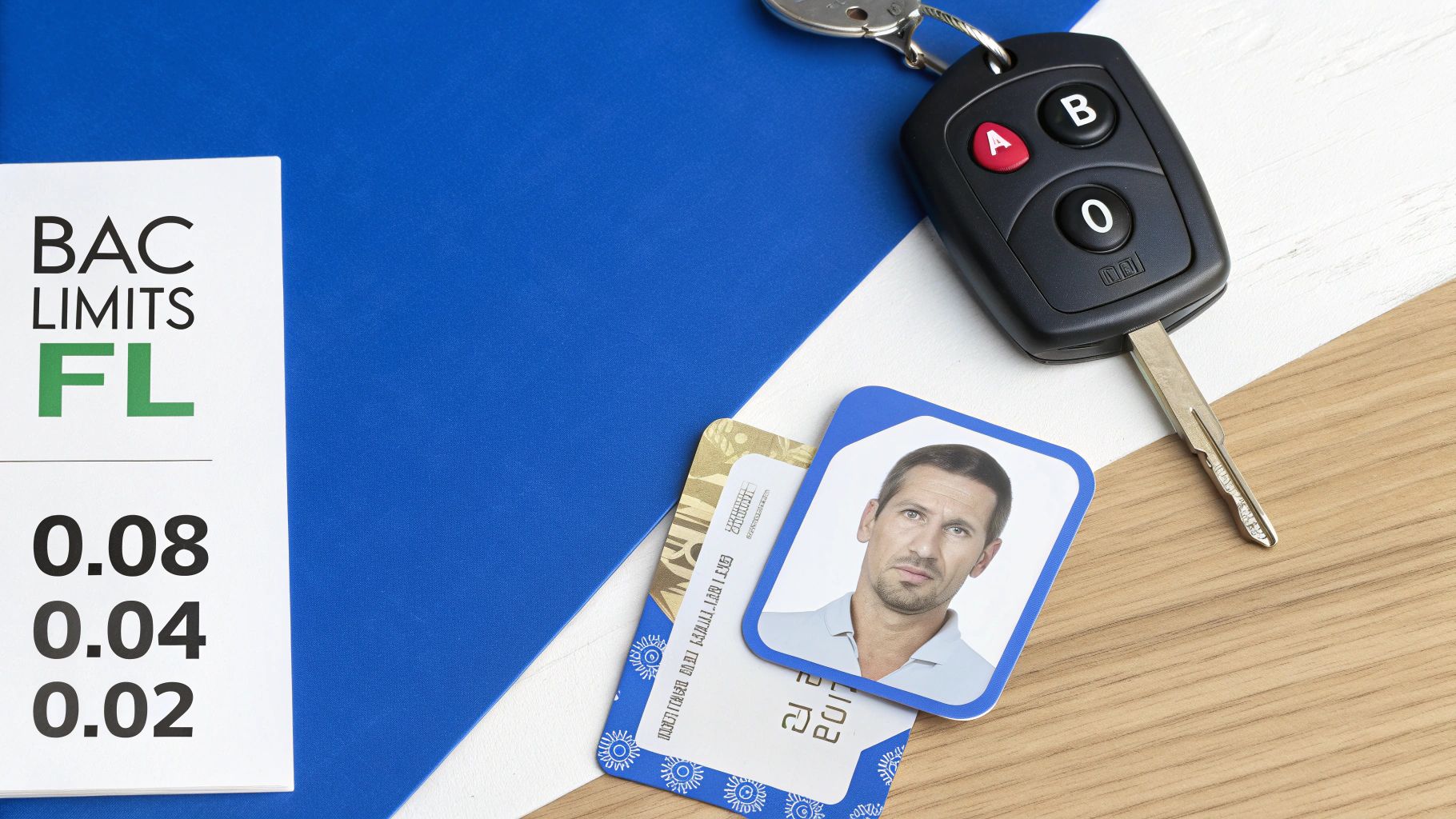
Different Limits For Different Drivers
Florida applies different thresholds according to the driver's age and the vehicle being operated:
Drivers 21 and older: The per se limit is 0.08% BAC when operating a noncommercial vehicle.
Commercial drivers: A 0.04% BAC applies when the driver is operating a commercial vehicle. The commercial-driver provision is addressed in Florida Statute § 322.61.
Drivers under 21: A BAC of 0.02% or more triggers an administrative suspension under Florida's zero-tolerance rule. Florida Statute § 322.2616 covers this rule. DHSMV explains that a first violation results in a six-month suspension and a second violation results in a one-year suspension in its guidance for teen and young adult DUI offenses.
Your Quick Reference Guide
Use this table to separate the administrative license consequences from the potential criminal case. A suspension is not itself a DUI conviction, and the existence of a criminal charge does not determine the validity of the administrative action.
Florida BAC Limits At A Glance
A quick summary of the legal Blood Alcohol Concentration (BAC) limits for different types of drivers in the state of Florida.
Driver Category | Legal BAC Limit | Key Consideration |
|---|---|---|
Standard Drivers (21+) | 0.08% | Per se DUI threshold for noncommercial drivers. An unlawful reading may also lead to administrative license action. |
Commercial (CDL) Drivers | 0.04% | Applies while operating a commercial vehicle and may result in criminal DUI charges and CDL disqualification. |
Underage Drivers (<21) | 0.02% | Zero-tolerance administrative suspension; this threshold is separate from an ordinary adult DUI limit. |
Being charged for driving over the BAC limit in Florida can be a confusing and stressful experience. If you find yourself in this situation, it's critical to understand the full range of potential consequences. Our firm's practice focuses on Florida DUI defense and is prepared to guide you through the legal process.
The 0.08 BAC Limit: What It Really Means for Florida Drivers
Three separate ideas are often collapsed into the phrase "legal limit":

The limit for most adult drivers is 0.08%. This is the threshold Florida uses for a per se DUI charge.
At 0.08%, the driver's BAC meets the per se threshold. Prosecutors may rely on the chemical result without separately proving impairment through the driver's conduct.
BAC is not a safe drink-counting tool. The number of drinks does not establish a person's BAC or legal fitness to drive.
At What BAC Is a Driver Presumed Impaired In Florida?
At 0.08% BAC, Florida treats the driver as over the legal limit for per se DUI purposes. If you are asking what is the dui limit in florida, that is the standard adult per se threshold; it does not mean someone below 0.08% is automatically safe. If the evidence shows that alcohol or drugs impaired the driver's normal faculties, the driver may still be arrested and prosecuted. The impairment-based theory appears in Florida Statute § 316.193. Put another way, what is the legal limit for alcohol in florida depends on the driver's category, and impairment evidence may matter below the applicable per se threshold.
Why "Two Beers" or "One Drink per Hour" Is Unreliable
Alcohol does not move through every person's body on the same schedule. The amount consumed, alcohol concentration, body weight, body composition, food intake, elapsed time, and individual metabolic differences can all affect BAC. There is no reliable drink-count calculation that establishes a particular person's BAC or proves that they are fit to drive.
For example, two drivers who each consume two standard drinks within an hour may have different BAC readings because of differences in body size, food intake, drinking pace, and the drinks themselves. A larger drink, stronger pour, or additional drink changes the amount of alcohol consumed. "One drink per hour" is not a legal safe-harbor rule, and Florida does not provide drivers with a fixed number of beers or cocktails they may consume before driving.
What Actually Affects Your BAC?
The same number of drinks can produce different readings. For example, a person who drinks quickly on an empty stomach may have a different BAC than someone who drinks the same amount more slowly with food. Body size and composition, the strength and size of each drink, and individual differences in alcohol metabolism also affect the result. These variables make drink-count estimates unreliable; only a properly conducted chemical test measures the alcohol concentration.
The Two-Front Battle of a DUI Arrest
A DUI arrest in Florida initiates two separate legal processes that must be addressed at the same time.
The Administrative License Suspension: This is handled by the Florida Department of Highway Safety and Motor Vehicles (DHSMV), not the court. You have a short window—10 days—to challenge the suspension and fight to keep your license.
The Criminal Court Case: This is the legal proceeding where a prosecutor must prove you were driving under the influence beyond a reasonable doubt. The penalties may include fines, probation, DUI school, and jail time.
A favorable outcome in one case does not automatically resolve the other. You have to address both the administrative and criminal sides to protect your license and your record. Our practice focuses on DUI defense and helping clients through both processes. Past results do not guarantee future outcomes.
How Much Can You Drink And Still Drive In Florida?
There is no dependable number of drinks that is legal for every person in Florida. A person who consumes two beers may be below 0.08%, at 0.08%, or above it. The result depends on the drinks themselves and the driver's physiology, meal, drinking pace, and elapsed time. A legally compliant breath or blood test measures the alcohol concentration; counting cans, bottles, or cocktails does not.
The safer decision rule is simple: do not drive after drinking. A number of drinks, a subjective feeling of sobriety, or coffee, food, or a cold shower does not create a legal exemption. If a driver is unsure, the only reliable choice is not to drive.
Special Cases: Harsher BAC Limits for Commercial and Underage Drivers
While the standard 0.08% BAC is the legal line for most adult drivers in Florida, the law does not treat everyone the same. The rules become stricter for commercial drivers operating commercial vehicles and drivers under the age of 21.
For these drivers, the margin for error is smaller. Violating these lower limits can trigger consequences beyond a typical DUI.
The 0.04% BAC Limit For Commercial Drivers
Commercial Driver’s License (CDL) holders are essential to Florida’s economy, responsible for operating everything from trucks to city buses. Because of the size and weight of their vehicles, a crash can be catastrophic.
Florida sets a 0.04% threshold for a driver operating a commercial motor vehicle. The commercial-driver rules are addressed in Florida Statute § 322.61. A violation can affect a commercial driver's ability to continue working. The penalties may include:
CDL Disqualification: A first offense usually means losing your CDL for one full year. If you were hauling hazardous materials, that increases to three years.
Lifetime Ban: A second offense can result in a lifetime ban from holding a CDL again.
Criminal Charges: In addition to commercial-license consequences, a driver may face standard criminal DUI penalties, including fines and potential jail time.
Understanding the difference between commercial vs personal auto insurance is critical for professional drivers, who face stricter limits and serious consequences.
Florida’s Zero Tolerance Law For Drivers Under 21
For drivers under the legal drinking age of 21, Florida applies its "Zero Tolerance" policy. The BAC limit for anyone under 21 is 0.02%. This is an administrative threshold, separate from the ordinary adult DUI threshold.
The rule is set out in Florida Statute § 322.2616, which allows for an administrative license suspension for an under-21 driver with a BAC of 0.02% or higher. A 2024 SAMHSA report estimated that 236,000 Florida residents aged 12–20 used alcohol in the past month; the SAMHSA report on underage drinking provides the cited national survey data.
The penalties for violating the zero-tolerance law are administrative and separate from any criminal court proceedings.
First Offense: An underage driver who registers a 0.02% BAC or higher will have their license suspended for six months.
Subsequent Offenses: A second violation results in a one-year suspension.
Refusing the Test: Refusing a test can result in a one-year suspension for a first refusal and an 18-month suspension for a subsequent refusal.
These administrative penalties are immediate. For young drivers, the only safe choice is not to drive after drinking.
How Law Enforcement Measures BAC In Florida
When a police officer suspects a driver is impaired, the process may involve observation, roadside exercises, and chemical tests. Florida's implied-consent rules apply to chemical testing following a lawful arrest. The requirements and scope of consent are set out in Florida Statute § 316.1932. Refusing a test can trigger separate administrative consequences, as described in DHSMV's administrative-suspension guidance.
The Initial Stop And Field Sobriety Exercises
It may start with a routine traffic stop. An officer might pull you over for a moving violation like swerving or speeding, or you might be stopped at a DUI checkpoint. If you want to know more about your rights in those situations, our guide on the legality of DUI checkpoints in Florida breaks it down.
If the officer notices signs of impairment—such as the smell of alcohol, slurred speech, or difficulty retrieving a license—they may ask you to step out of your car to perform Standardized Field Sobriety Tests (SFSTs).
These are not chemical tests; they're physical coordination exercises designed to help an officer assess possible impairment. The three most common SFSTs are:
Horizontal Gaze Nystagmus (HGN): The officer asks you to follow a pen or their finger with your eyes, checking for involuntary jerking motion.
Walk-and-Turn: You may be instructed to walk nine steps, heel-to-toe, along a straight line, turn around, and walk back.
One-Leg Stand: This test requires you to stand on one foot while counting aloud for about 30 seconds.
Medical conditions, fatigue, or nervousness can affect performance. The results may contribute to an officer's decision to arrest, but they are not a direct measurement of BAC.
Preliminary and Evidentiary Breath Tests
A Preliminary Alcohol Screening (PAS) test uses a handheld device at the roadside. Its primary function is to help an officer decide whether probable cause exists to arrest. It is not the same as the post-arrest evidentiary breath test used to prove a per se BAC violation.
After arrest, the driver is normally taken to a station or approved testing facility for an evidentiary breath test. Florida uses the Intoxilyzer 8000 for evidentiary breath testing. Florida's approved breath-testing program and applicable procedures are described in Florida Administrative Code Rule 11D-8. The evidentiary result is typically used to establish the statutory BAC threshold in court. A roadside PAS reading can support probable cause, but the evidentiary test supplies the formal chemical result. The legality of the stop and compliance with testing procedures may also matter.
DHSMV explains the license consequences in its administrative-suspension guidance: an unlawful alcohol level of 0.08 or higher or a refusal to submit to an approved breath, urine, or blood test can lead to administrative license action.
Blood And Urine Tests
Breath tests are commonly used to measure alcohol, but Florida law also addresses blood and urine testing in specified circumstances. Florida Statute § 316.1933 covers blood tests in cases involving serious bodily injury or death, and Florida Statute § 316.1932 addresses chemical testing, including blood and urine tests, under its stated conditions.
Blood Tests: A blood draw may be required if a driver is unconscious, has been in an accident causing serious injury or death, or is suspected of impairment by drugs that a breath test cannot detect.
Urine Tests: These are less common for alcohol but may be used when drug impairment is suspected, since a urine sample can screen for other substances.
This infographic lays out the different BAC thresholds for commercial and underage drivers, which may be relevant to an officer's decisions during an investigation.
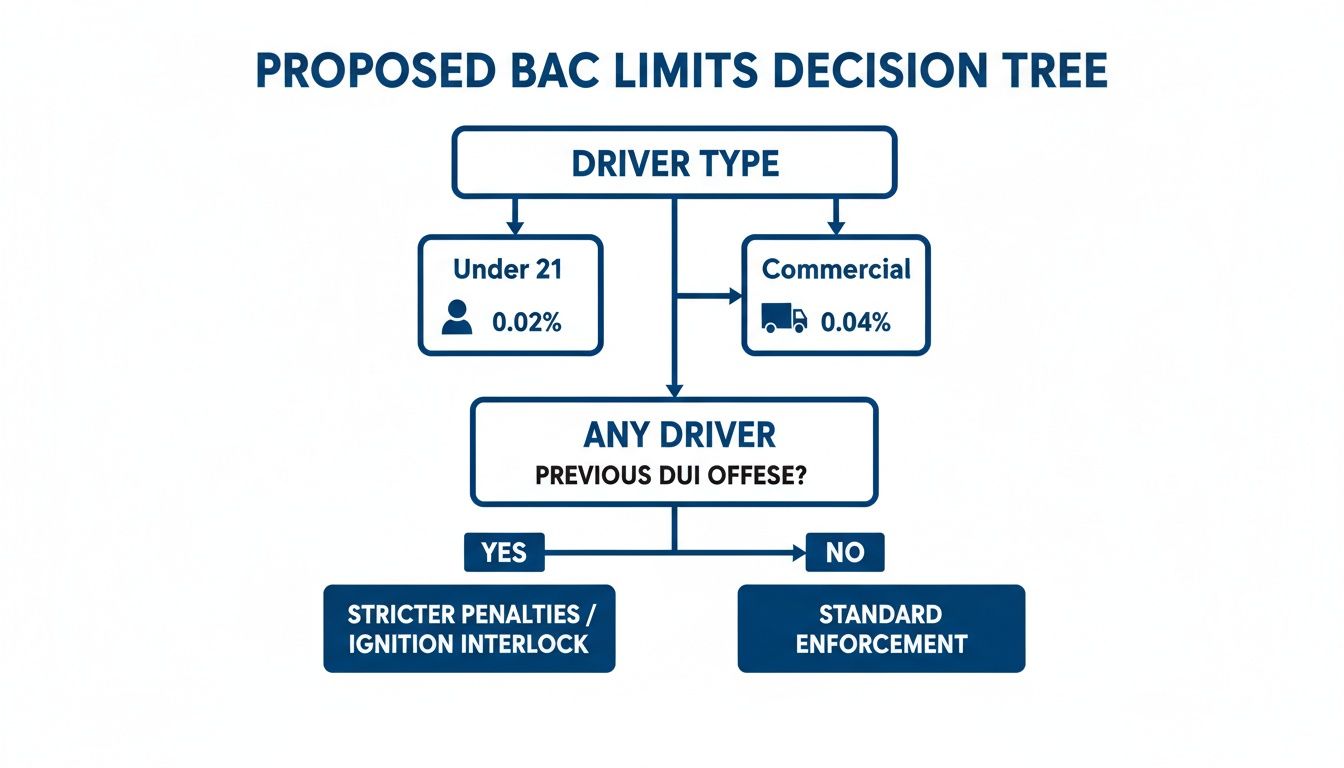
The chart highlights the lower thresholds for underage drivers (0.02%) and commercial drivers (0.04%).
Testing methods can have potential flaws. A defense attorney may examine the observation period before testing, device maintenance and calibration records, compliance with required procedures, and whether a medical condition could have affected a reading. Those issues are separate from whether the driver was impaired and may affect the evidence. Our goal is to protect your license and record by examining the circumstances of your case.
The Full Spectrum Of Florida DUI Penalties
A DUI charge in Florida can lead to administrative action by DHSMV, criminal penalties imposed by a court, and other long-term costs.
The administrative process and criminal case proceed separately. Each has its own requirements and potential consequences, and both may need attention.
Administrative Penalties Handled By The DHSMV
The Florida Department of Highway Safety and Motor Vehicles (DHSMV) can suspend a license after an arrest based on an unlawful alcohol level or a refusal to submit to a chemical test. Its DUI administrative-suspension guidance explains these actions.
Immediate License Suspension: If your BAC is over the legal limit or you refuse a breath test, the officer may confiscate your license.
A Strict 10-Day Deadline: You have 10 days from the date of arrest to request a hearing to challenge the administrative suspension. Missing the deadline may mean losing the opportunity to challenge it.
Criminal Penalties Determined By The Court
If you are convicted of DUI in criminal court, a judge may impose penalties based on the circumstances, including BAC, prior offenses, and whether an accident was involved.
A first-offense DUI is a criminal charge, not a traffic violation. For more details, see our guide to first-time DUI penalties in Florida.
Potential Penalties For A First-Time Florida DUI
This table outlines common administrative and criminal penalties for a standard first-offense DUI in Florida. Penalties can increase based on BAC level and other factors.
Penalty Category | Typical Range or Requirement |
|---|---|
Jail Time | Up to 6 months (or 9 months with BAC > 0.15) |
Fines | $500 to $1,000 (or $1,000 to $2,000 with BAC > 0.15) |
Probation | Up to 12 months |
License Suspension | 180 days to 1 year |
Community Service | Mandatory 50 hours |
Vehicle Impoundment | 10 days |
DUI School | Level 1 (12 hours) |
Ignition Interlock Device | Required for at least 6 months if BAC was 0.15 or higher |
Penalties can increase depending on the circumstances of the case.
The Hidden Financial And Personal Costs
Beyond court-ordered fines and potential jail time, a DUI conviction can bring additional expenses and requirements.
Drastic Insurance Hikes: A DUI conviction requires FR-44 insurance, a special type of high-risk coverage. Premiums can increase substantially and coverage is required for at least three years.
Ignition Interlock Device (IID): For many convictions, especially those with a high BAC, you may have to install an IID at your own expense. The device prevents a car from starting if it detects alcohol.
Mandatory DUI School: Convictions require completing a state-approved substance abuse course.
Probation and Community Service: A sentence may include probation and 50 hours of community service.
The cumulative effect of these penalties can affect finances, employment, and personal freedom. Our practice focuses on criminal traffic matters across Florida.
Navigating A DUI Charge In Florida
A DUI arrest in Florida can be stressful and involve tight deadlines and serious consequences. The case is not determined by a breathalyzer number alone; evidence and the procedures used to obtain it may also matter.
Building A Strategic Defense
A DUI defense involves examining the specific facts of the case, including the BAC result, the stop, and the testing procedures.
The Traffic Stop: Did the officer have a legal reason to pull you over? An unlawful stop may affect whether evidence gathered afterward can be used in court.
Field Sobriety Exercises: We look at whether the exercises were administered appropriately and whether conditions, physical limitations, or instructions affected the results.
Breathalyzer Maintenance: The Intoxilyzer 8000 requires maintenance and calibration. Records may be reviewed to assess whether the device was functioning properly.
The central focus is protecting driving privileges and minimizing long-term consequences. A defense strategy depends on the facts and evidence in the individual case.
Our Approach to Your Case
At Ticket Shield, we understand that a DUI charge can create anxiety. Our office in Broward represents clients across the state.
From your first free consultation, we'll listen to your account and explain your options. We communicate with the court and DHSMV on your behalf. In fact, over 99% of our clients never have to set foot in a courtroom.
If you're facing a DUI charge related to the BAC limit in Florida, contact us for a free, confidential consultation. Submitting your information does not create an attorney-client relationship.
Attorney Advertisement. Office in Broward. Past results do not guarantee future outcomes.
Frequently Asked Questions About Florida BAC Limits
These answers address practical concerns, but they are general information rather than legal advice about a particular arrest or charge.
How Many Drinks Is 0.08 For A Man?
There is no fixed number. Two men of the same weight can reach different BAC levels after the same drinks, and a person's result can change depending on food and timing. Florida does not recognize a drink-count formula that guarantees a BAC below 0.08%. A breath or blood test is needed to determine the chemical result.
Can You Legally Drive After 2 Beers?
You cannot know from the number of beers alone. Two beers may leave one driver below 0.08% and another above it. The safest answer is not to drive after drinking; for a driver under 21, even 0.02% can trigger an administrative suspension.
How Much Are You Allowed To Drink And Drive In Florida?
Florida provides no allowance expressed as a number of drinks. For most drivers, the per se threshold is 0.08% BAC, commercial drivers face 0.04% while operating a commercial vehicle, and drivers under 21 face a 0.02% zero-tolerance threshold. Even below those numbers, a driver whose normal faculties are impaired may be charged with DUI.
Can You Be Charged With DUI If My BAC Is Below 0.08%?
Yes. A BAC of 0.08% or higher is per se evidence of the statutory violation. Below 0.08%, the prosecution may rely on evidence that alcohol or drugs impaired your normal faculties, including driving, speech, and performance on field sobriety exercises. The chemical result does not eliminate other possible DUI evidence.
What Happens If I Refuse A Breathalyzer Test?
Refusing a breathalyzer test in Florida can have immediate consequences under the state's implied-consent law. Florida Statute § 316.1932 addresses a driver's consent to chemical testing following a lawful arrest.
First Refusal: A first refusal generally results in an administrative license suspension for one year.
Second or Subsequent Refusal: A subsequent refusal generally results in an 18-month suspension and may be charged as a separate first-degree misdemeanor.
A prosecutor may seek to introduce evidence of a refusal in court. After a DUI arrest and license suspension, you have 10 days to request a formal review hearing with DHSMV to challenge the administrative action. See the agency's administrative-suspension guidance.
Can A DUI Conviction Be Removed From My Record?
In Florida, a DUI conviction cannot be expunged or sealed if you were convicted or pleaded no contest. To understand the long-term impact, see our guide on whether you can get a DUI off your record in Florida.
If you are facing a DUI charge related to the BAC limit in Florida, contact Ticket Shield, PLLC for a free, confidential consultation. Ticket Shield, PLLC