Navigating the DUI License Suspension in Florida: A Practical Guide
Facing a dui license suspension florida? Learn the 10-day rule, admin hearings, and steps to protect your driving privileges.
When you get arrested for a DUI in Florida, you’re suddenly thrown into a confusing and overwhelming situation. The first thing to understand is that a DUI arrest immediately kicks off an administrative license suspension. This is a civil penalty handled by the state, and it happens completely separately from your criminal court case.
If you provided a breath sample that was 0.08% or higher, or if you refused the test altogether, the officer likely took your license right then and there. From that moment, a 10-day clock starts ticking. You have just over a week to take decisive action to protect your driving privileges.
Your First Steps After a Florida DUI Arrest
A DUI arrest in Florida doesn't just start one legal battle; it starts two. You're now facing parallel processes that run at the same time but have completely different objectives. One is with the criminal court system, and the other is with the Florida Department of Highway Safety and Motor Vehicles (DHSMV).
It’s absolutely critical to understand that these are separate tracks. The criminal court case is what most people think of—it’s where your guilt or innocence will be decided and where a judge might impose penalties like fines, probation, or even jail time.
The DHSMV’s administrative process, on the other hand, cares about one thing and one thing only: your privilege to drive in the state of Florida.
The Two Parallel Paths
Think of it like this: the arrest is the starting pistol for two different races, and you have to run both simultaneously.
The Criminal Case: This is the legal fight over the DUI charge itself. It involves prosecutors, court dates, and potential criminal penalties. The outcome here can lead to a court-ordered license suspension, but that’s a decision made much later in the game.
The Administrative Suspension: This process is immediate and automatic. The moment you're arrested for DUI anywhere in Florida, from Miami-Dade to the Panhandle, the DHSMV starts the paperwork to suspend your license. This happens long before you ever see the inside of a courtroom for the criminal charge.
After the arrest, the officer usually takes your physical driver's license and gives you a citation. That piece of paper isn't just a ticket; it doubles as a temporary driving permit. But it's only good for a very short time, and it also serves as your official notice that the clock has started on your right to challenge the suspension.
To help you visualize how these two processes work, here's a simple breakdown:
Two Paths After a DUI Arrest
After a DUI arrest in Florida, you are navigating two separate legal systems at the same time. One is focused on your driving privileges (the DHSMV), and the other is focused on the criminal charge (the courts). Here's how they compare.
Aspect | Administrative Suspension (DHSMV) | Court-Ordered Suspension (Criminal Case) |
|---|---|---|
Who's in Charge? | Florida Department of Highway Safety & Motor Vehicles (DHSMV). | The criminal court system in the county of your arrest. |
What's the Goal? | To determine your eligibility to drive based on the arrest. | To determine your guilt or innocence of the DUI charge. |
When Does it Start? | Immediately upon arrest. | After the State Attorney's office formally files charges. |
Key Deadline? | You have only 10 days to request a hearing. | Follows the timeline of the criminal court case, which can take months. |
The Outcome? | Suspension or reinstatement of your driving privilege. | Conviction or acquittal, leading to fines, probation, or jail time. |
Understanding this dual-track system is the first step toward building a defense. While they run in parallel, the actions you take in the administrative case can sometimes influence the criminal one, and vice versa.
Why Immediate Action is Critical
Florida’s system is built on a strict and unforgiving timeline. The state's DUI license suspension is an automatic administrative process that kicks in right after an arrest, completely independent of what happens in court. For a first-time offense with a BAC of 0.08% or higher, an automatic 6-month suspension begins.
You have an extremely narrow window—just 10 days from the date of your arrest—to request a formal hearing with the DHSMV to challenge this. If you miss that deadline, you automatically forfeit your right to contest the suspension, and it goes into effect without you ever getting a chance to tell your side of the story.
On top of the license issue, understanding DUI bail costs is another immediate financial pressure that comes with an arrest. The moves you make in these first few days are crucial and can have a massive impact on your ability to drive for months or even years to come. Our guide on what happens after a DUI arrest offers more detail on how to navigate this incredibly stressful period.
Attorney Advertisement: This content is for informational purposes only and does not constitute legal advice. Past results do not guarantee future outcomes. Our practice focuses on traffic and DUI defense. Office in Broward. Submitting information via our forms does not create an attorney-client relationship.
Understanding the Critical 10-Day Rule
The clock starts ticking the moment you’re arrested for DUI in Florida. Those first 10 days are, without a doubt, the most important period for your driver's license. This isn’t just a random deadline; it’s a fork in the road where a single decision will dictate your ability to drive for months to come.
What you do in this window is everything. If you do nothing at all, the choice is made for you. Failing to act within these 10 calendar days means you automatically give up your right to challenge the administrative suspension. It goes into effect, and you’re off the road for a period determined by your arrest—whether you failed a breath test or refused one.
The Two Paths You Can Take
You have two distinct options, and you have to choose one within that tight 10-day timeframe. Each has its own pros and cons, and the right move really depends on your specific case, your driving history, and whether you absolutely need to drive for work.
Request a Formal Review Hearing: This is the path where you can challenge the suspension. By filing the right paperwork with the DHSMV, you are officially contesting the suspension of your license.
Waive the Hearing and Apply for a Hardship License: This path means you skip the hearing in exchange for trying to get a restricted license for work, school, or other essential driving much faster.
This decision-making process can be confusing. The flowchart below helps visualize how a DUI arrest splits into two separate tracks: the administrative side with the DHSMV (which controls your license now) and the criminal side with the court system.
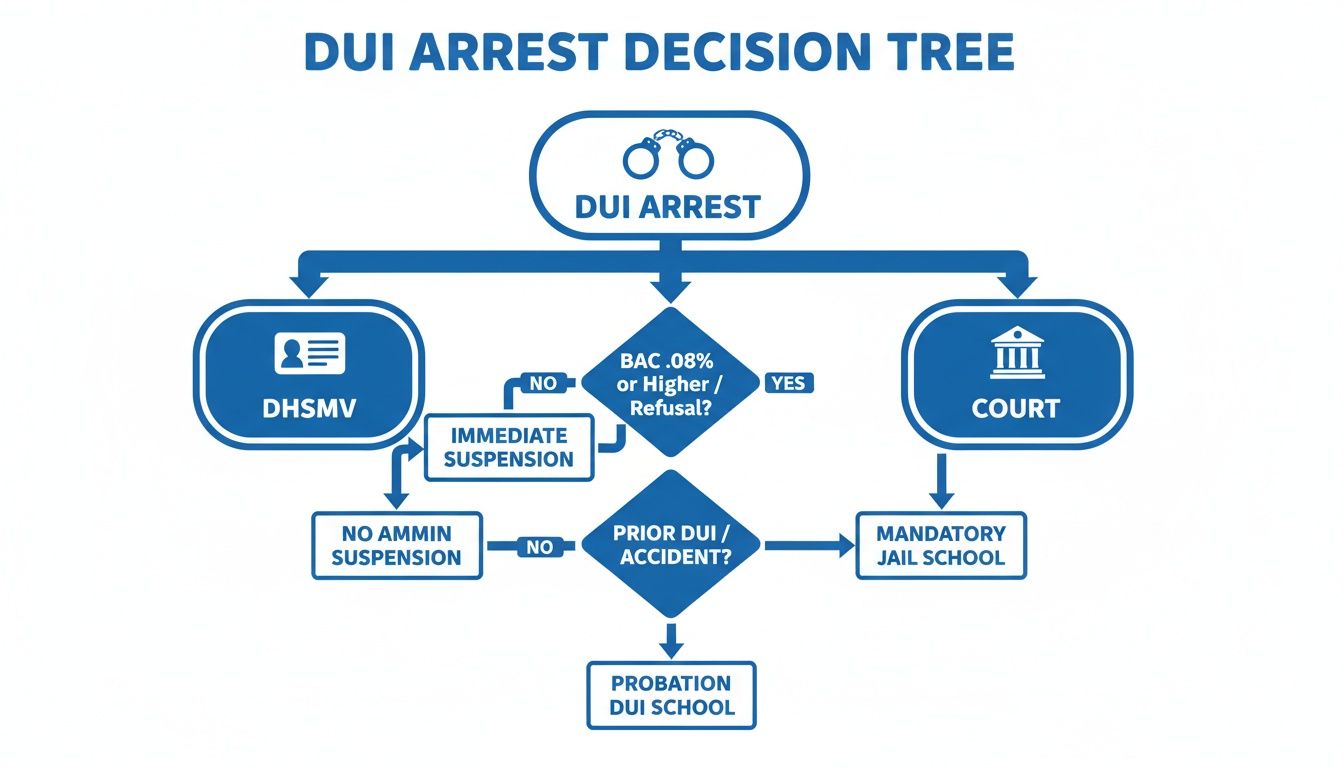
As you can see, your immediate focus has to be on that DHSMV track. That 10-day rule is the most urgent deadline you’re facing.
Path One: Challenging the Suspension
Choosing to request a Formal Review Hearing is your opportunity to contest the state's action. The goal here is to present evidence to a hearing officer and convince them to invalidate, or "set aside," the suspension entirely.
If you file on time, the DHSMV will typically issue you a temporary driving permit. This permit is usually restricted to Business Purposes Only (BPO), meaning you can keep driving for things like getting to work, school, or doctor's appointments while you wait for your hearing.
A "Business Purposes Only" restriction is defined by law as any driving necessary to maintain your livelihood. This includes your daily commute, any driving required for your job, and travel for educational, medical, or religious needs.
But there's a risk. If you go through with the hearing and the suspension is upheld, you’ll face a "hard suspension." This is a mandatory blackout period where you cannot drive at all—no exceptions. It’s typically 30 days for a breath test failure or a painful 90 days for a refusal before you can even think about applying for a hardship license.
Path Two: Securing a Hardship License
The other option is to waive your right to a formal review. This can be a strategic move for people who meet certain criteria, like having a clean record with no prior DUIs. By giving up the hearing, you may become immediately eligible to apply for that BPO hardship license.
This path completely sidesteps the risk of that 30 or 90-day "hard suspension." For someone in Broward County who drives for a living, this might be the most practical choice. The trade-off, however, is that you’re accepting the administrative suspension on your record without a challenge.
This decision is final. Once you waive your right to a hearing, you can't change your mind later. That’s why it’s so important to consult with an attorney who handles DUI license suspension in Florida to weigh the pros and cons for your specific situation. Our goal is to protect your license and your record, and that process starts with making the right call in those first 10 days.
What Happens at an Administrative Review Hearing
If you decide to challenge your license suspension within that critical 10-day window, your case moves to what’s called a Formal Review Hearing. It’s absolutely vital to understand what this hearing is—and what it isn't.
This is not your criminal DUI trial. You won't be arguing your guilt or innocence on the main DUI charge. Instead, think of this as a highly specific, focused legal proceeding with a very narrow scope.
The hearing officer from the DHSMV is like a referee reviewing a single, critical play in a football game, not the entire game's outcome. Their only job is to determine if the officer followed the proper legal procedures during your arrest.
The Key Issues Under Review
The entire hearing boils down to just a handful of legal questions. The State, usually represented by the arresting officer, has to prove its case based on a "preponderance of the evidence." This is a much lower standard than the "beyond a reasonable doubt" needed in criminal court, but it still creates real opportunities to challenge the suspension.
The hearing officer is there to answer a few simple questions:
Was the traffic stop lawful? Did the officer have a legitimate, legal reason to pull you over in the first place?
Was there probable cause for the DUI arrest? Did the officer gather enough evidence—from what they saw, your performance on field sobriety exercises, etc.—to justify the arrest?
Were you properly informed of implied consent? Did the officer correctly read you the warning about the consequences of refusing a breath, blood, or urine test?
Did you have a BAC of 0.08% or higher, or did you refuse the test? The State must present proof of either the test result or your refusal.
An experienced attorney knows how to approach each of these points. For example, if it can be shown the initial traffic stop was invalid, any evidence gathered after that moment may be thrown out, and the suspension gets overturned.
The Hearing Process and Potential Outcomes
A Formal Review Hearing is a real legal proceeding. Your attorney can present evidence, subpoena witnesses (including the arresting officer), and cross-examine them. The officer's testimony is given under oath and gets recorded.
This is a massive strategic advantage. The testimony obtained here can be used later in your criminal case to find inconsistencies in the officer’s story or identify weaknesses in the State's evidence. For many drivers, especially in heavily patrolled areas like Broward County, this hearing is the first and best chance to challenge the official narrative of the arrest.
There are only two ways this can go:
The Suspension is Invalidated: If your attorney successfully shows that the State failed to prove one of the key legal points, the hearing officer will "set aside" the suspension. Your driving privileges are fully restored right away.
The Suspension is Sustained: If the officer decides the State met its burden of proof, the suspension is upheld. You will then start the "hard suspension" period—that’s 30 days of no driving at all for a BAC over 0.08%, or 90 days for a refusal—before you can even think about getting a hardship license.
Our goal is always to protect your license and your record. Navigating these proceedings requires a focused, experienced approach. To get a deeper look at the legal arguments that may be used, check out our guide on the administrative license suspension hearing. While past results don’t guarantee future outcomes, a powerful defense at this early stage is invaluable.
Penalties Beyond License Suspension
While the first thing on your mind after a DUI arrest is usually your driver's license, the reality is that a DUI license suspension in Florida is just the start of the issues you may face. A conviction can set off a chain reaction of penalties that will affect your finances, your freedom, and your future for years to come. These aren’t minor inconveniences—they are serious legal and financial burdens.
It’s crucial to understand how these consequences stack on top of each other, creating a compounding effect that can feel completely overwhelming. For a family in Broward County, these penalties can mean severe financial strain and logistical nightmares that go way beyond just not being able to drive.
The Financial Cost of a DUI Conviction
The first and most direct impact from a DUI conviction is to your wallet. The costs start adding up immediately and will follow you long after your court case is closed. These aren’t optional fees; they are court-mandated payments you have to make to satisfy the terms of your sentence.
The financial burden doesn’t stop with court fines. First-time offenders are looking at fines between $500 and $1,000. That amount jumps to $1,000 to $2,000 if your BAC was 0.15% or higher, or if a minor was in the car. On top of the fines, you’ll be on the hook for mandatory DUI school, 50 hours of community service, and having your vehicle impounded for 10 days.
These mandatory costs quickly stack up:
Court Costs: Every criminal case comes with administrative fees that can easily tack on several hundred dollars.
DUI School Fees: You have to enroll in and complete a state-approved DUI program to get your license back, and you are responsible for the entire bill.
Ignition Interlock Device (IID): If the court orders an IID, you're paying for the installation, the monthly monitoring, and its eventual removal.
To give you a clearer picture of how dramatically these penalties escalate, let's look at the progression from a first to a third offense.
Florida DUI Penalties by Offense
Penalty | First Offense | Second Offense | Third Offense |
|---|---|---|---|
Fines | $500 - $1,000 | $1,000 - $2,000 | $2,000 - $5,000 |
Jail Time | Up to 6 months | Up to 9 months | Up to 12 months (if within 10 years of prior) |
License Suspension | 180 days - 1 year | 5 years (if within 5 years of prior) | 10 years (if within 10 years of prior) |
IID Requirement | 6 months (if BAC 0.15%+) | 1 year minimum | 2 years minimum |
Vehicle Impoundment | 10 days | 30 days | 90 days |
As you can see, the state gets progressively tougher with each conviction. A fourth DUI is a felony, leading to potential permanent license revocation and up to five years in prison. The way these consequences build makes professional legal help invaluable for protecting your future.
Mandatory DUI School and Community Service
Florida courts don't view a DUI as a simple mistake. A conviction means you'll be directed into educational and punitive measures meant to address the behavior.
First-time offenders are required to complete 50 hours of community service, and it's not optional. You have to finish it at an approved non-profit. On top of that, every driver convicted of DUI has to enroll in and pass a substance abuse course, better known as "DUI School."
Attorney Advertisement: This content is for informational purposes only. Past results do not guarantee future outcomes. Our practice focuses on traffic and DUI defense. Office in Broward.
Vehicle Impoundment and Potential Jail Time
In addition to the fines and classes, you’re also going to lose access to your car. For a first conviction, the vehicle you were driving during the arrest will be impounded for 10 days. It’s important to know this period doesn't run at the same time as any jail sentence, so you’ll have to deal with the impoundment separately.
And yes, jail time is a possibility, even for a first offense without any aggravating factors. A judge has the discretion to sentence a first-time offender to up to six months in county jail. That potential sentence climbs to nine months if your BAC was 0.15% or higher or if a minor was in the vehicle with you.
The threat of incarceration underscores how seriously the state takes a DUI charge and why a strong defense is so critical. Our team handles criminal traffic matters across Florida, and we explain more about these outcomes in our article on DUI penalties in Florida.
A Step-by-Step Guide to Reinstating Your License
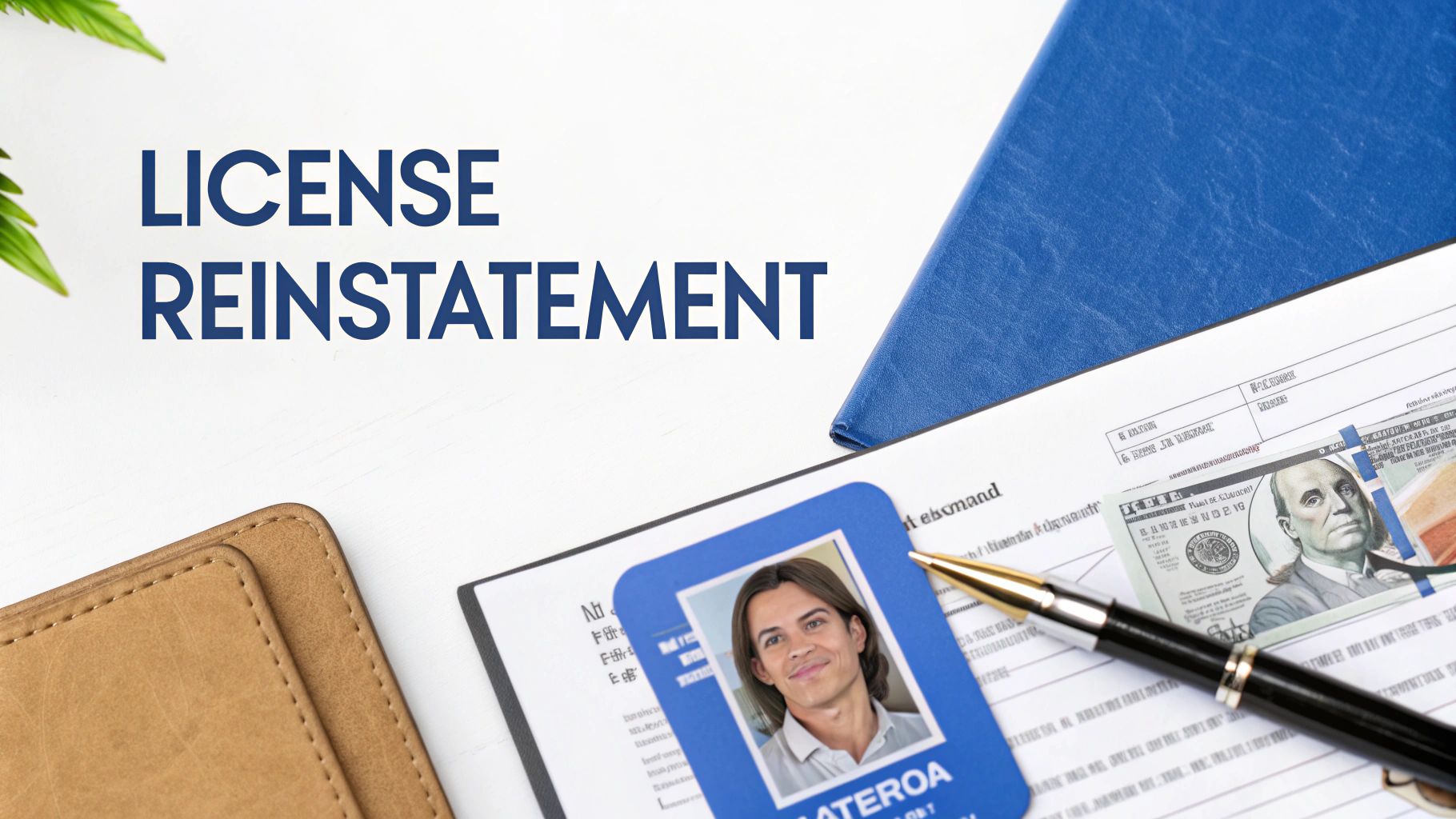
After a DUI license suspension in Florida, your driving privileges don’t just magically reappear when the calendar says it’s over. You have to actively earn them back by proving to the Florida Department of Highway Safety and Motor Vehicles (DHSMV) that you’re ready to drive responsibly again.
Think of it less like waiting out a time-out and more like completing a final exam. Every single requirement has to be checked off and documented before the DHSMV will even consider reissuing your license. Miss one step, and your license stays suspended, which can lead to even more legal trouble if you’re caught behind the wheel.
This whole process can feel like a maze, especially when you're just trying to move past a DUI charge. We’ve broken it down into a clear, step-by-step roadmap to get you back on the road legally.
Your Reinstatement Checklist
Getting your license back means working through a specific list of requirements from both the court and the DHSMV. The order really matters here, as some steps have to be completed before you can even start the next one.
Here’s the typical game plan you’ll need to follow:
Serve the Full Suspension Period: You have to wait until your administrative or court-ordered suspension is completely finished. There are no shortcuts here.
Complete a DUI Program: You must enroll in and graduate from a state-approved DUI school. This isn’t just about showing up; it involves substance abuse education and sometimes a follow-up evaluation or treatment plan.
Pay All Fines and Fees: This means settling up with the court for all fines from your DUI case, plus paying any administrative reinstatement fees the DHSMV requires.
Obtain SR-22 Insurance: You'll need to get your insurance company to file a special certificate, known as an SR-22, which proves you have Florida's required liability coverage.
Install an Ignition Interlock Device (IID): If your conviction requires it—like for a high BAC or a second offense—you must have a certified IID installed in your car and get proof of installation.
Understanding the Key Requirements
Nailing these requirements means paying close attention to the details. For example, finishing DUI school isn't enough; you need the official certificate of completion to hand over to the DHSMV. It’s non-negotiable proof that you've met the state’s educational mandate.
Likewise, that SR-22 is absolutely critical. It’s not a type of insurance, but a form your insurance provider files directly with the state. You’ll probably have to maintain it for several years, and if your coverage lapses for even a day, your insurer will notify the DHSMV, and your license will be suspended all over again.
Remember, the burden of proof is on you. You have to be the one to gather all the paperwork—from your DUI school certificate to your SR-22 form—and get it to the DHSMV. Staying organized is the key to making this process go smoothly.
Once you have all your ducks in a row, you can head to a local DHSMV office to finalize your reinstatement. Depending on your case, you might even have to retake the driver’s license exam. For a more in-depth guide, check out our article on how to reinstate a suspended license in Florida for more valuable insights. The goal is to get your full driving privileges back, and following these steps is the only path to get there.
How a DUI Arrest Affects Commercial Drivers
For a commercial driver, a DUI charge isn't just a legal problem—it's a direct threat to your livelihood. A Commercial Driver’s License (CDL) comes with much higher standards and far stricter rules, and a DUI license suspension in Florida can bring a professional driving career to a dead stop.
The stakes are higher right from the start because the legal limit is lower. While a regular driver has a BAC limit of 0.08%, a CDL holder operating a commercial vehicle is held to a strict 0.04% limit. A reading at or above that level is all it takes to trigger significant consequences.
The Career-Impacting Consequences of a CDL DUI
A DUI arrest is a serious matter for any driver, but for the professionals who drive for a living—from truckers hauling goods through Broward County to local delivery drivers—the penalties are uniquely harsh. You don't even need a conviction for the disqualification process to begin.
The biggest issue is the automatic one-year disqualification of your CDL that comes with a first-time DUI. This applies even if you were driving your personal car at the time of the arrest. If you get a second DUI conviction, it results in a lifetime disqualification of your commercial driving privileges.
Crucially, CDL holders are completely ineligible for a hardship license for commercial driving purposes. While a regular driver might get a Business Purposes Only (BPO) license to drive to work, a CDL holder cannot get one to operate a commercial vehicle. That means zero income from driving for at least a full year.
Heightened Stakes and Immediate Action
The numbers show just how critical this issue is for drivers across the state. Florida's enforcement efforts lead to over 33,000 DUI arrests every year. Areas with major commercial hubs are hotspots; for example, Broward County saw 3,314 DUI arrests in 2024, and Miami-Dade County averages more than 4,200 annually. Even with a drop in arrests over the past decade, thousands of drivers face these charges, making a focused legal strategy essential. You can see more about Florida's DUI arrest statistics to understand the landscape.
Because a CDL is a professional credential, a DUI arrest can also lead to immediate termination from your job, long before your case ever sees a courtroom. The combination of a lower BAC limit, a mandatory one-year disqualification, and the inability to get a hardship license for work makes a DUI one of the greatest threats to a commercial driver's career.
Our practice is built on traffic and DUI defense, and our goal is to protect your license and your record. Protecting a CDL is a specialized area of defense that demands immediate, knowledgeable action. For more information relevant to commercial drivers, check out our guide on how CDL speeding tickets can impact your career.
Frequently Asked Questions
When you're facing a DUI in Florida, the legal process can feel like a maze of overlapping timelines and confusing rules. Let's clear up some of the most common questions people have right after an arrest.
Will I Definitely Lose My License After a DUI Arrest in Florida?
Not necessarily, but you have to act fast. A DUI arrest automatically kicks off an administrative license suspension with the DHSMV, but this is not the final word. You have a critical 10-day window to request a formal hearing to contest it.
An experienced attorney can represent you at this hearing, presenting evidence and arguing to get the suspension thrown out. A favorable outcome at this hearing—or later in your criminal case—can prevent a suspension entirely. But if you do nothing in those first 10 days, the suspension goes into effect automatically.
What Is the Difference Between Refusing a Breath Test and Failing One?
The state of Florida has more severe consequences for a refusal. Failing a breath test by blowing a 0.08% BAC or higher leads to a 6-month administrative suspension for a first offense.
Refusing to take the test when an officer lawfully requests it triggers a much longer suspension: 12 months for a first refusal and an 18-month suspension if you've refused before. On top of that, the prosecutor can use your refusal as evidence against you in your criminal court case.
Can I Get a Hardship License After a DUI in Florida?
For a first-time DUI, it's often possible. A hardship license, also known as a Business Purposes Only (BPO) license, lets you drive for essential needs like work, school, church, and medical visits.
You've got two main paths to get one. You can waive your right to a formal hearing within that 10-day window, which makes you immediately eligible to apply for the hardship license. Or, if you challenge the suspension at the hearing and lose, you'll have to serve a period of "hard suspension"—typically 30 days for a failed test or 90 days for a refusal—before you can apply. Your driving record and the specific facts of your case will determine if you qualify.
How Can an Attorney Help with My License Suspension?
A DUI defense attorney is an important ally from day one. They can immediately file the paperwork to challenge the administrative suspension, making sure you don't miss that critical 10-day deadline.
At the DHSMV hearing, your attorney will represent you, cross-examine the arresting officer, and challenge the state's evidence. The goal is to identify weaknesses in their case to protect your license. At the same time, information learned at this hearing helps build a stronger defense for your separate criminal case. Our objective is to protect your license and your record. Past results do not guarantee future outcomes, but having a professional on your side is critical.
Attorney Advertisement: A DUI charge puts your freedom, your finances, and your ability to drive on the line. Don't face it alone. The team at Ticket Shield, PLLC has the experience to defend your rights and pursue the best possible outcome. Call us 24/7 for a free, confidential consultation to discuss your case. Let us help you protect your future. Learn more at https://www.ticketshield.com. Office in Broward. Submitting information via our forms does not create an attorney-client relationship. Prospective clients may not obtain the same or similar results.