
A Guide to DUI in Florida Penalties
Facing a DUI charge in Florida? This guide explains the full scope of DUI in Florida penalties, from first-offense fines to long-term consequences.

Getting arrested for a DUI in Florida, particularly in a high-traffic area like Miami-Dade County, throws you into an immediate legal firestorm. It’s not just one problem—it’s two, and they start the second the handcuffs go on. You're suddenly fighting a two-front war: one battle is with the Florida Department of Highway Safety and Motor Vehicles (DHSMV) to save your license, and the other is in criminal court to protect your record and your freedom.
What Happens Immediately After A Florida DUI Arrest
Being pulled over and arrested, especially in a bustling area like Miami-Dade County, is confusing and overwhelming. But the moments right after your arrest are absolutely critical because they kick off two entirely separate legal processes at the same time. Getting a handle on this dual-track system is the first step toward navigating the challenge ahead.
One track is the administrative case with the DHSMV. This isn't a criminal proceeding; it's a civil one that deals with just one thing: your privilege to drive in Florida. The other track is the criminal case. That’s the one that goes to court and involves a prosecutor, potential fines, probation, and even jail time. These two cases run on their own schedules, and the outcome of one does not automatically determine the outcome of the other.
The Critical 10 Day Deadline
This is the most urgent deadline you will face. After a DUI arrest anywhere in Florida, including Miami-Dade, you have exactly 10 days to challenge the automatic suspension of your driver’s license.
If you miss this 10-day window to request a formal review hearing with the DHSMV, you lose your right to fight the suspension. This has nothing to do with your criminal court date. You could have your criminal charges dismissed months down the road, but if you miss this deadline, your license will still be suspended for anywhere from six months to 18 months.
To understand just how important this period is, check out our detailed guide on what happens after a DUI arrest.
Florida's Implied Consent Law
Why does the state get to suspend your license so quickly? It all comes down to Florida's "Implied Consent" law. The moment you get behind the wheel of a car in this state, you have legally—or "implicitly"—agreed to take a chemical test like a breath, blood, or urine test if an officer has probable cause to believe you're impaired.
Refusing the test does not avoid the issue; it creates a different kind of trouble with its own serious consequences. A first-time refusal means an automatic one-year license suspension. If you refuse a second time, it’s an 18-month suspension, and you’ll also face a separate misdemeanor criminal charge just for refusing.
This flowchart breaks down the choice you face during a traffic stop and the immediate impact on your license.
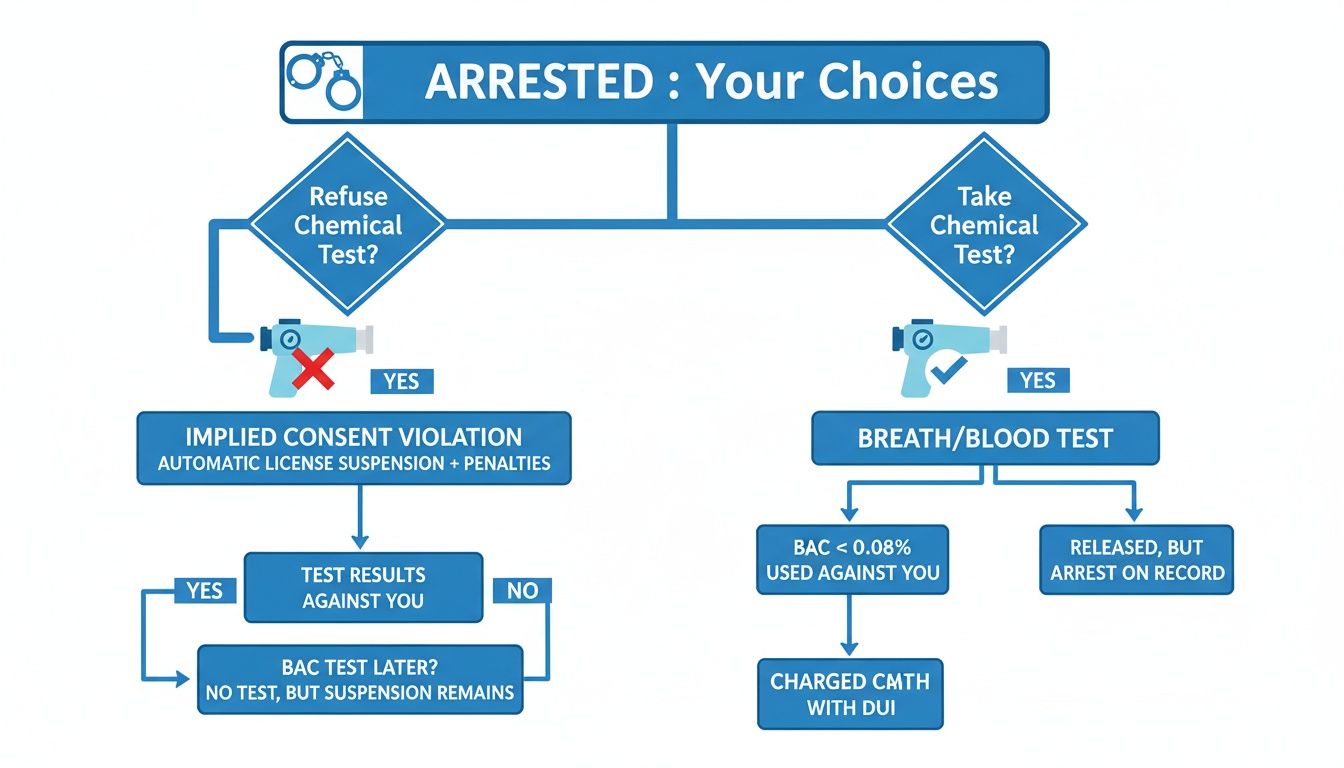
As you can see, both failing the test and refusing it lead straight to an administrative license suspension. This is exactly why that 10-day rule is so incredibly important.
A Closer Look at First-Offense DUI Penalties
For many people, a DUI charge is their first, and frankly intimidating, encounter with the criminal justice system. The experience can be overwhelming, and the legal language used is often confusing. Let's break down the standard penalties for a first-time DUI conviction in Florida, translating the legal jargon into real-world consequences.

Picture a young professional in Miami who depends on her car to commute to her downtown office every day. A first-offense DUI conviction doesn't just complicate one part of her life—it impacts nearly every aspect, starting with the immediate financial strain and the logistical challenges the court imposes.
The Financial and Administrative Hit
The first impact of a DUI conviction is usually financial. Florida law sets clear, mandatory minimums that can accumulate quickly. These aren't just suggestions; they are court-ordered obligations that must be met.
Florida's penalties ramp up quickly with each conviction. A first offense comes with mandatory fines between $500 and $1,000 for a standard case. That jumps to $1,000 to $2,000 if your Blood Alcohol Content (BAC) was 0.15% or higher, or if a minor was in the car with you. And that’s before you tack on hundreds more in court costs.
These penalties are just the beginning. The court will also stack on several non-negotiable requirements:
Community Service: A mandatory minimum of 50 hours of community service is required.
Probation: A judge will almost always sentence you to a probation period of up to one year.
DUI School: You'll have to enroll in and successfully complete a Level 1 DUI substance abuse course.
Vehicle Impoundment: Your car will be impounded for 10 days, and that time cannot overlap with any jail sentence you might serve.
Key Insight: These penalties are designed to be disruptive. Losing your car for 10 days, on top of having your license suspended, can make getting to work, school, or appointments feel nearly impossible. Suddenly, you're forced to rely on public transit in a sprawling area like Miami-Dade, or on rideshares and favors from friends.
Potential Jail Time and License Suspension
While not guaranteed for a first offense, the possibility of jail time is real. A standard first-offense DUI conviction carries a maximum sentence of up to six months in county jail. That potential sentence climbs to a maximum of nine months if your BAC was 0.15% or higher, or if a minor was in the vehicle.
Beyond jail, the impact on your driving privileges is significant. A conviction triggers a driver's license revocation that lasts anywhere from 180 days to a full year. For that professional in Miami, that means a year of figuring out how to navigate the city without being able to drive, which can put her job performance and personal life in a serious bind.
Getting a handle on these consequences is a critical first step for anyone facing a first-time charge. For a deeper dive into what to expect, check out our guide on first-time DUI penalties. An experienced attorney can walk you through how these penalties might apply to your specific situation. Our goal is to protect your license and your record. Past results do not guarantee future outcomes.
How Penalties Escalate For Repeat DUI Offenses
Any DUI charge in Florida is a serious legal problem, but the state’s laws are specifically designed to impose harsher penalties on repeat offenders. Think of the consequences like a steep staircase. A first offense puts you on the bottom step, but each subsequent charge is a significant and painful climb to a much higher level of punishment.
To implement this, Florida uses specific "lookback periods" to decide when a new charge counts as a repeat violation. An arrest within these windows is what triggers the severe escalations in penalties.

This system ensures that individuals with a history of driving under the influence face increasingly stringent consequences, including mandatory jail time, long-term license revocations, and the possibility of a felony conviction. If you're facing a second or third DUI, understanding these timelines is essential.
The Second DUI Offense: The Five-Year Lookback
Florida law becomes much stricter if you're arrested for a second DUI. The single most important factor is the timing. The state uses a five-year lookback period to determine if the penalties will be dramatically enhanced.
If your second DUI arrest happens within five years of a prior DUI conviction, the court must impose mandatory minimum penalties that are far more severe than for a first offense. This is not at the judge's discretion; the law requires it.
These enhanced penalties for a second offense within five years include:
Mandatory Jail Time: You will face a minimum of 10 days in jail. The maximum sentence jumps to nine months.
Increased Fines: Fines start at $1,000 and can climb to $2,000.
Lengthy License Revocation: Your driver's license will be revoked for a minimum of five years.
Ignition Interlock Device: You will be required to have an Ignition Interlock Device (IID) installed on your vehicle for at least one full year after your license is eventually reinstated.
This five-year window is the state's way of identifying and cracking down on repeat offenders quickly and decisively. Facing a charge within this period requires a sound legal strategy, as the consequences are designed to be punitive. If you're confronting this situation, it's critical to understand the specific challenges that come with a multiple-offense DUI.
Escalation Of DUI Penalties In Florida By Offense
To see just how drastically the stakes increase, it's helpful to compare the penalties side-by-side. The jump from a first to a second offense is steep, but the leap to a felony third offense can be life-altering.
Penalty Category | First Offense | Second Offense (within 5 yrs) | Third Offense (within 10 yrs / Felony) |
|---|---|---|---|
Fines | $500 - $1,000 | $1,000 - $2,000 | Up to $5,000 |
Jail Time | Up to 6 months | 10 days mandatory, up to 9 months | 30 days mandatory, up to 5 years prison |
License Revocation | 180 days to 1 year | Minimum 5 years | Minimum 10 years |
Ignition Interlock | 6 months (if high BAC) | Minimum 1 year | Minimum 2 years |
This table makes it clear: the state's tolerance for repeat DUI offenses diminishes very quickly, and the penalties reflect that.
When A DUI Becomes A Felony
The line between a misdemeanor and a felony DUI is a bright one, and crossing it carries consequences that can follow you for the rest of your life. In Florida, a DUI can be elevated to a felony based on your prior record. This is the point where potential penalties shift from county jail time to years in a state prison.
A third DUI conviction becomes a third-degree felony if it occurs within 10 years of a prior DUI conviction. This longer, 10-year lookback period casts a much wider net, catching offenses that happened many years apart.
Even more seriously, any fourth or subsequent DUI conviction, regardless of when the prior offenses happened, is automatically charged as a third-degree felony. There is no lookback period for a fourth offense; the state considers it a felony for life.
Crucial Distinction: A felony conviction is permanent. It results in the loss of fundamental civil rights, including the right to vote, own a firearm, or serve on a jury. It can also permanently disqualify you from certain professional licenses and career opportunities.
The penalties for a felony DUI conviction are severe and reflect the state's position:
Prison Time: A conviction can lead to a prison sentence of up to five years.
Substantial Fines: Fines can reach up to $5,000.
Extended License Revocation: A third offense within 10 years results in a minimum 10-year license revocation. A fourth offense can lead to a permanent lifetime revocation of your driving privileges.
Mandatory IID: An Ignition Interlock Device is required for at least two years if you ever get your driving privileges restored.
The escalation from a misdemeanor to a felony is the most significant jump in Florida's entire penalty structure. It underscores just how critical it is to build a defense against any repeat DUI charge.
Aggravating Factors That Turn a DUI Into a Much Bigger Problem
A standard DUI in Florida is already serious, but some situations can instantly raise the stakes. These are called aggravating factors, and their presence can turn a difficult situation into a legal nightmare, transforming a misdemeanor charge into something far more severe.
It’s a mistake to think all DUI arrests are the same. The specific details of your stop matter. Prosecutors will dig into the evidence for anything that points to a higher level of danger or recklessness, because Florida law demands tougher punishments when these factors are in play.
High Blood Alcohol Content
One of the most common ways to escalate a DUI is with a high Blood Alcohol Content (BAC). While the legal limit across Florida is 0.08%, the law draws another, more serious line in the sand at 0.15%. If your BAC is at or above this level, the penalties automatically get worse.
For a first-time DUI, a high BAC reading means you're immediately facing:
Fines: The maximum fine increases from $1,000 to $2,000.
Jail Time: The potential jail sentence jumps from six months up to nine months.
Ignition Interlock Device (IID): A conviction means you’ll be required to have an IID installed in your vehicle for at least six months.
This isn't arbitrary. The state's position is that a higher BAC means greater impairment, which translates to a greater threat on the road.
DUI With A Minor in the Vehicle
The law is fiercely protective of children. If you’re arrested for a DUI with anyone under the age of 18 in your vehicle, the penalties are ramped up to the same level as a high-BAC offense. This is true even if your BAC was just barely over the 0.08% limit.
This one factor elevates a standard first DUI into a much more serious charge. You're looking at fines up to $2,000 and a potential jail sentence of up to nine months. The courts view this as a serious failure of judgment, and the punishment reflects that.
DUI Resulting in Property Damage or Injury
The moment a DUI involves a crash, the entire legal equation changes. A DUI that causes only property damage or a minor, non-serious injury is usually charged as a first-degree misdemeanor. That’s a clear step up from a standard DUI, carrying penalties of up to one year in jail and a $1,000 fine.
But if that crash causes serious bodily injury, the consequences become incredibly grave. The charge gets bumped up to a third-degree felony, which is punishable by up to five years in prison. The state treats this as a violent crime, and it's prosecuted aggressively. Impaired driving continues to be a major problem on South Florida's busy roadways, from the Palmetto Expressway to I-95, which is a key reason the penalties for causing harm are so severe.
The Ultimate Escalation: DUI Manslaughter The most serious DUI charge in Florida is DUI Manslaughter. If an impaired driver causes an accident that results in someone's death, they face a second-degree felony. A conviction comes with a mandatory minimum of four years in prison and can lead to a sentence of up to 15 years.
Understanding these distinctions is absolutely critical. To learn more about the legal framework and potential outcomes for the most severe charge, read our in-depth guide on a DUI manslaughter sentence in Florida. The presence of any of these aggravating factors can completely change the direction of your case, making a robust defense more essential than ever.
The Hidden Costs and Long-Term Impact of a DUI
The fines and court dates are just the start. A DUI conviction in Florida isn't a single event; it’s the beginning of a long ripple effect that touches nearly every corner of your life. The penalties you see on paper are only a fraction of the real cost.
This isn't just about paying a fine and moving on. It's about navigating a future where a past mistake creates constant hurdles. The true impact of a DUI unfolds over time, from skyrocketing insurance rates to jeopardized career opportunities, following you long after your probation ends. It’s a permanent mark on your record that complicates life in ways you might not expect.
The Financial Aftershock: Insurance and FR-44 Filings
One of the first and most painful hits you'll feel is on your car insurance. Insurers see a DUI as a sign of high-risk behavior, and your premiums will increase to reflect that—often by 100% or more. This isn't a temporary hike; expect to pay those inflated rates for at least three to five years.
Before you can legally get back behind the wheel, you'll also have to file an FR-44 form with the state. Think of it as a certificate from your insurance company guaranteeing that you carry liability coverage far higher than what a standard driver needs.
Standard Florida Minimums: $10,000 for Personal Injury Protection (PIP) and $10,000 for Property Damage Liability (PDL).
FR-44 Requirements: A staggering $100,000 per person for Bodily Injury Liability, $300,000 per accident, and $50,000 for Property Damage Liability.
It's this combination of being labeled "high-risk" and being forced to buy significantly more coverage that makes post-DUI insurance so incredibly expensive.
Career and Professional Consequences
A DUI conviction is a public record, which means it will show up on just about any background check an employer runs. For professionals in a competitive market like Miami, it can instantly damage your reputation and trustworthiness.
This can create serious barriers to employment, especially in certain fields. Any job that involves driving, operating machinery, or handling sensitive information may suddenly be off-limits.
A DUI conviction can be absolutely devastating for anyone holding a Commercial Driver's License (CDL) or a professional license—think pilots, nurses, doctors, or lawyers. It can trigger an immediate suspension and disciplinary action from professional boards, potentially ending a career you've spent years building.
There’s a social stigma, too. The conviction can strain personal relationships and your standing in the community, creating a sense of judgment that’s hard to shake. You can explore a full breakdown of the far-reaching consequences of a DUI conviction to better understand the long road ahead.
Immigration and Your Criminal Record
For non-U.S. citizens, the stakes are even higher. While a single, straightforward DUI isn't always a deportable offense, it can create major roadblocks. If aggravating factors are present, a DUI can be classified as a "crime involving moral turpitude," which seriously threatens your immigration status, visa applications, and your path to naturalization.
Ultimately, a DUI conviction becomes a permanent part of your criminal record in Florida. It's a lasting shadow that can limit your opportunities for housing, education, and employment for the rest of your life. And this is a common problem—with 44,185 arrests in 2023 alone, countless Floridians are facing this reality. Miami-Dade saw 1,904 of those arrests, underscoring that this is a significant issue in the region. This highlights why a robust defense is so crucial from the very beginning; the goal isn't just to handle a court case, but to protect your entire future.
How an Experienced Defense Attorney Can Help
Getting arrested for a DUI in Florida is a serious situation, but it's important to remember that an arrest is an accusation—it is not a conviction. Trying to navigate the legal system alone is overwhelming because you’re not just fighting one battle, you’re fighting two: one with the DHSMV over your license and another in criminal court.
An experienced DUI defense attorney is your professional advocate in both arenas. Their job is to methodically protect your rights and challenge every piece of the state's case against you.

The primary goal is to scrutinize every piece of evidence the prosecution thinks it has. A strong defense strategy starts by questioning the very beginning of the incident. Was the initial traffic stop legally justified? Did the officer have probable cause to pull you out of the car and start a DUI investigation? Each step must follow strict legal standards, or the case can be weakened.
Deconstructing the Prosecution's Case
An effective defense involves a detailed, forensic examination of every procedure and piece of evidence. A good lawyer will analyze everything from the officer’s written report to the technical data logs behind any chemical tests. It's about finding weaknesses and ensuring your constitutional rights were protected from start to finish.
Key areas where a legal challenge may arise include:
Field Sobriety Exercises: Were these tests administered correctly according to standardized procedures? Did the officer account for environmental factors like bad weather, uneven ground, or your physical condition?
Breathalyzer and Blood Tests: Was the machine properly calibrated and maintained? Was the test given by a certified technician who followed every required protocol?
Violations of Your Rights: Were you read your Miranda rights at the proper time? Were you denied your right to speak with an attorney after you requested one?
The objective is to dismantle the prosecution's case piece by piece. Finding procedural errors or constitutional violations can lead to crucial evidence being suppressed, which can weaken the case against you.
Our practice focuses on traffic and DUI defense, and we are committed to protecting your driving record. Past results do not guarantee future outcomes, but our objective is always to fight for the best possible resolution for your specific circumstances.
Managing Both Legal Battles
An effective attorney handles both tracks of your case simultaneously. While building a defense for your criminal court date, they are also representing you at the separate administrative DHSMV hearing to fight your license suspension. This proactive, two-front approach is essential for protecting your ability to drive.
One of the cornerstones of this process is protecting your confidential conversations, which highlights the importance of understanding the Attorney-Client Privilege Rules. This protection allows you to be completely honest with your lawyer.
Ultimately, the goal is to secure a favorable outcome. That could mean negotiating a reduction of the charge to something less severe like reckless driving, or it could mean fighting for a complete dismissal of the case. When you’re facing the serious DUI in Florida penalties, strategic legal representation is essential.
Attorney Advertisement. Office in Broward. Prospective clients may not obtain the same or similar results. Submitting information via forms on this site does not create an attorney-client relationship.
Frequently Asked Questions About Florida DUI Penalties
When you're dealing with a DUI charge, questions come up fast. Below are some straightforward answers to the most common concerns we hear from drivers across Florida. This is a starting point, not a substitute for legal advice from a qualified attorney about your specific situation.
What Is the 10 Day Rule in a Florida DUI Case?
This is the most critical deadline you’ll face right after an arrest. The "10-day rule" is a hard deadline. From the moment you're arrested, you have exactly 10 calendar days to request a formal review hearing with the Florida DHSMV.
This hearing is your only chance to fight the automatic administrative suspension of your driver's license. If you miss that 10-day window, you automatically lose your right to challenge it, and your license will be suspended regardless of what happens in your criminal court case.
Can a DUI Be Reduced to Reckless Driving?
Yes, it’s possible, and it’s often one of the primary goals when defending a DUI case. Getting a DUI charge negotiated down to a lesser offense like reckless driving is a positive outcome. A reckless driving conviction carries less severe penalties and doesn’t come with the same long-term stigma as a DUI.
Whether this is an option depends entirely on the unique facts of your case. An experienced attorney will look for weaknesses in the prosecutor's evidence, procedural mistakes made by the police during the stop, or issues with a low BAC reading. These are the leverage points used to negotiate a better outcome on your behalf.
Will I Go to Jail for a First DUI in Florida?
It's possible, but it is not a certainty for a standard first-offense DUI. A judge has the authority to sentence you to up to six months in county jail, or up to nine months if there were aggravating factors like a high BAC.
Jail time becomes mandatory, however, as soon as you have a prior offense. A second DUI conviction within five years of the first one brings a mandatory minimum of 10 days in jail. A third DUI within ten years of a prior means you're facing at least 30 days behind bars.
Can I Refuse a Breathalyzer Test in Florida?
You can physically say no to a breathalyzer test, but it does not get you out of trouble. Under Florida's "Implied Consent" law, by having a driver's license, you've already agreed to submit to a test if lawfully asked. Refusing comes with its own set of immediate penalties.
First Refusal: You’re looking at an automatic driver's license suspension for one full year.
Second or Subsequent Refusal: The penalty gets much tougher. It’s an 18-month license suspension, and the refusal itself is a separate first-degree misdemeanor criminal charge.
On top of that, the prosecutor will likely use your refusal against you in court, arguing that you refused because you knew you were impaired. It's a difficult position to be in, and understanding these consequences is vital.
Facing a DUI charge in Florida can feel overwhelming, but you do not have to navigate it alone. The legal team at Ticket Shield, PLLC focuses on criminal traffic matters and is dedicated to protecting your license, your record, and your future. We handle criminal traffic matters across Florida, serving clients in all 67 counties, from Miami-Dade to the Panhandle.

