Understanding a Florida DUI Manslaughter Sentence in Miami-Dade
Facing a Florida DUI manslaughter sentence? This guide explains the sentencing guidelines, potential penalties, and legal factors you need to understand.

A DUI manslaughter conviction in Florida is one of the most severe sentences handed down in our state's criminal justice system. It’s not just a charge; it's a life-altering event. This is a second-degree felony, and a conviction comes with a mandatory minimum prison term, substantial fines, and the permanent loss of your driver's license.
Understanding the Gravity of a DUI Manslaughter Charge
When a fatal accident occurs and a driver is accused of being under the influence, the state of Florida doesn't treat it like a traffic violation. It pursues a charge of DUI Manslaughter, a serious felony with consequences that will echo for the rest of your life. These cases are handled with extreme seriousness in criminal courts across the state, from Miami-Dade County to the Panhandle.

This isn’t just a Florida trend. Over the last few decades, public outrage has pushed lawmakers nationwide to get tough on these cases. What might have been handled differently years ago now carries mandatory prison time. Tragically, in 2023 alone, 12,429 people were killed in crashes involving alcohol-impaired drivers. This statistic is a driving force behind the harsh penalties you see today.
Florida's Sentencing Framework
Florida uses a structured system called the Florida Criminal Punishment Code (CPC) to determine sentences. Think of it like a scoresheet. The state assigns points based on the crime's severity and other factors, and the total score calculates a minimum sentence.
A conviction for DUI manslaughter is a Level 8 offense under the CPC. In plain English, this score is high enough that it almost always results in a state prison sentence. The starting point for that calculation is a four-year mandatory minimum behind bars.
Attorney Advertisement: This content is for informational purposes only and does not constitute legal advice. Past results do not guarantee future outcomes. Our practice, with an office in Broward, focuses on traffic and DUI defense across Florida.
Key Penalties at a Glance
The penalties go far beyond prison walls. A conviction creates a ripple effect, touching nearly every corner of a person’s life—your freedom, your finances, and your future. The immediate legal penalties are severe, designed to punish and to send a message.
Many people have misconceptions about cases where a DUI resulting in death has occurred, and clearing those up reveals just how high the stakes are. The long-term consequences of a DUI conviction can be devastating.
To give you a clear picture, here's a breakdown of the typical penalties for a DUI manslaughter conviction in Florida.
Florida DUI Manslaughter Penalties at a Glance
The table below summarizes the penalties outlined in the Florida Statutes for a standard DUI manslaughter conviction. These are the starting points, and the final sentence can be influenced by many factors.
Penalty Component | Standard Range in Florida |
|---|---|
Felony Classification | Second-Degree Felony |
Prison Sentence | Up to 15 years in state prison (4-year mandatory minimum) |
Fines | Up to $10,000 |
Driver's License | Permanent Revocation |
Probation | Up to 15 years |
Community Service | Minimum 50 hours |
Vehicle Impoundment | 10 days |
DUI School | Level II (Substance Abuse Course) |
Criminal Record | Permanent Felony Conviction |
As you can see, the penalties are incredibly steep. Successfully navigating this legal landscape requires a deep understanding of Florida's laws and sentencing guidelines. Our goal is to protect your license and record, and that starts with making sure you are fully aware of what lies ahead.
The Building Blocks of a Miami-Dade DUI Manslaughter Charge
For the state to get a conviction for DUI manslaughter, a prosecutor has to build their case piece by piece, like assembling something from a blueprint. They must prove specific legal elements beyond a reasonable doubt. If they fail to prove even one of these core components, the whole case can fall apart.

Think of it like a three-legged stool. For the stool to stand, all three legs must be solid and firmly in place. A defense attorney's job is to test each leg, looking for a crack. If they can break just one, the entire stool collapses. This is exactly where a strong defense strategy begins—by challenging every single piece of the state's argument.
Element 1: Actual Physical Control of a Vehicle
First, the prosecution has to prove that the accused person was driving or in actual physical control of the vehicle. This sounds simple, but it can get surprisingly complicated, especially if there were no direct witnesses who saw the crash happen.
"Actual physical control" means the person had the capability and power to make the car go. This can even include someone found asleep at the wheel with the keys in the ignition, even if the car isn't moving. In a typical Miami-Dade County case where first responders find someone in the driver's seat after a crash, this element is usually easy to prove.
But what if there were several people in the car, and it’s not clear who was driving? The prosecutor's job gets much tougher. They'll have to rely on forensic evidence like DNA from the airbag, seatbelt markings, or witness statements to prove who was in control.
Element 2: Impairment or Unlawful Blood Alcohol Level
Next up, the state must prove the driver was under the influence of alcohol or a controlled substance so much that their "normal faculties" were impaired. The other way they can prove this is by showing the driver had an unlawful blood or breath alcohol level (BAC) of 0.08 or higher.
This element is often the biggest battleground in a DUI manslaughter case. The prosecution will throw everything they have at it, including:
Breath or Blood Test Results: A BAC of 0.08 or more is the clearest path for them, as it’s direct evidence of impairment under Florida law.
Field Sobriety Exercises: They'll use the driver's performance on tests like the walk-and-turn to argue they had impaired balance and coordination.
Officer Observations: The arresting officer will take the stand and testify about things like slurred speech, bloodshot eyes, or the smell of alcohol.
A defense attorney will put every piece of this evidence under a microscope. Was the breathalyzer machine properly calibrated? Was the blood sample contaminated or stored correctly? Could a medical issue explain poor performance on the field sobriety tests? Raising these kinds of questions is how you create reasonable doubt.
Element 3: Causation of Death
Finally—and this is the absolute core of a manslaughter charge—the prosecution must prove causation. This means showing a direct, unbroken link between the driver operating the vehicle and the victim's death. It's not enough to just show the driver was impaired and, tragically, someone died. They have to prove the driver’s impairment caused the crash that led to the death.
Crucial Point on Causation: The state must prove the defendant's actions were a "substantial factor" in the victim's death. If something else broke that chain of events—like another driver blasting through a red light and causing the accident—the defense can argue the defendant’s impairment wasn't the legal cause of the fatality.
To grasp the weight of this charge, it's worth understanding how a DUI can become a felony charge, as causing a death is the most serious way that happens. An effective defense often requires bringing in accident reconstruction experts to analyze the crash scene. If it can be shown that the accident would have been unavoidable even for a completely sober driver, that argument strikes right at the heart of the state’s case on causation. These complexities are why these cases are often called DUI homicide.
Factors That Can Increase or Decrease a Sentence in Miami
A DUI manslaughter sentence isn't some fixed number pulled from a statute book. Instead, Florida judges weigh a complex set of details specific to each case, balancing factors that can push a sentence higher or pull it much lower.
Think of it like a scale. The prosecution adds weights to one side to argue for a harsher penalty, while the defense adds weights to the other to provide context and argue for leniency. Understanding what goes on that scale is crucial.
Aggravating Factors That Increase Penalties
Certain facts can dramatically increase the severity of a DUI manslaughter sentence. Prosecutors across Florida, from Miami-Dade to Palm Beach County, will hammer these points to argue for the maximum possible prison time. These are the details that turn a tragic situation into what the court may see as a particularly egregious crime.
Some of the most powerful aggravating factors include:
Extremely High BAC: A Blood Alcohol Concentration (BAC) way over the 0.08 legal limit—think 0.15 or higher—is often treated as proof of extreme recklessness.
Prior DUI Convictions: A history of driving under the influence tells the judge that the defendant didn't learn from past mistakes. This is taken very seriously. While the penalties for a first-time DUI are already tough, a record with priors makes the sentencing outlook far worse.
Leaving the Scene: Fleeing a fatal accident is one of the worst things you can do. Under Florida Statute § 316.027, this act alone elevates DUI manslaughter from a second-degree felony to a first-degree felony, punishable by up to 30 years in prison.
Presence of a Minor: If a child was in the defendant's car during the crash, the court can enhance the penalties significantly.
Reckless Driving: Evidence of excessive speeding, weaving through traffic, or other dangerous driving behaviors right before the crash paints a picture of extreme disregard for others' safety and will almost certainly lead to a harsher sentence.
Mitigating Factors That May Reduce a Sentence
On the other side of the scale, a defense attorney’s job is to present compelling reasons for a more lenient sentence. These are not excuses, but they are crucial pieces of context that paint a fuller picture of the defendant and the circumstances surrounding the incident. The goal is to persuade the court that the minimum sentence, or one closer to it, is the most just outcome.
Legal Perspective: Presenting mitigating evidence is one of the most critical phases of sentencing. It allows the court to see the defendant as a whole person, not just the sum of their worst actions on a single day. Effective mitigation can be the difference between a sentence at the low end of the guidelines and one at the very top.
Possible mitigating factors could include:
No Prior Criminal History: A clean record helps show that this incident was a terrible, uncharacteristic, and isolated event.
Genuine Remorse: Sincere regret and taking responsibility for one's actions can have a powerful impact on the judge and even the victim's family.
Cooperation with Law Enforcement: Being cooperative and respectful during the investigation can sometimes be viewed favorably by the court.
Causation Issues: This is a big one. If a defense investigation reveals that the victim or another person was partially at fault for the accident—for example, they ran a red light or were driving erratically—this can be a powerful mitigating factor, even if it doesn't completely erase the DUI charge.
Personal Circumstances: A defendant's personal story matters. Factors like a history of mental health issues, a substance abuse problem for which the defendant is now actively seeking treatment, or strong family and community ties can all be presented to the court.
Ultimately, the unique facts of your case in Miami or anywhere else in Florida will shape the legal journey ahead. A defense attorney’s job is to aggressively challenge the state's aggravating claims while building a strong, persuasive case for mitigation.
What to Expect During the Sentencing Hearing
The sentencing hearing is the final step in a long and difficult journey. It’s the day the judge officially hands down the sentence for DUI manslaughter. For everyone involved, it’s an incredibly emotional and pivotal moment, the culmination of everything that began with the arrest. Knowing how this hearing works can help you prepare for what is undoubtedly one of the most stressful days of your life.
This isn’t another trial. Guilt has already been determined, either through a plea agreement or a jury's verdict. The hearing’s sole purpose is to decide the appropriate penalty. The prosecution will argue for a tougher sentence, and the defense will argue for a lighter one, each pointing to the facts of the case, aggravating factors, and any mitigating circumstances.
The Pre-Sentence Investigation Report
Long before the hearing date, a probation officer gets to work on a Pre-Sentence Investigation (PSI) report. This is a deep dive into the defendant's entire life—criminal history, family background, employment, and the specific details of the offense that brought everyone to court.
This report is incredibly influential. It also includes the victim's family's perspective and usually suggests a sentence based on Florida's scoring system. Both the prosecutor and your defense attorney will go over this document with a fine-tooth comb, checking for any inaccuracies that could unfairly sway the judge.
Arguments and Allocution
At the hearing, both sides will have their say. The prosecutor will stand up and argue for a specific sentence, emphasizing the harm caused and highlighting any factors that make the crime worse. Their job is to convince the judge that a significant penalty is necessary.
Then, it’s your defense attorney’s turn. They will present the counter-argument, focusing on any and all mitigating factors. This is the time to show evidence of genuine remorse, bring in character witnesses, or point out any weaknesses in the state’s case that might justify a sentence closer to the mandatory minimum. This is a critical moment where understanding the nuances of a guilty plea can be beneficial, as it often involves waiving certain rights in exchange for a potentially more predictable outcome. You can learn more by reading about what happens if you plead guilty in our detailed guide.
Your Right to Speak: The defendant gets a chance to speak directly to the judge. This is called allocution. It is an opportunity to express remorse, take responsibility, and ask the court for mercy. A sincere, well-prepared statement can make a real difference.
Victim Impact Statements
One of the most powerful and gut-wrenching parts of the hearing involves victim impact statements. Family members of the person who died are given the opportunity to share how the loss has devastated their lives. These statements are raw and emotional, designed to give the judge a full, human understanding of the consequences of the crime.
The Final Sentence
After listening to everyone, the judge will make their final decision and impose the sentence. They will state the length of imprisonment, the terms of probation, the amount of fines and court costs, and any other conditions. The judge will typically explain their reasoning, referring back to the PSI report, the arguments made in court, and the laws that guide their decision.
The infographic below illustrates some of the key factors that can push a sentence up or down, showing the balancing act between aggravating and mitigating circumstances.
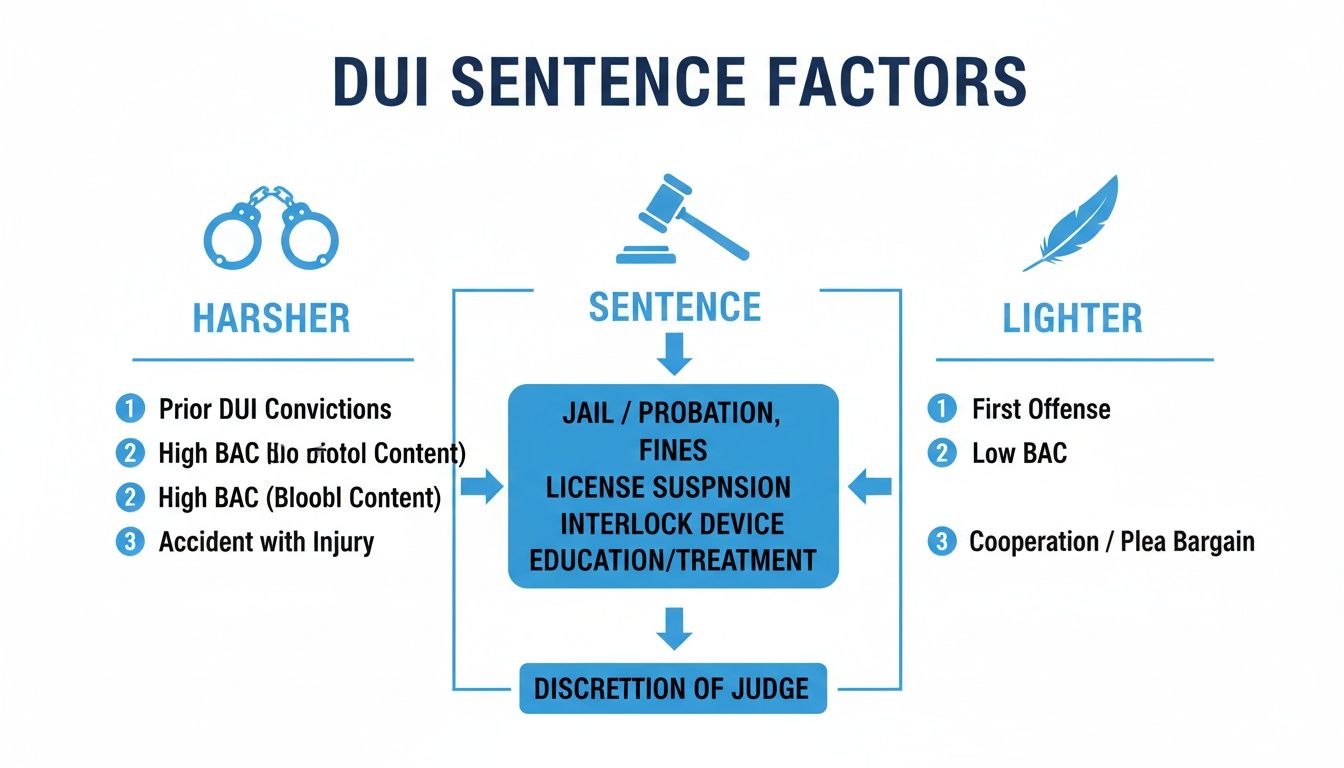
As you can see, things like prior offenses can result in much harsher penalties, whereas a clean record and other positive factors might lead a judge toward a more lenient sentence within the legal limits.
The Lifelong Impact of a Conviction
When a DUI manslaughter case ends, the criminal sentence is just the beginning. The conviction leaves behind a ripple effect of consequences that follow you long after any prison time or probation is served.
These are the collateral penalties—the ones that fundamentally change your life, closing doors and creating obstacles that can feel permanent. It's a heavy burden that reshapes your future in ways most people never have to consider.
The Permanent Loss of Your Driving Privileges
One of the most immediate and life-altering impacts is the permanent revocation of your driver's license. This isn't a temporary suspension; it's a lifetime ban. In a state like Florida, where a car is often a lifeline for work, family, and daily errands, losing that ability is nothing short of devastating.
Is there any hope of getting it back? While Florida law technically allows you to apply for a hardship license down the road, it's an incredibly difficult path. You’d need to complete your entire sentence, stay out of trouble for years, and then convince the state you're no longer a risk. There are absolutely no guarantees.
Attorney Advertisement: This content is for informational purposes only and does not create an attorney-client relationship. Our firm, with an office in Broward, handles criminal traffic matters across Florida. Past results do not guarantee future outcomes.
The Heavy Burden of a Felony Record
Beyond the loss of your license, you will carry the label of "convicted felon" for the rest of your life. A felony record in Florida is a massive barrier to rebuilding a normal life, shutting you out of opportunities that others take for granted.
This permanent mark on your record creates major hurdles in a few key areas:
Employment: Most employers run background checks. A conviction for DUI manslaughter will automatically disqualify you from countless jobs, especially anything requiring a professional license, a company vehicle, or a position of trust.
Housing: Finding a safe place to live becomes a serious challenge. Landlords almost always run background checks, and many will not rent to someone with a violent felony on their record.
Civil Rights: As a convicted felon, you lose certain fundamental rights. This includes the right to vote (until restored), the right to serve on a jury, and the right to own or possess a firearm.
Many people ask if a charge this serious can ever be wiped from their public record. The laws on this are extremely strict. For a full breakdown, you can read our guide on whether you can get a DUI off your record.
Facing a Wrongful Death Civil Lawsuit
Just when you think the legal battles are over, another one often begins. The victim's family has every right to file a separate wrongful death lawsuit against you in civil court. This case is completely independent of the criminal proceedings and has one goal: seeking financial compensation for their devastating loss.
A civil lawsuit can seek damages for things like:
Lost future income the victim would have earned
Medical bills and funeral costs
Pain and suffering
Loss of companionship
Even if you have no money or assets, a civil judgment can hang over your head for decades, allowing for wage garnishments and liens on any future property. It's a constant, painful reminder of the incident, underscoring the immense weight of a DUI manslaughter conviction.
Common Questions About DUI Manslaughter Sentencing in Miami-Dade
When you're facing a charge as serious as DUI manslaughter in Florida, the future can feel terrifyingly uncertain. The legal system is a maze, and the stakes couldn't be higher. This section is designed to give you straight answers to the most urgent questions people have.
Keep in mind, though, that every case has its own unique set of facts. This is for your understanding, not legal advice.
Is There a Mandatory Minimum Prison Sentence?
Yes. Florida law is very clear on this: a conviction for DUI manslaughter comes with a mandatory minimum prison sentence. This isn't a scenario where a judge can simply decide on probation instead of prison time.
The state's Criminal Punishment Code (CPC) scoresheet dictates the sentence, and DUI manslaughter is a Level 8 offense. Because of the high point value assigned to this crime, the calculation almost always results in a prison term.
By law, the absolute floor is four years in a state prison. That’s the starting point, and it only goes up from there depending on the circumstances.
Can a DUI Manslaughter Charge Be Reduced?
It's possible, but it is never a given. In some specific situations, a plea agreement for a lesser offense, like vehicular homicide, might be on the table. This depends entirely on the strength—or weakness—of the prosecution's case.
A skilled defense lawyer's first job is to put every piece of the state's evidence under a microscope. This means looking for holes in their case by scrutinizing:
The Traffic Stop: Was there a legitimate, legal reason for the officer to pull the car over in the first place?
The Investigation: Were field sobriety tests conducted properly? Were there errors during the arrest?
The Chemical Test: Was the breathalyzer machine correctly calibrated? Was the blood sample handled and stored according to strict legal protocols?
Causation: Can the prosecution prove, beyond a reasonable doubt, that the driver's impairment was the direct cause of the fatal accident?
If significant flaws are uncovered, it can create the leverage needed to negotiate for a reduced charge. The quality of the evidence is everything in these discussions.
What Is the Difference Between DUI Manslaughter and Vehicular Homicide?
The key distinction between these two very serious charges boils down to what caused the fatality. Both involve a death resulting from someone driving a vehicle, but the state has to prove a different core element for each one.
DUI Manslaughter: The prosecution must prove the driver was under the influence of alcohol or drugs to the point that their normal faculties were impaired, and this impairment caused the death.
Vehicular Homicide: The prosecution has to prove the driver operated their vehicle in a reckless manner that was likely to cause death or serious injury. This charge doesn't require any proof of impairment at all.
A Florida court recently confirmed that someone can be convicted of both offenses from a single crash without it being "double jeopardy." Why? Because each crime has a unique element the other lacks. DUI Manslaughter requires impairment, while Vehicular Homicide requires recklessness.
How Long Will My Driver’s License Be Revoked?
A conviction for DUI manslaughter in Florida means a permanent revocation of your driver's license. This isn't a temporary suspension that you just wait out. It is, for all practical purposes, a lifetime driving ban.
There is a small exception to the word "permanent." Many years after completing the full prison sentence and all probation, it may be possible to petition for a hardship license. This process is incredibly difficult and requires a formal hearing. You would have to prove that you've been a model citizen and are no longer a threat on the road. Getting a hardship license after a DUI manslaughter conviction is exceptionally rare.
Attorney Advertisement: This content is for informational purposes and does not constitute legal advice. Past results do not guarantee future outcomes. Our office is in Broward, and we handle traffic and DUI defense matters across Florida. Submitting information via our website does not create an attorney-client relationship.
Can I Be Sued in Civil Court as Well?
Yes, absolutely. The criminal case is just one side of the legal battle. The victim's family has every right to file a separate wrongful death lawsuit against the driver in civil court to seek financial damages. This can happen whether you are found guilty or not guilty in the criminal case.
A wrongful death lawsuit is about compensating the family for their devastating losses, which can include:
Medical bills from before the victim passed away.
Funeral and burial expenses.
Lost future income the victim would have earned.
Loss of companionship, emotional pain, and suffering.
A civil judgment can lead to wage garnishments and property liens that can follow you for decades, adding an enormous financial weight on top of the criminal penalties. This is why it's so critical to have a comprehensive legal strategy from day one.
If you are facing a DUI or serious traffic charge anywhere in Florida, the stakes are too high to go it alone. At Ticket Shield, PLLC, our practice focuses on traffic and DUI defense. Our goal is to protect your license and record. For a free, confidential consultation to discuss your case, contact us 24/7. Learn more at https://www.ticketshield.com.