How to Reinstate a Suspended License in Florida: A Clear Guide
Learn how to reinstate suspended license in florida with our step-by-step guide—resolve fines, complete required courses, and navigate FLHSMV efficiently.
To reinstate your Florida driver’s license after a suspension, you must resolve the underlying issue. This involves identifying the reason for the suspension, satisfying all court orders and course requirements, paying the necessary fines and fees to the Florida Department of Highway Safety and Motor Vehicles (FLHSMV), and providing proof of insurance if required.
The path forward depends entirely on the reason for the suspension, whether it was for unpaid tickets, too many points on your driving record, or a DUI.
Your Roadmap to a Reinstated Florida License
A suspended license can significantly disrupt your daily life. Suddenly, getting to work, running errands, or taking care of your family becomes a major challenge. The good news is that restoring your driving privileges is often a manageable process if you follow the correct steps.
This guide is your direct roadmap, and it all starts with the most critical first step: understanding why your license was suspended.
Whether it’s due to unpaid traffic fines in Miami-Dade County, a DUI conviction, or accumulating too many points on your record, each cause has a specific solution. You cannot move forward until you know exactly what the state requires from you.
Common Florida License Suspensions and First Steps
To get started, it's helpful to review the most common reasons for a suspension and the immediate action required for each. This table breaks down the typical first steps you'll need to take.
Suspension Reason | Initial Action Required | Typical Next Step |
|---|---|---|
Unpaid Traffic Tickets | Contact the Clerk of Court in the county where you received the ticket to pay outstanding fines and fees. | Pay the $60.00 reinstatement fee to the FLHSMV. |
Accumulating Too Many Points | Check your driving record to confirm the length of the suspension (30 days, 3 months, or 1 year). | Serve the suspension period and pay the $75.00 reinstatement fee. |
Driving Under the Influence (DUI) | Enroll in and complete a state-approved DUI school and any required substance abuse treatment. | File for an FR-44 insurance certificate and apply for a hardship license if eligible. |
Failure to Carry Insurance | Obtain a valid auto insurance policy that meets Florida's minimum requirements. | Provide proof of insurance to the FLHSMV and pay the $150.00 reinstatement fee. |
As you can see, the path for a points suspension is very different from that of a DUI. Pinpointing your specific issue is the only way to begin.
Charting the Path to Reinstatement
The journey to getting back on the road involves a clear sequence of actions. You’ll first need to resolve the core issue that led to the suspension. This could mean:
Paying Outstanding Fines: Often the simplest fix for unresolved traffic tickets.
Completing Required Courses: This might be traffic school for point-related issues or more intensive substance abuse programs for DUIs.
Obtaining Special Insurance: For certain offenses, you’ll have to file an SR-22 or FR-44 form to prove you have the required insurance coverage.
Paying Reinstatement Fees: Once everything else is done, the FLHSMV charges a fee to officially process the reinstatement.
This flowchart gives you a simple visual of how different suspension reasons lead down different paths.
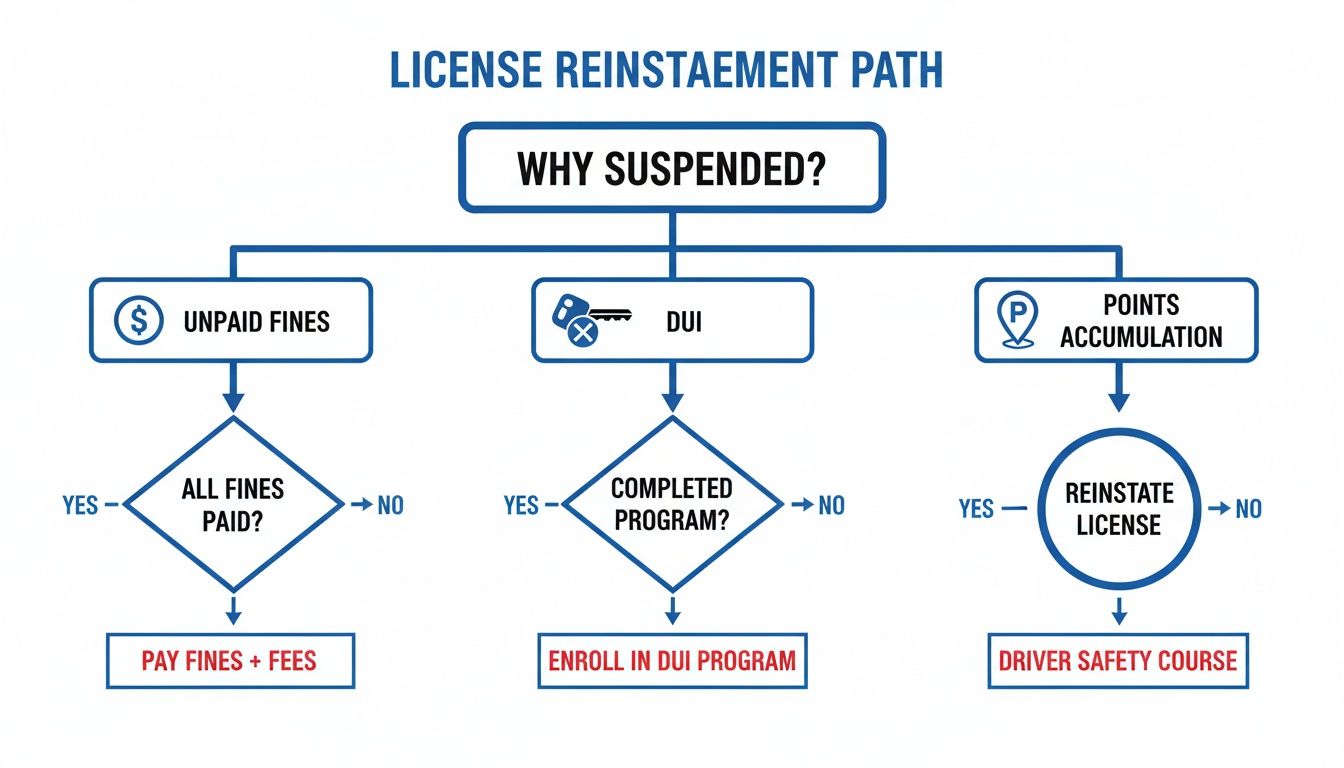
As the chart shows, clearing up unpaid fines is a much simpler process than the multi-step requirements for a DUI, which involves a much more complex set of obligations.
Why Every Detail Matters
Navigating this system can feel overwhelming, especially if you’re juggling requirements from different counties or courts. A small oversight—like a missed deadline or an incorrect form—can set you back weeks or even months. The goal of this guide is to provide the information needed to take control and get your license back.
Key Takeaway: The single most important thing you can do right now is confirm the exact reason for your suspension directly with the FLHSMV. This one piece of information dictates every single step you take from here.
Working with a law firm that focuses on traffic and DUI defense can simplify this journey. An attorney can help ensure every requirement is met correctly and on time, representing your interests and working toward a positive outcome. For a more detailed breakdown of the common reasons for a suspended license in Florida, our in-depth article can provide additional clarity.
This article is for informational purposes and should be considered an attorney advertisement. Our office is in Broward, and we handle traffic matters across Florida. Remember, past results do not guarantee future outcomes.
Finding Out Why Your License Was Suspended
Before you can begin the process of getting your Florida driver's license back, you need to investigate the cause. The path to reinstatement isn't a one-size-fits-all process; it's a specific checklist dictated entirely by the reason for your suspension. Trying to fix the problem without knowing the official cause is like trying to find an address without a map—you'll just waste time, money, and energy.
Your first move, and the most important one, is to get the official information straight from the Florida Department of Highway Safety and Motor Vehicles (FLHSMV). This isn’t a time for guessing or assuming what the problem is. You need to see exactly what the state has on its record.
Your Official Driving Record is the Key
The authoritative document here is your official driving record. It’s the master file that lists every ticket, every point, and every administrative action tied to your license. Most importantly, it will show the specific violation codes that triggered your suspension, leaving no room for doubt.
You have a couple of ways to get this crucial information:
Online Driver License Check: The fastest way to see your current status is through the FLHSMV's online portal. It gives you a real-time snapshot of whether your license is valid.
Order Your Driving Record: For the full story, you'll want to order your complete driving record. You can get a three-year, seven-year, or lifetime history directly from the FLHSMV or an authorized provider. This document will spell out the specific dates and reasons for any and all suspensions.
This step is absolutely non-negotiable. It tells you whether you're dealing with a simple unpaid ticket or a much more complex issue, like a Habitual Traffic Offender (HTO) designation. For a more detailed walkthrough, you can learn more about how to check if your license is suspended with our dedicated guide.
Decoding Common Suspension Triggers in Florida
Once that record is in your hands, you can pinpoint the cause. While there are dozens of reasons a license can be suspended, most fall into a few common categories. The solution for each one is completely different.
For instance, clearing up an unpaid traffic ticket in Broward County is a fairly straightforward task. It usually means contacting the Broward County Clerk of Courts, paying the old fine plus any late fees, and then paying a separate reinstatement fee to the FLHSMV. Once that's done, the suspension is often lifted quickly.
A suspension for a DUI conviction, on the other hand, is a much more involved matter. That process isn't just about paying fines; it's about satisfying a long list of legal and administrative requirements that can take months, or even years, to complete.
Attorney Advertisement: Our practice focuses on traffic and DUI defense matters. The information provided here does not constitute legal advice. Office in Broward.
Let's look at a common scenario. A driver thinks their license was suspended for a single speeding ticket they forgot about. They go online, pay that ticket and the reinstatement fee, but are surprised to find their license is still suspended. It's only after they pull their full driving record that they discover an older, unresolved ticket from a different county and a "Failure to Appear" notice, both of which triggered their own separate suspensions.
This is a classic pitfall. Without the complete picture, you might only solve part of the problem, leaving other suspensions active and keeping you from legally driving.
Comparing Suspension Scenarios
Understanding the differences between suspension types is critical for mapping out your next steps. The requirements vary dramatically not just in what you have to do, but also in complexity, timeline, and cost.
Suspension Type | Common Requirements | Typical Timeline |
|---|---|---|
Unpaid Citation | Pay fine and court costs, pay FLHSMV reinstatement fee. | 1-3 business days |
Point Accumulation | Serve the mandatory suspension period (e.g., 30 days), possibly complete ADI course, pay reinstatement fee. | 30 days to 1 year |
Insurance Lapse | Obtain new insurance, provide proof to FLHSMV, pay reinstatement fee. | 1-5 business days |
DUI Conviction | Complete DUI school, undergo substance abuse evaluation/treatment, obtain FR-44 insurance, serve suspension period, apply for hardship license. | 6 months to several years |
As the table clearly shows, a driver dealing with a point suspension has a defined waiting period, while someone facing a DUI has a long checklist of obligations that require a major investment of time and money. Identifying your specific situation is the only way to build an accurate game plan and avoid missing a small detail that could cause a massive delay in getting your license back. Our goal is to protect your license and record by ensuring you have the right information from the very start.
Tackling Your Reinstatement Requirements
Once you know why your license was suspended, it's time to shift from investigation to action. This is the part where you start methodically checking off every requirement the state has put in front of you. Think of it as a to-do list—each task you complete gets you one step closer to legally driving again. Staying organized here is the key to avoiding unnecessary delays.
The exact steps will depend entirely on your specific situation. For many people, the journey starts with handling old court fines or signing up for mandatory driving courses.

For others, the main hurdle will be getting specialized insurance to prove you're financially responsible. Let's break down these common requirements so you know exactly what you need to do.
Paying Off Fines and Leveraging Special Events
For a huge number of Florida drivers, the roadblock is purely financial. An unpaid traffic ticket is a common reason for a license suspension. It's a significant issue across the state—about 2 million Floridians have suspended licenses, and an estimated 72% of those are due to nothing more than unpaid fines and fees, not dangerous driving. You can see the full breakdown from the Fines and Fees Justice Center.
To help people clear this hurdle, many counties host an annual event called Operation Green Light. During these events, the Clerk of Court will often waive hefty collection agency fees, allowing you to pay off old fines at a much lower cost. It’s a valuable opportunity to settle old debts and become eligible for reinstatement, sometimes on the very same day.
For instance, during a recent Operation Green Light in Miami-Dade County, thousands of drivers were able to clear their records and get back on the path to a valid license. Keep a close eye on your local Clerk of Court’s website for announcements so you don't miss the next one.
Completing Your Mandatory Courses
Depending on why you were suspended, the FLHSMV will require you to complete certain driver education courses. These are non-negotiable. The state will not process your reinstatement paperwork until they have proof that you've passed the required classes.
Two of the most common courses you’ll run into are:
Traffic Collision Avoidance Course (TCAC): This is often assigned to drivers who were at fault in a crash that caused an injury or who received certain types of moving violations.
Advanced Driver Improvement (ADI): A 12-hour course that's usually required for point-related suspensions. It’s also a critical step for anyone trying to get a hardship license to drive for business or essential purposes.
Make sure you sign up with a state-approved course provider. Once you're done, they will report your completion directly to the FLHSMV, but it’s always a good idea to keep a copy of your certificate for your own records.
Securing Proof of Financial Responsibility
For more serious violations, Florida demands proof that you have adequate car insurance before you're allowed back on the road. This isn't just about showing your insurance card; your provider has to file a special certificate directly with the FLHSMV on your behalf.
Attorney Advertisement: This content is for informational purposes. Our office is in Broward, and we handle traffic and DUI matters across Florida. Our goal is to protect your license and record.
You'll likely hear about one of these two forms:
SR-22 (Certificate of Financial Responsibility): This is typically required for offenses like driving without insurance or some types of reckless driving.
FR-44 (Certificate of Financial Responsibility for DUI): This form is specifically for DUI convictions and comes with much higher liability coverage requirements than a standard policy.
You must keep this special coverage active and uninterrupted for a set period, which is usually three years. If you let the policy lapse for even a day, your insurance company is legally required to notify the FLHSMV, and your license will be suspended again.
Even after you've jumped through all these hoops, you might only qualify for limited driving privileges at first. You can get more details by checking out the requirements for a hardship license in Florida in our other guide. Tackling each of these steps one by one is the surest way to get your full driving privileges back.
Finalizing Your Reinstatement With the FLHSMV
You’ve met all the requirements—court orders are satisfied, courses are completed, and you have the right insurance. Now you're on the home stretch. The last big step is to make it official with the Florida Department of Highway Safety and Motor Vehicles (FLHSMV). This is where your hard work pays off, but you must handle this final stage with the same attention to detail.

This part of the process is all about submitting your final documentation and paying the state's reinstatement fees. The good news is the FLHSMV gives you a few different ways to get this done, so you have some flexibility. The main goal here is to get your application submitted completely and accurately to avoid any frustrating, last-minute delays.
Your Options for Reinstatement
You generally have three ways to finalize your license reinstatement. Picking the right one can save you a ton of time and prevent unnecessary headaches.
Online: For most common suspensions, the FLHSMV's MyDMV Portal is by far the fastest and easiest route. You can usually pay your fees and upload proof of compliance right from your computer.
By Mail: If you'd rather deal with paper or are required to submit physical documents, you can mail everything to the correct FLHSMV office. Just know this method is slower and requires you to be extra careful that every single form is included and filled out perfectly.
In Person: If you have a more complicated case or just need to get it done as soon as possible, your best bet is to visit a driver license service center. Always schedule an appointment online before you go to avoid spending your entire day in line.
No matter how you do it, have your paperwork organized and ready to go. This means your course completion certificates, proof of insurance (like an SR-22 or FR-44), and any court documents. When you finalize things with the FLHSMV, you’ll often be working with official PDF forms that demand precision.
Understanding the Reinstatement Fees
A critical piece of this final step is paying the correct reinstatement fees. These are completely separate from any court fines you’ve already paid, and the amount changes depending on why your license was suspended in the first place. Being ready for this cost helps avoid more delays.
Attorney Advertisement: This content is for informational purposes. Our firm, with an office in Broward, handles traffic matters throughout Florida. Our goal is to protect your driving record. Past results do not guarantee future outcomes.
For instance, the standard fee to reinstate for unpaid tickets is $60.00, but that number can jump quite a bit for other offenses. A suspension for an insurance lapse might come with a $150.00 fee, while a DUI-related reinstatement will be even higher. Always double-check the exact amount you owe on the FLHSMV portal. If you're not sure how to find that info, our guide on how to check your driving record walks you through the process.
Proactive Reforms Making a Difference
Navigating this system can be tough, but some areas are actively working to make it easier. Miami-Dade County is a perfect example. Facing a crisis with over 600,000 residents holding suspended licenses in 2020—a number that grew to 915,424 by 2022—the county took action. The Miami-Dade Driver's License Suspension Task Force used American Rescue Plan funds to implement reforms that reduced the number of suspensions by a staggering 73%, down to 246,676.
This incredible turnaround was achieved by dismissing old, non-dangerous cases and creating programs to help people resolve minor offenses. The results were powerful: 85% of participants in the Driver License Assistance Center successfully got their licenses back, saving residents a collective $4 million in collection fees. You can read more about how these reforms transformed a countywide crisis. It's a positive sign that shows a commitment to helping people get back on the road legally.
When You Need Legal Guidance for Your Reinstatement
Many drivers can handle a simple suspension on their own. For example, if you forgot to pay a ticket, you can often clear it up without legal assistance. But some situations are far more complex and high-stakes to tackle without professional help.
Trying to navigate the system alone when you're facing serious charges can lead to longer suspensions, heavier fines, and even criminal penalties. Knowing when to call an attorney is one of the most important steps you can take to protect your driving privileges.

This is about recognizing when an oversight could have consequences that follow you for years, affecting your job and your life.
Complicated Scenarios That May Require an Attorney
Certain suspensions aren't just administrative hiccups; they're tied to serious legal issues. If your license is on the line because of any of the following, you may want to seek legal counsel.
Habitual Traffic Offender (HTO) Designation: Being labeled an HTO triggers a mandatory five-year license revocation. This can happen if you accumulate three major traffic violations (like DUI or driving while suspended) or 15 moving violations within five years. An attorney can review your record for errors and challenge this severe designation.
Suspensions from Criminal Charges: A DUI, a reckless driving charge, or leaving the scene of an accident creates two separate battles. You have the criminal court proceedings and the administrative license suspension from the FLHSMV. These two systems run on parallel tracks, and an experienced attorney can help manage both at the same time to protect your rights.
Multiple Unresolved Citations: If you have tickets and court dates scattered across different Florida counties, the process can become a logistical challenge. A law firm that handles cases statewide can help centralize everything, deal with the various clerks of court, and make sure nothing falls through the cracks.
In these situations, a traffic defense firm does more than just offer advice. They can represent you in administrative hearings, negotiate with prosecutors on the underlying charges, and challenge the legal basis of your suspension.
How an Experienced Firm Can Help
Getting your license back from a complex suspension involves more than just filling out forms. It requires a deep understanding of Florida traffic law, local court procedures, and the administrative maze of the FLHSMV.
Attorney Advertisement: Our firm, with an office in Broward, focuses on traffic and DUI defense throughout Florida. The information here does not constitute legal advice, and submitting information via our forms does not create an attorney-client relationship.
An attorney can meticulously review your driving record to pinpoint the exact cause of every hold on your license. From there, they can build a clear strategy to tackle each issue in the right order, saving you from wasting time and money. Our goal is to protect your license and record by creating a clear path forward.
For drivers whose suspensions are tied to traffic accidents, it's critical to see the full legal picture. If your license issue is related to a crash, finding specialized legal services for auto and motorcycle accidents can be essential for understanding all your options, not just the ones related to your license.
Protecting Your Future Driving Privileges
Ultimately, deciding to hire a lawyer is about managing risk. For a simple unpaid ticket, the risk is relatively low. But for an HTO revocation or a DUI, the risk of a misstep is incredibly high. The consequences can impact your job, your finances, and your freedom for years.
A legal team can provide the support you need to get through the process as efficiently as possible. If you think your situation is too complicated to handle on your own, exploring your options with a suspended license lawyer can give you the clarity and direction needed to finally get back on the road. Remember, past results do not guarantee future outcomes, but professional guidance can be a valuable asset in seeking a favorable resolution.
Your Florida License Reinstatement Questions Answered
When you're trying to get your license back, many questions can arise. It can feel like a maze of rules and exceptions. Let's clarify some of the most common questions drivers ask.
How Long Does It Take to Reinstate a Florida License?
This is a frequent question, and the answer is: it completely depends on why your license was suspended. There’s no single timeline.
For a simple issue, like an unpaid ticket, you could potentially resolve the issue the same day. Once you settle the fine with the court and pay the FLHSMV reinstatement fee, it’s often a quick administrative fix.
But for more serious situations, patience is required. A DUI suspension, for instance, involves a different process. You have to serve a mandatory suspension period, complete DUI school, and then carry special FR-44 insurance for years. That’s a journey that can take months before reinstatement is even possible. Your official driving record is the only place to find the real timeline for your specific case.
Can I Reinstate My License Online in Florida?
Yes, for many common issues, you can, and it's usually the fastest way to get it done. The FLHSMV’s official MyDMV Portal is set up to handle reinstatements once you've met all other requirements, like paying fines or finishing a required course.
The online option is ideal for situations such as:
Unpaid traffic tickets.
Failure to complete a court-ordered traffic school.
Certain suspensions related to insurance lapses.
However, you'll have to handle more serious matters in person. If you've been designated a Habitual Traffic Offender (HTO), for example, there’s no online shortcut. You will need to visit a driver license service center and deal directly with an agent to begin that process.
What Is the Difference Between SR-22 and FR-44 Insurance?
Both SR-22 and FR-44 forms are proof of financial responsibility that your insurer files directly with the state. They sound similar, but they’re required for very different reasons and mandate different coverage levels.
An SR-22 is typically required for non-DUI offenses, such as driving without insurance or a reckless driving conviction. It proves you have at least Florida's minimum liability coverage: $10,000 for injury to one person, $20,000 per crash, and $10,000 for property damage.
An FR-44, on the other hand, is exclusively for drivers with a DUI conviction. Because the offense is considered more serious, the state demands much higher insurance limits. An FR-44 certifies that you carry at least $100,000 per person, $300,000 per crash, and $50,000 for property damage.
The Bottom Line: FR-44 is for DUI convictions and requires significantly higher insurance coverage. SR-22 is for lesser offenses and proves you meet the state minimums.
What Are the Penalties for Driving on a Suspended License?
Driving on a suspended license in Florida is a serious criminal offense, not a minor traffic infraction. The consequences become more severe with each offense.
A first offense is typically a second-degree misdemeanor, which can result in up to 60 days in jail and a fine of up to $500. A second offense is a first-degree misdemeanor, carrying up to one year in jail and a $1,000 fine.
A third offense is a third-degree felony, with a potential penalty of up to five years in prison and a $5,000 fine. Additionally, repeat offenses can lead to designation as a Habitual Traffic Offender (HTO), which comes with a five-year license revocation. It is never worth the risk to drive before your license is officially reinstated.
If you're facing a suspended license and aren't sure where to begin, you don't have to figure it out alone. At Ticket Shield, PLLC, our practice focuses on Florida traffic and DUI defense, and our goal is to protect your license and record. Get a free consultation to understand your options and start the process of getting back on the road.
Learn more and get your free consultation at Ticket Shield, PLLC