Requirements for Hardship License in Florida: A Quick Guide
Florida drivers can review the requirements for hardship license in florida, key waiting periods, costs, and common denial reasons.
Losing your driver's license in Florida can feel like your world has ground to a halt. Suddenly, getting to work, taking kids to school, or even just running to the grocery store becomes a massive logistical challenge. A Florida hardship license is a limited permit designed to get you back on the road for these essential trips, but obtaining one isn't a given. It all boils down to the reason for your suspension and proving that being unable to drive creates a serious hardship that stops you from earning a living.
How We Researched Florida Hardship License Requirements
This guide was updated by checking current Florida Department of Highway Safety and Motor Vehicles procedures, Bureau of Administrative Review hearing rules, Florida statutes, and practical county guidance on reinstatement and restricted driving privileges. We cross-checked the hardship process against official DHSMV materials on administrative reviews and BAR offices, the state’s hardship hearing application form HSMV 78306, Florida’s driver license reinstatement fee schedule, and the statutory restrictions in section 322.271, Florida Statutes.
Offense-specific rules change the answer depending on why the license was suspended, including DUI school, ignition interlock, and hard-suspension timing. Where county tax collectors or legal practice resources explain the same step more clearly, those sources show how the state process works in real life, not just on paper. A practical sorting test is simple: is the driver generally eligible now, eligible only after a waiting period, or barred unless the underlying suspension issue changes? That distinction matters more than generic definitions, because many denials happen when people apply too early, bring the wrong documents, or assume a hardship license covers more driving than it does.
Understanding the Florida Hardship License
A Florida hardship license is not a normal license or a full reinstatement. It is limited permission to drive after a suspension or revocation, usually for work, school, church, medical care, or another essential purpose approved through a Bureau of Administrative Review hearing. In common usage, the term often refers to a Business Purposes Only license.
Florida uses two main restricted-license labels:
Business Purposes Only (BPO): The broader of the two. It usually covers driving to and from work, driving required by your job, school, church, and necessary medical appointments.
Employment Purposes Only (EPO): Narrower than BPO. It generally limits driving to your job commute and tasks directly required for employment.
That difference matters. A BPO license may allow you to drive from home to work, then to a job site, then to a doctor appointment after work. An EPO license usually would not cover that doctor visit or a stop for class. Florida’s hardship authority comes from section 322.271, and the state treats these restricted privileges as exceptions, not entitlements.
A quick practical snapshot:
Usually eligible now: drivers suspended for points or many non-DUI issues once they enroll in the required course and can document need.
Eligible after a waiting period: many first-DUI and some repeat-DUI drivers, depending on conviction history, refusal history, and whether a hard suspension must be served first.
Commonly barred: drivers applying during a hard-suspension window, certain repeat-refusal cases, some serious-injury DUI cases, and people who cannot show required school enrollment or a legitimate need to drive.
Quick Guide to Florida Hardship License Eligibility
Reason for Suspension | Hardship License Type | Typical Waiting Period | Eligibility Status | Key Prerequisite |
|---|---|---|---|---|
Too Many Points | Business Purposes Only (BPO) | None in many cases | Generally eligible now | Enroll in Advanced Driver Improvement (ADI) course |
First-Time DUI conviction | Usually BPO | Offense-specific; often a hard-suspension period applies | Eligible only after waiting period | Enroll in DUI school; may need IID and reinstatement steps |
First DUI refusal | Usually BPO | Often 90 days unless a different rule applies | Eligible only after waiting period | Enroll in DUI school |
Second DUI conviction within 5 years | Often EPO or BPO depending on facts | 1-year hard suspension before petition | Eligible only after waiting period | DUI school, proof of need, likely IID |
Second or subsequent refusal in certain DUI settings | None | N/A | Commonly not eligible during the revocation period | Offense history controls |
Other non-DUI violations | Usually BPO | Varies by offense | Depends on underlying suspension | Fulfill court or DHSMV requirements |
One recent change is especially important for first-time DUI offenders. Ticket Shield notes that after 2023 legislation, some first-time DUI drivers with no prior DUI arrest history may begin the hardship process as early as three days after entering a plea instead of automatically waiting out the former 90-day refusal period, so long as they meet school and eligibility requirements in the updated Florida hardship-license overview. That does not mean every DUI applicant can drive immediately; the suspension basis still controls.
The most common reasons for a suspension that still allow for a hardship license include:
Point Suspensions: Accumulating too many points from tickets is a common reason for suspension. If you're not sure how close you are, check out our guide on how many points lead to a suspended license.
First-Time DUI: There is often a path to restricted driving, but the timing depends on the exact suspension, whether there was a refusal, and whether the person has prior DUI history.
Refusal to Submit to a Breath Test: A first refusal may still lead to hardship eligibility later, but repeat-refusal scenarios are much harsher.
If your case also involves FR-44 filing after a DUI-related reinstatement, it helps to understand how that coverage works before your hearing and reinstatement steps; see QuoteFii, LLC for a practical breakdown.
Attorney Advertisement. Office in Broward. Prospective clients may not obtain the same or similar results.
Reason for Suspension | Hardship License Type | Typical Waiting Period | Key Prerequisite |
|---|---|---|---|
Too Many Points | Business Purposes Only (BPO) | None | Enroll in Advanced Driver Improvement (ADI) course |
First-Time DUI | Business Purposes Only (BPO) | 30-90 days of "hard suspension" | Enroll in DUI School and sometimes install an IID |
Refusal to Submit to Test | Business Purposes Only (BPO) | 90 days of "hard suspension" | Enroll in DUI School |
Other Non-DUI Violations | Business Purposes Only (BPO) | Varies by offense | Fulfill any court-ordered requirements |
Your Step-By-Step Guide to the Hardship License Application
Trying to figure out the Florida DHSMV’s process for a hardship license can feel like you’ve been given a puzzle with half the pieces missing. The cleanest way to handle it is in sequence, because most delays happen when drivers do the right thing in the wrong order.
1) Confirm why your license is suspended and whether a waiting period applies
Before filing anything, check the exact suspension or revocation reason on your driving record and confirm whether you are eligible now or still serving a hard suspension. BAR hearing officers do not waive mandatory waiting periods. If your case is DUI-related, this first step is critical because an application filed too early is usually a dead end.
The state’s administrative review information and your driving record will usually tell you whether you are dealing with points, a DUI administrative suspension, a conviction-based suspension, or another revocation category.
2) Enroll in the required DUI school or ADI course
This is the step many applicants miss. Florida generally requires proof of enrollment in the right course before BAR will process the hardship request. For DUI-related cases, that usually means DUI school. For many non-DUI suspensions, it means an Advanced Driver Improvement course.
A practical legal source that tracks how BAR handles these applications explains that the school enrollment letter is a mandatory prerequisite and that BAR will not accept an otherwise unsupported application without it in this Florida hardship-license explanation.
3) Gather the documents BAR will expect
Most applicants should assume they will need a core packet, not just the form. Bring originals if possible and keep copies.
Typical documents include:
Form HSMV 78306 completed and signed using the state’s hardship/administrative hearing application
Proof of DUI school or ADI enrollment/completion
Photo identification
Driving record or suspension notice, if available
Proof of employment, school attendance, or medical need such as an employer letter, class schedule, or doctor documentation
Proof of residency if requested by the local BAR office
Insurance filing proof when your case requires SR-22 or FR-44 before reinstatement
Any court paperwork tied to the suspension, conviction, or required compliance steps
The employer or need documentation matters more than many people expect. Florida hardship rules are built around genuine necessity. One Florida legal explainer summarizes the standard well: the applicant must show a real need to drive for work, school, or medical care and that ordinary transportation alternatives are not enough in the circumstances described in these hardship-license steps.
4) File Form HSMV 78306 with the correct BAR office
You do not file a hardship request at a standard DMV counter. The application must go through the correct Bureau of Administrative Review office for where you live, work, or attend school. Florida lists BAR locations and hearing functions through its administrative review office directory.
5) Pay the hearing fee and any reinstatement fees
There are usually separate charges involved:
a hearing/application fee to request the BAR review,
one or more reinstatement fees if you are approved,
and offense-specific costs such as DUI school, IID setup, SR-22 or FR-44, or service fees.
Florida publishes statewide reinstatement charges on its reinstatement fee page. Local tax collector offices also often explain what must be paid before a restricted credential can be issued; for example, the Orange County Tax Collector’s hardship page outlines the BAR-hearing-first structure clearly.
6) Attend the hearing and prove your need
The hearing is where BAR decides whether to grant limited driving privileges. In practical terms, the officer is usually looking at three things:
are you legally eligible right now,
have you completed the required prerequisite steps,
and have you shown a credible, document-backed need to drive within the allowed limits.
Expect questions about your work schedule, school or medical travel, prior violations, course enrollment, and whether you understand the limits of BPO or EPO driving. If your packet is incomplete, if your timeline is wrong, or if your explanation sounds too broad, denial is common.
7) Complete any post-approval requirements before the restricted license is issued
Approval does not always mean you can drive that minute. Depending on the offense, you may still need to finish reinstatement, file proof of insurance, or install an ignition interlock device. Florida’s IID rules are administered through approved vendors and DHSMV policy; the state summarizes the program on its ignition interlock information page.
How long the process usually takes
For many non-DUI hardship requests, the timeline can be fairly short once the application is complete: a hearing may be scheduled within a few weeks, and issuance can happen the same day if there is no waiting period and all documents are in order. For DUI-related cases, the legal waiting period usually matters more than office scheduling.
A realistic range looks like this:
Course enrollment: often same day or within a few days
Document gathering and filing: a few days to 2 weeks depending on how quickly you can get employer or medical proof
Hearing scheduling: often within 2 to 4 weeks after filing, depending on the office
Issuance after approval: sometimes same day, but only after fees, insurance, and any IID requirements are satisfied
So the true answer is not just “30 days.” It can be under a month for straightforward point suspensions, or much longer when a DUI hard suspension or IID requirement applies. Once you’ve successfully navigated this process and served your suspension time, the final step is getting your full driving privileges back. For a detailed walkthrough on that, check out our guide on how to reinstate your suspended driver's license in Florida.
Navigating Hardship Rules for DUI and Serious Violations
When your license gets suspended for a DUI or another serious violation, getting a hardship license is a whole different ballgame. The usual process changes, and the Florida Department of Highway Safety and Motor Vehicles (DHSMV) brings in a much stricter set of rules. You have to know these conditions inside and out, because one wrong move can get your application denied flat out.
For these major offenses, Florida often enforces a hard suspension period. During that time, the question is not whether you have a good reason to drive, it is that the law does not yet permit hardship relief.
The basic steps for applying still look the same on the surface, as this graphic shows.
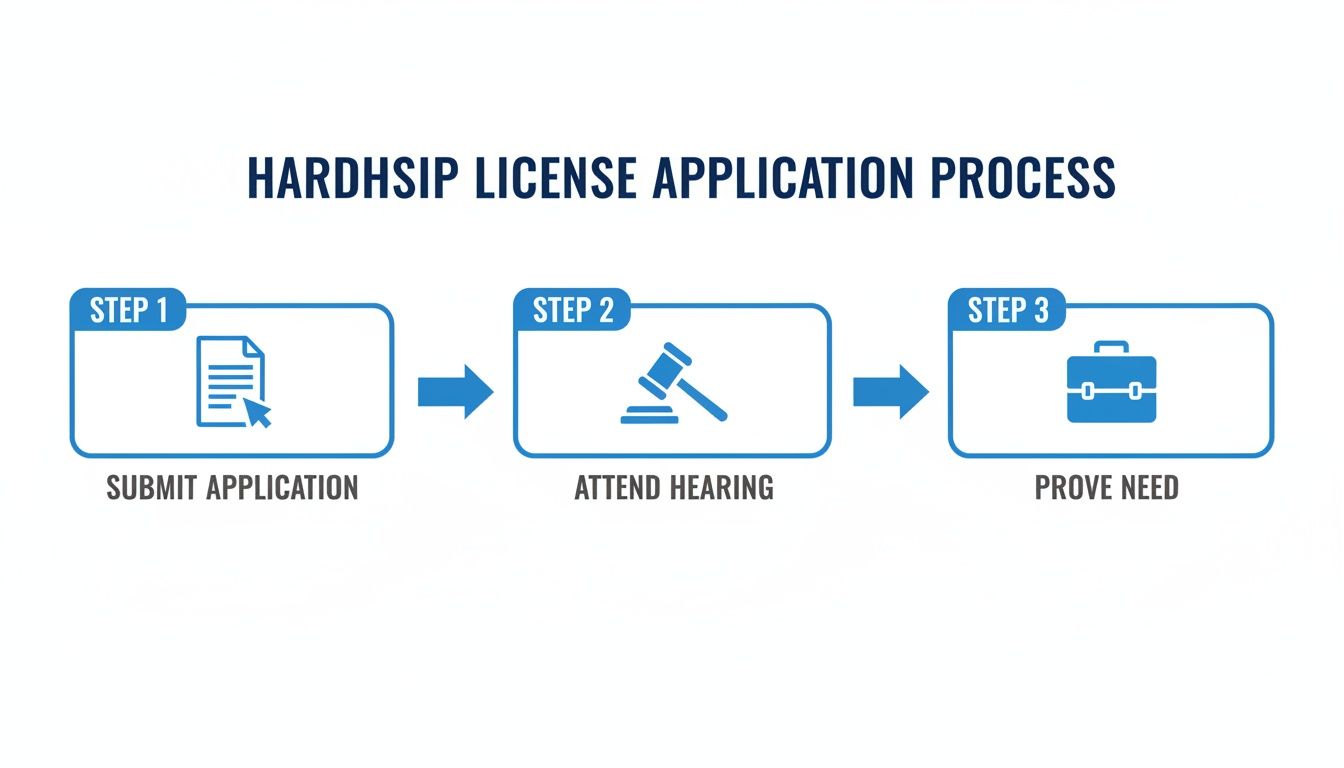
No matter why your license was suspended, you still have to file the paperwork, go to a hearing, and prove your case. But for DUIs, the hurdles you have to clear are much, much higher.
Hard suspension first, hardship later
For many DUI-based suspensions, eligibility turns on whether the mandatory no-driving period has expired. That is why readers often get conflicting answers online: one source may be talking about an administrative suspension after arrest, while another is talking about a conviction-based suspension after court.
A few anchor points help:
A first DUI conviction may allow hardship privileges after the applicable hard-suspension period and completion of prerequisites.
A first refusal has historically required a 90-day hard-suspension period before hardship eligibility in many cases.
A second DUI within five years triggers a much harsher revocation structure and usually at least a 1-year period before a hardship petition can even be considered.
A second or subsequent refusal can move the case into a category where hardship relief is not available during the revocation period.
For the underlying legal framework, Florida places these restrictions in section 322.271, while BAR’s hearing process is summarized in Ticket Shield’s guide to the administrative license suspension hearing process.
Florida DUI hardship timing and barriers
DUI scenario | Status now | What usually happens next | Common additional requirement |
|---|---|---|---|
First DUI conviction, lower BAC case | Not eligible yet if hard suspension is still running | May petition after required period | DUI school, reinstatement fees |
First DUI conviction with BAC .15 or higher | Not eligible yet until mandatory period is served | May petition later; IID often required | IID, DUI school |
First refusal | Not eligible yet during hard suspension | May petition after waiting period if otherwise qualified | DUI school |
Second DUI within 5 years | Not eligible yet during one-year hard suspension | Petition possible only after that period | IID, proof of need |
Second refusal / later refusal situations | Often not eligible during revocation period | Relief may be barred for that revocation | Offense history controls |
DUI involving serious bodily injury or other disqualifying facts | May be barred or face much tougher restrictions | Case-specific review required | Court and statutory limits apply |
DUI school is mandatory, not optional
Here’s a critical point that trips up a lot of people: you must be enrolled in a state-approved DUI program before the DHSMV will even look at your hardship application. This isn't something you can do later.
Key Takeaway: You can't get your hardship license first and then sign up for DUI school. Proof of enrollment is a mandatory piece of paper you have to bring with you to your hearing. If you don't have it, your application is dead on arrival.
Ignition interlock can be part of the price of getting back on the road
For many DUI-related hardship cases, another requirement is the Ignition Interlock Device (IID). This is a breath-testing device wired into the vehicle. You pay for installation, monitoring, and removal. Florida explains approved IID administration and compliance on its state IID page.
Common reasons hardship requests are denied in serious-violation cases
In practice, denials often happen for reasons that are avoidable:
filing during a hard-suspension period,
failing to enroll in DUI school before applying,
missing proof of employment, school, or medical need,
prior noncompliance with a restricted license,
trying to minimize or obscure prior DUI or refusal history,
not completing insurance or IID steps required for issuance.
That is why the key distinction is not "eligible" or "ineligible." Many DUI applicants are not eligible yet rather than permanently barred, but some fact patterns put them in a category where hardship relief is unavailable for that revocation.
Attorney Advertisement. Office in Broward. Our goal is to protect your license and record. Past results do not guarantee future outcomes.
Who Is Not Eligible for a Hardship License in Florida?
This is the part many articles leave too vague. Florida has both temporary bars and more serious disqualifying situations, and readers need to know which bucket they are in.
Not eligible yet
These drivers may still qualify later, but not at the moment they want to apply:
Anyone still serving a mandatory hard suspension after a DUI-related event
Applicants who have not enrolled in the required DUI school or ADI course
Drivers missing proof of need for work, school, church, or medical travel
People who have not completed required fee, insurance, or IID steps tied to reinstatement
Drivers whose underlying suspension issue is still unresolved because a court or DHSMV compliance item remains open
Often not eligible at all for the current suspension or revocation period
These are the scenarios that more often lead to a legal bar rather than a simple delay:
Second or subsequent refusal situations where Florida law does not allow hardship relief during the revocation period
Certain multiple-DUI patterns, especially where the statute imposes a longer revocation before any hardship petition is permitted
Serious bodily injury or other aggravated DUI facts that can sharply limit or defeat hardship eligibility depending on the disposition
Applicants who previously violated hardship restrictions and are now asking BAR for another exception without restoring credibility
Common denial triggers even when a person is theoretically eligible
Even if someone falls into a category that can qualify, these facts commonly sink the application:
applying at the wrong BAR office,
incomplete Form HSMV 78306,
no employer letter or weak proof of necessity,
saying the license is needed for errands that are outside BPO or EPO limits,
inconsistent statements about work hours or job duties,
prior driving outside an earlier restricted license.
The simplest way to think about it is this: Florida does not grant hardship privileges because driving would be convenient. It grants them only when the law allows it and the applicant proves a narrow, documented need.
Common Mistakes and Driving Restrictions to Understand
Getting a hardship license is a huge step, but the work isn't over once you have it in hand. Keeping it means following the rules to the letter. All too often, drivers accidentally put their restricted license at risk by making simple mistakes or just misunderstanding the very strict limits on their driving. Knowing these common pitfalls is the key to staying out of trouble and getting your full license back on schedule.
You have to treat the hardship license period with the seriousness it demands. This isn't just a temporary inconvenience—it's a set of legally binding restrictions. Just one slip-up can lead to having your hardship license yanked, new criminal charges filed, and a much longer, tougher road back to driving freely again.
Pitfalls That Can Derail Your Application
Before you even get the license, a few common stumbles can get your application flat-out denied at your DHSMV hearing. Hearing officers are looking for perfect compliance, and any little oversight can be enough for them to say no.
Watch out for these frequent application-stage mistakes:
Incorrect SR-22 Filing: It's not enough to just ask your insurance agent for an SR-22. You have to double-check that the form has been successfully filed with and accepted by the DHSMV before your hearing. A receipt from your agent won't cut it; it has to be in their system.
Failing to Pre-Enroll in Courses: Don't wait until after your hearing to sign up for your required ADI or DUI school. You must show up with proof of enrollment or completion at the hearing itself. This is a non-negotiable step.
Missing the 10-Day Window: For DUI-related administrative suspensions, you have a razor-thin 10-day window from the date of your arrest to request a formal review hearing. Miss that deadline, and you might give up your right to challenge the suspension, which can seriously complicate your ability to get a hardship license right away.
Incomplete Documentation: Forgetting an employer letter, proof of where you live, or any other required form will bring your application to a dead stop. The burden is 100% on you to show up with a complete and convincing file.
Understanding Your Driving Restrictions
The single most important part of having a hardship license is understanding what "Business Purposes Only" (BPO) means. It's not a suggestion; it is a strict legal definition. Breaking these rules isn't like getting a minor traffic ticket. It is a criminal offense.
Driving outside the scope of your hardship license restrictions is considered Driving While License Suspended Without Knowledge, a criminal traffic violation. A conviction can lead to the immediate revocation of your hardship license and reset the clock on your original suspension.
A BPO license allows you to drive for any activity necessary to "maintain livelihood." This generally covers things like:
Driving to and from your job.
Driving on the clock if it's required for your work.
Getting to and from school if you're a student.
Traveling for necessary medical appointments.
Driving to attend religious services.
What is NOT covered? Many drivers get tripped up on this point. The BPO license absolutely does not cover personal errands or recreational trips.
For example, you cannot legally:
Drive to a restaurant to grab dinner.
Go to the movies or a friend's house.
Take your kids to the park or soccer practice.
Make a quick, non-emergency trip to the grocery store.
Think of it this way: if the drive isn't directly tied to your job, health, education, or church, it's almost certainly against the rules. Any deviation puts your license—and your freedom—on the line. Playing by the rules is the only way to get through your suspension period and move on with your life.
The Hidden Costs of a Suspended Florida License
Losing your license in Florida isn't just an inconvenience. For someone who depends on a vehicle, it’s a significant crisis that can throw your entire life off balance. A car isn't a luxury here; it's how you get to work, take care of your family, and handle just about everything. When that’s suddenly gone, the walls can start closing in fast.
This is exactly why getting a hardship license is so important. A suspension can kick off a devastating domino effect, often starting with losing your job. From there, it’s a quick slide into financial trouble, making it tough to cover rent, groceries, or other bills. It’s a vicious cycle that’s hard to break out of.
The Economic Ripple Effect of Suspensions
The damage from a suspended license doesn’t stop with one person—it sends ripples across the entire state. A staggering number of suspensions in Florida have nothing to do with dangerous driving. Instead, they’re tied to unpaid fines and fees, a policy that hurts both workers and the businesses that need them.
The numbers are pretty shocking: between 2017 and 2021, Florida sent out over 5.1 million suspension notices just for unpaid fines. This policy puts a chokehold on our economy. Small businesses in construction, trucking, and hospitality struggle to find people to fill jobs. With a significant portion of the adult population unable to drive legally, a statewide labor shortage only gets worse, and that affects all of us. You can dive deeper into this issue in this detailed report on Florida's driver's license suspension policies.
Personal and Financial Consequences
On a personal level, not being able to drive creates a logistical nightmare. Simple, everyday tasks become massive challenges.
Job Security: How do you keep a job, or find a new one, without a reliable way to get there? In many parts of Florida, public transit just isn't a realistic option.
Healthcare Access: Getting to a doctor’s appointment becomes a huge obstacle, especially if you or a family member has a chronic condition that needs regular care.
Family Responsibilities: Taking the kids to school, caring for an elderly parent, or even just making a grocery run becomes significantly more complicated.
And the financial pain goes way beyond the initial fines. A suspension hammers your car insurance requirements. Premiums can go through the roof, and the need for special coverage like an SR-22 just adds another heavy financial weight to carry.
It’s a frustrating loop: a minor ticket leads to a fine. If you can't pay it, your license gets suspended. Now you can't work to earn the money to pay the fine, and you sink deeper into debt and legal trouble.
Danger escalates when you're faced with driving illegally to keep your job or losing your income entirely, and many people feel forced to take that risk. But getting caught can turn a bad situation into a disaster. It's critical to understand the penalties for driving with a suspended license, because a conviction can mean jail time, more fines, and an even longer suspension. That is why getting professional assistance to address the root problem is a sound strategy.
How a Proactive Defense Can Protect Your Driving Privileges
Understanding if you qualify for a Florida hardship license is important. However, the best-case scenario is never needing one. A hardship license is a fallback plan, not a goal. It’s a process filled with restrictions, steep fees, and the constant feeling of being under a microscope.
The single most effective strategy is a proactive defense that seeks to prevent the license suspension before it ever happens.
Taking immediate action the moment you get a ticket or face a DUI charge is your best shot at protecting your freedom to drive. If you wait until your license is already suspended, you're immediately on your back foot, forced to fight your way through the DHSMV hearing process. Attacking the root of the problem—the charge itself—can help you sidestep that entire ordeal.
Avoiding Suspension Through Smart Legal Action
A dedicated traffic defense firm steps in. We challenge the evidence, search for procedural mistakes, and negotiate directly with prosecutors. Our practice focuses on traffic and DUI defense, with the primary goal of keeping your license valid and your record clean. We handle criminal traffic matters across Florida, working to find outcomes that keep our clients on the road, no strings attached.
A proactive approach can yield several potential positive results:
Getting Charges Dismissed: If the state's case has weaknesses, motions can be filed to have the charges dropped entirely.
Negotiating Lesser Charges: It's often possible to negotiate a charge down to something less serious that doesn't trigger an automatic license suspension.
Finding Alternative Solutions: We can frequently arrange for alternatives like traffic school or other programs that prevent points from ever hitting your record.
A traffic ticket or a DUI charge isn't just an inconvenience. It's a direct legal challenge to your freedom to drive. A proactive defense meets that challenge head-on, aiming to shut the problem down before a suspension even becomes a possibility.
Taking the First Step to Protect Your License
Don't wait until you're staring at hardship application forms to ask for help. The minute you have a ticket in your hand or are facing a charge is the time to make a move. At Ticket Shield, we offer a free consultation to go over the details of your case and map out a potential defense strategy. Our team is ready to pursue the best possible outcome for our clients in all 67 Florida counties.
Attorney Advertisement. This is an advertisement for legal services. Office in Broward County, Florida. Submitting information through our website does not create an attorney-client relationship. Past results do not guarantee future outcomes; prospective clients may not obtain the same or similar results.
Common Questions We Get About Hardship Licenses
When you're facing a suspension, the same practical questions come up over and over: cost, timing, whether the 10-day DUI issue matters, and how to tell whether you are eligible or just hoping you are.
How much does a hardship license cost in Florida?
There is no single all-in price because the total usually includes several separate charges: the BAR hearing fee, reinstatement fee, course tuition, and sometimes SR-22 or FR-44 insurance filing costs. If your case requires an ignition interlock device, add installation and monthly monitoring on top of that. Florida posts statewide reinstatement charges on the DHSMV reinstatement fees page. In real cases, the hearing itself is only one piece of the cost.
What is the 10-day hardship license issue after a DUI arrest?
The 10-day issue is often misunderstood. After many DUI arrests, the officer issues a temporary permit and the driver has 10 days to request a formal review hearing to challenge the administrative suspension. That deadline is about preserving review rights, not automatically granting hardship status. If the review window is missed, the suspension usually starts, and the driver may then have to pursue hardship relief under the normal BAR rules instead. That process is explained in more detail in our guide to the administrative license suspension hearing process.
How do I know if I am eligible now, eligible later, or not eligible at all?
Start with three questions:
Why is the license suspended or revoked?
Is there a hard-suspension period still running?
Have I enrolled in the required DUI school or ADI course and gathered proof of need?
If the answer to the second question is yes, you are usually not eligible yet. If the answer to the third is no, you may be legally eligible but practically unready. If your case involves repeat refusals, certain repeat DUI patterns, or serious-injury facts, you may fall into a category where hardship relief is barred for the current revocation term.
How long does it take to get a hardship license in Florida?
The office scheduling portion is often measured in weeks, but the legal waiting period is what controls many DUI cases. If there is no mandatory hard suspension and your documents are complete, a hearing may be set within 2 to 4 weeks, and the restricted license can sometimes be issued the same day as approval. If a DUI waiting period applies, the timeline becomes that waiting period plus the filing and hearing schedule. The step-by-step process above is the best roadmap for shortening avoidable delays.
Can I use a BPO hardship license for groceries, family errands, or social trips?
Usually no. BPO is broader than EPO, but it is still limited. Work, school, church, and necessary medical travel are the classic approved uses. Personal errands, social outings, and convenience trips are where many drivers get into trouble. If you violate the restriction, you risk new charges and losing the hardship privilege.
Where can I get help with the next step?
If your license is on the line, time is not on your side. The best way to protect your ability to drive is to get ahead of the problem. Contact Ticket Shield, PLLC today for a free, confidential chat about your situation and what your options really are. Head over to Ticket Shield to get started.
DUI Offense Scenario | Mandatory Hard Suspension Period | Ignition Interlock Device Required |
|---|---|---|
First DUI Conviction (BAC < .15) | 30 Days | Yes, 6 Months |
First DUI Conviction (BAC >= .15) | 30 Days | Yes, 6 Months |
First DUI Refusal (No Conviction) | 90 Days | Yes, 1 Year |
Second DUI Conviction (within 5 years) | 1 Year | Yes, 1 Year |
Second DUI Refusal (within 5 years) | 18 Months (No Hardship Allowed) | N/A |
Third DUI Conviction (within 10 years) | 2 Years | Yes, 2 Years |