How to Reinstate Your Suspended Driver's License in Florida
How to reinstate your suspended drivers license in Florida: check online eligibility, pay separate fees, and know when a DMV visit is still required.
Thursday, October 23, 2025
How to Reinstate Your Suspended Driver's License in Florida: Quick, step-by-step guide to meet requirements, pay fines, and restore driving privileges.
Before taking any action to reinstate your suspended driver's license in Florida, the first step is to determine the precise reason for the suspension. Once you understand the cause, you can follow the specific court and FLHSMV requirements, pay the necessary fines and fees, and work towards getting back on the road.
The path forward differs significantly depending on whether the suspension is due to excessive points, a DUI, or an unpaid ticket.
How We Evaluated the Florida Reinstatement Process
The practical sequence Florida drivers face is: identify the suspension reason, confirm what agency controls the hold, clear the underlying problem, then complete reinstatement with the Florida Department of Highway Safety and Motor Vehicles. Public FLHSMV tools for driver license status checks and driving record and reinstatement information reflect these procedures, which align with the payment and compliance paths commonly handled through county clerks, courts, and related agencies.
We also focused on the distinction readers care about most: what can often be handled online, what still requires a service center or Bureau of Administrative Reviews hearing, and what cannot move forward until another agency releases its hold. In our experience, the biggest delays usually do not come from the final FLHSMV payment itself; they come from trying to pay the state before the court, insurer, or outside agency has fully updated the case.
This article is informational, Florida-specific, and written to help you avoid wasted trips and rejected online transactions.
Why Is My Florida Driver's License Suspended?
Understanding why your license is suspended is the critical first step. This is not a one-size-fits-all problem. The Florida Department of Highway Safety and Motor Vehicles (FLHSMV) has a different procedure for every situation. The steps to resolve a suspension from accumulating points are entirely separate from those required for a DUI.
Identifying the specific cause is essential, since it dictates the entire plan for restoring your driving privileges.
Driving-Related Suspensions
Most suspensions are tied directly to actions that occurred behind the wheel. While these are often straightforward to understand, the requirements for reinstatement can become complex.
Accumulating Too Many Points: Florida's point system should be taken seriously. If you accumulate 12 points within 12 months, you are facing a 30-day suspension. The penalties increase from there.
Driving Under the Influence (DUI): A DUI arrest alone can trigger an immediate administrative suspension, often before a conviction in criminal court. A conviction brings on even tougher, mandatory license revocations. For a first-time DUI, the administrative suspension often takes effect long before the court case concludes. You can learn more about these critical first moves in our guide on the administrative license suspension hearing.
Unpaid Traffic Tickets: This issue affects many people. Forgetting to pay a ticket or missing a court date can lead to a suspension. It's also one of the most common—and preventable—reasons drivers lose their license.
Non-Driving Related Suspensions
It is a common misconception that you can only lose your license for driving mistakes. The state can and will suspend your driving privileges for issues that have nothing to do with your performance on the road.
Key Insight: A significant number of license suspensions are not from poor driving. They are tied to financial or administrative problems, which often means you'll be dealing with government agencies beyond just the FLHSMV.
For example, failing to pay court-ordered child support can lead to an indefinite suspension until you are back in good standing. The same applies to certain drug offense convictions, even if a car was not involved.
To illustrate how differently states handle reinstatement, Maryland makes clear that reinstatement after certain suspensions or revocations is not automatic and requires a formal MVA application. Florida is often more digital for basic holds, but it still follows the same core rule: you must clear the reason for the suspension before the state will restore full driving privileges.
If your suspension is linked to alcohol offenses, resources on how to quit drinking can be very helpful. Taking steps to address the root cause is an effective way to show the state you are responsible and committed to preventing future issues.
To quickly see what you might be facing, this table breaks down some common suspension reasons and the typical starting point for reinstatement.
Common Florida License Suspensions and First Actions
Reason for Suspension | Governing Florida Statute | Typical First Step for Reinstatement |
|---|---|---|
Excessive Points | §322.27(3) | Wait out the suspension period (30 days to 1 year); pay reinstatement fee. |
DUI (First Offense) | §322.2615 / §322.28 | Complete DUI school; apply for a hardship license if eligible. |
Failure to Pay Ticket | §322.245(1) | Pay the outstanding citation and any late fees with the county clerk. |
Failure to Pay Child Support | §322.245(2) | Settle the obligation with the Dept. of Revenue and get a release. |
Drug Conviction | §322.055 | Complete a substance abuse course; serve the mandatory revocation period. |
No matter the cause, your first call to action is the same: confirm the official reason for your suspension directly with the FLHSMV. That record is your roadmap, dictating every single step you need to take from here on out. Past results do not guarantee future outcomes, but our goal is to protect your license and record.
This post is for informational purposes only and does not constitute legal advice. Submitting information via our forms does not create an attorney-client relationship. Office in Broward.
How to Check Your Florida Driver's License Status
Start with the official record, not with assumptions. Florida gives you two useful tools: the public driver license check for a quick status snapshot and the driving record/history options for the deeper detail you need to plan reinstatement. I have seen many drivers lose time by paying the wrong office first; the status screen tells you whether the license is valid, suspended, or revoked, but the full record usually tells you why and what still has to be cleared.
Getting Your Hands on Your Official Florida Driving Record
The FLHSMV offers a few different ways to obtain your record. The fastest route is online, where you can review status immediately and then order the record if you need the detailed entries.
Here’s a look at the portal you'll use:
Just enter your driver's license number, and you’ll receive an instant update. This is the critical first step to confirm what you’re dealing with and begin figuring out how to resolve it.
For the full details, however, you'll need your complete driving record. You have three main options for that:
Online: The quickest way is through the FLHSMV's online portal or an authorized third-party vendor. You will need a credit card for the small fee.
In-Person: You can always visit any Florida driver license service center and request a copy. Make sure you have a valid ID with you.
By Mail: If you're not in a hurry, you can fill out a request form and mail it in with the fee. This is the slowest method.
How to Actually Read Your Driving Record
Once you have the document, skip the parts that are just historical and focus on the active suspension or revocation entries. You are looking for the effective date, the reason code, and any notation showing what must be completed before the hold can be removed.
Typical clues include:
Failure to Pay Citation / Failure to Appear: Usually means a court or clerk hold must be cleared before FLHSMV can process reinstatement.
Insurance Suspension: Often points to a lapse case that may be handled faster once proof of coverage is on file and the state fee is paid.
DUI-related entries or revocations: These usually involve DUI school, possible hard suspension periods, FR-44 requirements, and often an in-person step.
Hardship-license language or BAR references: This is a sign the case is not a simple online payment matter.
Multiple open items from different agencies: These are the cases that frustrate people most, because paying one hold does not remove the others.
Key Takeaway: Think of your driving record less as a history report and more as a decision sheet. It tells you whether you may be able to finish online, whether you need a service center or BAR office, or whether another agency still has to send a clearance first.
What to Look For Before You Try an Online Reinstatement
A quick status check does not automatically mean you are eligible to finish the process online. Before you attempt payment, confirm these decision points:
Unpaid citation or missed court date hold: Clear it with the county clerk or court first. For example, the Miami-Dade Clerk traffic payments page shows how county payment systems handle ticket balances separately from FLHSMV state fees.
Insurance-related suspension: You may be able to move faster if your insurer has already filed the required proof and the hold is only waiting on a state reinstatement payment.
DUI-related requirement: Expect additional conditions such as school completion, FR-44 filing, and possible in-person processing.
Hardship-license case: These often require a Bureau of Administrative Reviews process rather than a simple online checkout.
More than one hold: If the record shows court, child support, insurance, or criminal-related issues at the same time, do not expect a single online payment to restore driving privileges.
In my experience, the most common failed online attempt happens when someone pays a state fee before the clerk, court, insurer, or outside agency has transmitted the release.
What to Have Ready Before You Start
Before you try to resolve anything online or in person, gather:
Your Florida driver license number
Citation, case, or docket numbers for any court-based hold
Proof of course completion or enrollment if ADI or DUI school is required
Confirmation that your SR-22 or FR-44 filing has been submitted, if applicable
A payment method for county fines and a separate payment method for FLHSMV fees if needed
It’s also wise to understand how long these violations will remain on your record and affect you. For a deeper dive on that, you can learn more about how long traffic tickets stay on your record in our guide. Once you have this official information, you can stop guessing and start taking action.
Can You Reinstate Your Florida License Online?
Sometimes, yes, but only after the underlying hold is cleared. Florida does offer online tools and payment paths, yet full reinstatement is not universally available for every suspension type. The practical rule is simple: if your case is administrative and straightforward, online options are more likely; if it involves DUI consequences, hardship eligibility, hearings, or outside-agency approvals, expect an in-person or multi-step process.
Cases Commonly Handled Online
Florida drivers often have the best chance of completing reinstatement online when the case involves:
an unpaid traffic citation that has already been resolved with the clerk or court,
an insurance-related suspension where proof has already been filed,
a routine reinstatement fee payment after a suspension period has ended, or
a status issue that no longer requires document review by a hearing officer.
In those cases, the online status and record tools are the first place to check whether the remaining step is just payment and verification.
Cases That Usually Are Not Fully Online
Online reinstatement usually becomes less realistic when the file involves:
DUI suspensions or revocations,
a request for a hardship license,
multiple simultaneous holds,
unresolved court noncompliance,
child-support or other agency-based suspensions, or
any case where FLHSMV needs to review documents before restoring privileges.
I generally tell readers to think of Florida's online system as a payment and status tool, not a universal substitute for every reinstatement path.
Florida Compared With Other States
This is not unusual. Michigan, for example, allows drivers to pay certain license reinstatement fees online, but the underlying approval process can still require separate manual steps. New Jersey is even narrower; its MyLicense FAQ makes clear that true online reinstatement features are tied to certain professional boards rather than ordinary driver-license reinstatement. Florida sits somewhere in the middle: more convenient than many states for basic cases, but still very dependent on the reason for the suspension.
Tackling Your Florida Reinstatement Requirements
Once you've pulled your driving record, you have the official list of what's standing between you and getting back on the road. It's time to start checking things off. The Florida Department of Highway Safety and Motor Vehicles (FLHSMV) has a specific process for everything, from paying old fines to finishing required classes. The key is to handle each item completely and in the right order.
Looking at the list can feel overwhelming. But think of it as a clear roadmap. Every task you complete is one step closer to getting your driving privileges back.
This is the basic game plan: get your official record, pinpoint the exact requirements, and then build your strategy.
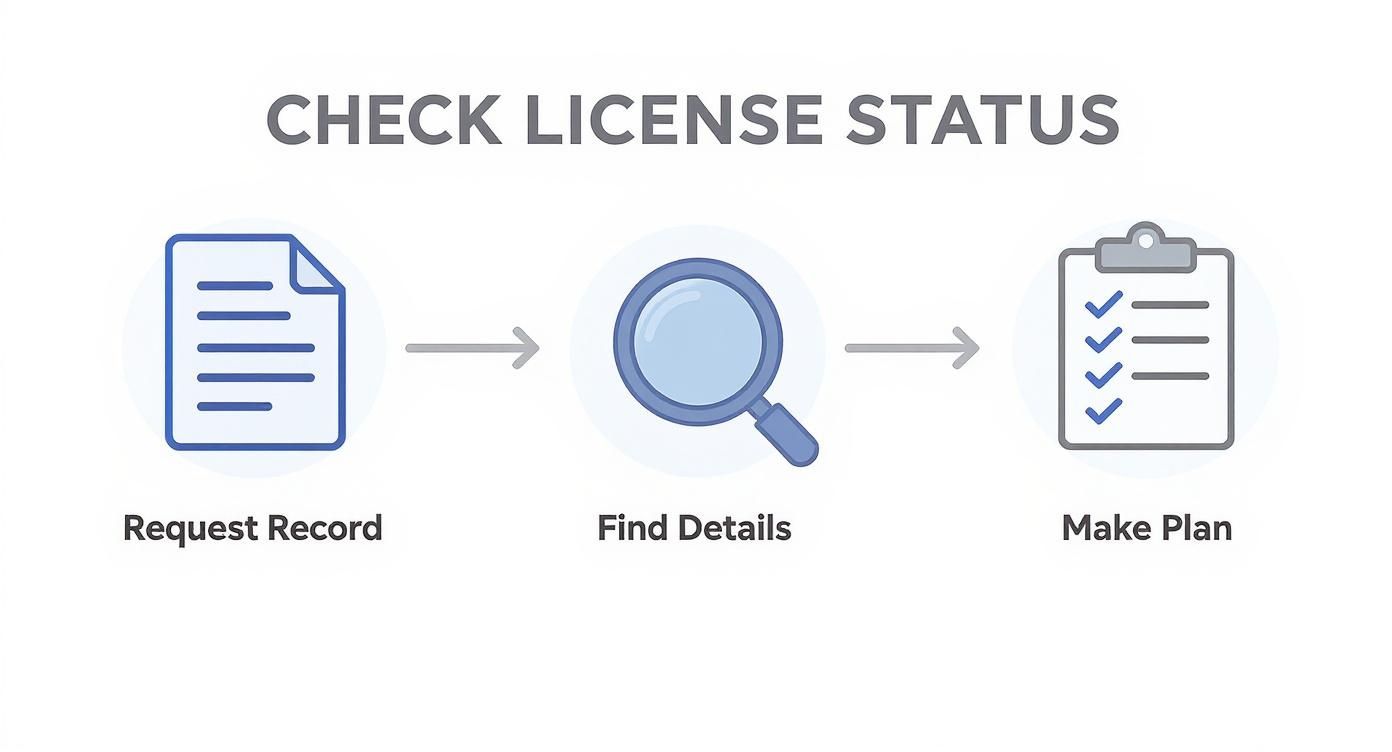
Starting with that official record is essential. It’s the only way to build a plan you can trust.
Settling Outstanding Fines and Fees
One of the biggest hurdles people face is an old, unpaid traffic ticket or court fine. If your record shows a "Failure to Pay Citation" or a similar hold, nothing else matters until you clear that debt. The FLHSMV will not consider your reinstatement request.
These fines are not paid to the FLHSMV. You'll need to pay the Clerk of Court in the county where you received the ticket. Most counties allow you to pay online, but you can also pay by mail or in person. Once you've paid, keep the clearance letter or receipt—it's your proof.
Here is where people can get confused. There are two different fees you have to cover:
The Original Fine: This is the penalty for the actual traffic ticket.
The Reinstatement Fee: This is a separate fee you pay directly to the FLHSMV after you’ve cleared the ticket with the county.
You must pay both before your license can be restored.
Enrolling in and Completing Mandatory Courses
Depending on why your license was suspended, the state will almost certainly require you to complete specific educational courses. This is their way of ensuring you've addressed the root cause of the problem. These are not optional.
Advanced Driver Improvement (ADI)
If you accumulated too many points or were designated a Habitual Traffic Offender (HTO), you can expect to be required to complete a 12-hour Advanced Driver Improvement (ADI) course. Make sure the provider you choose is state-approved, otherwise, it won't count.
Florida DUI School
For any suspension related to drugs or alcohol, DUI School is mandatory. The course you take depends on your history:
Level I DUI Program: This is a 12-hour course designed for first-time offenders.
Level II DUI Program: If you have prior DUI convictions, you will be required to take the more intensive 21-hour course.
You must enroll, finish the class, and obtain your certificate. While the school should notify the FLHSMV electronically, it is a good practice to keep a physical copy for your own records.
Important Note: Do not procrastinate. These classes take time, and you cannot get your license back until the FLHSMV receives confirmation that you've passed.
Demystifying SR-22 and FR-44 Insurance Filings
Few things create more confusion than SR-22s and FR-44s. Let’s clarify this: these are not types of insurance. They are certificates your insurance company files with the state to prove you have the legally required coverage.
An SR-22 is usually required for serious violations like reckless driving or driving without insurance. It proves you meet Florida's minimum liability insurance limits. Expect to keep this on file for three years.
An FR-44 is a different matter, specifically for DUI convictions. It is much stricter, requiring you to carry liability coverage of $100,000/$300,000/$50,000—significantly higher than the state minimum. Just like the SR-22, you must maintain it for three consecutive years. If your coverage lapses for even one day, your license will be suspended again.
To get one of these, you will need to call an insurance company licensed in Florida and specifically ask for an SR-22 or FR-44 filing. They will issue the policy and send proof directly to the FLHSMV. Be prepared for your premiums to increase. If you are trying to understand the FR-44 side of a DUI-related case, Select Insurance Group, Inc.'s guide gives a useful overview of the filing and coverage issues that often delay reinstatement.
Navigating a suspension can be challenging. If you're struggling to understand the requirements or need someone to represent your interests, our practice focuses on traffic defense throughout Florida. See how a knowledgeable suspended license lawyer can help protect your driving record. Our goal is to guide you through the process efficiently. Past results do not guarantee future outcomes.
Attorney Advertisement. Office in Broward. Submitting information does not create an attorney-client relationship.
Applying for a Florida Hardship License
In Florida, not having a driver's license is often not a viable option. Your job, your children's school, and even getting groceries typically require a car. A full license suspension can disrupt your entire life.
That’s where the Florida hardship license can be helpful. It can be a genuine lifeline, but let’s be clear: it's a limited privilege, not an automatic right.
A hardship license does not mean you are back on the road without restrictions. It means you can drive for very specific, pre-approved reasons, and the FLHSMV is strict about it.
What Can You Use a Hardship License For?
The state breaks it down into two types of hardship licenses, and knowing which one you might qualify for is the first piece of the puzzle.
Business Purposes Only: This is the more common type. It allows you to drive to and from your job, and it also covers any driving you must do as part of your job.
Employment Purposes Only: This one is much more restrictive. It only allows you to drive to and from work. No side trips.
Follow the rules. If you're caught driving for any other reason, you can lose the hardship license and likely face new criminal charges.
Navigating the Application Process
Applying for a hardship license is a detailed and sometimes tedious process. You cannot just fill out a form and hope for the best. You will need to gather specific documents and, in many cases, attend a formal hearing to argue your case.
The journey starts at a Bureau of Administrative Reviews (BAR) office, where you will submit your application and all supporting evidence. You must arrive prepared.
Key Insight: Think of the hardship license hearing as your opportunity to convince the state that you genuinely need to drive and can be trusted to follow the rules. The hearing officer's decision is based entirely on the proof you provide and the case you make.
To put together a solid application, you’ll need a few key items:
Proof of ADI or DUI School Enrollment: You must show you’ve already signed up for or completed any required driver improvement courses. For most suspensions, this is a mandatory first step.
Application for Hardship License: You will have to fill out the official state form, ensuring it’s 100% accurate and complete.
Proof of SR-22 or FR-44 Insurance: If your suspension requires it, you must have proof that your insurance company has filed the correct certificate with the state.
The Hearing at the BAR Office
For many suspensions, particularly those related to DUIs, a formal hearing is mandatory. This is not just a quick chat; it's a serious administrative proceeding. A hearing officer will review your file, listen to your testimony, and then decide whether to grant you the hardship license.
During the hearing, they will want to know why you need the license and what you have done to address the problems that led to the suspension. Honesty and preparation are paramount.
Obtaining a hardship license is often a critical part of learning how to reinstate your suspended driver's license because it helps you manage essential tasks while you work on meeting all the requirements for full reinstatement. However, the path looks very different depending on why your license was suspended. For example, DUI-related applications face much more scrutiny and often come with "hard suspension" periods where you cannot drive at all, with no exceptions.
Our practice focuses on traffic and DUI defense across Florida, and our goal is to protect your license and record. Successfully applying for a hardship license requires careful preparation and a clear understanding of the state's strict criteria. Past results do not guarantee future outcomes.
This post is an Attorney Advertisement. Office in Broward. Submitting information via our forms does not create an attorney-client relationship.
Tying It All Up: Finalizing Your Reinstatement with the FLHSMV
After you know the suspension reason and complete the required steps, what exactly happens next in Florida, and do you have to go to the DMV to finish it? The answer depends on which of three paths your case falls into.
Path 1: Cases Often Completed Online or With Minimal FLHSMV Follow-Up
Some Florida suspensions are relatively straightforward once the underlying issue is resolved. These commonly include:
paid-off traffic citations or failure-to-comply cases that the clerk has already cleared,
certain insurance suspensions after proof is on file,
expired suspension periods where the only remaining step is the state reinstatement fee, and
routine cases with no BAR hearing requirement and no outside-agency block.
For these matters, the usual sequence is:
Resolve the underlying hold first with the clerk, court, insurer, or other source of the suspension.
Pay the FLHSMV reinstatement fee if the status tools or your record show that payment is still required.
Check your status again through the official Florida license check tool before you drive.
If the status changes to valid and your physical card is still current, you may not need a separate office visit. If the card was confiscated, expired, or needs replacement, you will still need a service center for a new credential.
Path 2: Cases That Usually Require a Service Center or BAR Office
You should expect an in-person step when the reinstatement involves judgment calls, document review, or restricted-driving eligibility. That commonly includes:
DUI suspensions or revocations,
hardship-license applications,
cases requiring a Bureau of Administrative Reviews hearing,
situations where the online record does not show all documents as received,
multiple active holds that need staff review, and
requests for a new physical license after the underlying privileges are restored.
In practice, people ask, "Do I have to go to the DMV to reinstate my license in Florida?" Sometimes yes. If your case needs a hearing, identity verification, paper review, or a license to be reissued, an office visit is usually unavoidable.
Path 3: Cases That Cannot Be Finalized Until Another Agency Sends Clearance
FLHSMV cannot override another agency's hold. If the suspension stems from unpaid support, court noncompliance, insurance reporting problems, or another outside issue, your first payment to the state will not fix it.
These cases usually require you to:
Clear the matter with the controlling agency first.
Wait for electronic or documented release to reach FLHSMV.
Pay the state reinstatement fee once the hold is eligible for removal.
Verify status before driving.
From what we see, multi-agency holds are the biggest source of repeat suspensions and rejected reinstatement attempts because drivers assume one receipt equals full clearance.
Florida Payment Sequence That Prevents Most Delays
If you only remember one workflow, make it this one:
Step 1: Pay or complete the underlying requirement with the clerk, court, school, insurer, Department of Revenue, or other agency.
Step 2: Confirm that the hold was released or transmitted to FLHSMV.
Step 3: Pay the FLHSMV reinstatement fee if still due.
Step 4: Recheck your status before driving.
County fines and state reinstatement fees are separate charges. That distinction matters. Paying the clerk does not automatically pay FLHSMV, and paying FLHSMV does not erase an unpaid county balance.
Common Florida Reinstatement Fee Range
The exact amount depends on the suspension type, but the state reinstatement fee commonly falls in the range already noted in this article:
Typical FLHSMV reinstatement fee: $45 to $75
County court fines and late fees: varies by case and county
Course fees: paid separately to the approved provider
SR-22 or FR-44 filing costs: separate from court and state fees
I usually advise people to budget for at least two categories of payment, not one: the charge that caused the hold and the FLHSMV fee that restores the privilege.
How Long It Usually Takes to Show as Valid
Simple online-eligible cases may reflect quickly once all agencies have updated their records, but same-day restoration is not guaranteed. In-person processing can also move fast when every document is complete, yet outside-agency holds often take longer because FLHSMV must receive the release first.
The safe move is the same in every scenario: verify the license status after payment and before driving. Until the system shows you as valid, you should assume the suspension is still active.
Got Questions About Getting Your Florida License Back? We've Got Answers.
Can I pay online to reinstate a Florida license?
Often, yes, but only after the underlying case is cleared. If your suspension came from an unpaid citation, missed compliance, or certain insurance issues, you may be able to finish the state side online once the clerk, court, or insurer has updated the hold. Start by checking the FLHSMV status tool and then review the FLHSMV driving record and service information to see whether the remaining step is payment, document review, or an office visit.
Do I have to visit the DMV or a BAR office in person?
Not always. A simple case may be handled without an in-person trip if the only missing step is payment and status verification. You usually need to go in person when the case involves a DUI, a hardship license, a Bureau of Administrative Reviews hearing, identity or document review, or a replacement physical license. In our experience, readers are often surprised that the online part is easiest only after every outside hold has already been released.
What documents should I gather before I try to pay anything?
Have your driver license number, citation or case numbers, proof that any required ADI or DUI course is complete or enrolled, confirmation that an SR-22 or FR-44 filing has been submitted if required, and a payment method for both county and state charges. If you are missing just one of those pieces, the payment may go through while the suspension remains active.
How long does online versus in-person reinstatement take to show in Florida?
Online-eligible cases can update quickly, but they are not always immediate. In-person transactions may also post fast when the file is clean and complete. The longer delays usually come from court, insurance, or agency releases that have not yet reached FLHSMV. The safest step is to verify your result through the official status check before you drive, even if you have already paid.
Trying to handle all this on your own can be stressful and confusing. At Ticket Shield, PLLC, our practice focuses on Florida traffic and DUI defense. We handle criminal traffic matters across the state with the goal of protecting your license and your record. For a free consultation to discuss your specific case, visit us at Ticket Shield.
Attorney Advertisement. Office in Broward. Past results do not guarantee future outcomes. Prospective clients may not obtain the same or similar results.