How to Check if Your Florida License Is Suspended
Need how to check if license is suspended in Florida? Use the official FLHSMV DL Check, see what statuses mean, and know the next step.
Finding out your Florida driver's license is suspended can be a nasty surprise. Your driving privileges can be revoked for reasons that have nothing to do with being on the road. A simple oversight, like a missed court date for a non-moving violation or an unpaid ticket you never even saw, can escalate fast.
That's why the quickest, easiest way to know for sure is to use the official Florida Department of Highway Safety and Motor Vehicles (FLHSMV) online portal. It’s a free and instant check that only asks for your driver's license number to tell you exactly where you stand.
How We Verified This Florida License Suspension Check Process
We rebuilt this guide against Florida's official sources rather than repeating generic suspension advice. In our review, we checked the live FLHSMV DL Check portal, the state's driver record request options and reinstatement materials, plus county court and clerk resources that explain how unpaid tickets, failures to appear, and local holds can trigger a suspension.
What we found is that the free status check is useful for one narrow question: whether your driving privilege is currently valid, suspended, revoked, canceled, or otherwise limited. It does not usually give the full case history you need to fix the problem. If you need suspension dates, court case numbers, points history, or the exact reinstatement items, you will usually need a full driving record or the county court that placed the hold.
Practical questions Florida drivers face include: what information you need before using the portal, what the result screen tends to show, when a clerk's office is more helpful than the state portal, and when you should stop driving immediately and verify reinstatement before getting back on the road. If Florida updates the DL Check flow, reinstatement fees, or record-order process, those official pages would control over any secondary source.
Why You Need to Proactively Check Your Florida License Status

Here's something many drivers don't realize: you can be driving on a suspended license and not even know it. But "I didn't know" isn't a defense that holds up in court.
Driving on a suspended license, even unknowingly, is a serious offense in Florida. It can lead to a whole mess of legal consequences that can disrupt your life.
The Hidden Risks of an Unchecked License
The consequences for Driving While License Suspended (DWLS) can be severe. Depending on whether you knew about the suspension, a first offense could be a civil infraction or a second-degree misdemeanor. The penalties aren't something to take lightly:
Hefty Fines: These can add up quickly, making it even harder to get your license back.
Vehicle Impoundment: Police can have your car towed and impounded, and you’re the one stuck with the bill.
Jail Time: A conviction for DWLS with knowledge can result in jail time, especially if it's not your first offense.
Habitual Traffic Offender Status: Rack up multiple convictions, and you could face a five-year license revocation.
These problems often start with simple administrative slip-ups. A 2017 analysis of DMV data found that over 42.3% of active suspensions across the country were for failing to show up in court, and another 22.4% were for not paying fines. You can read more about these national findings on license suspensions. It just goes to show how easily paperwork issues can take you off the road.
Checking your license status is the single most important first step you can take. It empowers you to tackle any potential problems head-on before they spiral into criminal charges, protecting your record, your insurance rates, and your ability to get where you need to go.
Using the Official FLHSMV Portal to Verify Your License
The fastest way to confirm your Florida license status is the state's free FLHSMV DL Check tool. This is the status lookup Florida provides directly, so it is the best starting point when you need a same-day answer.
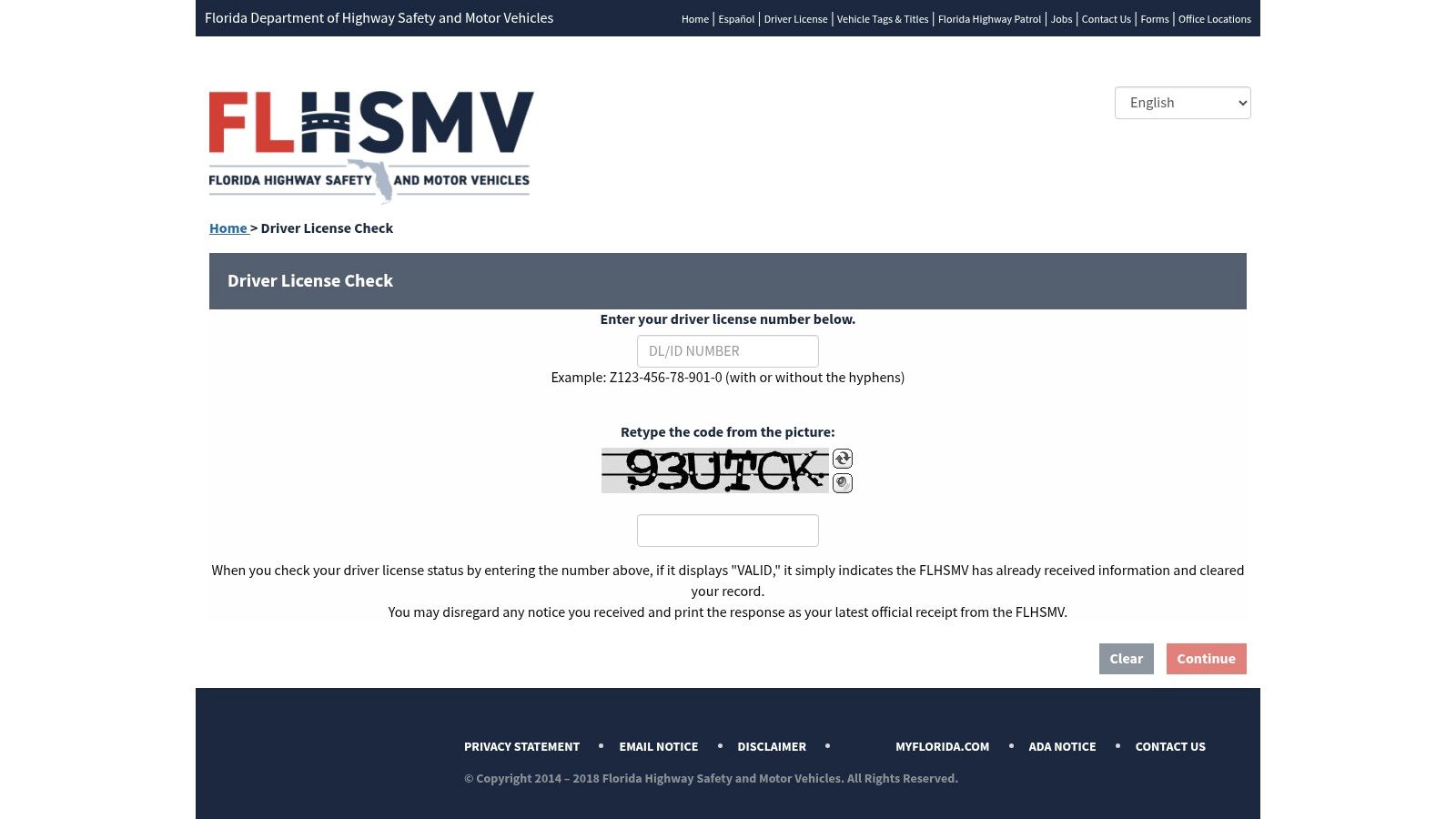
In our review of the FLHSMV process, the portal worked well for quick confirmation but not for deep diagnosis. It answered the immediate question of whether the credential was valid, yet it did not replace a full record when the screen showed a vague suspension code.
What You Need Before You Start
Have these details ready before opening the portal:
Your Florida driver license number
Your date of birth
Enough time to answer the identity prompts without rushing
A way to save the result, such as a screenshot or written note of the status and any code shown
If you do not know your license number, skip the quick portal check and move to the driving-record or in-person options below. The free status tool is built around the license number.
Step-by-Step: How to Run the Official Status Check
Go to the official Driver License Check page.
Enter your Florida driver license number exactly as it appears on your card.
Complete the required identity or security prompts.
Submit the request and wait for the status screen to load.
Read the current license status shown on screen.
If the result is anything other than valid, write down the wording exactly.
If the wording is unclear, order your official driving record through FLHSMV before you try to fix the issue.
What I would not do is rely on memory after closing the tab. A short label like "failure to pay" is easy to misremember, and that small detail matters when you call a clerk, tax collector, or attorney.
Statuses You May See Besides Valid or Suspended
Drivers often expect the portal to show only "valid" or "suspended," but Florida records can reflect several conditions. The exact wording can vary, but common possibilities include:
Valid: Your current privilege appears active.
Suspended: Your privilege is temporarily withdrawn until you satisfy the listed requirement.
Revoked: Your privilege has been terminated, often for a more serious reason, and getting back on the road may require a longer process.
Canceled: The credential is no longer in effect, often for administrative reasons.
Disqualified: Most important for CDL holders; this can affect commercial driving privileges even if other status questions remain.
Expired: Not the same as suspended, but you still cannot lawfully drive on an expired credential.
The result screen usually gives a current status and may include a short explanation or code. In our review, that explanation was often enough to point you in the right direction, but not enough to tell you every court case, every unpaid balance, or every step required for reinstatement.
What the Portal Usually Shows
The free check is best treated as a snapshot. It can usually confirm:
your present driving status
whether there is an active suspension or other hold
a short reason label tied to the status
It usually does not provide the full underlying file, such as:
complete citation history
all points on your record
every county case number
copies of notices mailed to you
all reinstatement fees and documents due
the full timeline behind older suspensions or prior clearances
That is why the next step after a suspension result is often to order a 3-year, 7-year, or complete record from FLHSMV. The state explains those record options on its driver license records page. For a broader walkthrough, you can learn more about how to check your driving record in our detailed guide.
How to Read Vague Suspension Labels
Some portal labels are clear; others are frustratingly short. Here is the practical way to read the ones drivers see most often:
Failure to Pay: Usually means a court-ordered fine, traffic ticket, financial responsibility amount, or related obligation was not paid by the deadline. Your next action is to contact the county clerk or agency connected to that obligation and confirm the balance and release process.
Failure to Appear: Usually means a missed court date, hearing, or required response. Your next action is to contact the court listed on your record and ask how to clear the nonappearance and restore compliance.
Points Suspension: This means the issue is tied to point accumulation. Florida's point thresholds are explained by the state, and you can learn more about how many points lead to a license suspension in our detailed article.
Insurance or Financial Responsibility Hold: This can follow a lapse in required coverage or a crash-related financial responsibility issue. Your next action is to confirm what proof must be filed and whether an SR-22 is required.
A quick portal result can tell you that the problem exists. It usually cannot tell you whether one county hold is the only issue or whether several separate holds are stacked together.
One reason this matters: county sources regularly note that drivers often do not know they are suspended until they try to handle another DMV task. The Miami-Dade Clerk's suspended license information explains how unpaid traffic matters can lead to suspension and why checking status early saves time.
Other Ways to Check on Your Driving Privileges
If the portal is unavailable, you do not know your license number, or you need more than a yes-or-no answer, there are other official ways to verify your status. The best option depends on whether you need quick confirmation, a formal record, or help clearing a local hold.
Quick Comparison of Your Main Options
Method | Typical speed | Likely cost | Best use case |
|---|---|---|---|
FLHSMV online status check | Immediate | Free | Fast confirmation of current status |
Phone call to FLHSMV or local office | Same day to several days | Usually free | Clarifying a status label or asking what office to contact next |
Driving record by mail | Slowest | Record fee plus mailing costs | Getting an official paper trail or fuller history |
In-person tax collector or driver license office | Same day if you can get served | Fees may apply depending on the transaction | Reinstatement steps, document review, payment, or identity issues |
County clerk or county court contact | Varies by county | Depends on fines or copies requested | Resolving a failure to appear, failure to pay, or local court hold |
By Phone: Best for Clarifying What the Portal Means
A phone call is worth trying when the online result gives you a label that is too vague to act on confidently. Have your full name, date of birth, driver license number, and a pen ready before you call. If the issue involves a specific county ticket or court date, also keep any citation number or old notice nearby.
Ask focused questions:
What is my current status?
What agency placed the hold?
Is this a court issue, insurance issue, points issue, or reinstatement-fee issue?
Do I need to contact a county clerk, FLHSMV, or a tax collector office next?
In our review, phone help was most useful for narrowing the path forward, not for replacing a full record. If the representative cannot tell you enough to act, your next step should be to order the record or contact the county directly.
By Mail: Best for an Official Record You Can Keep
Mail is the slowest option, but it can make sense if you want a formal paper record or do not want to handle the request online. Florida provides driver record request options through the FLHSMV records and general information page.
This method is worth using when:
you need a copy for personal files
you are documenting an old suspension history
you want the details in a format you can review carefully before calling agencies
Expect delays compared with the instant portal result. Have your identifying information ready and follow the state's instructions closely so the request is not rejected for missing information.
In Person: Best for Reinstatement or Identity Problems
An in-person visit is often the best move when you are past the checking stage and into the fixing stage. Local tax collector offices and driver license service centers can be helpful when you need to pay a reinstatement fee, present proof of insurance, show course completion, or sort out a mismatch in your identification.
Bring:
your driver license or other government ID
any court paperwork or suspension notice
proof of insurance if your issue involves coverage
payment method for reinstatement or record fees
course completion paperwork if applicable
What I have seen trip people up is assuming a payment to one office automatically clears every hold everywhere. It may not. If a county clerk has not yet transmitted compliance, or if there are multiple holds, the status may stay suspended until each item is released.
County Clerk or Court Contact: Best for Failure-to-Pay and Failure-to-Appear Holds
If the suspension reason points to unpaid tickets, missed court, or a county-specific traffic case, contact the relevant clerk of court or county traffic division directly. This is often the fastest way to confirm the exact case number, balance, court requirement, or compliance step holding up your license.
That local contact is usually more useful than the state portal when the problem is narrow and county-based. The state system can tell you there is a hold; the county is often the office that can tell you exactly how to clear it.
Getting to the Bottom of Your Florida License Suspension
Finding out your license is suspended is a gut-punch, but figuring out why is the first step toward getting back on the road. The reason for the suspension is everything—it dictates the fines you’ll pay, the classes you might have to take, and the entire roadmap to getting your driving privileges back.
A lot of drivers are shocked to find out a suspension isn't always about dangerous driving. In fact, plenty of suspensions come from administrative slip-ups or violations that have nothing to do with being behind the wheel.
If your suspension is tied to insurance requirements, it can help to read a plain-language overview like Professional Insurance Advisors, LLC's guide before you start calling carriers or filing paperwork.
The Surprising Reasons: Non-Driving Suspensions
It’s a huge misconception that only serious traffic offenses can sideline your license. Many Florida suspensions are triggered by issues that can easily fall through the cracks in our busy lives.
Failure to Pay Court Fines: This is easily one of the most common culprits. A simple, unpaid ticket for a minor infraction can snowball into a full-blown suspension if you ignore it.
Failure to Appear in Court: Missing a court date is a big deal, even if it’s for something small. It’s an almost guaranteed way to get your license suspended until you handle the original issue.
Failure to Pay Child Support: Under Florida law, falling behind on court-ordered child support can lead directly to the suspension of your driver’s license.
These non-driving suspensions are a massive issue. A 2018 study on New Jersey drivers, for example, found that a jaw-dropping 91% of suspensions had nothing to do with traffic safety. Failure to pay fines alone accounted for 58% of new suspensions. That just goes to show how easily a financial or clerical oversight can cost you the right to drive.
When It Happens on the Road: Traffic-Related Offenses
Of course, what you do behind the wheel is still the most direct path to a license suspension. These offenses are usually tied to how severe the violation is or how often they happen.
The classic cause is racking up too many points on your driving record. In Florida, it’s a straightforward system: get 12 points within 12 months, and you’re looking at a 30-day suspension. You can learn more about how many points lead to a license suspension in our detailed article.
Other serious traffic offenses can trigger an immediate or mandatory suspension, including:
DUI Conviction: A conviction for Driving Under the Influence comes with automatic suspension periods. There’s no getting around it.
Habitual Traffic Offender (HTO): This is a big one. If you’re convicted of three major traffic offenses (like Driving While License Suspended) within a five-year window, the state will revoke your license for five years.
CDL Violations: For professional drivers, the rules are even tighter. Certain violations can disqualify a Commercial Driver’s License holder from driving for a living, sometimes permanently.
Pinpointing the exact reason for your suspension is step one. Once you know what caused it, you can build a clear plan to tackle the root problem and start the process of getting your license reinstated.
What to Do if You Find Out Your License Is Suspended
That moment of discovery—realizing your license is suspended—can feel like a punch to the gut. But as frustrating as it is, this is a fixable problem. The most important thing to do right now is take a breath, park the car, and figure out a clear plan to get your driving privileges back.
Your first move is to find out exactly why it was suspended. Was it an unpaid ticket? A DUI? Too many points? The path to getting your license reinstated depends entirely on the reason for the suspension, so you need to know what you’re up against. Your driving record is the best place to find this information.
The reasons for suspension can vary wildly, from simple administrative issues to serious driving offenses.

As you can see, suspensions can stem from financial problems, a history of traffic violations, or a single major offense. Each one has its own unique solution.
Getting Back on the Road: The Reinstatement Process
For a lot of drivers, getting reinstated is a matter of checking off a few administrative boxes. If your suspension is for something straightforward like an unpaid ticket, the fix is often just as straightforward: pay the original fine plus the state’s reinstatement fee.
But other situations require a few more steps. Some of the most common requirements include:
Taking Required Courses: Depending on what happened, you might need to complete a basic driver improvement course or a more intensive 12-hour Advanced Driver Improvement (ADI) course. For anything DUI-related, specific substance abuse courses are mandatory.
Getting an SR-22: For serious violations like a DUI, Florida will require you to file an SR-22 form. This isn't insurance. It is a certificate from your insurance company that proves you’re carrying the state’s minimum liability coverage.
Paying All Reinstatement Fees: Every suspension comes with a reinstatement fee that must be paid directly to the FLHSMV. Your license won't be valid again until this is settled.
The financial burden of this process can be heavy. In the last five years, 25 states have changed their laws around suspending licenses for unpaid fines because they recognized the economic hardship it creates. In Phoenix, for example, over half of the people who had their license suspended for fines ended up losing their jobs. This is a situation we see all the time here in Florida, where a simple traffic ticket can quickly put someone's livelihood at risk. You can read a full analysis on how license suspensions impact employment on ALEC.org.
To give you a clearer picture, let's look at what's typically required for different types of suspensions.
Common Florida License Reinstatement Requirements
The table below breaks down the usual steps you'll need to take to get your license back, based on the reason for the suspension. Keep in mind that every case is unique, and you might have additional requirements depending on your specific situation.
Reason for Suspension | Common Reinstatement Steps | Associated Fees |
|---|---|---|
Unpaid Traffic Ticket | Pay the outstanding court fine and any late fees. | Reinstatement Fee ($60 for failure to pay) |
Too Many Points | Complete an Advanced Driver Improvement (ADI) course. | Reinstatement Fee ($75 for points suspension) |
DUI Conviction | Complete a DUI school/substance abuse course. Obtain an SR-22. | Reinstatement Fee (varies, $130+), course fees, SR-22 filing fees |
Lack of Insurance | Provide proof of current Florida auto insurance. | Reinstatement Fee (starts at $150 for first offense) |
This table covers the basics, but the most important thing you can do is confirm your specific requirements directly with the FLHSMV to make sure you don't miss anything.
When Legal Representation May Be Needed
While you can handle some suspensions on your own, there are situations where going it alone is a massive risk. If you're facing a suspension for a criminal traffic offense or have been labeled a Habitual Traffic Offender (HTO), the stakes are much higher.
An HTO designation in Florida means an automatic five-year license revocation.
Trying to handle a situation this serious without legal guidance can make things more difficult. An attorney whose practice focuses on traffic law can help you understand all your options, challenge the suspension if possible, and walk you through every step of the reinstatement process.
For a more detailed look at the process, check out our guide on how to reinstate your suspended driver's license in Florida.
Common Questions About Florida License Suspensions
Can Your Florida License Be Suspended Without You Realizing It?
Yes. A suspension can happen after a missed court date, unpaid citation, insurance-related issue, or another compliance problem, and some drivers do not realize it until they try to renew something or get stopped. County clerk resources regularly warn that unpaid traffic matters can trigger a suspension even when the original notice was missed or misunderstood. The safest move is to verify your status through the official FLHSMV DL Check and, if it shows a problem, contact the county or agency connected to the hold the same day.
Next action: Run the state status check now, then order your record or call the listed county if the wording is unclear.
Is the Online Status Check Enough to Reinstate Your License?
No. The online portal tells you your current status, but it does not reinstate anything by itself. Reinstatement usually requires one or more separate steps such as paying a court balance, filing insurance proof, completing a required course, or paying a state fee. Florida's record and licensing materials make that distinction clear: status lookup is a check, while reinstatement requires satisfying the underlying hold and any state conditions.
Next action: Use the portal to confirm status, then complete the specific reinstatement items before you assume you are cleared to drive.
Can You Drive as Soon as You Pay the Ticket or Fee?
Not safely or legally unless the state record has updated to show your privilege is restored. Paying a fine or completing a class may be necessary, but the hold still has to be lifted in the system. This is one of the easiest mistakes to make: people treat payment as the finish line when it is really just one step in the process.
Next action: After you pay or file what is required, verify that FLHSMV shows a valid status before driving.
What If the Portal Says Suspended but Does Not Explain Enough?
That is common. The free portal is a snapshot, not a full case file. A short label like failure to pay or failure to appear usually means you need more detail from your official driving record or the county clerk that placed the hold. The state's driver record information is the better source for dates, case references, and older history.
Next action: Order your driving record and contact the county or agency named in the record to confirm the exact release requirements.
What Are the Penalties for Driving with a Suspended License?
Driving while suspended in Florida can lead to criminal charges, fines, and increasingly serious consequences if it happens more than once. It can also create long-term problems if repeated convictions lead to Habitual Traffic Offender consequences. For the offense breakdown, you can learn more about the penalties for driving with a suspended license in Florida in our detailed guide.
Next action: If your status is anything other than valid, stop driving and confirm reinstatement requirements before getting back on the road.
If you need more help understanding your options, visit Ticket Shield, PLLC.
Record Type | Information Provided | Best For |
|---|---|---|
Status Check | Current license validity (Valid/Suspended) | A quick, free, and immediate confirmation of your current driving privilege. |
Driving Record | Detailed history of violations, points, and suspension details | Understanding the why behind a suspension and what steps are needed for reinstatement. |