What Is a Pretrial Diversion Program: Florida Guide
Facing Florida charges? Learn what is a pretrial diversion program, if you're eligible, & how an attorney helps you avoid conviction and protect your record.

A pretrial diversion program is a deal that pauses prosecution while you complete strict conditions. Finish it, and the charge can be dismissed. In Florida, that can protect your record, license, and insurance. It is not automatic, and DUI cases often face extra barriers.
You may be reading this right after an arrest, a booking, or a first court date notice. Your phone is full of advice. Family members are guessing. Someone told you to “just ask for diversion” as if it’s a form you fill out and move on.
That is not how this works in Florida.
If your case is moving through a courthouse like the Richard E. Gerstein Justice Building in Miami-Dade, you’re already in a system that moves fast and punishes mistakes. A pretrial diversion program can be a real way out. It can keep a charge from ending in a conviction. It can also fall apart if you miss deadlines, misunderstand eligibility, or walk into court without a strategy.
For many drivers, especially people facing DUI-related allegations, reckless driving, or other serious traffic-linked charges under Chapter 316, the right move is to treat diversion as a legal negotiation, not a favor. Florida Statute 316.193 is the obvious pressure point in DUI cases. A DUI conviction threatens your license, your job, and your future. The earlier you build a plan, the more options you keep.
Table of Contents
Your Guide to Pretrial Diversion After a Florida Charge
A lot of clients first hear the phrase what is a pretrial diversion program while they’re standing in panic. They’ve been arrested. They’re worried about work on Monday. They don’t know whether they’re about to lose their license or carry a criminal record for years.
That fear is justified.
In Florida, a diversion offer can be the difference between a dismissed case and a conviction that follows you into job applications, background checks, professional licensing, and insurance reviews. For drivers, the pressure is sharper. A charge tied to driving conduct can affect your ability to commute, keep a commercial opportunity, or avoid license consequences tied to Chapter 316 offenses.
Practical rule: If diversion is even a possibility in your case, your lawyer should start working on it immediately, before the prosecutor locks into a standard prosecution path.
Here’s the hard truth. Diversion is not a gift. It’s not a right. It’s not something the court casually hands out because you say you’re sorry. It’s a structured program that usually requires prosecutor approval, formal conditions, and strict compliance.
County practice matters too. Miami-Dade doesn’t always look like Orange County. A prosecutor in one courthouse may be open to a negotiated path that another office rejects. That’s why generic internet advice is dangerous. A “first offender” in one county may still need a strong mitigation package in another.
If you’re charged with DUI under Florida Statute 316.193, the stakes rise again. Many standard diversion tracks don’t welcome DUI defendants at all. That doesn’t mean you have no options. It means your options need to be built, argued, and protected.
What Exactly Is Pretrial Diversion in Florida?
A pretrial diversion program is an agreement that puts prosecution on hold while you complete conditions set by the State and, in some cases, approved by the court. If you complete the program successfully, the charge is dismissed. If you fail, the prosecution resumes.
What the program actually does
Think of diversion as a controlled off-ramp. You do not win your case the day you enter. You earn the dismissal by finishing the terms.
In Florida practice, you may hear different labels. Prosecutors and courts often use terms like Pretrial Intervention, Deferred Prosecution, or similar local program names. The label matters less than the legal effect. The common idea is the same. Your case pauses while you satisfy conditions.
That’s very different from just pleading guilty and asking for mercy. It’s also different from an outright dismissal, where the State drops the charge without making you complete a program.
If you’re still trying to sort out the early stages of the criminal process, it helps to separate diversion from release issues. A lot of people confuse the two. This overview on understanding pretrial release is useful because it shows that getting out while your case is pending is not the same thing as getting the case dismissed.
You also need to avoid mixing diversion up with other non-conviction outcomes. A separate disposition may still leave conditions or legal consequences in place. If you want to compare diversion to another delayed-resolution model, read this guide on what a plea in abeyance means.
Diversion vs pleading guilty vs dismissal at a glance
Outcome | Result on Your Record | Immediate Steps | Long-Term Impact |
|---|---|---|---|
Pretrial Diversion | Pending charge while you complete program terms, then dismissal if successful | Sign agreement, follow supervision terms, complete all conditions | Can protect you from a conviction if you finish everything |
Pleading Guilty | Conviction or adjudication-related consequences become the central risk | Enter plea, accept sentence or sanctions | Harder to undo later, and the record damage is immediate |
Dismissal | Charge is dropped without a conviction | Case ends without program participation | Strongest immediate record protection because there is no supervision contract to complete |
Diversion is a path to dismissal. It is not the dismissal itself.
That distinction matters because people sabotage good cases by treating diversion casually. They think admission equals success. It doesn’t. The win comes at the end.
How Does a Florida Diversion Program Work Step-by-Step?
A Florida diversion case usually unfolds in a sequence. Miss one part, and the whole thing can slide back into standard prosecution.
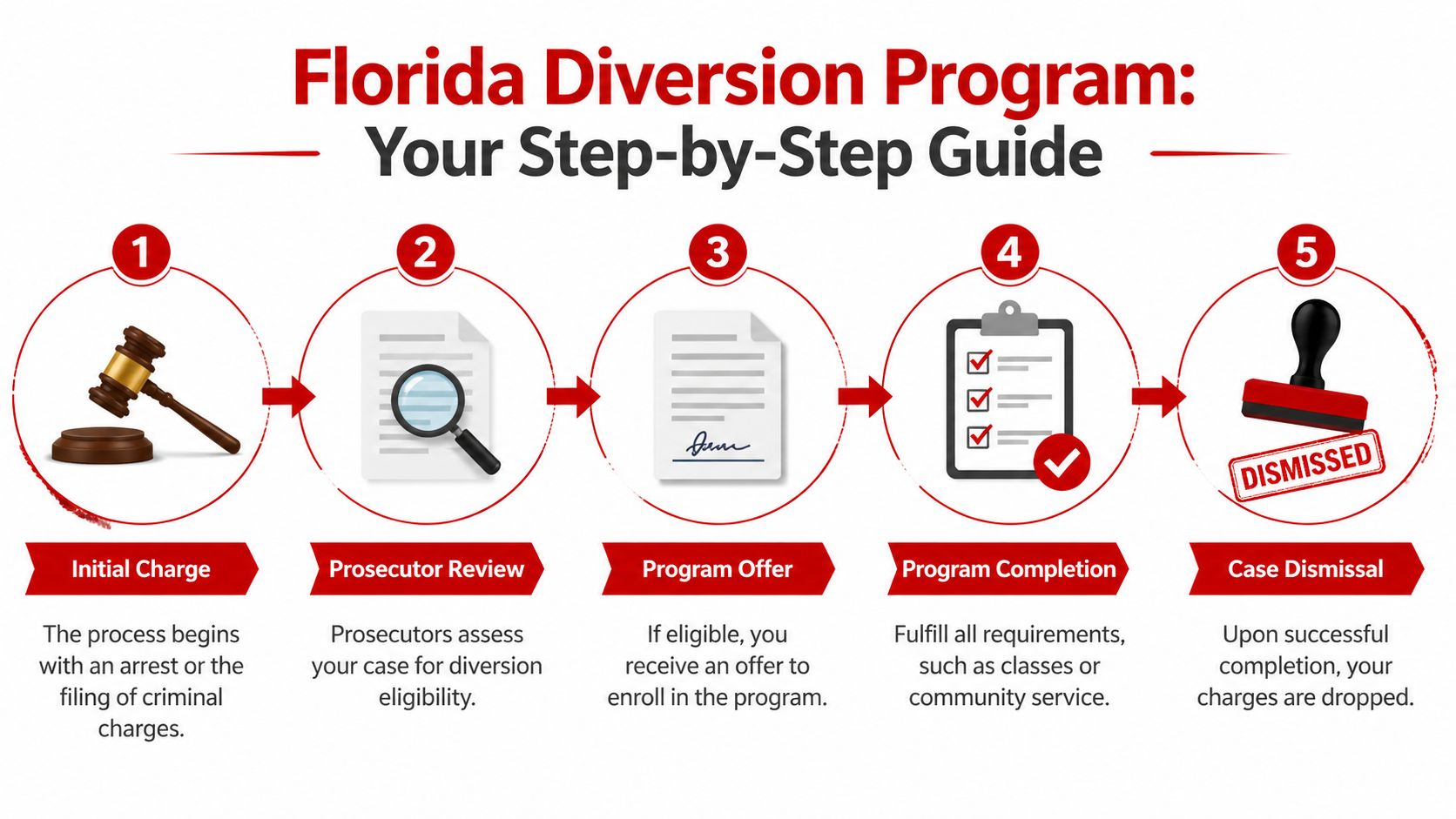
What happens first after the charge
The process starts with an arrest, notice to appear, or formal filing. Your first mistake is waiting to “see what happens.” Florida prosecutors often form early impressions based on the charging documents, driving history, alleged facts, and your background.
Your lawyer should move fast. That usually means collecting the report, identifying weaknesses, preparing mitigation, and contacting the prosecutor before your case hardens into a routine plea offer. If you haven’t even reached arraignment yet, this breakdown of what happens at an arraignment hearing helps you understand where diversion discussions often begin.
Programs generally use a risk-needs assessment to set conditions, and program duration typically caps at 18 months, with a 12-month average in many Florida jurisdictions, according to the Vera Institute’s explanation of how diversion programs work. The same source notes that successful completion rates often exceed 85%, and successful completion leads to dismissal.
Here’s the usual early sequence:
Charge review
The prosecutor looks at the offense, your record, and the facts that make your case harder or easier to divert.Eligibility screening
Some counties screen for criminal history, prior diversions, accident facts, substance issues, and whether the alleged conduct created unusual public safety concerns.Defense presentation
Strong lawyering matters. Your attorney can frame the incident as an isolated lapse instead of a pattern.
How the agreement is built and completed
Once the State is open to diversion, the terms have to be negotiated and documented. That document is not casual paperwork. It is a contract with consequences.
Common steps look like this:
Formal offer issued
The prosecutor proposes the conditions, length, reporting rules, and what happens if you violate.Agreement signed
You accept the terms. From that point forward, deadlines matter. Every class, payment, and reporting date matters.Supervision period begins
You complete the assigned conditions. Depending on the case, that can include classes, counseling, community service, treatment, restitution, or check-ins.Compliance proof submitted
Certificates, receipts, logs, and reports usually have to be turned in correctly and on time.Dismissal request and case closure
After successful completion, the State dismisses the charge.
A diversion program rewards disciplined clients. It punishes disorganized ones.
The danger is simple. People think the hard part was getting accepted. Often, the hard part is staying compliant for months while life keeps happening. Work shifts change. A class provider cancels. Someone forgets to upload a certificate. Then the prosecutor says you violated.
That is why going alone is a gamble.
Who Is Typically Eligible for Diversion in Florida?
Eligibility is never as simple as “first offense equals diversion.” That’s the sales pitch people hear online. Real court practice is narrower.

What prosecutors usually look for
Most programs favor people who look manageable on paper. That often includes someone with little or no record, a non-violent allegation, and facts that don’t suggest a high ongoing risk.
But “usually” is the key word.
In Florida, county-by-county differences can change the answer. One office may care heavily about your lack of priors. Another may care more about whether there was a crash, an injury claim, a bad statement to police, or aggravating facts tied to driving behavior under Chapter 316. Orange County prosecutors may approach a traffic-related misdemeanor differently than Miami-Dade. Broward may require a different mitigation presentation than Hillsborough.
That’s why your lawyer’s job is not just asking, “Is my client eligible?” The better question is, “How do I make this client acceptable to this prosecutor in this courthouse?”
Useful factors often include:
Clean or limited prior history
Less baggage helps. Older, minor history may still be manageable with the right presentation.Stable personal background
Employment, school enrollment, military service, family responsibilities, and treatment progress can matter.Case-specific mitigation
Voluntary counseling, early classes, restitution efforts, or proof of accountability can reshape how the prosecutor sees you.
Why DUI charges are different
Many articles often fall short. They talk about diversion in general terms and skip the hardest issue.
Most diversion programs explicitly exclude DUI offenders, according to the National Criminal Justice Reference Service overview of pretrial diversion programs. That matters directly in Florida because DUI charges under Florida Statute 316.193 often trigger a much harsher prosecutorial response than other first-time offenses.
If you’re facing DUI, don’t assume you can walk into a standard diversion track. In many places, you can’t. Your lawyer may need to fight for an alternative result instead, such as a negotiated reduction, a different rehabilitative path, or another strategy designed to protect your record and driving privileges. For a closer look at that issue, review this guide to a Florida DUI diversion program.
Hard truth: DUI defendants who rely on generic advice usually learn too late that the “program” they were counting on was never actually on the table.
That’s especially dangerous if you drive for work, hold a professional license, or need a clean background for military or security purposes.
What Are the Common Requirements and Conditions?
Once you’re accepted, the program tells you exactly how serious it is. Diversion is structured. It is supervised. It is designed to test whether you follow directions.
What you may be required to do
Federal pretrial diversion programs, which often serve as a model for state systems, rely on a detailed risk assessment to recommend conditions. The Department of Justice explains in its pretrial diversion guidance that supervision averages one year, and successful completion, achieved in over 90% of cases in some districts, results in charge dismissal.
Florida programs often use similar categories of conditions:
Reporting and supervision
You may need to check in with a case manager, probation-style officer, or program administrator. Missed check-ins create immediate problems.Classes or counseling
Alcohol education, substance abuse treatment, anger management, safe driving courses, or other rehabilitative work may be required depending on the charge.Community service
This shows accountability. It also gives the State an easy compliance metric.Financial obligations
Program fees, restitution, class costs, and administrative costs can all be part of the deal.No new arrests
This is often the most important condition. A new charge can destroy the agreement even if the new case is weak or later reduced.
What can go wrong during supervision
Clients often underestimate the administrative side. They assume the program only cares whether they stayed out of trouble. That’s false. The program also cares whether you followed every instruction exactly.
Common failure points include:
Problem | Why it hurts | What you should do |
|---|---|---|
Missed class or counseling session | It signals noncompliance | Reschedule immediately and document the issue |
Late payment or unpaid fee | It can block completion approval | Ask your lawyer to address it before it becomes a violation |
Missing proof of completion | The State may treat completed work as incomplete | Save certificates, receipts, and attendance logs |
New traffic or criminal allegation | It can trigger termination review | Call your lawyer the same day |
Some counties are flexible about minor administrative issues. Others are not. The Orange County Courthouse may handle program compliance differently from what you’d see in Miami-Dade or Broward. That local reality matters more than any generic article.
If you enter diversion, run your life like every deadline matters. Because it does.
What Are the Benefits and Risks of Entering Diversion?
The reason people fight for diversion is simple. The upside is enormous. The risk is also real.

The main benefit is avoiding a conviction
A landmark study of the San Pablo Adult Diversion Project found that diverted participants achieved a 90% case dismissal rate, compared with 6.6% for the control group, according to the National Institute of Justice summary of the pretrial adult diversion study.
That is the primary value of diversion. It is not convenience. It is not just avoiding a court hearing. It is keeping a charge from becoming the conviction that brands your record.
For drivers, that matters because record damage often spreads beyond the courtroom. Employers care. Insurers care. Licensing boards care. Even if you later qualify for a softer disposition, the difference between a dismissal path and a conviction path can define your next several years.
If you’re weighing diversion against another non-conviction-style outcome, you should also understand the difference between dismissal and a court withholding adjudication. This guide on what withheld adjudication means is worth reading before you agree to anything.
The risk is that failure puts you back in the case
Diversion is not free. You pay with time, discipline, money, and attention. If you violate the terms, the State can revive the prosecution and put you back where you started, sometimes with a worse negotiating posture because you already failed a chance at leniency.
The risk analysis is straightforward:
Benefit
You may avoid a conviction entirely.Cost
You may spend months completing conditions that demand real effort.Danger
One bad step can reactivate the case.
That doesn’t mean diversion is a bad deal. In many cases, it’s the right deal. But it has to fit the facts, the county, and your ability to finish what you sign.
The wrong client can fail a good program. The right client can use it to save a career.
That is why you don’t accept diversion just because it sounds better than court. You accept it when it is strategically better than the alternatives.
Why You Need an Attorney to Navigate Diversion Programs
You get offered diversion after an arrest and feel relief for about ten seconds. Then the difficulties begin. The offer in Miami-Dade may look nothing like the offer in Orange County, and a DUI-related charge can knock you out of standard options before you even understand what is on the table.

A lawyer does more than ask for diversion
Diversion is prosecutor discretion. It is also local culture, office policy, screening rules, and timing. If you walk in alone, you are trusting the State to explain your best option to you. That is a mistake.
A defense lawyer handles three pressure points that decide whether diversion helps you or hurts you:
Getting you considered in the first place
Prosecutors do not approve every clean-looking case. They look at the police report, your record, the alleged driving behavior, the county's current policy, and whether your file was presented the right way.Fixing bad terms before you sign
Some agreements are manageable. Some are traps. A vague alcohol condition, a bad reporting rule, or a deadline you cannot realistically meet can set you up to fail. Counsel should push for clear language, reasonable timelines, and conditions tied to your actual case.Protecting you if compliance becomes a fight
Providers make mistakes. Paperwork gets rejected. New allegations can trigger panic from the prosecutor's office. If nobody steps in fast, a temporary problem becomes a revoked deal.
Federal prosecutors have long used pretrial diversion as a screening and rehabilitation tool, as explained in this review of federal pretrial diversion programs. The point for you is simple. Diversion is not charity. It is a negotiated outcome, and negotiated outcomes favor the side that comes prepared.
A consultation should focus on strategy, pressure points, and county-specific practice. If you want to know what a smart first meeting should cover, read this guide on a criminal defense attorney consultation.
County differences can change the whole analysis
Florida does not run diversion like one unified system. Miami-Dade prosecutors may view a traffic-linked misdemeanor one way. Orange County may require different screening, different classes, different deadlines, or a different level of formality before approval. Broward and Hillsborough have their own habits too.
That matters most in close cases.
A lawyer who works in these courts knows whether the issue is eligibility, presentation, timing, the arrest narrative, or a prosecutor's concern about public safety optics. That kind of judgment does not show up on a county website. It shows up after years of dealing with the same offices, the same objections, and the same unwritten rules.
DUI-related charges need extra caution
DUI is where generic diversion advice falls apart. Many standard pretrial diversion programs do not apply to DUI charges under 316.193. Even when someone says a reduced charge or alternate resolution might be possible, that does not mean you should assume diversion is available, wise, or safe for your license.
A DUI-related file can involve criminal exposure, administrative license consequences, alcohol education demands, ignition interlock issues, and factual disputes about driving, impairment, or testing. One wrong move can damage both the court case and the driving privilege side of the case.
You need someone looking at the full board.
If your case involves alleged driving conduct under Chapter 316, especially a DUI arrest or a related reduction discussion, your lawyer should evaluate the county's practices, the prosecutor's likely position, and the collateral damage of every proposed deal before you sign anything.
Direct access to your attorney matters when things go sideways
Diversion cases break down in ordinary ways. A class provider reports the wrong completion date. A background form is incomplete. A prosecutor reads a new citation as a violation. The issue is rarely dramatic at first. It becomes serious because nobody with judgment addresses it quickly.
That is why intake mills and middleman-heavy operations are a bad fit for this kind of case. You need legal advice from your lawyer, not a call center script.
Ticket Shield, PLLC handles traffic, DUI, and related criminal driving cases statewide and allows clients to communicate directly with their attorney by phone or text. That model matters in diversion cases because local deadlines are short, county practices differ, and quick decisions can protect an otherwise solid outcome.
This short video gives added context on why attorney strategy matters in traffic-linked criminal cases:
You are not hiring counsel to fill out forms. You are hiring counsel to protect the deal, your record, and your license before one preventable mistake costs you all three.
Frequently Asked Questions About Florida Diversion Programs
Can a diversion program end early for good behavior
Sometimes, but don’t count on it. The answer depends on the county, the prosecutor, and the written agreement. Some offices want every requirement completed and every month served exactly as written.
What happens to my arrest record after I complete diversion
Completion usually leads to dismissal of the charge, but record issues don’t fix themselves. You should ask your lawyer what additional steps may be available to clean up the record after dismissal.
Do I have to admit guilt to enter diversion
Not always. Many diversion agreements are not the same as a guilty plea. But never assume the paperwork is harmless. Read every term with counsel before you sign.
Do diversion programs vary between counties like Orange, Hillsborough, and Broward
Yes. They vary in availability, screening, required documents, compliance culture, and how flexible prosecutors are with violations. That local difference is one reason generic online advice fails Florida drivers.
Is diversion available for DUI in Florida
Sometimes a client hears “maybe” and mistakes it for “yes.” That is dangerous. DUI-related cases often face extra barriers, and many standard diversion programs exclude them. A lawyer may need to pursue a different path to protect your record and license.
What should I do right now if I think I may qualify
Take these steps immediately:
Hire counsel fast
Early action preserves options.Gather your documents
Citation, bond papers, court date notice, and any proof of classes or treatment.Stay arrest-free One new allegation can wreck your advantage.
Do not contact the prosecutor alone
You can hurt your case trying to help it.
If you’ve been charged in Florida and your goal is No Points, record protection, and a serious strategy for dismissal, contact Ticket Shield, PLLC for a free consultation. Speak directly with a lawyer, get a real assessment of whether diversion is possible, and protect your license before the case gets away from you.