What is a Plea in Abeyance? Florida Law Explained
What is a plea in abeyance? Learn if it applies in Florida, its alternatives, and how our attorneys help protect your driving record.
A plea in abeyance is a deal where the court holds your plea without entering a conviction, then dismisses the charge if you complete conditions. Florida doesn’t use that name statewide, but similar diversion programs can protect your record.
You got a ticket. Maybe it was speeding under Florida Statute § 316.187. Maybe it felt minor when the officer handed it over. It isn’t minor now.
Now you’re searching legal terms late at night, trying to figure out whether “what is a plea in abeyance” has anything to do with your case in Florida. You’re worried about points. Insurance. Work. Court. You might already be imagining yourself standing in front of a judge at the Edgecomb Courthouse in Tampa, trying to explain a bad moment on the road.
That stress is real. So is the confusion.
The problem is that a lot of what you’ll find online explains a legal tool used elsewhere, then leaves Florida drivers with the wrong impression. You need the Florida answer, not the textbook answer. You need to know what helps protect your license and your record in counties like Hillsborough, Miami-Dade, and Broward.
Table of Contents
Your Shield Against a Complicated System
You don’t need more jargon. You need a straight answer.
A plea in abeyance is a legal arrangement where a plea is accepted, but the court holds off on a conviction while the person completes conditions. That concept matters. But in Florida, the name can distract you from the essential issue: whether there’s a path to keep points off your license and damage off your record.
Why Florida drivers get misled
A lot of drivers type in “what is a plea in abeyance” because they’ve heard it from a friend, seen it online, or read a forum post. Then they assume Florida works the same way. It doesn’t.
That mistake costs people opportunity. They focus on the wrong label instead of the right strategy.
Practical rule: Don’t chase a phrase. Chase the outcome. In a Florida traffic case, the outcome you want is simple. No conviction if possible. No points if possible. No insurance fallout if possible.
What actually matters in your case
If you’re dealing with a Florida citation, the key questions are more practical:
Can the charge be challenged
Can the prosecutor be pushed toward a diversion result
Can court appearances be handled for you
Can the final resolution protect your license
Those answers depend on the county, the charge, the facts, and the judge. A speeding case under § 316.187 is not handled the same way as every other moving violation. A case in Miami-Dade won’t always look like a case in Broward or Hillsborough.
That’s why you need precision. Not generic online advice. Not recycled explanations from another state. Florida traffic defense is local, tactical, and time-sensitive.
What Exactly Is a Plea in Abeyance
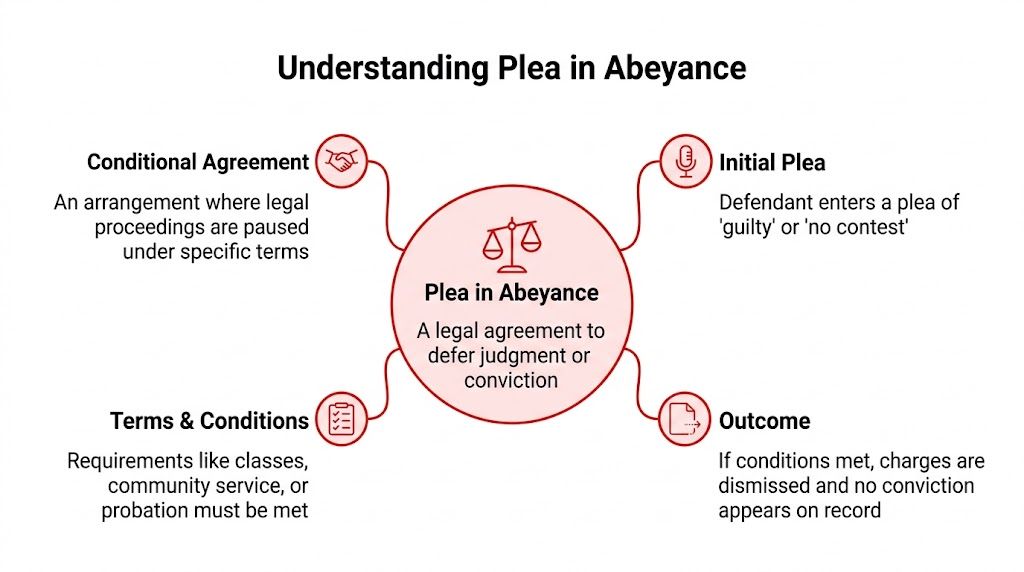
A plea in abeyance is a conditional deal with the court.
You enter a guilty plea or a no contest plea. The court accepts it, but does not enter a conviction right away. Instead, the case sits in a holding pattern while you complete specific terms. Under the legal framework described in Utah Code §77-2a-1(3), that probation-like period is typically 6 to 12 months. If you complete the conditions, the case can be dismissed. If you fail, the original plea can be used to enter a conviction and sentence.
How the basic deal works
Think of it as a probationary contract.
The court says: we will hold off on the conviction, but only if you do exactly what this agreement requires. That may include classes, community service, fines, counseling, or staying out of trouble for the full period.
You’re trading certainty for discipline. If you perform, the charge can go away. If you slip, the protection disappears fast.
Here’s the basic flow:
Step | What happens |
|---|---|
Plea entered | You plead guilty or no contest |
Judgment paused | The court holds the conviction back |
Conditions imposed | You must complete specific terms |
Final outcome | Completion can lead to dismissal. Failure can trigger conviction |
Why the name matters less than the result
Clients often get hung up on whether they need that exact legal term. Usually, they don’t.
They need a resolution that functions the same way. That’s why it helps to understand related outcomes such as withheld adjudication. The names differ. The consequences are what count.
A good legal outcome isn’t defined by the phrase attached to it. It’s defined by what lands on your record when the case is over.
The concept is simple. The execution is not. These agreements can protect you, but only if the terms are realistic and the facts support taking the deal in the first place.
Does This Option Exist for Florida Drivers
Short answer. Not as a uniform statewide Florida statute under that name.
If you were hoping Florida has a formal, statewide plea in abeyance system, that’s the wrong assumption. A background source specifically notes the gap: Florida lacks a uniform statute, which leaves county-specific diversion or deferred options as the practical path.
Florida does not use a uniform statewide plea in abeyance statute
That matters because many drivers waste time searching for a Florida rule that doesn’t exist in that form.
Florida traffic court is driven by local practice. Prosecutor discretion matters. County programs matter. Judicial preferences matter. In some places, options are more flexible. In others, they’re tighter. That’s true whether you’re near the Richard E. Gerstein Justice Building in Miami or the Broward County Judicial Complex in Fort Lauderdale.
So if you ask, “Does Florida have plea in abeyance?” the accurate answer is no, not as a standard named statewide mechanism.
What Florida uses instead
Florida drivers may still have access to results that feel very similar in practice:
Pre-trial diversion
Deferred prosecution
Conditional dismissals
County-specific negotiated resolutions
The exact path depends on the charge and the county.
Here’s the clean comparison.
Feature | Classic Plea in Abeyance | Florida Diversion Programs |
|---|---|---|
Name | Formal plea in abeyance | Usually diversion, deferred prosecution, or similar local program |
Structure | Plea entered, conviction held | Terms negotiated through local court or prosecutor process |
Availability | Defined by that jurisdiction’s rules | Varies by county, office, charge, and judge |
Goal | Dismissal or reduction after compliance | Dismissal or other record-protective outcome after compliance |
Key risk | Violation can trigger conviction | Violation can collapse the deal and restart prosecution leverage |
If you want the Florida version of this discussion in plain English, this breakdown on traffic ticket deferral is a useful companion.
The point is direct. Stop asking whether Florida uses the same vocabulary. Ask whether your county offers a real path to keep the case from ending in a damaging conviction.
How Do Florida's Diversion Programs Protect Your Record
When diversion works, it changes the whole trajectory of the case.
Instead of ending with a conviction that hits your driving record, the case is steered toward dismissal after you complete agreed conditions. A verified source states that deferred plea agreements have posted successful completion rates exceeding 85% in some jurisdictions, and that similar diversion programs in Florida can dismiss 70-80% of eligible citations, preventing points and insurance hikes, according to the Utah Courts reference used for this comparison.
What your lawyer is actually trying to negotiate
This isn’t magic. It’s negotiation.
A lawyer’s job is to push for a structure that protects your record while staying realistic about what the court and prosecutor will accept. In traffic-related cases, that often means some combination of:
Traffic school
Court costs or program fees
A compliance period with no new violations
Community service or other specific conditions
The target outcome is often a dismissal mechanism rather than a conviction-based closeout. In practice, that can mean the prosecutor abandons the charge after successful completion.
When a case ends in dismissal instead of conviction, that difference follows you far beyond court day.
For some drivers, especially those balancing work reputation and public visibility, legal cleanup overlaps with broader concerns about digital presence. That’s why some people also look at effective record management strategies after the legal piece is resolved.
Why completion matters more than the label
The label on the program matters less than the final paperwork.
If the deal is completed, your lawyer is trying to secure the cleanest available ending under local procedure. That provides the protection. Not a catchy term. Not a website phrase. A concrete file result.
A few hard truths:
Not every case qualifies. Serious allegations, bad driving history, or aggravating facts can limit options.
Terms must be followed exactly. Miss a requirement and your advantage can evaporate.
DUI is its own category. If your case touches alcohol or impairment issues, you need analysis specific to that charge. This overview of a Florida DUI diversion program explains why the strategy changes.
Diversion protects your record by replacing a damaging end with a controlled one. But it only works if the agreement is well negotiated and fully completed.
What Are the Strategic Pros and Cons You Must Weigh
Diversion is not automatically the right move.
Sometimes it’s smart. Sometimes fighting the charge outright is better. The decision turns on the evidence, the judge, the county, and your risk tolerance.
When the deal helps
The upside is obvious. If the program is well structured and you complete it, you may avoid the most painful consequences of a traffic conviction.
That can mean:
No points
No conviction
Less risk to insurance
Less disruption to work and licensing concerns
For a busy professional, commercial driver, rideshare driver, or service member, that result can be far more valuable than “winning” an argument that still leaves risk on the table.
When the deal can hurt you
The downside is discipline and a weakened negotiating position.
You may give up the chance to press for a not guilty outcome at trial. You may also be stepping into a compliance system that expects precision. A verified source explains the danger clearly: even minor new violations can trigger a show-cause hearing, and up to 25% of agreements are revoked in some monitored cases for substantial non-compliance.
That’s not abstract. It means a small mistake can revive a case you thought was contained.
Question | If the answer is yes | Why it matters |
|---|---|---|
Is the evidence weak | Consider fighting harder | You may not need the deal |
Is the outcome risk high | Diversion may be safer | It reduces exposure if available |
Can you follow every condition | Then diversion is realistic | Compliance is everything |
Are you likely to pick up another ticket soon | Be careful | One new problem can wreck the agreement |
If you’re tempted to just admit guilt and move on, stop and read this plain-language discussion of what happens if you plead guilty. That decision closes doors fast.
A strategic deal is only good if the terms fit your life and your lawyer has already tested the strength of the state’s case.
How Does This Court Outcome Affect Your License, Insurance, and Future
Traffic court doesn’t stay in traffic court.
It follows you into your insurance file, your job applications, your professional reputation, and sometimes your ability to drive for work at all. That’s why the difference between a conviction and a dismissal is so serious.

Two very different paths
A conviction can trigger points and create long-term problems. A dismissal can cut that off before it spreads.
If you rely on driving for your income, the threat is bigger. Delivery drivers, rideshare drivers, and other professionals don’t just worry about fines. They worry about account status, internal company reviews, and whether one bad court result starts a chain reaction.
If you’re trying to understand the long view, this guide on how long traffic tickets stay on record helps frame the problem.
Dismissed is better than convicted, but records still matter
Dismissal is stronger than conviction. But dismissal doesn’t always mean invisibility.
A verified source explains that the initial charge and plea may remain on public records until formal expungement, and such records can appear in over 70% of employment background checks according to this discussion of plea in abeyance record effects.
That distinction matters.
Convicted is worse.
Dismissed is better.
Expunged may still matter for full cleanup where available.
If your career depends on clean screenings, security-sensitive work, or public trust, you can’t afford to treat those as the same result. They are not.
What Immediate Steps Should You Take After a Charge
Act quickly. Small mistakes at the start of a case create bigger problems later.

Don’t just pay the ticket. In many situations, paying closes the case as an admission and strips away options you may have had to challenge it or negotiate a cleaner result.
Save every document now. Keep the citation, court notice, bond paperwork, and anything the officer gave you. Screenshot relevant texts, app logs, GPS data, work dispatches, and timeline details while they’re fresh.
Write down what happened. Do it today. Road conditions, weather, traffic flow, signs, officer statements, where you were pulled over, and anything said during the stop. Memory fades fast.
Do not discuss the case casually. Don’t argue about it online. Don’t explain it to coworkers. Don’t hand the prosecutor extra facts through carelessness.
Check the deadline on the citation. Missing a response date can turn a manageable ticket into a procedural mess.
Talk to a Florida traffic defense lawyer before choosing a plea. That’s the move that protects everything else.
The first bad decision in a traffic case is usually made before anyone steps into court.
Why You Need a Lawyer, Not an App, for These Negotiations
Diversion deals are negotiated by people. Not software.
An automated app can intake a ticket. It can send reminders. It can move volume. What it can’t do is exercise legal judgment in the moments that matter. It can’t read the prosecutor’s posture in a local courtroom. It can’t argue for a specific condition set that fits your facts. It can’t text you directly when the deal on the table has hidden risk.
Negotiation is not automation
A traffic diversion result depends on strategy.
Sometimes the right move is to push for dismissal terms. Sometimes it’s better to reject the offer and attack the case. Sometimes the prosecutor’s first position is weak and should be challenged. Sometimes the judge’s local practice changes the whole calculation.
That’s not a workflow problem. It’s lawyering.
If you want a broader consumer-side view of what people value in representation, this article on the top qualities clients look for in an attorney is worth reading. The themes are simple. Responsiveness matters. Trust matters. Judgment matters.
Direct attorney access changes outcomes
You should be able to ask hard questions and get a real answer from a lawyer.
Will this program keep points off my license
What happens if the prosecutor won’t offer diversion
Should we fight this stop instead
What if I travel for work and can’t appear
What if I get another citation during the compliance period
A chatbot can’t protect you from a bad legal decision. A middleman can’t negotiate credibility. A volume-based ticket operation may process your file without building a real county-specific strategy.
When your record is on the line, you want legal advice from the person responsible for the result.
Frequently Asked Questions About Florida Traffic Diversion
Can every ticket qualify
No. Eligibility depends on the charge, the county, the facts, and your history.
Some cases are stronger candidates than others. Higher-risk driving allegations or more serious fact patterns may shrink the available options. The right first question isn’t “Is diversion automatic?” It’s “What’s realistic in this courthouse with these facts?”
Will you have to go to court
Often, a lawyer can handle much of the process for you in routine traffic matters. That’s one reason representation matters. It reduces disruption and keeps you from saying the wrong thing in court.
Still, some cases require appearances. You should never assume you’re excused until your lawyer confirms it.
What do these programs usually require
Requirements vary, but they commonly involve compliance-based conditions such as school, fees, service, or a period without new violations.
The exact package should be negotiated with your life in mind. A deal you can’t realistically complete is a bad deal.
What happens if you get another ticket during the program
That can become a serious problem fast.
A new violation may lead the court or prosecutor to say you failed the agreement. Once that happens, the protection you thought you had can disappear, and your position may be weaker than it was at the start.
Common question | Short answer |
|---|---|
Is Florida’s system called plea in abeyance | No, not as a uniform statewide statute |
Are there similar alternatives | Yes, in the form of local diversion or deferred resolutions |
Is compliance strict | Yes |
Should you decide alone | No |
If you’re searching “what is a plea in abeyance,” the Florida answer is this: the label isn’t the point. The point is securing the cleanest available outcome before a traffic charge damages your license, insurance, and future.
If you want a lawyer-led defense focused on the No Points goal, contact Ticket Shield, PLLC for a free consultation. You’ll speak directly with your attorney by phone or text. Not a chatbot. Not a middleman. Visit TicketShield.com now.