Florida Speeding Fines Guide to Avoid Points and High Costs
Explore Florida speeding fines, points, insurance impacts, and defense. See how TicketShield.com can help you lower costs and keep your license clean.

You're probably reading this with a citation on your passenger seat, a court deadline approaching, and one bad thought running in circles: “Should I just pay it and move on?”
That's exactly how drivers get burned.
A Florida speeding ticket isn't just a fine. It can trigger points, push you toward suspension, inflate the total cost once county fees are added, and in extreme cases turn into a criminal problem instead of a routine traffic matter. Drivers who move fast and click “pay” online often give up defenses they never knew they had. If you need a quick primer on the immediate process after a citation, review what happens when you get a speeding ticket.
Table of Contents
Florida Speeding Fines Overview
You get stopped on I-95, Florida's traffic is moving fast, and the officer says you were over the limit. You assume this will be a fixed amount, something simple, something you can handle in two minutes online. That assumption is where trouble starts.
Florida ties speeding penalties to both how fast you were going and where the stop happened. The base fine comes from Florida Statute §318.18, while the legal speed framework comes from Chapter 316, including §316.187, which caps speed limits on limited access highways at 70 miles per hour and other qualifying divided highways outside urban areas at 65 miles per hour under the statute itself, not driver folklore or guesswork, as set out in Florida Statute §316.187.
A key problem is that the base fine is often not the number you pay. Counties add local costs and surcharges. That means two drivers with the same speed in different counties can face different totals. One county may be manageable. Another may sting enough to make “just pay it” a costly mistake.
Practical rule: Never evaluate Florida speeding fines by the statute alone. You need the county total, the point exposure, and the defense value before you decide anything.
The stakes rise fast if you drive for work, hold a clearance, commute long distances, or already have prior points. And if the allegation involves extreme speed, the issue may no longer be a normal civil citation at all. That's where lawyer-led defense matters. Not an automated app. Not a ticket mill with layers of intake staff. You need direct legal analysis from someone who knows how Florida courts and Florida traffic enforcement work.
Breaking Down Florida Speeding Fines by MPH and Zones
The legal speed cap matters
Before you even get to fines, know the legal ceiling. Under Florida Statute §316.187(2)(a), limited access highways are capped at 70 miles per hour, and certain other divided highways outside urban areas are capped at 65 miles per hour under state law, as provided in the Florida speed limit statute. If you were driving above that cap, the officer starts with a clean statutory footing.
That matters because many drivers defend these tickets emotionally. “Everyone was going that speed.” “Traffic was flowing.” “I was keeping up.” None of that changes the statute.
Florida speeding fine structure
Florida doesn't use a gentle progression. The fines jump in tiers. Under Florida Statute §318.18(b), the base schedule is set out in Chapter 318 of the Florida Statutes.
MPH Over Limit | Base Fine | School Zone Fine |
|---|---|---|
6–9 mph | $25 | $50 |
10–14 mph | $100 | $200 |
15–19 mph | $150 | $300 |
20–29 mph | $175 | $350 |
30+ mph | $250 | $500 |
Those are base fines. In school zones and construction zones, the base is doubled. That single fact changes the entire risk analysis if the stop happened near a school or inside an active work zone. If you want a county-by-county breakdown of common totals, review how much is a speeding ticket in Florida.
Why one mph can cost you far more
Florida's structure punishes threshold crossings. The sharpest example is this: under the statute, 6 to 9 mph over is $25, but 10 to 14 mph over is $100, a 400% increase when you cross that threshold by a single mile per hour, according to §318.18.
That's why defense strategy often focuses on the exact speed reading, not just guilt or innocence in the broad sense. If the measurement can be challenged, or the officer's evidence leaves room to negotiate the stated speed, moving a case into a lower bracket can materially change the outcome.
A few points matter here:
The first tier starts at 6 mph over: Below that, many drivers expect a warning, but you shouldn't rely on officer discretion.
The 10 mph line is expensive: Crossing it changes the base fine dramatically.
The zone matters as much as the speed: School and construction zones double the base number before county costs enter the picture.
The county still has the last financial word: The table above is only the statutory starting point.
If your citation sits right on a threshold, don't plead out before someone reviews the speed proof and the charging details.
Impact on License and Points Under Florida Law

The point system is brutally simple
Florida uses a binary point structure for speeding. That simplicity is exactly why drivers misjudge the risk. Under Florida's speeding point rules, 14 mph or less over the limit adds 3 points, while 15 mph or more adds 4 points, and 12 points within 12 months triggers a suspension, as summarized in Florida speeding ticket point rules.
That means the 15 mph threshold matters more than most drivers realize. It isn't just another mile per hour. It increases the point penalty and brings you closer to a suspension much faster. If you already have points, or you drive full time for Uber, Lyft, DoorDash, or another platform, that extra point can become the difference between working and sitting still. For a closer look at how these violations hit your record, see Florida speeding ticket points explained.
Extreme speed brings a different level of risk
There's another category drivers can't afford to misunderstand. Under §316.1922, Florida treats dangerous excessive speeding differently. The rule applies to conduct involving 50+ mph over the limit or speed at 100+ mph, and the penalties include a $500 fine for a first offense, possible imprisonment, and revocation consequences for repeat offenses, as reflected in Florida's uniform traffic citation penalty materials.
That's not a “high-end speeding ticket.” That's a category with far more serious exposure.
Key point: Drivers often focus on the fine and ignore the license. The license is usually the bigger issue.
If your livelihood depends on a clean record, don't treat a point-bearing citation like parking enforcement. Florida's point system is designed to stack. Once points accumulate, your options narrow and your advantage lessens.
Insurance Costs and Financial Strategy
The expensive part of a speeding ticket often starts after you pay it.
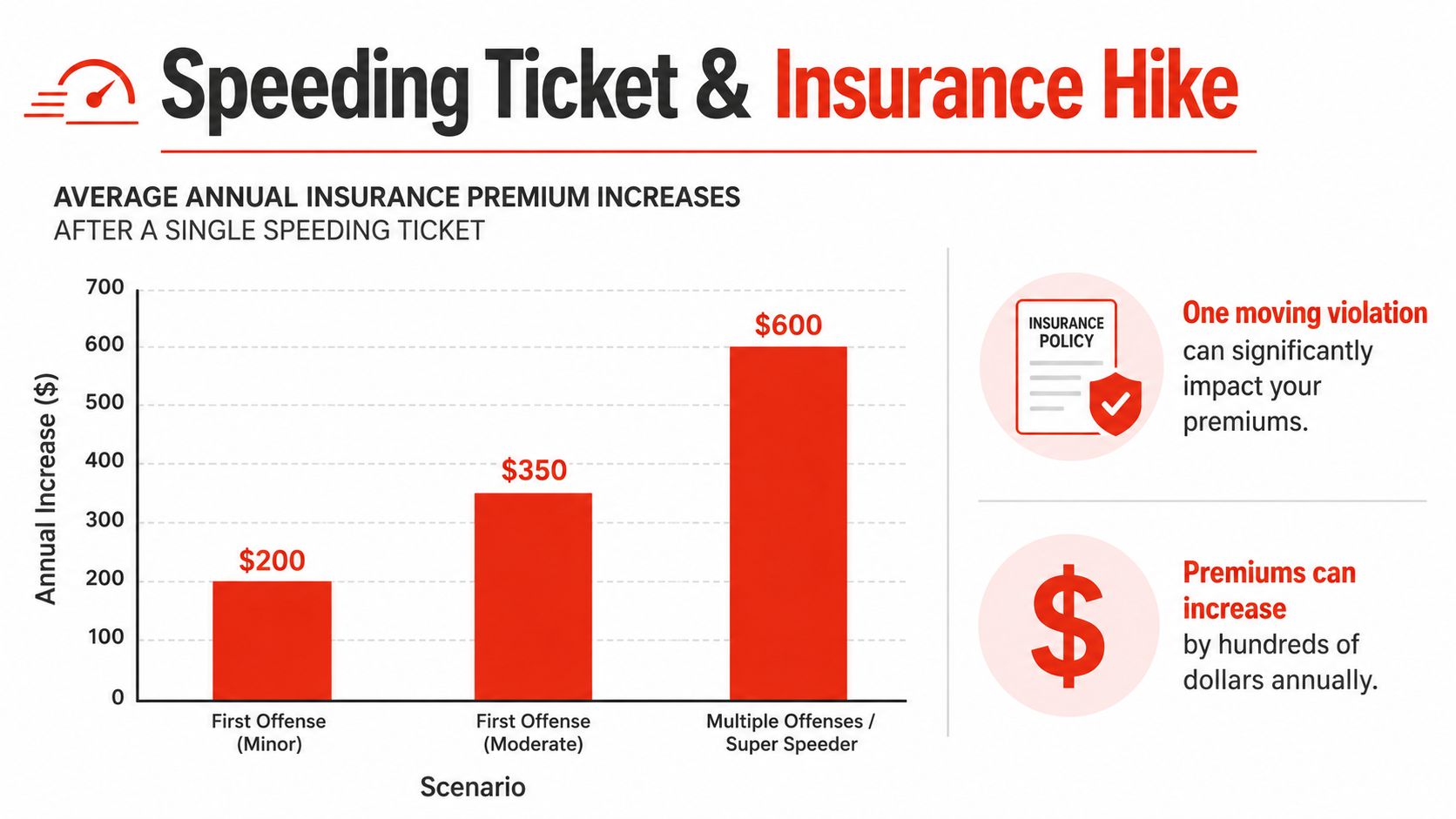
Paying the ticket is rarely the lowest-cost move
The county total can already be much higher than the statutory base. Verified Florida data shows county surcharges, school or construction multipliers, and local fees can push standard-road totals in places like Miami-Dade or Hillsborough into the $274 to $281 range, and enhanced zones can reach $449+ before additional local add-ons, as discussed in Florida's treatment of speeding fines and local surcharges.
Then insurance enters the picture. I'm not going to invent premium numbers for you, and you shouldn't trust anyone who does without a real source. The practical point is simpler. Insurers don't see “I just paid it and moved on.” They see a moving violation.
If you're reviewing your coverage after a citation, it helps to get Wispra's car insurance tips and compare policy structure before your next renewal. That won't erase a ticket, but it can help you make smarter decisions when the record impact hits your premium.
A lot of drivers also want a plain-language breakdown of likely premium consequences after a citation. This guide on the cost of insurance increase after a Florida speeding ticket is a useful starting point.
Use the BDI option carefully and on time
Florida gives some drivers a strategic tool. Taking a Basic Driver Improvement course within 30 days can reduce fines by up to 18% and remove points, according to Florida's traffic fine provisions.
That matters for drivers whose work depends on a clean record. Delivery drivers and rideshare drivers often don't have room for a point hit.
Here's the catch. BDI isn't a universal answer. It may help in some cases. In others, fighting the ticket makes more sense than using your election on a case that could have been reduced or dismissed.
Here's a quick video that addresses the financial side of these cases:
Think beyond the fine
Your financial strategy should answer three questions:
Will paying this create points?
Is BDI the right use of your election?
Is the county total high enough that a defense is the more cost-effective move?
This is the section where a practical service can help. Ticket Shield, PLLC handles Florida traffic defense statewide and lets clients communicate directly with their attorney by phone or text, which is a very different model from automated apps or ticket mills that route drivers through non-lawyer intake layers.
Common Defenses and How to Contest Your Ticket
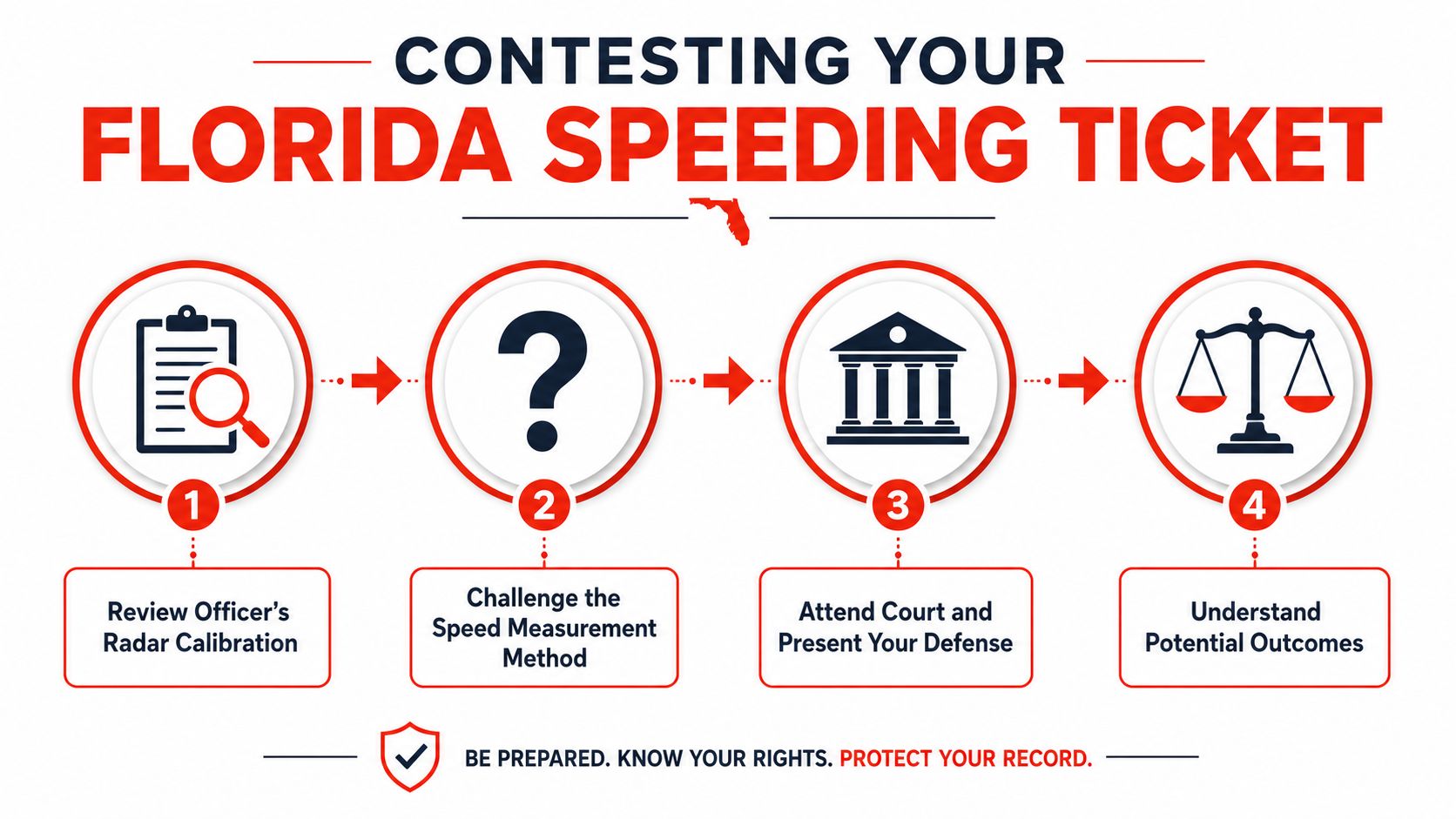
Start with the officer's proof
A speeding case stands or falls on proof. Under Florida traffic court materials, the officer must establish four specific elements to support an unlawful speed citation: an established speed zone, you operating the vehicle, excessive speed, and the reliability of the speed determination device. The officer also must have completed proper training and be able to establish the device's accuracy, as reflected in Florida traffic court training materials on civil infractions.
That gives you a real roadmap for contesting the ticket.
Start here:
Get the citation and review every line. Look for the exact speed alleged, the location, the statute cited, and whether the zone description makes sense.
Preserve your own evidence early. Photos of signage, lane layout, sight lines, and road conditions can matter.
Request the proof behind the speed reading. If radar or laser was used, calibration and operator training become important.
Check whether the stop location matches the zone. A weak zone foundation can damage the state's case.
If you want a broader defense overview, review how to beat a speeding ticket.
Attack the right issue, not the wrong one
Drivers often focus on excuses that don't move judges. “I was late.” “Traffic was flowing.” “I didn't think it was a big deal.” None of that attacks the legal proof.
What does matter is whether the government can prove its case cleanly.
Measurement reliability: Was the device shown to be accurate and properly used?
Training foundation: Was the officer qualified to rely on that device?
Speed zone validity: Was there an established, supportable zone?
Charging precision: Does the alleged speed place you exactly on a harmful threshold that should be tested, not conceded?
You don't beat a speeding ticket by explaining your morning. You beat it by forcing the state to prove every required element.
Some cases are also resolved through negotiation rather than trial. That can mean reducing the stated speed, protecting against points, or resolving the matter in a way that avoids the worst collateral damage. Strategy depends on the county, the judge, the officer's paperwork, and your record.
When the ticket crosses into criminal territory
Beginning July 1, 2025, House Bill 351 changes the stakes for extreme-speed cases. The law criminalizes dangerous excessive speeding involving 50+ mph over the limit or 100+ mph total when it threatens safety, making it a misdemeanor punishable by up to 30 days in jail, with mandatory revocation consequences for repeat offenses, according to the Florida Senate bill analysis for House Bill 351.
That means some drivers who think they're dealing with a payable citation are walking into a criminal case instead.
If your speed allegation is anywhere near that level, act immediately. Don't assume you can pay online. Don't wait for the situation to fix itself. Don't trust a chatbot to distinguish between a civil ticket and a misdemeanor exposure.
County Differences and Local Fee Variances

The state sets the base and counties raise the total
A lot of online guides fail drivers. They quote the state base fine and stop there. That's incomplete.
Verified Florida data shows a 20 to 29 mph violation can total $250 in Miami-Dade, while the same bracket can cost $294 in another county under local fee structures, based on the statutory framework and county add-ons described in Florida's speeding fine statute and related fee discussion. In Palm Beach County, a 10 to 14 mph violation rises from a $100 statutory base to $206, a 40% increase over the state fine alone under that same statutory framework.
That difference is not trivial. It changes how you evaluate settlement, school election, and whether contesting the case makes financial sense.
Why local practice affects defense strategy
Counties don't just differ in totals. They differ in practice. Court administration, scheduling, and local resolution patterns can affect how a case should be handled. That's why a statewide, one-size-fits-all answer is weak advice.
County math matters. A citation that looks manageable on paper can become a much heavier obligation once local costs are added.
When you're evaluating Florida speeding fines, always ask two separate questions. What is the statutory base? What is the actual county total? If you only ask the first question, you're not making a legal decision. You're guessing.
Frequently Asked Questions and Next Steps
Can you waive a court appearance
Sometimes, yes. Sometimes, no. It depends on the charge level and the county's process. Routine civil speeding matters are often handled without you personally appearing, but that should never be assumed in an extreme-speed case or any case with criminal exposure. Confirm the requirement before the deadline passes.
Can you ask for a continuance
Yes, but timing matters and local procedure matters. A continuance request isn't a magic reset button. If you need more time to gather records, secure counsel, or address a scheduling conflict, make that move early and properly. Waiting until the last minute is how drivers lose options.
When does a plea bargain make sense
A negotiated resolution makes sense when it protects what matters most. For most drivers, that means No Points. If a negotiated outcome can reduce the speed bracket, avoid points, or control the financial fallout better than a risky hearing, it may be the right call. If the state's proof is weak, fighting may be stronger than pleading.
You should also keep one principle in front of you. Automated apps and ticket mills are built for volume. Your license is not a volume problem. It's your record, your insurance, your work, and in some cases your clearance or commercial future. You need direct access to the lawyer handling the case, not a chain of middlemen.
If you've been cited, don't pay first and ask questions later. Visit Ticket Shield, PLLC now for a free consultation and fight for the result that matters most: No Points on your license.