How to Beat a Speeding Ticket in Florida
How to beat a speeding ticket - Learn how to beat a speeding ticket in Florida. Get a lawyer-led playbook for strategic defenses, court navigation, and why

You saw the lights. Your stomach dropped. The officer handed you a citation, and now you're staring at a decision that feels small but isn't.
A Florida speeding ticket is not just a fine. If you pay it, you're usually closing the case by admitting guilt. That can affect your driving record, your insurance, and, for some drivers, your job. If you drive for Uber, Lyft, or delivery apps, or if you need a clean record for military-related work, this choice matters even more.
Florida speeding cases under Florida Statute 316.187 should be handled strategically. You need to think about evidence, procedure, and record protection immediately.
Table of Contents
Just Got a Florida Speeding Ticket? What Should You Do First?
What Are the Most Common Legal Defenses to a Speeding Ticket?
Just Got a Florida Speeding Ticket? What Should You Do First?
You are back in your car, the officer has walked away, and the ticket is in your hand. The first mistake happens in the next ten minutes. You pay it online, call it done, and accidentally hand the state a conviction.
Do not pay the ticket until you understand the consequences. In Florida, payment usually means a guilty plea. That can put points on your license, trigger insurance problems, and leave a record that follows you long after the fine is gone.
Under Florida Statute 316.187, the charge is about speed, but your real problem is what a conviction can do to your driving record. For a commuter, that may mean higher premiums. For a gig worker, it can put platform eligibility at risk. For military personnel, especially those dealing with base access, security requirements, or command scrutiny, a simple traffic conviction can create avoidable headaches.

That is why your first decision matters more than the stop itself.
Why paying the ticket is usually the wrong first move
Paying the fine feels efficient. It is often the most damaging option.
A guilty plea closes off defenses before anyone examines the officer's observations, the speed measurement method, the wording of the citation, or whether the case can be resolved without points. Florida drivers lose good outcomes every day because they treat a speeding ticket like a bill instead of a record case.
Practical rule: Treat the ticket as a threat to your record, income, and insurance. Not as a small expense.
That warning is even more important if you drive for work. Uber and Lyft drivers, delivery drivers, field technicians, and CDL-adjacent workers often focus on the fine and miss the larger cost. The same goes for service members and military families who need to keep administrative problems off their plate. A quick payment can create weeks or months of fallout.
Traffic court also moves fast. At places like Miami's Richard E. Gerstein Justice Building, unprepared drivers often make permanent choices before they understand what could have been challenged or reduced.
What you should do instead
Freeze the impulse to pay. Check the response deadline on the citation. Save a clear copy of the ticket. Then get case-specific guidance before you make any election that cannot be undone.
If you want a starting point, read this guide on what to do when you get a ticket in Florida. Then make your next move based on record protection, not convenience.
One more warning. Avoid ticket mills, non-lawyer intake funnels, and app-style services that turn your case into a form submission. Speeding cases are won on details, timing, and judgment. You want a lawyer looking for a no-points result, not a system built to process volume.
What Immediate Steps Should You Take at the Scene?
Right after the stop, your job is not to argue. Your job is to protect the record.
That starts with what you say, what you don't say, and what evidence you keep before it disappears.

What should you say to the officer
Be polite. Be calm. Be brief.
Don't try to explain your speed. Don't guess. Don't volunteer statements like "I was only keeping up with traffic" or "I know I was going a little fast." Those comments can become the prosecution's favorite part of the file.
Use this standard approach:
Provide the required documents: Hand over your license, registration, and proof of insurance when asked.
Stay respectful: Keep your tone neutral and cooperative.
Avoid roadside arguments: The shoulder of the road is not where you win the case.
Don't admit speed: If asked questions designed to get an admission, keep your answers short and noncommittal.
Sign if required: Signing the citation generally acknowledges receipt, not guilt. If you're unsure, review whether you have to sign traffic tickets in Florida.
Say less than you want to. Most drivers talk themselves into trouble before they ever reach court.
What evidence should you preserve right away
The strongest speeding defenses often begin with small facts gathered early. If you wait, those details fade. Video gets overwritten. Weather changes. Your memory softens.
As soon as it's safe, document the stop:
Record the exact location: Note cross streets, mile markers, landmarks, and lane position.
Capture conditions: Write down weather, lighting, traffic density, and road surface conditions.
Photograph visibility issues: If signs were obscured or the officer's position limited observation, document that.
Save dashcam footage immediately: Export it before your device overwrites the file.
Note what the officer said: Radar, laser, pacing, or visual estimate. That detail matters later.
List witnesses: If a passenger saw the stop or road conditions clearly, keep their contact information.
Short notes made that day carry more weight than a vague recollection weeks later.
Here's a quick visual overview that reinforces the importance of preserving facts early:
What should you avoid after the stop
Drivers make a second wave of mistakes after they leave. They throw the ticket in a console. They miss deadlines. They post about the stop online. They assume the case is too minor to fight.
Don't do that.
A better response looks like this:
Move | Why it matters |
|---|---|
Read the ticket carefully | Errors and deadlines matter immediately |
Store all photos and video | Evidence disappears fast |
Avoid discussing the facts casually | Loose statements can undermine your defense |
Act before the deadline | Waiting limits your options |
If you want to know how to beat a speeding ticket, start here. Preserve facts early, avoid admissions, and keep every option open.
What Are the Most Common Legal Defenses to a Speeding Ticket?
Most speeding cases are not won with speeches. They're won with specifics.
At the Broward County Judicial Complex in Fort Lauderdale, the cases that hold up best are the ones built on evidence problems, ticket defects, and proof issues. That's where a real defense begins.
Can faulty radar or lidar evidence be challenged
Yes. Often.
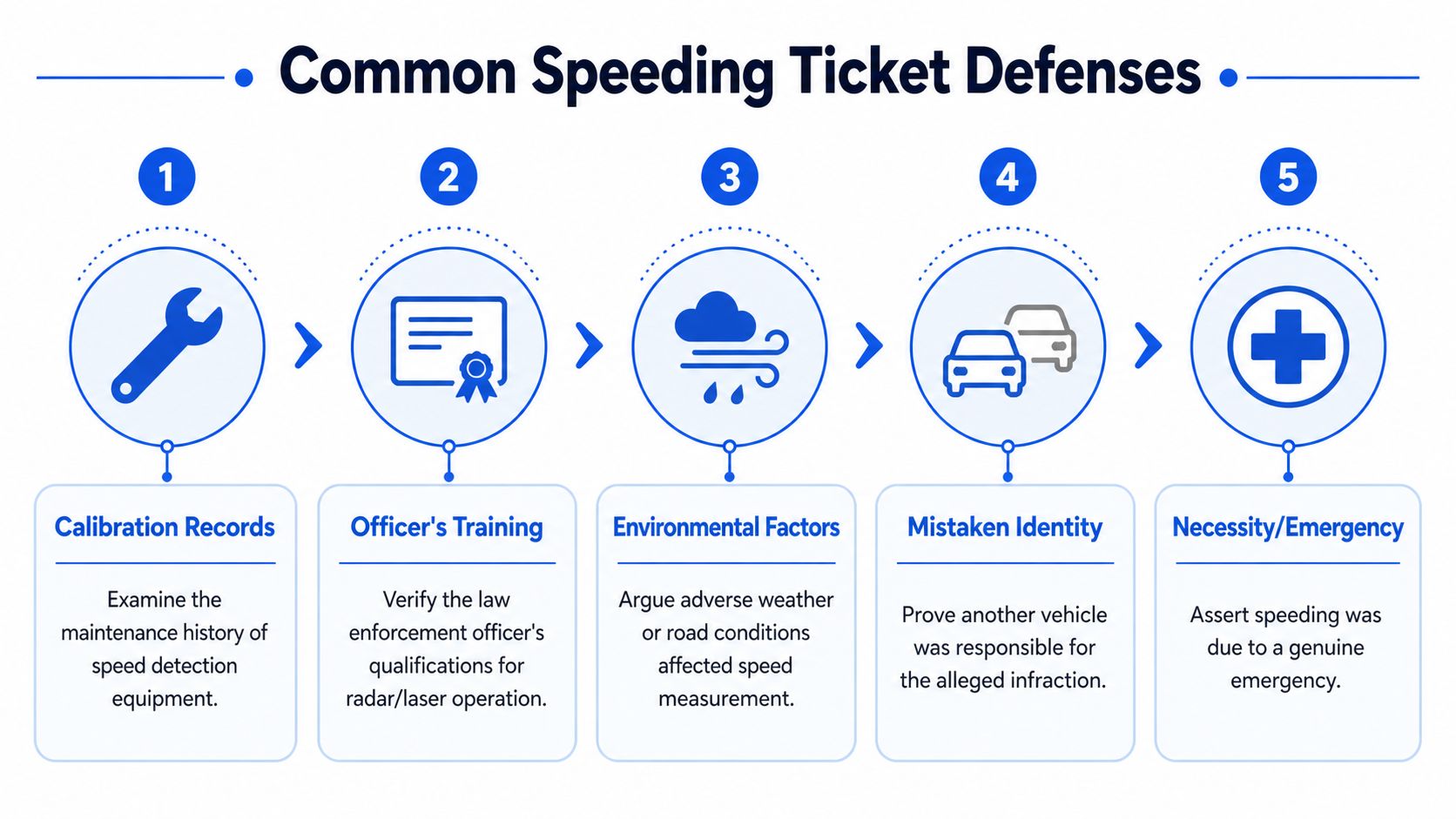
One of the most effective ways to fight a speeding ticket is to force the state to prove that its speed-reading equipment was properly maintained, calibrated, and used by a properly trained officer. According to the Tucson.com report on contested speeding tickets and calibration challenges, challenging equipment calibration and ticket errors leads to dismissals in 20% to 40% of contested speeding tickets, radar and lidar devices require calibration every 6 to 12 months, and courts dismiss 28% of cases when prosecutors can't produce those records. The same report notes a 1987 Florida Supreme Court ruling establishing that uncalibrated radar citations are inadmissible.
That is not a technicality. That is evidence law doing its job.
A proper review often includes:
Calibration records: Was the device tested and maintained as required?
Officer training proof: Was the officer qualified to operate the equipment?
Method of measurement: Radar, lidar, pacing, or visual estimate each creates different defense issues.
Use conditions: Heavy traffic, weather, angle, and surrounding vehicles can affect reliability.
If you want a plain-English breakdown of the technology, read how radar speed guns work in traffic cases.
Equipment evidence is only strong when the paperwork behind it is strong.
Can mistakes on the ticket help your case
Yes, if the mistake matters.
Clerical errors are common. Wrong vehicle information, a flawed location, or a bad date can damage the reliability of the citation and the state's proof. Some errors are harmless. Some open the door to dismissal or favorable negotiation.
What matters is context. A typo that doesn't affect identification may not move the case. But a wrong vehicle description combined with weak officer notes and poor memory can become a serious credibility problem.
Look closely at:
Vehicle make, model, and tag information
Date and time of the alleged violation
Location details
Statute cited
Officer notes, if available through discovery
When do surrounding conditions matter
More than drivers think.
Environmental conditions can support a defense when they call the officer's observations into question or help explain the reading. Heavy traffic can create identification issues. Rain and road glare can affect visibility. Obstructed signs or lane congestion can matter depending on the facts.
Necessity arguments also come up, but they require proof. If there was a genuine emergency, you need evidence, not a story built after the fact.
A smart defense usually combines several points instead of relying on one. Equipment records. Ticket review. Scene conditions. Witnesses. Video. That is how weak cases start to break apart.
How to Use the Florida Court System Strategically
You get stopped on Dale Mabry, take the ticket, and by that night you are ready to pay it online just to make it disappear. That is where drivers hurt themselves. The first court decision is not about convenience. It is about whether you hand the state a conviction without forcing it to prove the case.
In Tampa, cases at the Edgecomb Courthouse often turn on deadlines, preparation, and local practice. If you plead guilty too fast, you give up room to challenge the evidence, negotiate a reduction, or protect your record from points.
Why a not guilty plea gives you better options
A not guilty plea keeps every defense tool available.
It gives you time to review the charge, demand the state's evidence, and decide whether the case should be challenged at hearing or resolved through negotiation. It also stops you from locking in a conviction before anyone has examined the officer's file.
That matters more than drivers realize. Gig workers can lose platform access over a record issue that looked cheap to resolve. Military personnel and drivers in security-sensitive jobs can face questions that have nothing to do with the amount of the fine.
How discovery, timing, and court settings can affect the result
Discovery is where the case starts to show its weak points. You can seek the citation, officer notes, speed measurement records, and other materials the state plans to rely on. Once you have the file, you can compare what is written now with what the officer will need to say under oath later.
Timing matters too.
A continuance is not a trick. It is a legal tool that can help when the defense needs records, when the state's file is incomplete, or when a hearing date creates avoidable risk. Used correctly, scheduling decisions can improve your position. Used carelessly, they waste time and annoy the court. The point is to use procedure on purpose.
A smart court approach usually includes:
Entering a not guilty plea before the deadline to preserve your right to fight.
Requesting discovery so you can review the state's proof before the hearing.
Checking the file for gaps or inconsistencies in the citation, officer notes, and speed measurement records.
Using continuances only when they help the defense and fit the court's rules.
Preparing for negotiation and hearing at the same time so you are not cornered into a bad plea.
If you are weighing whether that process is worth paying for, review what a Florida traffic lawyer typically costs.
What a negotiated result can really protect
A good result in traffic court is often a reduced charge, not a trial verdict.
The goal is to protect the record. A reduction to a non-moving violation can keep points off your license and limit the damage that follows a speeding conviction. That is the issue many drivers miss when they focus only on the fine.
For app-based drivers, points can threaten income. For military members, commercial drivers, and people whose jobs depend on a clean record, a quick guilty plea can create problems long after the court date is over. Handle the case with that risk in mind.
Is Hiring a Lawyer for a Speeding Ticket Worth the Cost?
You are standing on the shoulder, looking at a speeding citation, and the first bad decision is already waiting for you. Pay it, and the case is over fast. The problem is that a fast ending can create a driving record problem that stays with you long after the fine is gone.
Hiring a lawyer is worth it whenever the record matters more than the ticket amount. In Florida, that is a lot of cases.
The true comparison is not attorney's fees versus the face value of the citation. The actual comparison is attorney's fees versus points, insurance increases, missed work, court time, and a conviction that can keep hurting you. Drivers who plead guilty because the fine looks manageable often realize too late that they bought the most expensive outcome.
That risk is sharper for Florida drivers who earn money behind the wheel. If you drive for Uber, Lyft, DoorDash, Instacart, or any delivery platform, a points-producing conviction can threaten your ability to stay active. If you are military, hold a security-sensitive position, or drive for work, a guilty plea can create questions that go far beyond one traffic stop. Generic advice misses that. You cannot.
A lawyer also changes the pressure in the case. The court sees a driver who intends to defend the citation properly. The officer's paperwork, speed measurement records, and case details get reviewed by someone who knows what can be challenged and what can be negotiated. That is how avoidable convictions get avoided.
If you are comparing price, start with a realistic fee range. Review what a Florida traffic lawyer typically costs, then compare that number against the long-term cost of a conviction on your record.
Why direct lawyer access matters
Traffic cases are detail-driven. One missing note, one timing problem, or one weak speed reading can change the outcome. If the lawyer handling your case does not get the right facts from you quickly, the defense gets weaker.
That is why direct communication matters. Some services run speeding tickets through a volume system where staff collect information and pass it along. That can miss the details that matter to your license and livelihood.
Ticket Shield, PLLC is a Florida law firm that handles these cases with lawyer-led communication by phone or text, rather than routing clients through middlemen or automated app workflows. If your goal is to avoid points, direct legal judgment matters.
You do not hire a lawyer because a ticket feels unfair. You hire one because pleading guilty can be the most expensive mistake in the case.
Why Protecting Your Driving Record is Your Top Priority
The fine is the bait. Your record is the main issue.
A speeding ticket under Florida Statute 316.187 can affect far more than one day on the road. It can change what insurers see. It can create problems for work-related driving. It can put pressure on drivers who depend on a clean record to stay active, employable, or professionally secure.
What should stay front and center
Keep your focus on outcomes that protect the future:
Avoid a rushed guilty plea: Convenience today can create a record problem tomorrow.
Preserve evidence early: Notes, photos, dashcam footage, and witness details help build a stronger case.
Use legal defenses strategically: Equipment issues, citation errors, and surrounding conditions can matter.
Treat court procedure seriously: Deadlines, discovery, and negotiation can change the result.
Prioritize no-points solutions: For many drivers, that is the outcome that matters most.
A smart result is not just paying less. A smart result is protecting the record.
Florida drivers often ask how to beat a speeding ticket as if there is one trick. There isn't. The right approach is disciplined, fact-specific, and focused on what the state can prove. That's how records stay cleaner and bad cases get challenged properly.
If you want to keep the long-term damage off your history, start by understanding how to get a speeding ticket off your record in Florida. Then act before the deadline closes your options.
If you want a lawyer-led defense focused on the No Points goal, visit Ticket Shield, PLLC for a free consultation.