How Much Does a Traffic Lawyer Cost in Florida? 2026
Get 2026 insights into how much does a traffic lawyer cost in Florida. Understand fees for speeding, DUI, & other violations to protect your license and record.
In Florida, traffic lawyer fees for routine tickets can start at $49 for simple infractions, while more serious charges like reckless driving can start around $1,500 and a first DUI can start at $2,500 (Auto Allies, Houlon Berman). A more important question is not price. It is what happens to your record if you do nothing.
You saw the lights. You pulled over. The officer handed you the citation, and now you are staring at the fine like that is the whole problem.
It is not.
In Florida, paying a ticket is often an admission. If your citation falls under Chapter 316 of the Florida Statutes, including speeding under Florida Statute 316.187, the damage can go far beyond the amount printed on the ticket. Points, insurance consequences, license risk, and employment trouble hit harder than the fine itself.
A lot of drivers make the same mistake. They compare the ticket fine to the lawyer fee and stop there. That is short-term thinking. If you maintain your vehicle, you already understand that a small preventative expense can protect you from a much larger repair later. The same logic applies here. If you are already thinking about total driving costs, this overview of how much a tune up costs gives useful context on how minor spending now can avoid bigger losses later.
If you are trying to understand the full financial picture, including court-related charges, review this breakdown of https://www.ticketshield.com/insights/how-much-is-court-cost-for-traffic-ticket before you decide to just pay and move on.
Table of Contents
What Is the Typical Cost for Different Florida Traffic Violations
Key Questions to Ask Before You Hire a Florida Traffic Attorney
What Is the True Cost of a Florida Traffic Ticket
You get the ticket on a Tuesday morning, see a manageable fine, and feel tempted to pay it before lunch. That quick payment can end up costing far more than the amount printed on the citation.
The cost of a Florida traffic ticket is not just the fine. It is the record entry, the insurance consequences, the risk of added points, and the pressure that builds if you already have prior violations. The legal fee matters, but the better question is what you are buying. A real defense strategy, direct advice, and someone protecting your record usually cost less than the long tail of a bad result.
This is especially critical if you:
Drive for work and depend on a clean record to keep earning
Hold a professional license or sensitive position where violations raise red flags
Commute every day and cannot risk problems with your driving privileges
Already have points and cannot afford another mistake on your record
Why paying the ticket can be the expensive choice
Paying a ticket is often treated like housekeeping. It is not. In many cases, it is an admission that locks in consequences before anyone has reviewed the stop, the officer's observations, or the paperwork for weaknesses.
That is exactly how ticket mill apps make money. They train drivers to focus on speed and convenience, not exposure. They push the smallest visible number, then leave you to deal with the insurance increase, the employment fallout, and the repeat-offender problem later. If you want to see why direct legal access matters more than a slick intake screen, read why a local lawyer beats app-based traffic services.
A real attorney looks at the ticket as the start of the problem, not the total problem.
Tip: Convenience is expensive when it puts a permanent mark on your record.
What Florida law makes clear
Florida traffic court is built for volume. Cases move fast. Judges and clerks see endless lines of drivers who just want to get it over with. That makes it easy to plead out too early and hard to undo the damage later.
Whether your case is set in Broward, Orange County, or your local county court, the rule stays the same. Protect the record first. Worry about convenience second.
If you are asking how much does a traffic lawyer cost in florida, ask the smarter question. Are you paying for a shield around your license, your insurance, and your future, or are you paying for a quick transaction that leaves you exposed?
Are You Hiring an Attorney or Just an App
A lot of drivers think all traffic services do the same thing. They do not.
Some systems are built like intake funnels. You upload a ticket. You get automated updates. You rarely know who is handling the case. You may never speak directly to the lawyer. That is not legal protection. That is case processing.
What a ticket mill usually looks like
These services are designed for volume. They want speed, not strategy.
Common warning signs:
You cannot text or call the lawyer handling your case
A chatbot handles intake and status questions
A non-lawyer middleman becomes your main contact
You get generic reassurance instead of county-specific advice
Nobody explains the consequences of a plea on your record
If your case is in Miami at the Richard E. Gerstein Justice Building or in Fort Lauderdale at the Broward County Judicial Complex, local procedure matters. A generic workflow is not a defense plan.
What a real attorney relationship looks like
You should know who represents you. You should be able to ask direct questions. You should get direct answers.
That is the difference between legal counsel and a software front end.
One option in this space is Ticket Shield, PLLC, a Florida firm that states clients communicate directly with their attorney by phone or text rather than through middlemen or chatbot-style intake systems. If you want to understand why that distinction matters, read https://www.ticketshield.com/insights/why-choose-a-local-lawyer-over-apps.
Key takeaway: You are not buying an app interface. You are hiring judgment, accountability, and someone who can make strategic decisions when your record is on the line.
What you are paying for
If a service is built around automation, the value proposition is speed and scale.
If a service is built around attorney access, the value proposition is protection.
Those are not the same product. One treats your ticket like a transaction. The other treats it like a legal problem with consequences.
When you compare prices, compare the model first. A lower number means very little if you cannot reach the person responsible for your case.
How Are Florida Traffic Lawyer Fees Structured
Florida traffic lawyers usually charge one of two ways. Flat fee or hourly billing.
That sounds simple. It is not. The billing model tells you a lot about how your case will be handled, how easy it will be to reach your lawyer, and whether the quote is built to protect you or to process you fast.
Flat fees usually fit routine tickets
For ordinary traffic citations, flat fees are usually the smarter structure. The work is often predictable enough for a lawyer to quote a price upfront and stand behind it.
That matters for one reason. You need clarity before you hire anyone.
A flat fee usually means:
You know the cost before the case starts
You can call or text without worrying about a bigger bill
You can compare one firm against another on real terms
You are less likely to get nickeled-and-dimed for routine work
If you want to see how this model is commonly presented, review this explanation of flat-fee traffic ticket lawyers in South Florida.
Be careful, though. A low flat fee can mean efficiency. It can also mean volume. Some ticket mill services keep the price low by pushing cases through a system built for scale, not attention. If you cannot tell who is responsible for your file, the fee is buying convenience for them, not protection for you.
Hourly billing shows up in harder cases
Hourly billing is more common when the case carries more risk and more moving parts.
That usually means criminal traffic charges, heavily contested allegations, multiple hearings, witness problems, motion practice, or facts that need real investigation. In those cases, the lawyer may not know at the start how much work the defense will require.
Hourly billing is not a problem by itself. Surprise billing is the problem.
If a lawyer charges hourly, ask for the hourly rate, the minimum billing increment, who will bill time on the file, and what work is likely to drive the total up. If they dodge those questions, leave.
Which fee structure should you want
For a standard ticket, I would choose a clear flat fee every time.
For a serious traffic case, I care less about the label and more about the terms. You need to know exactly what is included, what triggers extra charges, and whether the lawyer handling the case is accessible when something changes.
That is the fundamental cost question. You are not paying for a price tag. You are paying for judgment, access, and a lawyer who can step in before a bad ticket turns into points, higher insurance, a license problem, or a permanent mark on your record.
My advice: Ask one blunt question before you sign. “What, exactly, am I paying for, and when does the bill go up?” If the answer is vague, keep your wallet and keep looking.
What Is the Typical Cost for Different Florida Traffic Violations
The price of a Florida traffic lawyer rises with the risk attached to the charge. That is how it should work.
A cheap quote on a serious case should make you nervous. Ticket mill apps use low numbers to pull drivers in, then give them almost no access, no real strategy, and no one to step in when the case gets complicated. A real lawyer charges for protection, not for software convenience.
For common civil tickets, Florida firms often quote flat fees at the low end for simple matters and higher flat fees for cases that need more court work or more aggressive handling. For a useful point of reference, Houlon Berman notes typical ranges such as minor speeding or red-light cases around $100 to $300, reckless driving around $1,500 and up, and first-offense DUI cases starting around $2,500.
Here is the practical breakdown.
Violation Type | Typical Attorney Fee Range |
|---|---|
Simple infractions and routine tickets | $49 to $500 |
Minor speeding or red-light tickets | $100 to $300 |
Reckless driving | About $1,500 and up |
First-offense DUI | About $2,500 and up |
Routine tickets sit at the lower end because the legal work is narrower. The lawyer reviews the citation, checks for procedural problems, handles the court process, and pushes for an outcome that protects your record.
Serious charges cost more because the consequences cost more. Reckless driving can leave you with a criminal-style stain that follows you into job applications and insurance renewals. DUI exposure is worse. License issues, court appearances, long-term record damage, and higher insurance costs can hit all at once.
If you are pricing out a speeding case, compare the attorney fee against the full fallout of the ticket, not just the fine. This guide on how much a speeding ticket in Florida can really cost helps make that comparison clear.
My advice is simple. Do not shop for the lowest number. Shop for the lawyer who will shield you from points, insurance spikes, license trouble, and a record problem that keeps getting more expensive long after the court date is over.
What Does a Traffic Lawyer's Fee Cover
A real Florida traffic lawyer does far more than stand next to you on a court date. You are paying for someone to get between you and a system that moves fast, rewards shortcuts, and punishes mistakes that stay on your record long after the fine is paid.
That is the part ticket mill apps hide. They sell speed and convenience. You need protection, judgment, and someone you can reach when the case takes a bad turn.
A proper fee usually covers the work that decides the outcome before anyone says a word in court. That includes reviewing the citation for legal defects, checking filing deadlines, examining the officer's notes and any available evidence, handling court communications, and pushing for a result that protects your license and record. In many routine cases, counsel can also appear for you so you do not have to miss work or walk into court unprepared. As noted earlier, many Florida traffic firms market that clients often do not need to appear personally.
What work happens before court
At the Edgecomb Courthouse in Tampa or any other Florida court, strong traffic defense starts with preparation, not theatrics.
A lawyer should be doing work such as:
Reviewing the citation for factual mistakes and legal issues
Tracking deadlines and local court requirements
Analyzing officer notes, radar details, and available evidence
Handling communication with the clerk, prosecutor, or hearing officer
Positioning the case for a reduced charge, withheld adjudication, or another record-saving result
Preparing the appearance so you are not guessing about what happens next
For a general look at what a traffic ticket attorney does, see https://www.ticketshield.com/insights/traffic-ticket-attorney.
What you are paying for
You are paying for access to a person who knows the county, knows the players, and knows which arguments are worth making.
You are also paying to avoid cheap-service problems. App-based ticket services are built for volume. They collect your payment, route the file, limit contact, and keep the process opaque. If your case is unusual, if your driving history makes the risk higher, or if the court pushes back, that bargain price stops looking like a bargain.
A real lawyer's fee should cover case strategy, negotiation, court handling, and record protection. That last part matters most because the fallout from a bad result can follow you into insurance renewals, job screenings, and future licensing issues. If you want a broader view of what can linger after a single bad outcome, read the long-term impact of violations on your driving record.
Ask a simple question before you hire anyone. Who handles my case, and can I talk to that person? If the answer is vague, the fee is buying distance, not protection.
Is Hiring a Traffic Lawyer a Good Investment
You get a Florida ticket on Tuesday. By Thursday, an app is promising a cheap fix in a few taps. By renewal time, you are the one stuck with the record, the insurance fallout, and the limits that come with a bad outcome. That is why the central question is not "How much does a lawyer cost?" It is "What am I paying to protect?"
The strongest reason to hire a traffic lawyer is simple. The fee is temporary. A bad result can stay attached to your driving history, your insurance profile, and your work options long after the case is closed.
To see the issue clearly, start with this visual:
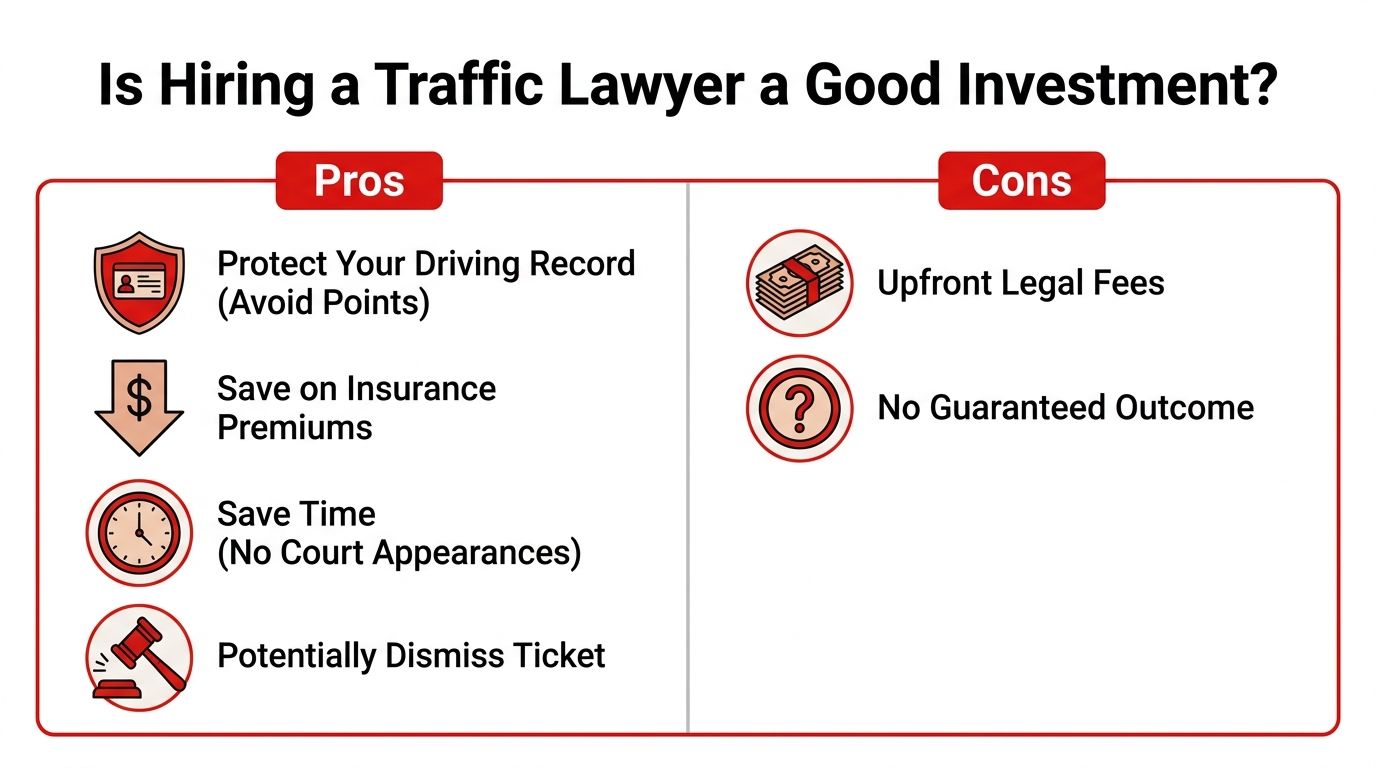
What are you paying to avoid
You are paying to reduce risk that can outlast the ticket itself.
That means protecting your record, avoiding unnecessary points, limiting insurance trouble, and keeping one mistake from turning into a pattern the next court or employer sees. As noted earlier, even a routine ticket can become expensive once the long-term consequences attach.
If you want a broader consumer-friendly look at how violations can affect your record over time, this overview of the long-term impact of violations on your driving record is useful background.
You are also paying for something ticket mill apps do not sell. Accountability. If your case is unusual, if the court pushes back, or if your driving history already puts you in a vulnerable spot, an app cannot stand next to you and make judgment calls. A real lawyer can.
A lawyer cannot guarantee a dismissal. No honest attorney will. What a good lawyer does is protect your options, spot avoidable mistakes, and keep you from paying for a fast, cheap service that disappears the moment your case gets complicated.
A short explanation helps:
When does hiring a lawyer make the most sense
Some cases are minor on paper and serious in real life. You should treat legal help as urgent if the ticket threatens your income, your license, or a record you cannot afford to damage.
Move fast if:
You drive for Uber, Lyft, delivery, or field work
You already have prior points
You hold a CDL-sensitive or clearance-sensitive position
The charge is reckless driving, DUI, or a suspended-license matter
You cannot afford court appearances or missed work
In those situations, the fee is not just a cost. It is a defensive investment in your future. Pay for access to a lawyer who knows your county, answers your questions, and takes responsibility for the result they are trying to achieve. That is worth far more than a bargain app that treats your case like one more file in a stack.
Key Questions to Ask Before You Hire a Florida Traffic Attorney
Do not hire a firm until you ask hard questions. A real lawyer will answer them directly.
Ask these before you sign
Will I speak directly to my attorney by phone or text? If the answer is vague, that is a warning.
Do you handle cases in the county where my ticket was issued? If your case is set at the Orange County Courthouse, county familiarity matters.
Is this a flat fee or can the bill increase later? You need clarity upfront.
What is your main goal in my case? The answer should focus on record protection, point avoidance, and damage control.
Do I need to appear in court? Many drivers hire counsel because they want the matter handled without losing work time.
Are you promising a dismissal? Be careful. Serious lawyers do not make guarantees they cannot control.
Immediate Steps to Take
Send the ticket for review right away: Waiting limits your options.
Do not just pay it online: That may close off defenses.
Write down what happened while you remember it: Details fade fast.
Save every document and notice: Deadlines matter.
Ask about the No Points strategy first: That is the issue that usually matters most.
Get Your Free Consultation and Protect Your Record. Visit TicketShield.com to start your defense now and fight for No Points. |
|---|
If you want a lawyer-led defense instead of an automated app, visit Ticket Shield, PLLC. Speak directly with an attorney, act quickly, and focus on the outcome that matters most. No Points.