Driving License Points Florida: What Every Driver Must Know
Driving License Points Florida. Learn how driving license points in Florida work, from point values and suspension thresholds to traffic school options. Protect
You're holding a Florida traffic citation and telling yourself you'll pay it, put it behind you, and move on. That's the mistake I see most often. A ticket isn't just a fine. It can become a conviction, add points to your Florida driving record, affect insurance underwriting, and move you closer to a license suspension.
The Florida driving license points system is cumulative. A single citation may look manageable, but another conviction can change the situation quickly. Before you pay, understand what the ticket can do and what options may keep points off your record.
Table of Contents
What a Florida Traffic Ticket Really Costs You
An officer hands you a citation on I-4 or US-19. The roadside conversation ends, and you assume the matter is simple: pay the fine and keep driving. In Florida, that payment generally functions as a guilty plea. Once the clerk processes it, the conviction can affect your driving record under the state's licensing framework.
The immediate cost is the court fine and required fees. The larger concern is what follows. A conviction can add points, remain relevant on your driver record for years, and give an insurer a reason to reassess your policy at renewal. The Florida Department of Highway Safety and Motor Vehicles states that points assigned from a conviction remain on the driver record for at least five years from the date of disposition. Florida DHSMV explains how points affect suspensions and driver records.
Practical rule: Don't treat the fine as the full price of a ticket. The conviction is often the part that creates the lasting exposure.
The default choice can create a second problem
Drivers commonly make three errors:
Paying before checking eligibility: You may give up the opportunity to contest the citation or elect an available course.
Assuming one ticket is harmless: Florida's system counts convictions together, so a later ticket can push you toward a suspension threshold.
Waiting for a warning from the state: The clerk processes the disposition. Your insurer and the licensing agency may react later, after your decision is already locked in.
Florida assigns 3 points for speeding 15 mph or less over the limit, while reckless driving or failing to obey a traffic control signal can carry 4 points, according to the state's point guidance. Review Florida's official point schedule. That means a citation that feels minor can become important when combined with other convictions.
The right first move is simple. Don't mail a check or click a payment button until you know whether the disposition will add points and what defense or mitigation options remain available.
The Legal Framework Behind the Points System
A Florida citation can affect your license through two connected bodies of law. Chapter 316, the Florida Uniform Traffic Control Law, defines conduct that leads to moving violations, including speeding, careless driving, reckless driving, following too closely, and other traffic offenses. Read the Florida Statutes Chapter 316 traffic-law framework.
Chapter 322 governs driver licensing. Florida Statute 322.27 authorizes the state to suspend a license when convictions produce enough points under the statutory schedule. It supplies the graduated suspension structure that connects accumulated points to licensing consequences. Read Section 322.27 on Florida license suspensions.
How the statutes connect
The process follows a defined legal chain:
Chapter 316 defines the traffic violation.
The court or clerk records the disposition.
The conviction appears on the driver record.
Section 322.27 authorizes the Department of Highway Safety and Motor Vehicles to apply the point consequences.
Florida Statute 322.27 states that 12 points within 12 months supports a suspension of up to 30 days, while also authorizing later graduated thresholds. The statute is the licensing mechanism behind consequences that can outlast the original citation, including problems you may later discover with your record or insurance.
For a practical explanation, review Ticket Shield's Florida driver license points guide. Automated ticket mills often reduce the decision to payment processing. A lawyer-led review instead asks what disposition the citation will produce, whether you can contest it, and which available strategy best protects your license.
Paying a ticket can close the court file while activating a separate licensing consequence under Chapter 322. Treat payment as a legal election, not a clerical shortcut. Before you pay, have the citation evaluated so you do not trade a quick resolution for points that remain on your record.
How Florida's Suspension Thresholds Work
Florida applies a graduated suspension ladder based on points accumulated during rolling time windows. The official state guidance identifies 12 points within 12 months, 18 points within 18 months, and 24 points within 36 months as the key thresholds. The corresponding suspension periods are up to 30 days, up to three months, and up to one year, respectively.
Points Accumulated | Suspension Length |
|---|---|
12 points within 12 months | Up to 30 days |
18 points within 18 months | Up to three months |
24 points within 36 months | Up to one year |
A driver with three convictions can cross the first threshold quickly:
A 4-point speeding conviction
A 3-point careless driving conviction
A 6-point leaving-the-scene citation
Together, those convictions produce 13 points. The driver has crossed the first suspension line, even if the earliest ticket is less than a year old.
The calculation uses rolling windows. An older conviction may still count if it falls within the applicable period. Do not assume a ticket has stopped mattering because it no longer feels recent. The Department of Highway Safety and Motor Vehicles evaluates the convictions recorded during the relevant window, then applies the corresponding licensing consequence.
Your license can be at risk before you ever receive a dramatic citation. A mix of ordinary convictions can create the problem.
Your defense strategy should prevent points from accumulating before you reach another threshold. A lawyer-led Ticket Shield review examines the citation and its possible disposition, while an automated ticket mill may process the matter without addressing the cumulative effect. If every ticket becomes a separate conviction, you may learn about the risk only after a suspension notice arrives.
Common Florida Violations and Their Point Values
The charge printed on your citation is only the starting point. The disposition controls what reaches your driving record. A citation may be dismissed, reduced, or resolved under a different violation, changing the licensing consequences.
For example, an officer may cite you for a higher-level speeding offense, but your lawyer may negotiate a resolution to a lower-point moving violation. The original allegation remains part of the case history, while the final conviction determines the points assessed. Do not assume that paying the citation produces the same result as contesting it.
Don't confuse the allegation with the outcome
A payment can close the court file while creating a conviction on your record. If that conviction carries points, it joins your other convictions in the rolling calculation used to evaluate suspension risk.
The difference can be practical. A reckless-driving allegation may be resolved as a less serious traffic offense, or a moving violation may be resolved with no points when the court permits that outcome. The exact result depends on the statute, court, prosecutor, and facts. You need to know the proposed disposition before you accept it.
A non-point resolution is not automatically harmless. Fines, court requirements, and insurance review may still follow, and insurers can consider the broader driving record even when the outcome adds no points.
Ticket Shield reviews the citation, your record, and the available disposition before you make a payment decision. An automated ticket mill may process the ticket without examining how another conviction could affect your license or insurance. That difference matters when several ordinary citations are close together.
Check the state record after the case closes. If the recorded outcome differs from the agreement or your expectation, address it promptly. Do not wait until another citation turns a recordkeeping error or overlooked conviction into a licensing emergency.
When Points Expire and How Long They Stay Visible
Florida uses more than one timeline, and drivers often confuse them. The state says points assigned from a conviction remain on the driver record for at least five years from the date of disposition. Review Florida's official explanation of point-record retention.
That long retention period is different from the period used for a particular suspension calculation. A conviction may remain visible on the record even after it no longer counts in the same way toward a specific rolling threshold. Insurance companies may also apply their own underwriting rules when reviewing your driving history.

Check the record instead of guessing
You should distinguish among:
The violation date
The disposition date
The period used for suspension calculations
The period an insurer reviews
The length of time the event remains visible on an official record
A driver may think points disappeared because a certain threshold calculation changed. That doesn't mean the underlying conviction vanished from every record or stopped affecting insurance decisions.
If you're trying to understand whether an old conviction still matters, obtain the official driving record and review the disposition. Ticket Shield's guide to removing points from a Florida driving record can help you identify the questions to ask before you make another election or payment.
How Points Drive Up Your Insurance Premiums
Your insurer doesn't need to wait until you reach a suspension threshold before reviewing your record. A conviction can affect underwriting even when your license remains active.
A 3-point speeding conviction may affect eligibility for preferred pricing or lead to a surcharge. The precise result depends on the insurer, your coverage, location, vehicle, and existing driving history. A higher-point conviction can create a more serious underwriting concern, especially when it appears alongside other adverse events.
The dollar question has no universal answer
You'll sometimes hear a precise estimate for what a ticket will cost in insurance increases. That number can't be responsibly promised without reviewing your policy and the insurer's rules. The financial effect may continue through the period the company uses for underwriting, but the amount and duration vary.
That uncertainty is exactly why you should act before the conviction is entered. Once you pay, you may have fewer ways to protect the record. Read Ticket Shield's explanation of the insurance impact of a Florida speeding ticket.
Ask your insurer for a written impact estimate if the conviction has already been recorded. If the ticket remains unresolved, get legal advice first. A cost-effective defense may protect more than the immediate fine. It may also protect your licensing position and future insurance eligibility.
Special Rules for Teen and Under-21 Drivers
Teen drivers don't always fall under the same practical rules as fully licensed adults. Families often assume the standard point ladder applies, then discover that a younger driver faces a separate restriction.
For drivers under 18, Florida's rules can impose a business-purposes-only restriction for one year after six points within 12 months, with each additional point adding 90 days. Review the Florida under-18 point explanation.
Age Group | Suspension Trigger | Length | Traffic School Eligible |
|---|---|---|---|
Under 18 | 6 points within 12 months | Business-purposes-only restriction for one year | Depends on the citation and eligibility |
Under 18 | Each additional point after the threshold | Adds 90 days | Depends on the citation and eligibility |
18 and older | Adult point thresholds may apply | Depends on the applicable threshold | Depends on the citation and eligibility |
Parents should act before payment
A teen's license can affect school, work, medical appointments, and family transportation. Don't assume that paying a citation is a harmless administrative step. Review the driver's age, license status, prior dispositions, and available options before electing a resolution.
You can also review Ticket Shield's Florida zero-tolerance guidance, but confirm the current requirements for the specific citation. A prompt attorney review may identify a defense or alternative resolution before the Department takes action.
Traffic School and Other Ways to Keep Points Off
Traffic school can be useful, but it isn't automatic and it isn't the same as a legal defense. You generally must make the election before paying the fine or entering the disposition that creates the conviction. Missing the deadline can eliminate the option.
The commonly discussed limits include a four-ticket lifetime cap and a frequency rule of one course per 12 months, but eligibility depends on the violation and the driver's history. Confirm the rules with the clerk or a Florida traffic attorney before you elect the course.
Compare the available paths
Basic driver improvement school can prevent points from being assessed when properly elected and completed for an eligible citation. It doesn't erase points already added to your record.
A negotiated reduction may resolve the citation as a non-moving violation, such as a faulty-equipment charge, where available. That outcome can produce a different licensing and insurance result from accepting the original moving violation.
Withholding adjudication may avoid a formal conviction in an eligible case, but the effect depends on the precise resolution and the driver's record. Dismissal is the cleanest point-protection result because the original allegation doesn't become an assessed moving conviction.
Why timing changes your options
A clerk can process an election or payment. A lawyer can evaluate the stop, the equipment, the officer's observations, procedural defects, and negotiation options. Those are different functions.
If you're eligible for school, complete every requirement and verify that the clerk received the certificate. If the citation threatens your record, don't automatically choose the course without comparing it with a defense strategy. Keeping points off entirely may matter more than closing the ticket quickly.
How Ticket Shield Fights to Keep Points Off Your Record
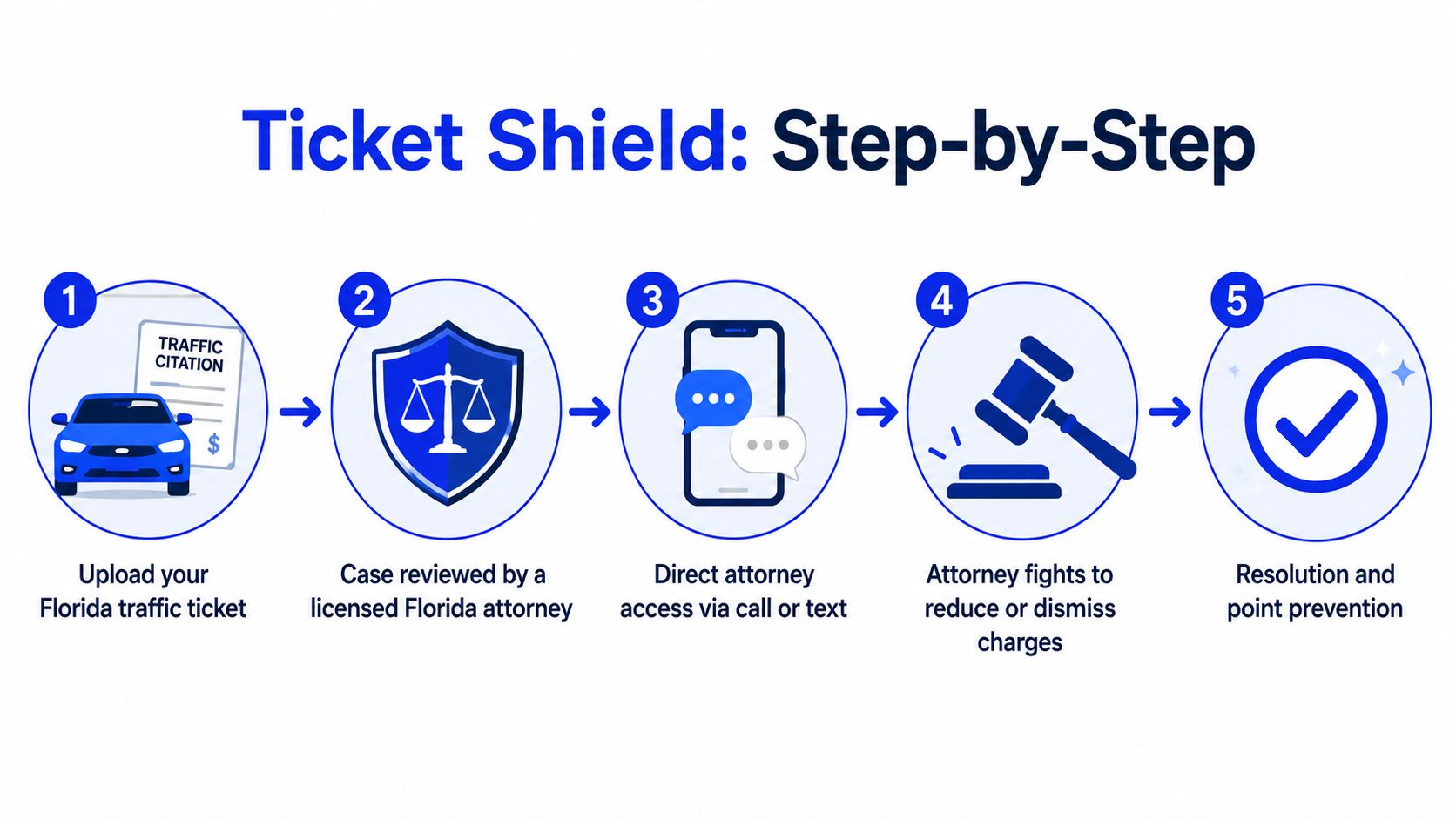
Ticket Shield, PLLC uses a lawyer-led model for Florida traffic defense. You upload the citation through the firm's website, the matter is reviewed, and you can communicate directly with your attorney by phone or text instead of dealing only with a corporate answering service or automated chatbot.
What attorney involvement changes
A defense may involve reviewing the citation for defects, examining the legal basis for the stop, requesting available evidence, and negotiating with the prosecutor when the facts support a reduction or dismissal. The attorney's job is to pursue an outcome that protects your driving privilege, not merely to transmit a payment.
Automated ticket mills often focus on high-volume processing. They may send a representative to enter a routine plea or pay the fine while giving you little explanation of the resulting record. That can leave you with points you didn't realize you were accepting.
The measurable objective should be clear before the case is resolved: pursue No Points whenever the facts and law allow it.
Watch the process overview below for a visual explanation of how a lawyer-led traffic defense can move from citation review to resolution.
Ask who will handle your case, how you'll communicate with that person, and what result the representation is designed to pursue. Those answers tell you far more than an automated promise to “handle” the ticket.
Reinstating a Suspended Florida License
Reinstatement starts with determining why the Florida license was suspended and whether the suspension period and every court obligation have been satisfied. A point suspension may require a review by the Florida Department of Highway Safety and Motor Vehicles, payment of the applicable reinstatement fee, and proof that required conditions have been completed.
You may also need to address insurance verification, court costs, traffic school, or other conditions tied to the underlying matter. Don't assume that the end of the suspension period automatically restores your driving privilege. Administrative holds can remain until the required documentation reaches the correct agency.
A practical reinstatement checklist
Confirm the suspension reason: Review the official status rather than relying on memory or an old notice.
Clear court obligations: Resolve fines, course requirements, and any other court conditions.
Address insurance documentation: Ask the insurer and DHSMV what proof is required for your file.
Pay the reinstatement fee: Confirm the amount and accepted payment method with the agency.
Verify reinstatement: Don't drive until the state confirms that your privilege is valid.
If a license examination or vision screening is required, use a current resource such as Style Site Optical's guide to DMV eye tests to understand what the screening may involve. That guide isn't a substitute for DHSMV instructions, but it can help you prepare.
A Florida traffic attorney can coordinate the record review, identify lingering holds, and help you document compliance. Ticket Shield's Florida license reinstatement guide provides another starting point for organizing the process.
Quick Answers to Common Points Questions
Do out-of-state drivers avoid Florida point consequences? No. A conviction can be reported through applicable interstate driver-record arrangements and may affect the record maintained by the driver's licensing state. Florida's point system is not something you should ignore because you live elsewhere.
Is an SR-22 a license? No. An SR-22 is an insurance-related financial-responsibility filing made by an insurer. It isn't a driver license and doesn't itself restore driving privileges.
Can points be negotiated away after a guilty plea? Generally, you cannot bargain points off after accepting a conviction. Prevention usually requires a different disposition, such as dismissal, an eligible withhold, or a properly elected driver improvement course before the case is finalized.
Does traffic school erase existing points? No. A course may prevent new points for an eligible citation when properly elected, but it doesn't retroactively remove points already assessed. Review the record and course eligibility before relying on it.
Protect Your License Before the Next Citation Hits
You have one Florida driving record, and every disposition deserves careful attention. Don't pay first and investigate later. A free consultation with a Florida traffic defense attorney can help you compare traffic school, negotiation, and litigation before points reach your record or push you toward suspension.
Upload the citation, explain your situation, and ask directly what outcome the defense is pursuing. Your target should be clear: protect your license and pursue No Points.
Ticket Shield, PLLC offers lawyer-led Florida traffic defense with direct attorney communication by phone or text, not a faceless automated ticket service. Visit Ticket Shield, PLLC for a free consultation and take the first step toward a No Points outcome on your license.