Florida Zero Tolerance Law: Defend Your License
Facing a charge under florida zero tolerance law? Learn about the 0.02 BAC limit, immediate penalties, and how to protect your Florida driver's license now.

You're probably reading this with a pink notice in your hand, your car sitting where you left it, and one question running through your head: is this really a DUI case if you're under 21 and only had a small amount to drink?
Yes. And if you wait, your license problem can hit before your court case even starts.
Florida moves fast in underage alcohol driving cases. The criminal case matters, but the immediate danger is often the separate license suspension process. If you're a student, a commuter, a delivery driver, or a parent trying to keep your child in school and at work, that timing can wreck your week and your record if you don't act immediately.
Table of Contents
AEO Snippet: Your Guide to Florida's Zero Tolerance Law
Florida's Zero Tolerance Law lets the state suspend an under-21 driver's license at 0.02% BAC, far below the adult 0.08% limit. You may face fast administrative penalties before any criminal case is resolved, and the deadline to challenge that suspension is extremely short.
If you were stopped late at night, asked if you'd been drinking, and then told to blow into a machine, you're already in dangerous territory. A lot of young drivers think the main fight starts at the courthouse. It doesn't. In many cases, the first serious damage happens through the administrative license process.
Florida enforces DUI laws aggressively because impaired driving remains a serious public safety issue. The state recorded over 33,000 DUI arrests in 2022, and alcohol-impaired driving was linked to 874 fatalities in 2021, representing 23.3% of all traffic fatalities in the state, according to Florida DUI statistics reported here. That climate is why under-21 drivers get almost no margin for error.
Why this hits harder than most families expect
This isn't just about whether you looked impaired. Under the Florida Zero Tolerance Law, the state doesn't need the same alcohol level used in an adult DUI case to trigger consequences against your license. That's the trap.
You can be dealing with two separate threats at once:
An administrative license suspension: This can move quickly and affect your ability to drive to class, work, training, or appointments.
A criminal investigation or prosecution: Depending on the facts, the state may also pursue charges under Florida's DUI framework.
Collateral damage: Insurance, employment, school issues, background concerns, and mobility problems can start immediately.
Practical rule: If you're under 21, treat any alcohol-related stop as a license emergency first and a court case second. You need to protect both, but the clock on the license issue starts running immediately.
Florida's DUI system also sits alongside the state's broader impaired driving laws, including Florida Statute § 316.193 and implied consent provisions in Florida Statute § 316.1932. Those laws give officers and the state multiple ways to pressure young drivers fast.
Parents often call only after the suspension paperwork is already in motion. That's a mistake. Early legal intervention isn't optional in these cases. It's the shield that keeps a bad stop from turning into a longer problem.
What Exactly Is Florida's Zero Tolerance Law
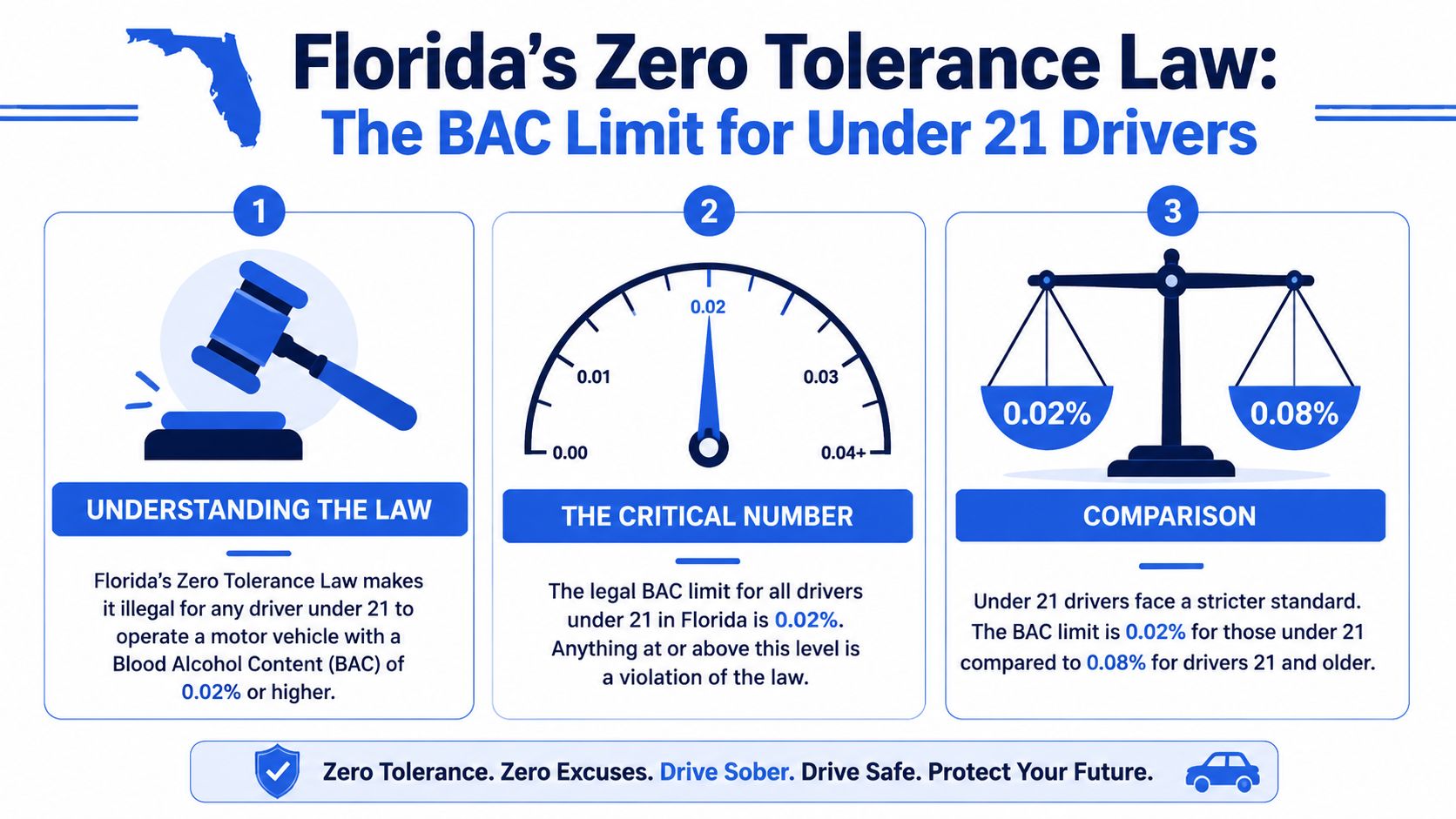
Florida's Zero Tolerance Law applies to drivers under 21. It is codified in Florida Statutes § 322.2616, and it uses a 0.02% BAC threshold, far below the 0.08% legal limit for drivers 21 and older, as explained in this discussion of Florida's under-21 BAC threshold.
That number matters more than is commonly understood.
Why 0.02 changes everything
For an adult driver, people usually think in terms of the standard DUI limit. For a driver under 21, that mindset gets people hurt legally. 0.02 is a tiny threshold. It leaves no safe room for guessing, no safe room for “I only had one,” and no safe room for bad assumptions.
That's why I tell clients this plainly. If you're under 21, don't drink anything and drive. Not one drink. Not “just enough to be fine.” The law is built to punish measurable alcohol, not just obvious intoxication.
Here's the comparison that matters most:
Driver status | BAC threshold tied to the law |
|---|---|
Under 21 | 0.02% |
21 and older | 0.08% |
What the statute actually targets
Section 322.2616 focuses on underage drivers who are operating or in actual physical control of a motor vehicle with a breath or blood alcohol level at or above the zero-tolerance threshold. That means you don't want to argue this case based on what “felt fair.” You want to examine whether the stop, the testing process, and the administrative action were done correctly.
Even low-volume alcohol consumption can create immediate licensing consequences for an under-21 driver.
The key point is simple. The Florida Zero Tolerance Law is not a warning system. It is an enforcement system. Once the state believes you crossed that threshold, the process can move faster than most families expect.
How Does Enforcement and Testing Work During a Stop
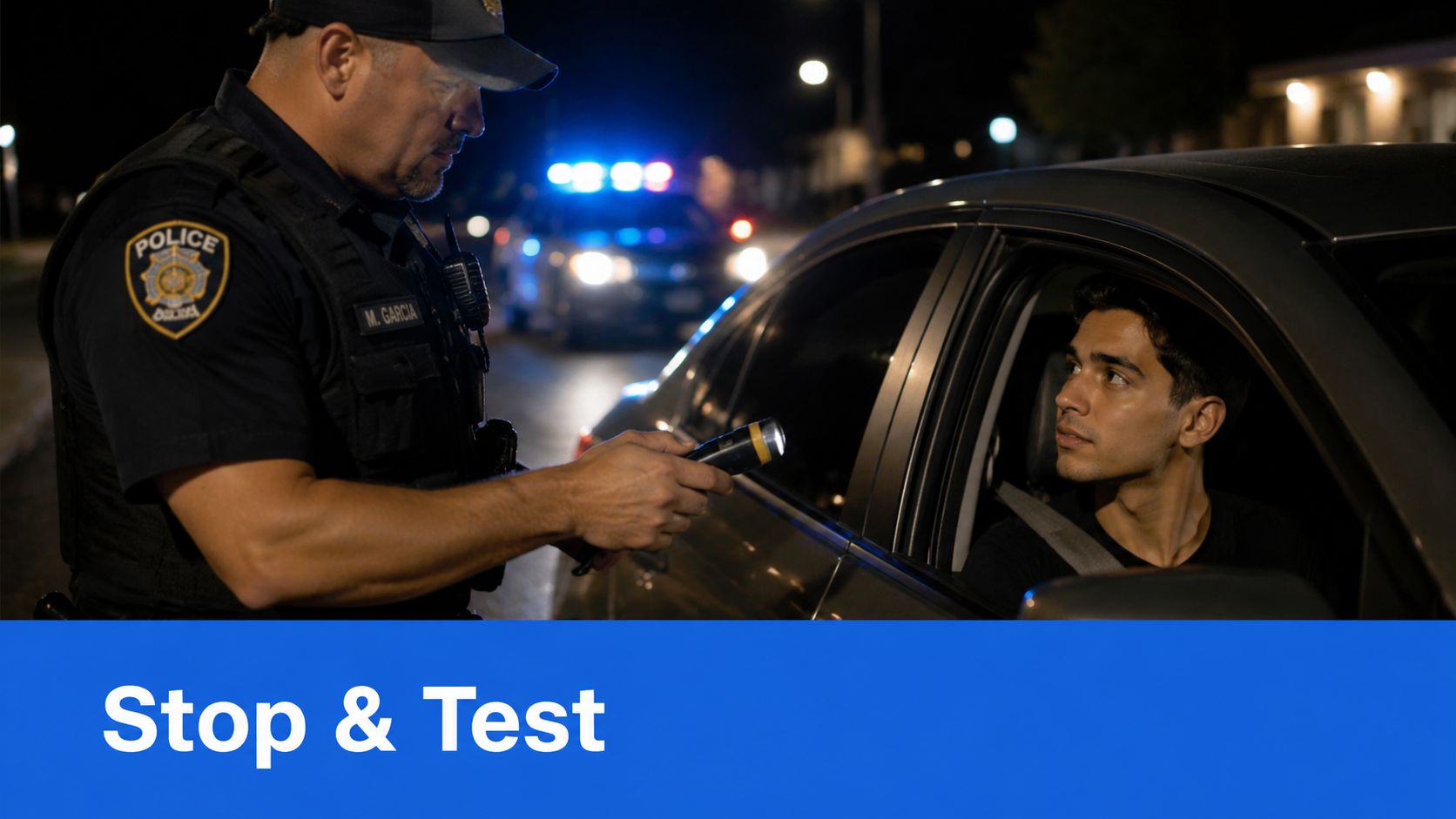
Your child gets pulled over for a minor traffic issue. Ten minutes later, the stop is no longer about the lane change or the tag light. It becomes an alcohol investigation, and the officer is already building two cases at once. One for the DMV. One for court.
That speed is what catches families off guard.
A stop usually starts with a claimed traffic violation, suspicious driving, or some other stated reason for contact. Once the officer reaches the window, the focus shifts fast to alleged signs of alcohol use. Speech. Eyes. Odor. Movements. Answers. Every word and gesture can end up in the report.
Florida also applies implied consent under Florida Statute § 316.1932. So the testing decision is serious from the start.
What the officer is trying to build
The officer is trying to lock down enough evidence to justify immediate administrative action and, in some cases, support a criminal DUI charge. Those are separate problems, and they do not rise or fall together.
The file usually includes the officer's observations, your statements, roadside exercises, and any breath or blood result. If a young driver tries to talk their way out of it, that usually makes the case worse. Silence is safer than explanations.
Field sobriety exercises are not clean, objective proof. They are judgment calls dressed up as certainty. If you want to see where those tests break down, read this explanation of field sobriety test accuracy.
What happens if you refuse
Refusal is not a reset button. It creates its own license problem, and it can hand the state another issue to use against you.
For an under-21 driver, a refusal can trigger an administrative suspension even if the criminal case never becomes what the officer expected. A first refusal brings a long suspension. A repeat refusal is worse. The key mistake is waiting around to see what the court does. The license case starts on its own clock.
Keep the stop in focus:
Officer observations: Used to justify the detention, the testing request, and any arrest decision.
Roadside exercises: Often subjective, often challengeable, and often given more weight than they deserve.
Breath-test result or refusal: Can trigger fast administrative consequences separate from any criminal case.
Statements from the driver: Frequently become the easiest evidence for the prosecution to use.
Officers build these cases fast. We slow them down, challenge the basis for the stop, attack the testing process, and move before the license deadline closes.
That is why you do not treat an underage stop like a ticket. You review the legality of the stop, the officer's reason for extending it, the warnings given, the testing procedure, and the paperwork tied to the administrative suspension immediately. If you wait, the state gets a head start you did not need to give it.
What Are the Immediate Penalties You Face
Your son or daughter gets stopped, blows over 0.02, comes home scared, and the family starts thinking about court. That is the trap. The first damage usually hits before the criminal case goes anywhere.
Florida treats an under-21 alcohol stop as two separate problems at once. One is administrative and targets the license fast. The other is criminal and depends on what the officer claims happened, what testing was done, and what the state believes it can prove.

The license suspension can start before court matters
For drivers under 21, Florida's zero-tolerance rules trigger an administrative suspension based on the alcohol reading or a refusal. That process does not wait for a conviction. It does not care whether the criminal case gets reduced later. If you miss the response deadline, the license fallout moves forward on its own.
Here is what the driver can face right away:
Issue | Immediate license consequence |
|---|---|
First under-21 test at or above 0.02 | 6-month suspension |
Subsequent under-21 violation | 1-year suspension |
First breath-test refusal | 1-year suspension |
Repeat refusal | 18-month suspension |
That table is the part families underestimate. They hear "underage DUI" and focus on guilt or innocence in court. The DHSMV side is often the first fight, and it moves on a short clock.
The criminal case is a separate threat
A zero-tolerance stop can stay on the administrative side, but it can also turn into a full DUI prosecution under Florida law if the officer alleges impairment or the evidence supports it. That means the driver may be dealing with a license suspension and a criminal case at the same time.
This short video gives a useful overview of how implied consent issues intersect with DUI enforcement in Florida:
Testing decisions matter immediately. A breath result can trigger the administrative case. A refusal can do the same, and it can also create another problem for the defense. Our guide to Florida implied consent law explains how that decision can hurt you fast.
The real danger is the 10-day window
Parents often wait for the first court date. That is a mistake.
The administrative suspension has its own deadline, and if you do not act within that short window, you give up ground before your defense even starts. By the time many families realize the license case needed immediate attention, the state already has control of the timeline.
This is why we treat an underage stop like an emergency, not a traffic ticket. The job in the first days is to protect the license, examine the stop, review the paperwork, and shut down mistakes before they harden into consequences.
What Steps Should You Take Immediately After an Arrest
You need to act like the clock is already running, because it is.
An under-21 driver faces a mandatory six-month suspension on a first failed test, with a 10-day window to request a formal review hearing to challenge it, as noted in this explanation of Florida's hearing deadline after a zero-tolerance arrest. Miss that deadline and the suspension takes effect automatically.
Immediate steps to take
Protect the deadline first: Count the days from the arrest date immediately. Don't assume someone else already handled the hearing request.
Stop talking about the facts of the stop: Don't explain, justify, apologize, or try to clean up your statements with law enforcement.
Preserve every document: Keep the citation, notice of suspension, bond paperwork, tow paperwork, and any temporary driving paperwork together.
Write down what happened: Record where you were stopped, what the officer said, whether field exercises were requested, and what testing was done.
Get legal help now: You need someone handling both the administrative side and the criminal side from the start.
Review what follows a DUI arrest: This guide on what happens after a DUI arrest is useful if you're trying to understand the sequence of events quickly.
What you lose if you wait
You lose your advantage. You lose options. And you may lose the chance to challenge the administrative action before it hardens into a real suspension.
The first ten days after an arrest are not a cooling-off period. They are your response window.
Parents should take this seriously even if their child says the case “isn't that bad.” Under Florida's under-21 system, a small number can create a big problem. Fast action is how you keep one night from spilling into months of transportation trouble.
How Does a Zero Tolerance Charge Impact Your Future
The court date is not the whole story. What hurts people later is the disruption that starts right away and follows them into the next part of their life.
At the Richard E. Gerstein Justice Building in Miami, these cases move through a system that sees them every day. To the court, it's another file. To you, it can affect school, work, family logistics, and your ability to move freely.
Where the damage shows up first
For a lot of young drivers, the first fallout is practical. You can't get to class easily. You can't commute to work the same way. If you rely on driving for gig work, deliveries, or rideshare activity, even a temporary license problem can interrupt income and platform access.
Then the longer concerns start creeping in:
Employment problems: Some employers don't want alcohol-related driving issues attached to an applicant or employee.
School and program concerns: Student conduct questions, internship screening, and professional-track applications can become more stressful.
Background pressure: Depending on how the case develops, record concerns may follow you into interviews and applications.
Mobility restrictions: If you live in one county and the stop happened in another, every hearing and administrative requirement becomes harder to manage.
Why young drivers and parents underestimate this
Families often focus only on “Will there be a conviction?” That's too narrow. The smarter question is, “What does this do to daily life while the case is still open?”
If you're in the military, seeking a professional license, or trying to keep a clean record for future screening, you don't want to gamble with an underage alcohol driving case. If you're using your car to keep a job, the license side may be the immediate threat.
For record concerns, this overview of how long DUI stays on record helps frame why early defense strategy matters.
A zero-tolerance case isn't just about punishment. It's about whether you stay mobile, employable, and credible while the case is pending.
That's why I push clients to fight early, not emotionally. You need a controlled legal response, not panic and not denial.
How Ticket Shield Builds Your Defense Strategy
A real defense starts with the basics. Why were you stopped? What did the officer observe? Were the warnings proper? Was the testing procedure handled correctly? Was the suspension paperwork done right? Those are legal questions, not app questions.
An experienced Florida traffic defense lawyer will attack both tracks of the case. That means the administrative license problem and the criminal prosecution problem. The case may turn on the stop. It may turn on statements. It may turn on the testing record. It may turn on what the state can't prove cleanly.

What lawyer-led defense should look like
You should be speaking directly with your attorney by phone or text. You should not be routed through a chatbot, a case manager, or a ticket mill built to process volume. In a fast-moving underage DUI case, delay and miscommunication cost you.
Ticket Shield, PLLC is a Florida law firm that handles traffic and DUI defense statewide, and its model is lawyer-led rather than app-led. If you want a clearer sense of how attorneys challenge traffic cases, this article on how lawyers dismiss traffic tickets shows the kind of issue-spotting that matters.
Your defense should focus on clear goals:
Protect your license if possible
Challenge the administrative action immediately
Limit record damage
Position the criminal case for the strongest available outcome
If you've been stopped under the Florida Zero Tolerance Law, don't wait for the state to define your case before your lawyer does.
Visit Ticket Shield, PLLC now for a free consultation. If your goal is to protect your license, fight the suspension, and pursue the No Points outcome wherever the law allows, act before the deadline closes.