Field Sobriety Test Accuracy: A Florida Driver's Guide
Discover the real field sobriety test accuracy rates. A Florida DUI defense firm explains the flaws in FSTs and how to protect your rights after an arrest.

TL;DR: No, field sobriety tests aren't reliably accurate proof of DUI. They can produce false positives, they're highly subjective, and sober drivers fail them for innocent reasons. In Florida, an arrest under § 316.193 is the start of a case, not the end of it.
You were driving home. Then the lights hit your mirror. A few minutes later, you're on the shoulder of a dark Florida road trying to follow strange instructions while traffic rushes past. You feel nervous, off-balance, and watched. Then the officer says you “failed” and arrests you.
That moment feels final. It isn't.
In Florida, DUI cases often lean hard on roadside observations and field sobriety exercises. But field sobriety test accuracy is nowhere near as clean as police reports make it sound. These tests are not a direct readout of intoxication. They are behavioral tasks. And behavior changes when you're scared, tired, injured, confused, or standing on bad pavement in bad lighting.
If your stop happened near the Orange County Courthouse in Orlando, or anywhere else in Florida, the same rule applies. The state still has to prove its case. The officer's opinion is not the same thing as proof. In many cases, the right move is to attack how the stop happened, how the tests were given, and what those tests can show. That's why motions like a motion to suppress evidence can matter so much when the roadside investigation was flawed.
Table of Contents
Your Guide to Challenging Flawed Sobriety Tests

Roadside sobriety testing is sold as objective. It isn't. It's a fast, high-pressure screening process built around an officer's observations, memory, and scoring.
That matters because your arrest report usually reads better for the state than the roadside experience felt to you. The report may say you swayed, missed heel-to-toe steps, started too soon, raised your arms, or couldn't keep balance. But that same report often leaves out the obvious human reality. You were anxious. Cars were passing. The surface may have been sloped. The instructions may have been rushed, clipped, or hard to hear.
Practical rule: A “failed” field sobriety test doesn't prove you were impaired. It proves the officer says you performed poorly under roadside conditions.
Officers know these exercises help build probable cause. Prosecutors know juries tend to trust police descriptions. That's why the defense has to get specific, fast. We don't just ask whether you did well or poorly. We ask what shoes you were wearing, whether you had an old injury, whether the wind was strong, whether emergency lights were flashing in your face, and whether the officer changed the instructions halfway through.
Why does the roadside setting matter so much
These tests don't happen in a lab. They happen beside highways, in parking lots, on dim streets, and during stressful traffic stops. That setting is part of the defense, not background noise.
A strong challenge often focuses on details like these:
The surface: Gravel, uneven pavement, painted lines, wet ground, and roadway slope can all affect balance.
Your body: Back pain, knee issues, vertigo, fatigue, age, and normal coordination differences can change performance.
The instructions: Multi-step commands are easy to misunderstand when you're frightened and trying to avoid making things worse.
The officer's interpretation: The same movement can be written up as a “clue” of impairment instead of a normal stress response.
The state wants the jury to see confidence and science. Your defense needs to show context, subjectivity, and reasonable doubt.
What Are Standardized Field Sobriety Tests
The tests most officers use come from the Standardized Field Sobriety Test, often called the SFST battery. In Florida DUI cases, officers commonly treat them as a gatekeeper before arrest, and prosecutors later use them to support a charge under Florida Statute § 316.193.
If you want the broader Florida DUI framework around these investigations, this overview of Florida DUI law is a useful starting point.
Which tests does the officer usually use
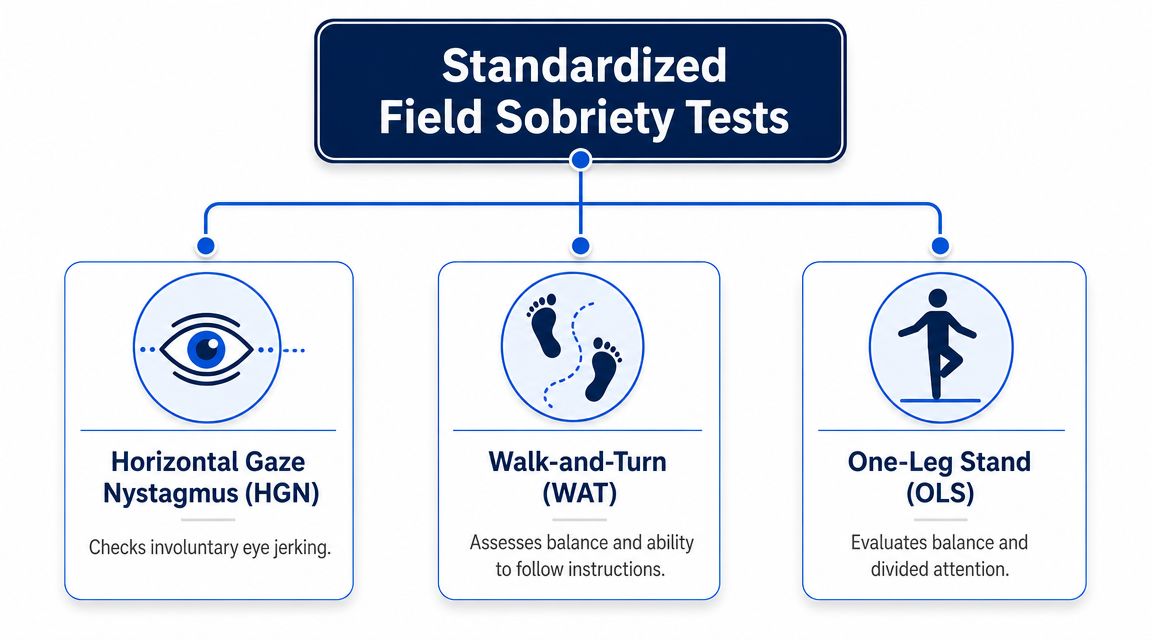
The standardized battery usually includes three exercises:
Test | What the officer claims to assess | Defense concern |
|---|---|---|
Horizontal Gaze Nystagmus | Involuntary eye jerking while following a stimulus | Sensitive to administration errors and observation issues |
Walk-and-Turn | Balance, instruction-following, and divided attention | Hard for many sober people in roadside conditions |
One-Leg Stand | Balance and concentration | Easily affected by injury, fatigue, footwear, and surface |
The Horizontal Gaze Nystagmus, or HGN, is the eye test. The officer asks you to follow an object with your eyes while keeping your head still. Police treat this as the most important single field test because they believe it reflects neurological effects of alcohol. From a defense view, the problem is simple. The officer has to administer it correctly, observe tiny eye movements correctly, and rule out other causes correctly.
The Walk-and-Turn sounds simple until you remember how it's done. You're told to stand in a starting position, listen without moving, then take heel-to-toe steps, turn in a specific way, and return the same way. That's not ordinary walking. That's a memory-and-balance drill given during a tense detention.
The One-Leg Stand asks you to raise one foot and hold still while counting as instructed. Again, this sounds easy on paper. On a roadside shoulder at night, it often isn't.
Why do these tests feel harder than they should
Because they are harder than normal body movement.
These are not everyday tasks. They are divided-attention exercises performed under pressure, while a police officer watches for mistakes.
A sober person can look shaky for innocent reasons. A person with no physical issue can still get tripped up by rigid instructions. Someone trying very hard to comply can start too soon, stop mid-task to ask a question, or focus on not falling instead of remembering every step.
That is why defense lawyers don't treat these as clean pass-fail events. We treat them as human performances shaped by stress, setting, wording, and officer bias.
How Accurate Are Field Sobriety Tests Really
You were asked to stand on the side of a Florida road, late at night, with patrol lights flashing and an officer already looking for mistakes. Then the state turns around and calls that performance proof of impairment. That is a weak shortcut, and in many DUI cases it is one of the first places I attack.

If your case also involves a breath or blood allegation, understanding Florida's legal blood alcohol level rules helps put the roadside testing in context.
What numbers will the prosecutor lean on
Prosecutors love to cite validation studies because the numbers sound clean and persuasive in a courtroom. The National Highway Traffic Safety Administration reported in its original field study that officers were correct about whether a driver was at or above the relevant BAC threshold 81 percent of the time when using the three-test battery, and reported individual rates of 88 percent for HGN, 79 percent for Walk-and-Turn, and 83 percent for One-Leg Stand in that study's final scoring model, according to the NHTSA SFST study report.
The state also points to later NHTSA-sponsored validation work claiming 91 percent accuracy for the three-test battery in identifying drivers at or above 0.08, based on a sample of suspected DUI motorists, according to the 2007 San Diego field validation study.
Those numbers sound strong until you ask the question that matters in a real defense case. How many sober, tired, anxious, injured, or medically compromised people get swept into the same pile?
What those numbers do not prove
Field sobriety tests do not measure alcohol concentration. They measure how a person performs under stress while an officer scores behavior through a checklist. That is a very different thing.
The San Diego validation study itself reported that 32 percent of drivers who were below 0.08 were still classified as above 0.08 based on the test battery, according to the same NHTSA validation report. That is the false-positive problem in plain terms. A significant group of people who were not over the legal limit still looked bad enough on these exercises to trigger the officer's conclusion.
That matters because your case is not about whether these tests look scientific in a training manual. Your case is about whether the officer can rule out innocent explanations for the so-called clues. In many Florida DUI arrests, the answer is no.
Here is the defense point I want a client to understand right away:
A headline accuracy rate does not clear the false-positive problem. The state can brag about overall accuracy and still be wrong about a specific sober or marginal driver.
These tests are weaker near the legal limit. That is where many DUI cases live, and that is where uncertainty matters most.
Officer interpretation drives the result. The officer chooses the location, gives the instructions, decides whether you started too soon, stepped slightly off line, raised your arms, or counted incorrectly.
False positives create reasonable doubt. If stress, fatigue, pain, age, footwear, panic, or a medical issue can explain the clues, the state's confidence drops fast.
One more point gets ignored too often. Researchers examining how SFST statistics are framed found that some arrest-accuracy claims can be misleading because the measure changes dramatically depending on the BAC target being used, according to the Law, Probability and Risk analysis. That is a serious warning sign. A polished percentage in a prosecutor's argument is not the same thing as reliable proof of impairment in your case.
I also look closely at the human side of the stop. Anxiety alone can affect concentration, balance, speech, and memory under pressure. If that sounds familiar, this explanation of how to stop overthinking and worrying gives useful context for why sober people can look rattled during roadside testing.
The right response after an arrest is simple. Do not assume a claimed "failure" ends the case. Get the body cam, the dash cam, the arrest report, the testing conditions, your medical history, and the exact wording of the instructions reviewed by a DUI defense lawyer immediately. That is how you turn shaky roadside opinions into reasonable doubt.
Why Do So Many Sober People Fail These Tests
Failure of roadside exercises often isn't due to drunkenness. Many such failures occur because the exercises are vulnerable to innocent explanations.
That's the heart of the defense. Once a judge or jury sees how many non-alcohol factors can mimic “clues,” the state's confidence starts looking like overreach.
What innocent factors can look like impairment
Some causes are physical. Others are mental. Others come straight from the environment the officer chose for testing.
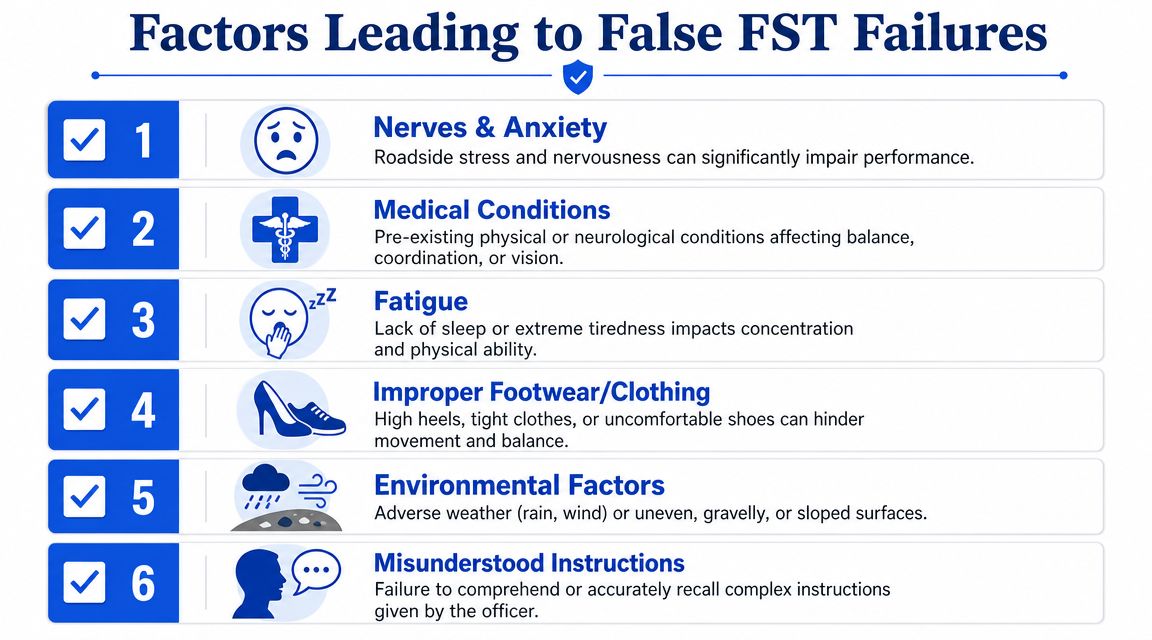
A sober driver may perform poorly because of:
Nerves and panic: A traffic stop can spike anxiety fast. Shaking, stiff movement, rushed responses, and trouble concentrating can follow.
Fatigue: Late-night driving, long work shifts, and lack of sleep can affect balance, attention, and memory.
Medical issues: Inner ear problems, vertigo, back pain, knee injuries, foot problems, diabetes, and neurological conditions can all matter.
Footwear and clothing: Boots, heels, tight clothing, work uniforms, or dress shoes can interfere with balance tasks.
Road conditions: Gravel, crowned roads, sloped shoulders, poor lighting, wind, and passing traffic can throw off anyone.
Instruction problems: Many people misunderstand the sequence, especially when the officer gives rapid, multi-step directions.
If you're still spinning out mentally after the arrest, a practical non-legal resource on how to stop overthinking and worrying can help you regain enough focus to document what happened clearly.
Why false positives create real reasonable doubt
The most damaging point for the state is this. Field sobriety tests don't reliably separate actual impairment from innocent poor performance.
Recent randomized clinical-trial evidence found that highly trained officers classified 49.2% of placebo participants as FST impaired, according to the clinical trial published in PMC. These were placebo participants. That means poor test performance and officer classification occurred even without the drug exposure being studied.
That finding matters because it destroys the lazy assumption that “bad on the test” equals “impaired.” It doesn't.
A roadside sobriety exercise is only as trustworthy as the conditions, the instructions, and the officer's interpretation. All three can fail.
When I evaluate a DUI case, I don't treat field tests as neutral science. I treat them as opinion evidence disguised as precision. If you were scared, exhausted, injured, distracted, or tested in a poor location, that isn't a side issue. That may be the core of your defense.
A good challenge often asks questions like these:
Were you physically capable of doing what was asked?
Did the officer account for visible limitations or complaints of pain?
Was the testing area fair?
Did the instructions change mid-test or come too quickly?
Did the body camera match the report language?
Reasonable doubt doesn't require proving why every clue appeared. It requires showing the officer's conclusion is not the only fair interpretation.
How Are FST Results Used in a Florida DUI Case
In Florida, roadside sobriety exercises usually serve one immediate purpose. They help the officer justify the arrest.
Under Florida Statute § 316.193, the state prosecutes DUI cases based on alleged impairment or an unlawful alcohol level. But the path into that prosecution often starts with the officer claiming your driving, appearance, speech, and field test performance created probable cause.
If your case is moving through Tampa, that fight may play out in a courtroom like the Edgecomb Courthouse. The location changes. The legal pressure points do not.
What role do the tests play under Florida law
Field sobriety tests are commonly used in three ways:
To support probable cause for arrest: The officer writes that your performance justified taking you into custody.
To shape the narrative for the prosecutor: The report creates a story of impairment before any courtroom testimony begins.
To persuade a jury visually and verbally: Prosecutors often rely on body camera footage and officer descriptions to make normal human mistakes look suspicious.
These tests are not the same as a chemical result. They are observational evidence. That distinction is critical. A defense lawyer can attack observational evidence by showing the observation was rushed, biased, poorly administered, or disconnected from actual impairment.
If your arrest triggered a threat to your driving privilege, you also need to understand the separate process for an administrative license suspension hearing.
How does a defense lawyer attack these results
The challenge usually happens on several fronts at once.
First, the lawyer examines legality. Was the stop lawful? Was the detention extended without a valid basis? Was there enough for the arrest before the chemical request?
Second, the lawyer examines administration. Did the officer follow standardized procedures? Did the officer choose a fair place for testing? Did the officer ignore your footwear, injury, age, or visible physical limitation?
Third, the lawyer examines credibility. Does the body camera match the report? Did the officer claim you were swaying when the video shows stable posture? Did you ask questions because you were confused, or because you were impaired?
The state's DUI case often looks strongest on paper. It can weaken fast when the video, the setting, and the science are put side by side.
That is why a bad field sobriety performance is not the end of the case. In many Florida DUI files, it is the beginning of the substantive defense.
Your Immediate Steps to Protect Your License and Your Future
You need to move now. Waiting helps the state, not you.
A DUI accusation in Florida can affect your license, your record, your job, and your insurance. If you're a rideshare driver, delivery driver, military service member, licensed professional, or someone who cannot lose driving privileges, delay is dangerous.
What should you do today
Write down everything: Record where the stop happened, what the officer said, what you wore, what shoes you had on, what the weather was like, and whether the ground was level.
Preserve evidence: Save receipts, ride logs, parking records, text timestamps, medical records, and anything that helps reconstruct your timeline or physical condition.
Identify witnesses: If a passenger, bartender, valet, friend, or bystander saw your condition before or during the stop, get names and contact details.
Request help immediately: DUI cases move fast, and license issues can move faster. You need a defense plan right away.
Review your legal options: A focused overview of DUI defense in Florida can help you understand the pressure points before you speak further.
What should you avoid doing
Don't explain the case on social media: Prosecutors love screenshots.
Don't assume the officer's version is unbeatable: Arrest reports are not sacred.
Don't rely on automated apps or ticket mills: DUI defense is not a chatbot problem. You need direct attorney judgment, fast.
Don't wait for court to start preparing: The best evidence often disappears early.
Don't treat a roadside “failure” as a conviction: It is an allegation, and allegations can be dismantled.
The right defense starts with facts, speed, and direct legal guidance. If you want to protect your license and push back against a weak DUI narrative, you need a lawyer-led strategy now, not a middleman.
If you were arrested after “failing” roadside tests, act now. Ticket Shield, PLLC is a Florida lawyer-led firm, not an automated app and not a ticket mill. You speak directly with your attorney by phone or text. Get a free consultation today and start fighting for the outcome that matters most. No Points. Visit TicketShield.com now.