Legal Blood Alcohol Level Florida: Legal Blood Alcohol
legal blood alcohol level florida is 0.08 for most drivers, 0.04 for CDL holders, and 0.02 for under 21—plus what happens after arrest.
In Florida, the legal blood alcohol level is 0.08% for most drivers, 0.04% for commercial drivers, and 0.02% for drivers under 21. If you were arrested, your license is already at risk. Act now.
The stop is over. You’ve been booked. Your car may be impounded. You’re home now, staring at paperwork, trying to figure out what the legal blood alcohol level florida rule means for your case.
Here’s the immediate takeaway: Florida uses different alcohol thresholds for different drivers, and a DUI arrest usually creates two separate problems at once—an administrative fight over your license and a criminal case in court. In our review of Florida statutes and DUI procedure, that two-track structure is the part people underestimate most.
Florida prosecutors take DUI arrests seriously because alcohol-impaired driving remains a major statewide issue. In 2022, alcohol-impaired-driving crashes and fatalities were part of a continuing national problem tracked by NHTSA’s 2022 impaired-driving report, and Florida remained one of the states with high alcohol-related death totals. That reality shapes how police, prosecutors, and judges approach these cases.
Your job now is simple. Protect your license. Protect your record. Stop talking. Get strategic. If you need a fuller breakdown of the first days after an arrest, review what happens after a DUI arrest in Florida.
Table of Contents
Your Guide to Navigating a Florida DUI Arrest
A DUI arrest in Florida isn’t just a bad night. It’s a legal emergency. Under Florida Statute § 316.193, the state can prosecute you based on a blood alcohol or breath alcohol result, officer observations, or both.
That matters because many drivers make the same mistake after release. They focus only on the court date. That’s backwards. Your license problem starts first.
You are dealing with a dual-track system. One track runs through the state’s administrative process involving your driving privilege. The other runs through criminal court and can lead to penalties that follow you for years. Those tracks move on different timelines, and they require immediate decisions.
Practical rule: Treat the first days after arrest as evidence-gathering time, not explanation time. Don’t try to talk your way out of a DUI after the arrest is over.
If your case lands in a major courthouse such as the Richard E. Gerstein Justice Building in Miami-Dade, the paperwork may look routine. It isn’t. Every form, every officer note, and every test record can become evidence for or against you.
Three things should be clear right now:
An arrest is not a conviction. Police allegations are only the opening move.
Silence protects you. You don’t need to explain your evening to anyone but your lawyer.
Speed matters. The state’s deadlines won’t pause while you “wait and see.”
The legal blood alcohol level florida issue is only one piece of the case. The main fight is whether the state can prove its case legally, accurately, and completely.
For broader context on how alcohol affects reaction time, divided attention, and judgment before any arrest occurs, see Georgia DUI Schools. It is not Florida law, but it is a useful plain-language explanation of why impairment evidence and chemical-test evidence often overlap.
How We Reviewed Florida BAC Rules for This Guide
We rebuilt this guide by checking the current Florida DUI statutes, the implied-consent statute, and Florida DHSMV materials on administrative suspensions and hearings rather than relying on drink charts or generic DUI summaries. The key sources were Florida Statute 316.193, Florida Statute 316.1932, and DHSMV hearing information.
In practice, the threshold readers confuse most often is the under-21 number. A 0.02 result can trigger administrative consequences for a young driver even though the criminal analysis may not look exactly like a standard adult DUI prosecution. That distinction is easy to miss if you only read a one-paragraph summary.
We also reviewed how a Florida DUI case typically moves from stop to arrest to hearing: the basis for the stop, the officer’s observations, field sobriety exercises, the implied-consent warning, chemical testing, and the 10-day deadline to challenge an administrative suspension. That process matters more than any online “how many drinks” chart because alcohol absorption, body weight, food intake, timing, and machine procedure all vary case by case.
What Does the 0.08 BAC Limit Actually Mean
Florida’s main alcohol thresholds are straightforward once you separate them by driver type. For most adult drivers, the unlawful level is 0.08 or higher under § 316.193. Commercial drivers are generally held to a 0.04 standard in the CDL context, and drivers under 21 can face administrative action at 0.02 under Florida’s zero-tolerance framework described by Florida DHSMV.
That is the direct answer most readers need: for ordinary adult drivers, the legal limit is 0.08. But Florida law does not stop there. The lower thresholds for commercial and under-21 drivers exist because the state treats professional driving and young-driver alcohol use as higher-risk categories.
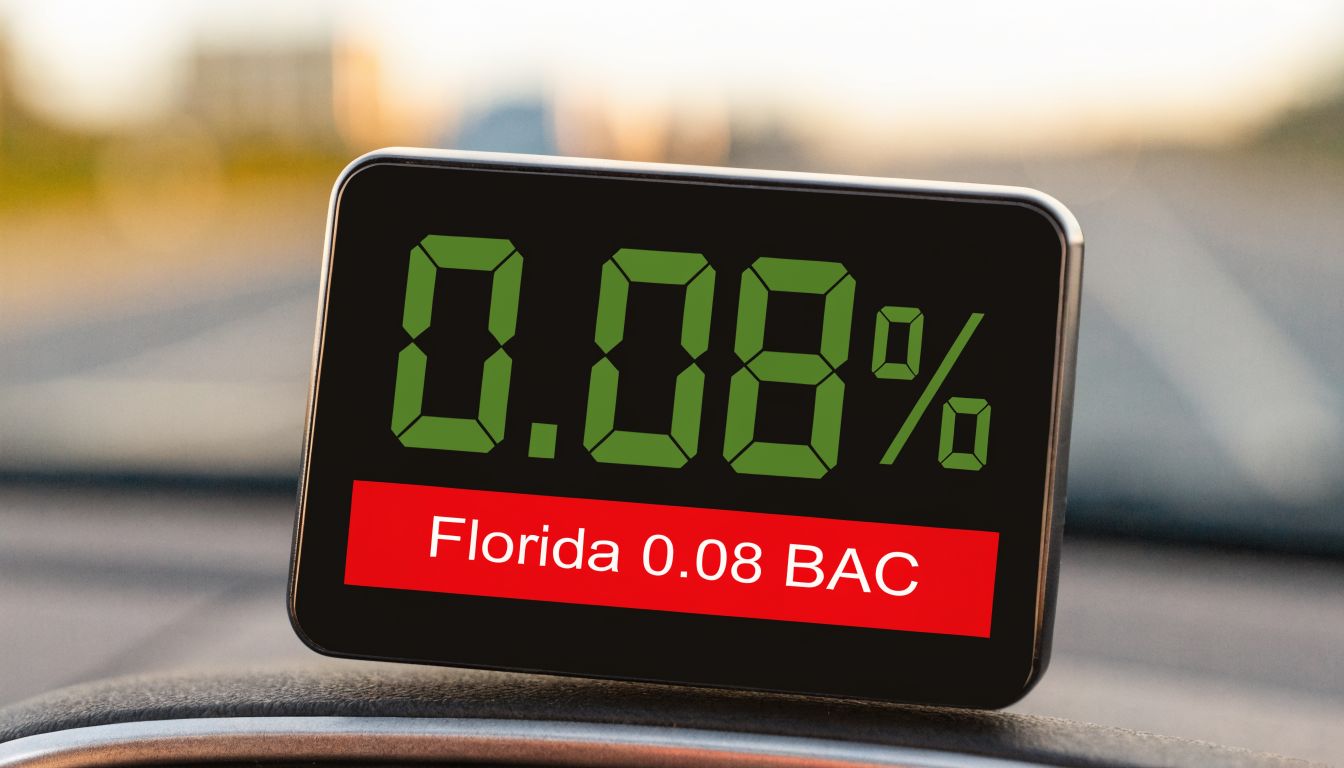
The phrase per se causes a lot of confusion. In plain English, it means the measured alcohol level itself can satisfy a key part of the state’s case. If a legally obtained, admissible test shows 0.08 or more for an adult driver, the prosecution does not have to rely only on weaving, slurred speech, or poor balance to argue the driver was over the unlawful limit.
Breath alcohol and blood alcohol are closely related but not identical in practice. Most Florida DUI cases use a post-arrest breath test at the station, which estimates alcohol concentration from deep-lung breath using an approved machine. Blood testing is less common and is usually used when breath testing is unavailable, when a crash involves serious bodily injury, or when officers suspect impairment by something other than alcohol. In our review of Florida DUI procedure, many people assume every DUI starts with a blood draw; in reality, breath testing is the more common path.
Just as important, a DUI allegation is still possible even without a test over 0.08. Florida can prosecute based on alleged impairment of normal faculties, so an officer and prosecutor may still pursue the case using driving pattern evidence, statements, video, field sobriety observations, and other testimony. The number matters, but it is not the only way the state tries to prove DUI.
Drink charts will not help you. They are guesses. They do not account for your body, your food intake, the timing of your last drink, the gap between driving and testing, or testing error. What matters is whether the state can prove the result is reliable and tied to the time you were driving.
Why 0.08 is only the start of the fight
A BAC result is only as good as the process behind it. In Florida, breath testing often involves the Intoxilyzer 8000. That machine must be properly maintained. The operator must follow the required steps. The observation period, testing sequence, records, and permits all matter.
Many first-time defendants miss the practical issue here: the state may present the number as if it appeared from a flawless machine in a flawless process. It did not. A serious review looks at whether the officer observed the driver long enough before the test, whether the machine’s maintenance history is complete, whether the samples were consistent, and whether the time gap between driving and testing weakens the result.
A serious DUI defense asks questions like these:
Was the machine inspected and maintained on schedule
Was the officer or breath test operator properly authorized
Was the required observation period completed
Did mouth alcohol, medical conditions, or contamination affect the result
Did the test show your alcohol level at the time of driving, or only later at the station
Those are not technicalities. They are the case.
If your reading was near the legal limit, this gets even more important. Small errors can matter. Delay can matter. Poor documentation can matter. That is why lawyer-led early action beats an impersonal volume practice every time.
For a focused explanation of Florida BAC limits and how the 0.08 threshold is used in DUI cases, start there, then get your own records reviewed immediately.
How Do Police Establish Probable Cause for a DUI Arrest
Most Florida DUI cases follow a sequence. First comes a lawful stop or other lawful contact. Then the officer documents observations that suggest impairment. Then come roadside exercises or other screening steps, an arrest decision, an implied-consent warning, and finally a chemical test request under § 316.1932. Understanding that chain helps you see how the state moves from suspicion to a charge.
The stop itself matters because the case needs a legal starting point. An officer may claim lane departures, speeding, a broken taillight, running a stop sign, or involvement in a crash. If the stop was unlawful, the evidence that followed can become vulnerable.
After contact, the officer begins building the narrative that appears in the arrest report: odor of alcohol, glassy or bloodshot eyes, flushed face, slurred speech, fumbling for documents, admission to drinking, or trouble following instructions. Those details often sound routine because they are repeated in report after report, but prosecutors use them to justify expanding the encounter into a DUI investigation.
Then comes the decision whether to ask for field sobriety exercises. These roadside tasks are different from chemical testing. Field exercises are used to support probable cause for arrest; they do not directly measure alcohol concentration. Post-arrest breath or blood testing is the step designed to generate a numeric alcohol result. In practice, readers often blur those two stages together, but the legal function is different.
What the officer is really doing
Field Sobriety Exercises are presented as neutral tests. They aren’t. They are evidence-building tools. The officer watches whether you sway, start too soon, miss heel-to-toe, raise your arms, or turn incorrectly.
Many drivers don’t realize a critical point. These roadside exercises are subjective. Stress, fatigue, injury, anxiety, age, footwear, and roadside conditions can all affect performance. Yet once the officer writes “clues of impairment,” those notes become the backbone of probable cause.
After that, if the officer believes probable cause exists, the driver is arrested and taken for chemical testing. Florida’s implied-consent process means the officer should give the statutory warning explaining the consequences of refusal. Most adults then face a breath test request. Blood testing is usually reserved for situations involving serious bodily injury, medical treatment that prevents breath testing, or investigations where a blood sample is otherwise authorized.
Evidence after arrest can become just as important as the roadside investigation. Video may show whether the driving was as bad as the report claims. Dispatch and body-cam timestamps can show how long the officer observed the driver before the breath test. Maintenance logs can show whether the machine was inspected as required. Observation-period records can show whether the officer really watched the driver continuously or whether gaps, distractions, burping, vomiting, smoking, or other events undermined the test sequence.
What you should have done and what to do now
You had the right to remain silent. You were not required to help the officer narrate the case against you. If you already answered questions or performed exercises, don’t panic. Many people do.
Focus on what can still be challenged:
The stop itself
The officer’s observations
How the exercises were explained
Whether body cam or dashcam matches the report
Whether the implied-consent warning and test procedure were properly documented
Police reports often sound stronger than the video looks. That gap is where defenses begin.
What Happens If You Refuse a Breath or Blood Test
This is one of the biggest pressure points in any Florida DUI arrest. After the arrest, the officer asks for a lawful chemical test. Under Florida Statute § 316.1932, Florida’s implied consent law, the refusal decision has immediate license consequences even before the criminal case is resolved.
If you blew over 0.08, a first-time offender faces a 6-month license suspension, along with criminal exposure under the DUI statute, as summarized in Florida’s DUI suspension process. If you refused, the license consequences are harsher on the administrative side.
Why refusal is not a simple escape hatch
A refusal can limit one piece of the state’s evidence. But it creates a different problem. Prosecutors often argue that refusal shows consciousness of guilt. They’ll try to frame the refusal as proof that you knew the result would be bad.
For a first refusal, the license suspension is one year, and there is no hardship license for the first 90 days. A prior refusal raises the stakes further.
That is why there is no universal “right” answer after the fact. Some drivers think refusing always helps. Others think blowing always helps. Neither is true across the board. The facts of the stop, the officer’s warnings, the paperwork, and the testing circumstances decide whether the refusal helps or hurts your defense.
A short explanation of the refusal issue is worth watching here:
What matters now
Your decision has already happened. Don’t waste time second-guessing it. Build the defense from where the case stands now.
Ask these questions immediately:
Did the officer properly warn you about refusal
Was the arrest lawful before the request was made
Was the requested test legally authorized
Do the reports and video match
The legal blood alcohol level florida issue matters. But refusal cases often turn on procedure, not just chemistry.
Are BAC Rules Different for Certain Drivers
Yes. Florida does not apply one alcohol threshold to every driver, and the differences matter because the consequences are not always identical. The quickest comparison looks like this:
Driver category | Main threshold | Why it matters |
|---|---|---|
Most adult drivers | 0.08 | Standard adult DUI benchmark under Florida law |
Commercial drivers | 0.04 | Lower limit tied to CDL safety rules and driving privilege |
Drivers under 21 | 0.02 | Zero-tolerance administrative action can start at a very low level |
Any driver at 0.15 or higher | 0.15+ | Not a separate basic limit, but a level that can trigger enhanced penalties |
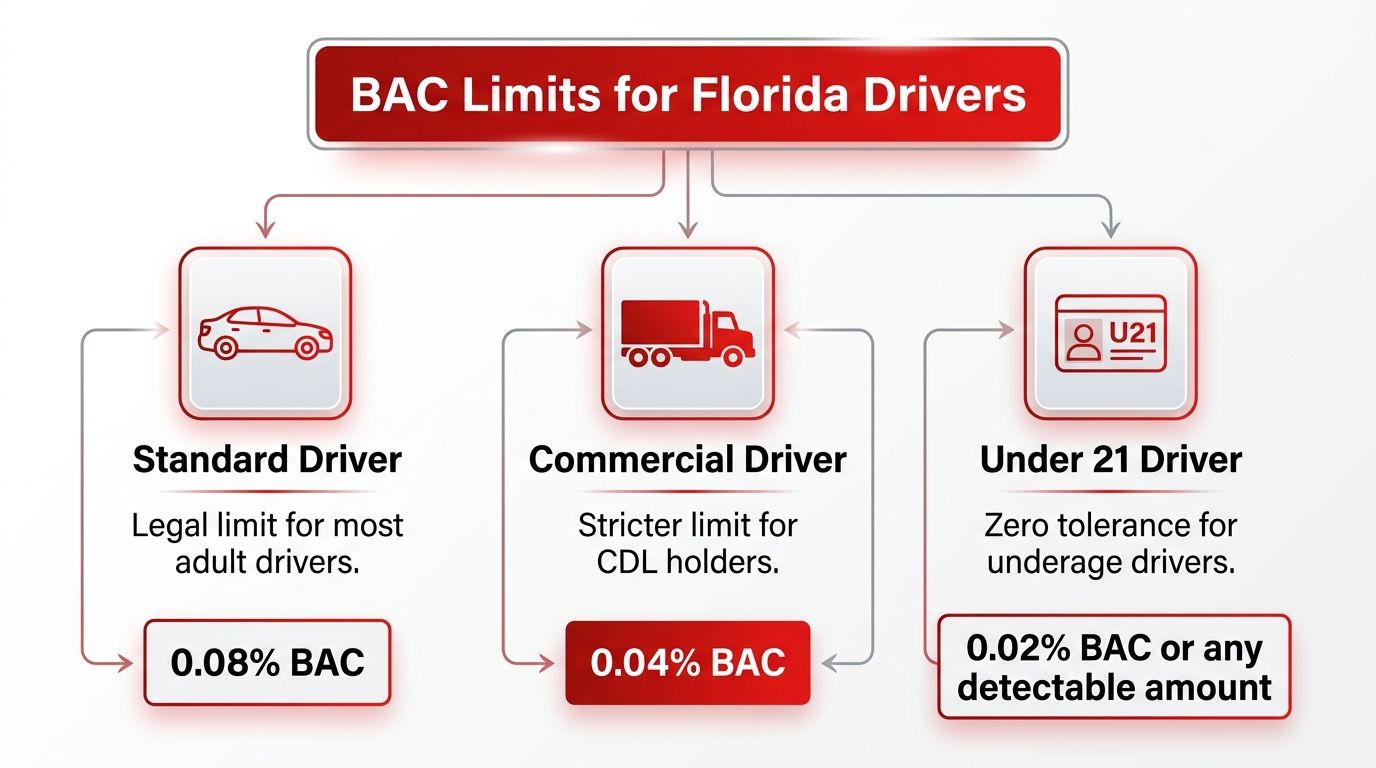
In our review of Florida DUI statutes and administrative rules, the important distinction is not just the number itself but what system is using it. Some thresholds affect the criminal case directly. Others create administrative consequences first, especially for young drivers and CDL holders. For the legal framework that controls these categories, review Florida DUI statutes and BAC thresholds.
What Is the Limit for Drivers Under 21
For drivers under 21, Florida applies a 0.02 threshold for administrative action. That is low enough that even limited alcohol consumption can put a young driver’s license at risk.
That does not automatically make every under-21 case identical to a standard adult DUI prosecution. A young driver can face a DHSMV suspension under the zero-tolerance system even where the criminal case requires different proof or is charged differently. In practice, families often get caught off guard: the license problem may move faster than the court case.
What Are the Rules for Commercial and Gig Drivers
Commercial drivers face a 0.04 alcohol limit in the CDL setting. The practical reason is simple: Florida and other states impose stricter standards on people operating commercial vehicles because the public-safety risk is higher.
CDL consequences can also differ from the standard adult-license consequences. A driver may be dealing with both the DUI case and separate commercial-driving consequences affecting employment and eligibility to drive commercially. Gig drivers are not subject to a special BAC statute in the same way, but an arrest can still disrupt app access and income almost immediately, which makes fast action on the license side especially important.
What About Boating Under the Influence
Florida also uses a 0.08 threshold in BUI cases, but boating under the influence is a separate offense from road DUI. The number is similar; the legal setting is not.
That distinction matters because vessel stops, marine patrol practices, and on-water observations can create different factual issues than a traffic stop on land. It is worth noting, but it should not distract from the core point: for road DUI, the driver categories above are the ones that usually change the threshold analysis.
What Happens at a BAC of 0.15 or Higher
A reported BAC of 0.15 or higher does not create a new basic legal limit. Instead, it can raise the stakes by triggering enhanced penalties under Florida’s DUI statute, including ignition interlock consequences in some first-offense situations.
That is why a 0.15 reading matters even though the standard adult threshold is still 0.08. Higher numbers tend to increase plea pressure, but they should still be examined like any other test result: machine history, observation period, operator conduct, and timing all still matter.
What Are the Immediate Penalties for a Florida DUI
The immediate consequences depend on what triggered the case. A breath result over 0.08, a refusal, an under-21 administrative result, a CDL-related incident, and a reported 0.15+ result do not all play out the same way. Florida separates administrative license action from criminal court penalties, and that distinction matters from the first day.
For most adults, a first arrest with an unlawful breath result can trigger an administrative suspension while the criminal case is still pending. A refusal usually creates a longer administrative suspension. An under-21 driver may face zero-tolerance administrative consequences even when the criminal side is more nuanced. A CDL holder can face additional damage to commercial driving privileges. And a reported 0.15+ level can increase exposure in court if there is a conviction under § 316.193.
The Administrative License Suspension
The license case starts first and moves fast. Florida DHSMV gives most drivers only 10 calendar days from the arrest date to request a formal review hearing to challenge the administrative suspension, as explained by DHSMV’s DUI hearing guidance.
That deadline matters because the administrative case is separate from what happens later in court. If you miss the hearing window, you may lose the chance to contest the suspension in that forum even though the criminal case is just beginning. In our review, this is the most consequential early deadline in a typical Florida DUI case.
Keep this table in front of you.
Action at Time of Arrest | Suspension Period | Hardship License Eligibility |
|---|---|---|
Blew over 0.08 on a first offense | 6 months | May be immediately eligible |
Refused a lawful test on a first refusal | 1 year | No hardship license for the first 90 days |
Under 21 with 0.02 or more | Administrative action may apply | Eligibility depends on the specific DHSMV process |
A hardship license is limited driving privilege, not full reinstatement. It may allow driving for work, school, business purposes, or other approved needs, but eligibility depends on the type of suspension and compliance with required steps such as DUI school. That is very different from fully winning the hearing or later beating the criminal charge.
Act like every day matters, because it does. Save the ticket, bond papers, DUI citation, temporary permit, tow documents, and anything the officer gave you. Then get counsel who handles the license hearing and the court case together. Florida’s DUI system rewards a coordinated response, not a handoff between disconnected offices. A lawyer-led Florida DUI defense strategy gives you a better shot at protecting both mobility and the case itself.
The Criminal Court Penalties
The criminal case brings a different set of risks. A first DUI conviction can mean fines, probation, community service, DUI school, possible jail exposure, and a court-ordered license suspension. A 0.15+ reading or a child passenger can increase penalties. A repeat offense or a crash with injury can raise the stakes much further.
The key difference is timing and source of authority. The administrative suspension is imposed through the DHSMV process soon after arrest. A court-ordered suspension follows a conviction or other court outcome. One can hit before the other, and they are not interchangeable.
That is where people get hurt by ticket-mill representation. High-volume operations often push the criminal court date while letting the DHSMV deadline slip or treating the hearing as an afterthought. You need someone building both tracks at once, using the hearing to question officers early, preserve testimony, and look for weaknesses the prosecution will have to live with later. Even broad legal marketing strategies discussed in TV Advertising for Lawyers do not tell you whether a firm will do that work for your case.
What the two-track system means for you
Protecting yourself starts with action in the first 10 days. Do not wait for the arraignment. Do not assume the court will fix the license problem. It will not.
Get the hearing requested. Get the reports. Get the video preserved. Get counsel who treats the license fight and the criminal case as one defense plan, because in Florida, that is the only smart way to handle a DUI arrest.
How Can You Defend Against a Florida DUI Charge
You defend a DUI by attacking the state’s proof, step by step. Not with excuses. With evidence. The state must prove the stop was legal, the investigation was proper, the testing was valid, and the evidence is reliable.
That gives you more room than many might expect.
Where strong DUI defenses usually start
Some defenses begin with the traffic stop itself. If the officer lacked a lawful basis to stop you, everything after the stop may be vulnerable.
Other defenses focus on roadside investigation. Field sobriety exercises are often poorly explained, badly demonstrated, or performed under lousy conditions. Video can expose that. So can inconsistent police paperwork.
Chemical testing creates another major opening. Breath testing depends on approved procedure, proper observation, and a machine operating the way it should. Blood testing depends on collection, handling, and analysis protocols. If the state skipped steps, rushed steps, or documented them poorly, the result can be challenged.
There are also timing defenses. Alcohol absorption can continue after driving stops. In some cases, a rising BAC argument can matter if your level was lower while you were driving than when later tested. Medical issues can matter too. Conditions affecting breath composition or physical balance can distort what police and prosecutors claim the evidence means.
A useful way to think about legal marketing claims versus actual legal service is this. Public advertising may get your attention, but your case is won by evidence review, motion practice, and court strategy. If you’re curious how firms think about visibility versus substance, this guide on TV advertising for lawyers gives helpful industry context. Your DUI defense, however, needs a real lawyer analyzing reports, video, testing logs, and deadlines.
Immediate Steps You Must Take After a DUI Arrest
Do these now. Not next week.
Write everything down today. Start with the reason for the stop, where you were, what you drank, what you ate, what shoes you wore, what the officer said, whether there was body cam, and when testing happened. Small details become major defense points.
Stop discussing the case. Don’t explain it to police, friends, coworkers, or the rideshare platform if you drive for income. Statements spread fast and help the prosecution more than they help you.
Preserve documents and digital evidence. Save the citation, notice of suspension, tow paperwork, bond forms, and screenshots of anything tied to your trip, route, or timeline.
Act like your license hearing matters, because it does. A lot of drivers learn this too late. The deadline won’t move because you were overwhelmed.
Protect your income immediately if you drive for work. Verified guidance for this article states that Uber, Lyft, and DoorDash drivers can be immediately deactivated after a single DUI arrest, which makes fast license protection and reinstatement a priority under Florida’s DUI statute framework.
Get legal review from a real attorney, not an intake maze. You need direct analysis, not a chatbot, a middleman, or a ticket mill that treats a DUI like a speeding citation.
For Florida drivers who want a lawyer-led option, Ticket Shield’s DUI defense overview explains the issues that should be reviewed right away. The key distinction matters. With a lawyer-led model, you speak directly with your attorney by phone or text instead of getting routed through layers of staff or automated apps.
If your case is pending near the Edgecomb Courthouse in Tampa, or anywhere else in Florida, the same rule applies. Fast action protects options. Delay closes them.
Don’t focus on proving you’re a good person. Focus on forcing the state to prove its case.
Frequently Asked Questions
What is the legal BAC in Florida?
For most adult drivers in Florida, the unlawful BAC threshold is 0.08. Commercial drivers are generally held to 0.04, and drivers under 21 can face administrative action at 0.02 under the state’s zero-tolerance rules. See § 316.193 and DHSMV hearing information.
Is 0.15 BAC drunk?
A 0.15 reading is well above Florida’s standard adult limit of 0.08, and in a DUI case it can trigger enhanced penalties if the result is admitted and the person is convicted. It is not a separate basic legal limit, but it is a level the statute treats more harshly because of the increased risk and penalty exposure.
Is a DUI a felony in Florida in 2026?
Usually, a first DUI in Florida is not a felony. But a DUI can become a felony in 2026 if it involves serious bodily injury, certain repeat-offense circumstances, or DUI manslaughter under Florida law. The charge level depends on the facts and the person’s record, not just the BAC number.
How many beers for a DUI in Florida?
There is no reliable beer count that tells you whether you will be at or over the limit. Body weight, metabolism, food, time, drink size, and the gap between driving and testing all change the result, which is why online drink charts are poor legal guidance. In practice, this is one of the most dangerous shortcuts people rely on.
Can you get a DUI in Florida if you blow under 0.08?
Yes. Florida can still prosecute DUI based on alleged impairment of normal faculties even without a test over 0.08. Officers and prosecutors may rely on driving behavior, statements, video, witness testimony, and field sobriety evidence.
Does refusing a breath test avoid a DUI charge?
No. Refusing a lawful test does not automatically prevent a DUI prosecution, and it can trigger a separate administrative license suspension under the implied-consent law. The state may still use officer observations, driving evidence, video, and the refusal itself in the case.
If you were arrested for DUI in Florida, get legal help now. Ticket Shield, PLLC provides a lawyer-led defense so you can speak directly with your attorney by phone or text, not a chatbot or middleman. The goal is simple. Protect your license, protect your record, and fight for the No Points outcome wherever the law allows.