DUI Defense Florida: Critical Steps to Protect Your Rights
Facing DUI charges in Florida? Learn critical first steps, DMV hearings, and strategic DUI defense Florida options to protect your license and record.

TL;DR: If you were arrested for DUI in Florida, your case started on two tracks at once. You must defend the criminal charge and move fast on the DMV suspension within 10 days under Fla. Stat. §322.64. Delay costs advantage, license rights, and options.
You’re probably reading this after a sleepless night. Your car may be impounded. Your license may feel like it’s hanging by a thread. You may have court paperwork on the kitchen counter and no clear idea what happens next.
Start here. A Florida DUI is not just a court case. It is a fast-moving legal problem with immediate consequences for your license, your job, your insurance, and your record. If you do the wrong thing in the first few days, you hand the State an advantage it hasn’t earned.
There is a path forward. But it starts with urgency, not denial.
Table of Contents
You Have Been Arrested for DUI in Florida What Now
The stop is over. The booking is over. The fear isn’t.
Now the full impact begins unless you respond the right way. In major Florida court systems, prosecutors and law enforcement handle DUI cases aggressively. In one recent year, Hillsborough County recorded 3,256 convictions, and Miami-Dade recorded 2,274, according to Florida DUI arrest and conviction data. That matters because it shows how seriously these cases are pushed in places like Tampa and at Miami’s Richard E. Gerstein Justice Building.

A lot of drivers make the same mistake after release. They tell themselves they’ll deal with it next week. They wait for the court date. They assume the paperwork will explain everything. It won’t.
You’re dealing with two clocks. One is the criminal case. The other is the threat to your license. Those clocks do not wait for you to feel ready.
The first problem is confusion
Individuals often don't know whether they were charged under Florida Statute §316.193, whether they refused testing, whether they blew over the legal limit, or what their temporary driving status is. That confusion is normal. What isn’t acceptable is letting that confusion turn into inaction.
Your first job is simple. Preserve your rights before the deadlines close.
Practical rule: Don’t treat a DUI like a traffic ticket. It is a criminal charge with a separate license fight attached to it.
The second problem is silence
You do not help yourself by calling the officer, explaining your side to the prosecutor, or posting online about what happened. You also don’t help yourself by taking advice from friends who had a completely different case in a completely different county.
Every DUI defense florida strategy starts with the documents, the stop, the testing process, and the timeline. Not opinions. Not panic.
Read a grounded overview of what happens after a DUI arrest and then act on your own case immediately.
If your arrest happened near the Edgecomb Courthouse in Tampa, the Broward County Judicial Complex, the Orange County Courthouse, or downtown Miami, the principle is the same. The state has already started building its file. You need to start building your defense today.
What Does a Florida DUI Charge Actually Mean
Florida does not need to prove you were falling-down drunk. That misunderstanding hurts people every day.
Under Fla. Stat. §316.193, the prosecution can generally pursue a DUI case in two ways. It can argue that your normal faculties were impaired, or it can rely on an unlawful alcohol level result. If you don’t understand that split, you won’t understand how to fight the charge.
Impairment is one path to conviction
“Normal faculties” is broad. It can involve how you spoke, walked, responded, turned, balanced, followed instructions, or drove. That means the prosecutor may try to build a case even if you believe your alcohol level was not the actual issue.
That’s why DUI defense florida work is detail-heavy. The bodycam matters. The dashcam matters. The officer’s wording matters. The timing matters.
In 2021, Florida law enforcement made over 38,000 DUI arrests. Those arrests were connected to thousands of crashes, including 407 fatalities from alcohol-only incidents and 420 from drugs-only incidents, according to Florida DUI statistics compiled from DHSMV data. The takeaway is straightforward. The state treats impaired driving enforcement as a priority, and prosecutors don’t need much encouragement to push these cases hard.
Alcohol level is the other path
If the State has a breath or blood result it believes is legally sufficient, it will try to use that result as the center of the case. But that doesn’t make the case unbeatable. It only tells you where the fight may begin.
A strong defense asks questions like these:
Was the stop lawful: If the officer lacked a valid legal basis to stop you, key evidence may be vulnerable.
Was the arrest supported: Probable cause is not automatic just because an officer says it existed.
Was the testing reliable: Machines, maintenance, observation periods, and operator conduct matter.
Was the timeline clean: Delays between driving and testing can create serious issues.
The State has the burden. You do not have to prove innocence. You attack weaknesses.
Driving is not always as simple as it sounds
The State also has to connect you to driving or actual physical control of the vehicle. Sometimes that point is obvious. Sometimes it isn’t. If an officer found you in a parked car, sleeping in a vehicle, or near the vehicle after the fact, those facts need serious review.
That is why clients should stop saying, “I was in the car, so I guess I’m stuck.” Maybe. Maybe not. The legal analysis depends on the exact facts, the officer’s observations, and what the evidence shows.
If your case is set in Orlando at the Orange County Courthouse or in Fort Lauderdale at the Broward County Judicial Complex, the statute is the same. The argument is built from the facts. Every word in the report needs to be tested, not accepted.
The Two Battles You Must Fight The Criminal Case vs The DMV Hearing
You leave jail believing your main fight starts at court. It does not. Your DUI case already split into two separate fights the moment the arrest happened, and if you ignore the DMV side, you hand the State an early advantage.
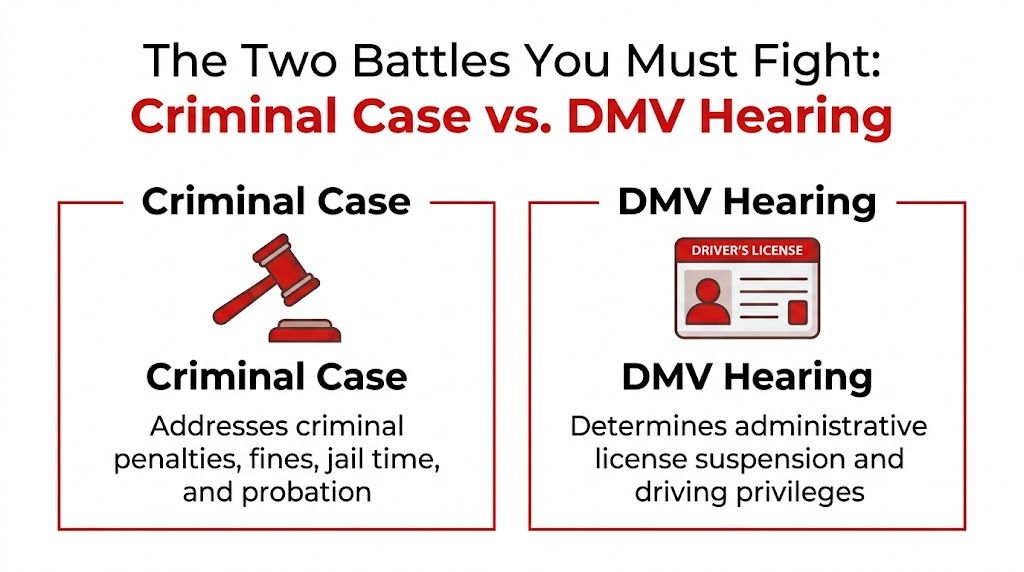
One track is the criminal prosecution under Chapter 316, usually focused on §316.193. The other is the administrative license suspension handled through the Department of Highway Safety and Motor Vehicles under §322.64. Different officials decide them. Different rules control them. Both can hurt you fast.
Why the court case and license case move separately
The criminal case is where prosecutors try to prove impairment or an unlawful breath or blood alcohol level. That case can lead to fines, probation, classes, ignition interlock requirements, and a permanent record.
The DMV track is about your right to drive. It moves on its own schedule, often much faster than the criminal case. Drivers get burned when they assume the license issue will wait for a judge. It will not.
A clear breakdown of the administrative license suspension hearing process shows how quickly that separate track starts affecting your options.
Criminal Court vs. DMV Hearing At-a-Glance
Factor | Criminal Court Case | DMV Administrative Hearing |
|---|---|---|
Main issue | Whether the State can prove DUI under Fla. Stat. §316.193 | Whether the suspension should stand under Fla. Stat. §322.64 |
Decision-maker | Judge in criminal court | Hearing officer through DHSMV |
Primary risk | Criminal penalties and record consequences | Loss of driving privileges |
Focus of evidence | Stop, arrest, observations, test results, legal defenses | Reasonable grounds, lawful arrest, refusal or alleged unlawful alcohol level |
Timing pressure | Court dates follow the filing process | Immediate action required after arrest |
Strategic value | Opportunity to challenge the prosecution’s proof | Opportunity to question the officer early under oath |
Why the DMV hearing can help your criminal defense
Good DUI defense in Florida does not treat the DMV hearing as a side issue. It is part of the defense plan from day one.
If you request the hearing on time, you may get an early chance to lock the officer into testimony under oath. That is not a small procedural step. It is a chance to test the stop, the arrest, the alleged refusal, the observation period, and the officer’s memory before the criminal case gets deeper into court.
The officer’s testimony is valuable because it can expose weak probable cause, contradictions with the report, missing details, and sloppy procedure. Those problems do not stay trapped in the DMV file. They can become suppression issues, impeachment points, or negotiation pressure in the criminal case.
Use the DMV hearing as an evidence tool, not just a license argument.
That is the angle many drivers miss. They either panic about driving or panic about court. A smart defense lawyer uses the first fight to strengthen the second.
The two-track mistake drivers make
Drivers usually make one of two bad decisions.
They focus only on criminal court: They wait for arraignment, hire help too late, and miss the early chance to challenge the suspension and question the officer.
They focus only on getting back on the road: They treat the DMV issue like paperwork and fail to build positions that could help beat or reduce the criminal charge.
Both mistakes weakened their position.
Your criminal case and your DMV case are separate, but your strategy should be unified. If your case is pending in Tampa at Edgecomb Courthouse or in Broward at the Broward County Judicial Complex, the rule is the same. The first days after arrest are active defense time, and the DMV deadline can shape what happens in criminal court months later.
What Are Your Immediate Steps in the First 10 Days
You get out of jail, your car is gone, your court date feels far away, and it is easy to make the worst mistake in a Florida DUI case. You wait.
Do not wait. The first 10 days after arrest decide more than whether you can drive next week. They can shape what evidence gets preserved, what testimony gets pinned down early, and how much pressure the State can put on you later.
Under Fla. Stat. §322.64, you have 10 days to request a Formal Review Hearing and challenge the administrative suspension. If you miss that deadline, the suspension starts without a fight. This guide to the Florida DUI license suspension process and 10-day deadline explains how fast that window closes.

The right response in these 10 days is disciplined and fast.
What to do immediately
Start with your paperwork. Gather the citation, notice of suspension, bond papers, towing documents, impound receipt, and any property inventory from the jail or vehicle. Missing papers create problems later.
Next, build your own timeline before stress blurs it. Write down where you were, when you last ate, what you drank if anything, when you drove, why you were stopped, what the officer asked, whether field sobriety exercises were requested, and whether you took or refused breath, blood, or urine testing.
Then protect evidence that will disappear if you sit on it. Save texts, call logs, rideshare records, bar or restaurant receipts, parking records, surveillance possibilities, and GPS data. If there were passengers or witnesses, get their names and numbers now.
Stop talking about the case. Do not post about it. Do not text your theory of what happened. Do not send angry messages to anyone involved. Those messages can become evidence.
Call a DUI defense lawyer fast enough to act before the deadline expires. A late consultation is better than none, but early action gives your lawyer room to request the DMV hearing, review the stop, and start collecting records before they are lost.
Why the DMV deadline matters so much
Drivers often treat the DMV side as a license problem and the criminal case as the primary case. That is backward.
The DMV hearing can give your lawyer an early shot at records, sworn testimony, and procedural weaknesses before the criminal case gets deeper into court. It can also protect your ability to drive, which matters because people under transportation pressure make bad decisions in criminal court. They plead too fast. They accept weak deals. They stop fighting because they need relief now.
That is why the first 10 days are about control.
If your license matters to your job, your kids, or your basic stability, act like the deadline is today. In many cases, that pressure point is exactly what the State counts on.
Here’s a short explanation of why this deadline is so dangerous:
Do not mistake a temporary permit for safety. The deadline still runs, and missed deadlines are hard to fix.
The smartest move in the first 10 days is simple. Protect your license, protect the evidence, and build the criminal defense at the same time. That is how you stop a DUI arrest from turning into a much bigger loss.
What Are Common and Effective Florida DUI Defenses
An arrest is not proof. A report is not proof. A breath result is not unbeatable proof.
Good dui defense florida work starts by asking where the State’s case is weak. Sometimes the weakness is the stop. Sometimes it is the breath machine. Sometimes it is the officer’s interpretation of field sobriety exercises. Sometimes it is the timing between driving and testing.

Was the stop legal
A DUI case can collapse if the initial stop was unlawful. Officers must have a valid legal basis to pull you over. That may be a traffic infraction, observed driving pattern, crash investigation, or lawful checkpoint procedure.
If the basis is weak, inconsistent, or contradicted by video, the defense may pursue suppression of evidence. That is often one of the most important moves in a DUI case because it attacks the foundation of the arrest itself.
A useful primer on motions to suppress evidence in Florida traffic cases shows why procedural mistakes by law enforcement can change the entire case.
A DUI defense does not begin with excuses. It begins with the legality of what the officer did.
Can the breath result be attacked
Yes. Often.
The rising BAC defense argues that your alcohol concentration may have been below 0.08% when you were driving, even if a later test showed a higher number. The same defense framework also attacks testing reliability. According to Florida DUI defense analysis discussing the rising BAC defense, the Intoxilyzer 8000 can be challenged based on a 15-25% margin of error and improper calibration. That source states these technical defenses can lead to reduced charges or dismissals.
That matters because jurors and prosecutors often treat a machine result as final. It isn’t. Machines require maintenance. Operators must follow protocol. Timing matters. Medical conditions may matter. The observation period matters.
A breath number is evidence. It is not the end of the analysis.
Are field sobriety exercises really reliable
Not in the way police reports often suggest.
Field sobriety exercises are heavily dependent on instruction, environment, and interpretation. Was the ground uneven? Were you wearing work boots? Were you exhausted? Did you have a bad knee, back pain, inner ear issues, anxiety, or a language barrier? Was traffic flying past while an officer gave rapid-fire commands on the roadside?
Those factors don’t excuse impairment. They do challenge reliability.
Common defense angles include:
Medical explanations: Balance issues, injuries, neurological conditions, and eye problems can affect performance.
Officer instruction errors: If the instructions were rushed, unclear, or not properly demonstrated, the result may be worthless.
Poor testing conditions: Roadside lighting, weather, surface conditions, and footwear can undermine the exercises.
Subjective scoring: Officers often record “clues” in a way that favors arrest, not neutrality.
Other defense issues that can matter
Some cases also involve:
Problems with actual physical control
Weak proof on driving time
Inconsistent bodycam versus report language
Refusal procedure issues
Miranda-related problems after arrest
No single defense wins every case. That’s why canned advice is dangerous. The right strategy comes from matching the law to the facts, then pressing the issue that creates the most pressure on the prosecution.
If your case is set in Palm Beach, Broward, Orlando, or Miami, the core principle stays the same. Don’t assume the evidence is strong because the arrest felt overwhelming. Many DUI cases look stronger on paper than they do under real scrutiny.
Why Should You Hire a Lawyer Instead of an Automated App
A DUI charge is not an app problem. It is a judgment problem.
Automated systems are built for scale. DUI defense is built on nuance. One wrong call on the license issue, one missed filing, one failure to spot a suppression issue, and the case gets harder fast. A chatbot cannot cross-examine an officer at the Broward County Judicial Complex. An intake center cannot tailor your defense to your medical history, employment risk, or county-specific practice.
A DUI charge needs judgment not automation
People get hurt by convenience. They assume a slick intake form equals legal strategy. It doesn’t.
Generic DUI defense advice also fails gig drivers. According to Florida DUI guidance focused on gig worker risks, platforms like Uber and Lyft often deactivate accounts within 24 hours of a DUI arrest, long before a court date. The same source explains that a specialized attorney can pursue expedited hearings under Fla. Stat. §322.271 to restore driving privileges more quickly, which is a point automated systems usually miss.
If you drive for rideshare or delivery, your case is not just about a charge. It’s about income interruption right now.
Direct attorney access matters in a crisis
You need a lawyer you can reach. By phone. By text. Without a middleman filtering your case into a script.
That’s one reason some drivers choose Ticket Shield, PLLC, a Florida law firm that handles DUI and traffic-related cases statewide and allows clients to communicate directly with their attorney by phone or text rather than through an automated app workflow. That difference matters when the issue is strategic, immediate, and personal.
The same principle shows up outside the legal field. If your case involves language barriers, official documents, or family members who need precise communication, the logic behind the importance of professional services is similar. Precision work needs trained humans, not generic automation.
A direct review of why a local lawyer can be better than an app for Florida traffic defense is worth reading if you are deciding how to respond.
If your license, record, or livelihood is on the line, do not outsource judgment to software.
The right lawyer should do more than file paperwork. That lawyer should identify the key advantage in your case, protect your rights early, and help you avoid making fear-based decisions. If you are a military member, a professional with licensing concerns, a Spanish-speaking driver, or a gig worker facing account deactivation, that human judgment is not optional. It is the defense.
Taking Control of Your DUI Defense in Florida
You are not powerless. You are under pressure. Those are different things.
A Florida DUI charge under §316.193 is serious, but it is still a case that must be proven. The state has to justify the stop, support the arrest, defend the testing, and survive scrutiny on procedure. At the same time, your license issue under §322.64 demands fast action. That dual-track reality is why hesitation is so costly.
What you do next matters more than what already happened on the roadside.
Take control with a short, disciplined approach:
Act before the deadline: If the DMV deadline is still open, treat that as today’s priority.
Get your facts organized: Documents, timeline, video, receipts, and witness details can shape the defense.
Stop making admissions: Casual explanations often become damaging statements.
Choose real legal representation: You need strategy, not automation.
There is also a practical reason to act early that many drivers overlook. A DUI arrest can lead to insurance stress even before a case is resolved. If you are trying to understand the broader Florida coverage environment while protecting your driving future, a neutral overview of home and auto insurance in Florida can help you think through the bigger picture without guessing.
You do not need to solve every part of this alone today. You do need to make one decisive move. Put your case in the hands of someone who can challenge the evidence, protect your license, and keep the first ten days from becoming your biggest mistake.
If you want a lawyer-led plan built to protect your license, record, and the No Points goal wherever possible, visit Ticket Shield, PLLC for a free consultation today.