What Is a Motion to Suppress Evidence in Florida?
What is a motion to suppress evidence in a Florida DUI or traffic case? Learn how this powerful legal tool can protect your rights and get charges dismissed.
A motion to suppress is a formal demand your lawyer makes to a judge. It asks the court to throw out evidence the police obtained by violating your constitutional rights. If the motion succeeds, the evidence is barred, and your case may be dismissed.
When you face a serious charge like a DUI, the State's case depends entirely on the evidence they collected. But what if they broke the law to get it? A motion to suppress holds them accountable. This legal action puts the police officer's conduct on trial. It argues that law enforcement violated your constitutional rights. It demands the judge forbid the prosecutor from using that "poisoned" evidence against you.
At Ticket Shield, PLLC, you work directly with your attorney via phone or text. We are not an automated app or a ticket mill that uses middlemen. We are a lawyer-led firm dedicated to protecting your rights. We will find the mistakes that can win your case.
What is a Motion to Suppress Evidence?

A motion to suppress is your shield against illegally obtained evidence. It is a powerful legal tool that asks a judge to act as a referee and enforce the rules against law enforcement.
Think of it this way: the Constitution is the rulebook for police. If an officer breaks those rules to gather evidence against you, that evidence is considered tainted. Your attorney files a formal motion arguing that because your rights were violated, the evidence cannot be used in court. This is a proactive defense. For a Florida driver, it could mean challenging the breathalyzer results from an illegal DUI stop. It could mean questioning how an officer found something while searching your car without a valid reason. We put every detail of the police encounter under a microscope to hold them accountable.
What is the Legal Foundation for Suppression?
The Fourth Amendment to the U.S. Constitution protects you from unreasonable searches and seizures. In Florida traffic and DUI cases, this is not an abstract theory. It is a practical shield that an experienced attorney uses to protect you.
When your lawyer files the motion, we must be specific. It is not enough to simply say, "my rights were violated." We must point to the exact facts of your case and the specific Florida laws—like Florida Statute § 316.089, which governs driving on roadways laned for traffic—that show the officer overstepped their authority.
This motion flips the script. The burden is no longer on you to prove your innocence. The burden is on the prosecutor to prove to the judge that every single piece of evidence against you was obtained legally. If they cannot, it gets thrown out.
What Does the Filing and Hearing Process Involve?
Timing is critical. Florida has strict deadlines for filing a motion to suppress. Missing one can mean you lose your right to challenge the evidence forever. Acting quickly is vital.
Here is how the process unfolds:
Investigation and Filing: Your lawyer will investigate everything—police reports, body cam footage, and dispatch logs. We pinpoint constitutional violations and draft a detailed motion. We file it with the court, whether at the Edgecomb Courthouse in Tampa or another jurisdiction.
The Suppression Hearing: The court then schedules a special hearing. This is a mini-trial focused entirely on the police officer's actions, not on your guilt or innocence.
Argument and Cross-Examination: Your lawyer will put the arresting officer on the stand and cross-examine them under oath. We force them to justify every decision they made. We then present our legal arguments, showing the judge precisely how their conduct was unconstitutional.
The Judge's Ruling: After hearing from both sides, the judge makes the final call. The motion is either granted or denied.
This hearing is a critical pre-trial event. You can learn more about key court dates in our guide on what happens at an arraignment hearing. Winning a motion to suppress is difficult, but when it succeeds, the impact is a game-changer. You can review the motion to suppress findings to see the high stakes involved. This is not something an automated ticket app can do for you. At Ticket Shield, PLLC, our attorneys handle this complex process. We know the system, anticipate the prosecutor’s arguments, and build your defense to put you in the best position to win.
What Are Common Reasons to Suppress Evidence?
Police make mistakes. It happens more often than you think. Those errors can unravel the case against you. Your best defense might be built on legal grounds you did not even know existed. An experienced attorney knows what to look for in every police report, video clip, and testimony.
At Ticket Shield, PLLC, we scrutinize every part of a traffic stop for procedural errors and constitutional violations. These form the bedrock of a powerful motion to suppress. From the busy halls of the Broward County Judicial Complex to courthouses across Florida, we hold law enforcement accountable.
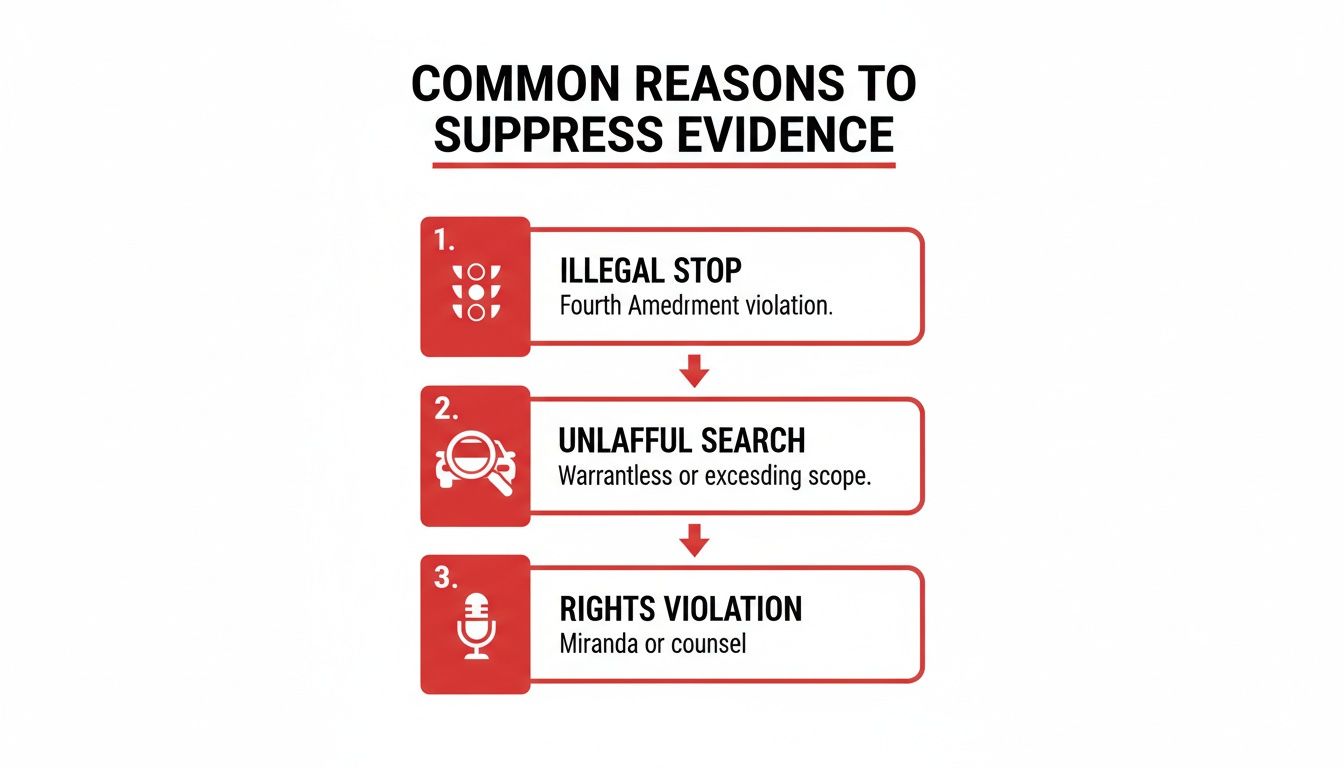
Why is an Illegal Traffic Stop Grounds for Suppression?
Think of your case like a line of dominoes. The traffic stop is the first one. If an officer cannot legally justify that first action, none of the others are allowed to stand.
An officer cannot pull you over on a whim. Florida law demands they have reasonable suspicion that you have committed a traffic violation or a crime. Without a valid reason, the entire stop is illegal. Any evidence collected afterward—every observation, every statement, every test result—is considered "fruit of the poisonous tree." If the stop is ruled illegal, the evidence that followed is thrown out. This could be anything from an officer misinterpreting a law like Florida Statute § 316.089 to not having a good reason to flash their lights.
What Makes a Search Unlawful?
The Fourth Amendment protects your vehicle. Police cannot search your car without a solid legal reason. An unlawful search is one of the most common and powerful grounds for a motion to suppress.
For a search to be legal, an officer generally needs one of three things:
A search warrant signed by a judge.
Your clear, voluntary consent, given without pressure or intimidation.
Probable cause that a crime is happening and evidence is inside your car.
That second point—consent—is where things often get blurry. Did you truly agree to the search? Or did the officer's tone and words make you feel you had no choice? That is called "coerced consent," and it is not valid. If you felt cornered into saying "yes," any evidence they found may be suppressed.
What About Miranda Violations and Chain of Custody Errors?
Your rights do not vanish in handcuffs. If police place you in custody and question you without reading your Miranda rights, any incriminating statements you make are usually inadmissible. The right to remain silent is your shield. If they fail to honor it, the prosecution cannot use your own words against you. People often wonder about the legality of recorded conversations. Knowing if Is It Legal to Record Calls? can become a factor.
Physical evidence must also be handled perfectly. The "chain of custody" is the official paper trail that tracks evidence from collection to court. If there are gaps or errors, we can argue the evidence may be contaminated or unreliable. This makes it subject to suppression. A a compromised chain of custody can destroy the State's case.
At Ticket Shield, PLLC, we explore every one of these avenues to dismantle the State's case. It is a key part of our strategy to get a DUI dismissed in Florida. This aggressive, detail-obsessed defense separates a dedicated law firm from a generic app. You are a client who deserves a real fight.
What Happens During a Suppression Hearing?
A suppression hearing is not your trial. It is a focused, pre-trial showdown where the spotlight is on the police officer's actions, not yours. Your guilt or innocence is not part of the conversation. The only question is whether the officer respected your constitutional rights.
This hearing is a pivotal moment. Your attorney puts the arresting officer on the stand and dissects every move they made. The prosecutor will try to defend the officer's conduct. In the end, the judge makes the final call.
How Does Your Lawyer Challenge the Officer?
Picture a high-stakes legal match playing out at Miami's Richard E. Gerstein Justice Building. Your attorney has filed a formal motion detailing the constitutional violations. Now, it is time to call the state’s most important witness—the arresting officer—to the stand.
Under intense cross-examination, we force the officer to justify every step:
Why did you pull this car over?
What specific observations made you suspect a DUI?
Did you follow the exact protocols for the field sobriety exercises?
Was the consent you got for the search truly voluntary?
At what point were my client’s Miranda rights read?
Our experience as former prosecutors gives you a serious advantage. We know the state’s playbook. We know the shortcuts officers take and where their testimony is most likely to crumble. We use that inside knowledge to dismantle their story in front of the judge. If you were at a DUI checkpoint, we dissect its setup to ensure it complied with strict legal standards, as detailed in our guide on Florida DUI checkpoint laws.
Why is an Experienced Lawyer Essential?
You cannot wait to challenge illegal evidence. Florida courts have strict, non-negotiable deadlines for filing a motion to suppress. If you miss that window, your right to challenge the evidence is gone.
This is why you need a dedicated attorney, not an app. At Ticket Shield, PLLC, you speak directly with your lawyer from the start. We handle all complex procedures for you, ensuring every motion is filed correctly and on time. We also handle court appearances for you in over 99% of our cases. You do not have to disrupt your life.
This hearing pits your defense against the prosecution before a judge. Winning means the evidence vanishes. This can force the state to offer a favorable plea or drop the case. You can discover more about how suppression hearings impact a case to see why expert legal guidance is crucial.
A motion to suppress is more than a form. It demands deep knowledge of constitutional law and courtroom strategy. It is an aggressive, proactive defense designed to protect your rights.
What Is the Impact of a Successful Motion?
Winning a motion to suppress is a game-changing event. It can dismantle the prosecution's case. By getting key evidence thrown out, we can often force the State to dismiss your charges, offer a major reduction, or face a trial they can no longer win.

When a judge grants our motion, the illegally obtained evidence is excluded. The prosecutor is legally forbidden from using it against you at trial. This leaves a massive hole in their argument and creates powerful opportunities for your defense.
How Can It Lead to a Case Dismissal?
For many charges, especially a DUI under Florida Statute § 316.193, the state's case often rests on one or two key pieces of evidence. This might be the breathalyzer result or the officer’s report.
If a judge rules this central evidence was obtained illegally, the prosecutor may be left with nothing. Without key evidence, they cannot prove their case beyond a reasonable doubt. They may have no choice but to drop the charges. This is a complete victory.
Your case is over. Your record stays clean. You avoid points, fines, and license suspension. This is the direct result of holding police accountable for unconstitutional actions.
How Can It Force a Favorable Plea?
Even if the case is not dismissed, a successful motion severely weakens the prosecutor's hand. Their "slam dunk" case becomes a risky gamble. They know their odds of conviction have plummeted.
This is where you gain leverage. A prosecutor facing a losing battle at the Orange County Courthouse is far more likely to offer a significantly reduced charge.
For example, a DUI charge might be reduced to:
Reckless Driving: A less severe charge that avoids harsh DUI penalties.
A simple traffic infraction: A non-criminal ticket.
These reductions are not offered out of kindness. They are forced by a strong legal defense that has taken away the prosecutor's best weapons. This is how we help clients find out if their DUI charges can be dropped or significantly lessened. The impact of successful suppression motions in criminal cases shows how effective this strategy can be. For professionals, this can mean the difference between a clean record and losing your livelihood.
Why Do You Need an Attorney for This Motion?
Filing a motion to suppress is not a DIY project. It is a complex legal battle. The rules are intricate, and the deadlines are absolute. One misstep can cost you your best defense. This is why you need a dedicated attorney, not an automated app.
Here are the immediate steps you should take:
Do Not Wait: Deadlines are unforgiving. Act now to preserve your options.
Write Everything Down: Document every detail you remember about the traffic stop.
Get Legal Counsel: Get a professional evaluation of your case before you do anything else.
Why Is an Experienced Lawyer Your Strongest Weapon?
At Ticket Shield, PLLC, you speak directly with your attorney. You will not be shuffled to a paralegal or a chatbot. We believe your case deserves the personal attention of an experienced attorney.
Successfully arguing a motion to suppress requires a deep understanding of constitutional law, court procedure, and strategy. Your case is handled by a legal professional with extensive experience—often a former prosecutor who knows the system from both sides. We have argued cases in demanding jurisdictions like Miami's Richard E. Gerstein Justice Building. We are not intimidated by aggressive prosecutors.
You can learn more about what to expect in our guide on the criminal defense attorney consultation. Do not risk your license, your career, and your future by going it alone.
Your rights are not a negotiation. Visit TicketShield.com now for a free, confidential consultation with a real attorney dedicated to fighting for No Points.