Florida DUI: Understand Charges and Defense Strategies
Facing a Florida DUI? Understand charges, penalties, & defense strategies. Get protected by an experienced lawyer, not an app. Free consult.

You're probably reading this after a sleepless night. Your car may be impounded. Your license may already be at risk. You're worried about jail, work, insurance, your family, and whether one bad stop just changed your life.
Start with this. A Florida DUI is two cases at once. One is the criminal charge in court. The other is the administrative fight over your license. If you treat this like a simple ticket, you make the first big mistake.
In Miami-Dade, where DUI enforcement remains heavy and annual arrest volume stays above 4,200 in recent summaries, local procedure matters and court familiarity matters at places like the Richard E. Gerstein Justice Building (Florida DUI hotspots data). This is not the time for guesswork.
Table of Contents
Your Florida DUI Arrest What You Must Do Now
TL;DR: After a Florida DUI arrest, protect your license first. You're facing two fights at once: a criminal case and a separate administrative suspension. The most urgent threat is the fast-moving license action, not your first court date. Act immediately and get a real lawyer involved.
Right now, your job is not to explain yourself to everyone around you. Your job is to stop the damage from spreading.
You need to understand the framework. Under Florida Statute 316.193, the criminal court will handle the DUI charge itself. Separately, the state can move against your driving privilege through an administrative process. The court date often receives primary attention because it feels more serious. Often, that's backwards.
Practical rule: Your first priority is preserving your ability to drive while your lawyer starts building the criminal defense.
If you were arrested, booked, handed paperwork, and released, it may feel like the worst part is over. It isn't. The early days after arrest are where people lose their advantage. They miss deadlines, say too much, fail to secure records, and assume the case will sort itself out. It won't.
Immediate Steps to Take
Read every paper you received: Your citation, notice of suspension, bond documents, and court paperwork matter. Don't toss anything in your glove box.
Write down what happened: Do it while your memory is fresh. Where were you stopped. What did the officer say. Did you perform roadside exercises. Did you provide breath, blood, or urine. Were there passengers.
Stop talking about the case: Don't post online. Don't text detailed explanations. Don't try to “clear things up” with law enforcement.
Preserve evidence: Save rideshare receipts, restaurant receipts, parking records, photos, and names of witnesses who saw you before the stop.
Get legal guidance fast: Use a lawyer, not a call center. If you want a plain-English breakdown of the next phase, review what happens after a DUI arrest in Florida.
Why speed matters
A Florida DUI charge sits inside a broader public-safety problem. Nationally, 11,904 people died in alcohol-impaired driving traffic deaths in 2024, and NHTSA reports about 32 people die each day in drunk-driving crashes, roughly one death every 44 minutes (NHTSA drunk-driving data). That reality shapes how police, prosecutors, and judges treat these cases. They do not take them lightly.
That's why you need to be organized and strategic from day one. Fear is normal. Passivity is costly.
What Legally Defines a DUI in Florida
Florida law does not require the state to prove a DUI only one way. That surprises people. They think the breath number is the whole case. It isn't.
Under Florida Statute 316.193, a Florida DUI is a dual-theory offense. Prosecutors can try to convict you by showing your normal faculties were impaired, or by proving a BAC of 0.08 or more in breath or blood under the statutory standard (Florida Statute 316.193).

Why the state has two ways to try to convict you
Think of it as two lanes into the same courtroom result.
In the first lane, the prosecutor argues you were impaired. That can include the officer's observations, your driving pattern, roadside exercises, your speech, your balance, and how you responded during the stop. In the second lane, the prosecutor relies on chemical evidence and says the BAC number itself meets the legal threshold.
That has one immediate consequence. A “good” driving pattern doesn't automatically save you if the test result is high. And a result below the usual limit doesn't automatically end the case if the officer claims your normal faculties were impaired.
Why normal faculties matters so much
“Normal faculties” is not abstract courtroom language. It goes to ordinary functions like seeing, hearing, walking, talking, judging distance, driving, and responding normally. That's why DUI arrests often turn on details that drivers underestimate.
A defense has to attack the lane the state is using. If the case leans on a breath result, the testing process matters. If the case leans on observations, the stop video, body camera, officer wording, and your physical condition matter.
A Florida DUI defense is not one generic argument. It is a targeted attack on the specific proof the state chose.
If you're trying to understand the legal threshold in more detail, read Florida's legal blood alcohol level rules. Then stop googling random answers and start focusing on your own facts.
What Is an Administrative License Suspension
Most drivers think the criminal case is the main event. It's not the first emergency. Your license is.
The administrative side moves separately from court. It can hit your ability to drive to work, take your kids to school, keep a commercial position, or stay active on a delivery or rideshare platform. That's why people who wait for arraignment often put themselves in a worse position before the criminal case even gets moving.

Why the real emergency is your license
You have 10 days from arrest to challenge the administrative suspension. Miss that deadline and you can lose the chance to fight it in time. This is the deadline too many people never see coming because they are fixated on the criminal paperwork.
That is the hidden threat in a Florida DUI case. The court process feels bigger, but the license issue hits faster.
Immediate Steps to Take
Count the days correctly: Start from the date of arrest, not from the date you calm down enough to deal with it.
Treat the suspension notice as urgent: It is not routine paperwork.
Request legal help before the window closes: If you need a starting point, review how an administrative license suspension hearing works.
Plan for work impact now: If you drive for income, every lost day matters.
Don't assume winning in criminal court fixes the license issue automatically: These are separate tracks.
Here is the process in visual form.
What a hearing can accomplish
A hearing gives your lawyer an early chance to examine the basis for the stop, the officer's grounds for arrest, the testing path, and the paperwork. It can also create opportunities to lock in testimony early. That matters later.
The administrative case is not a side issue. It is your first chance to pressure-test the state's version of events.
People who handle this quickly usually make better decisions in the criminal case. People who ignore it start the rest of the defense already behind.
What Is the Timeline From Arrest to Court
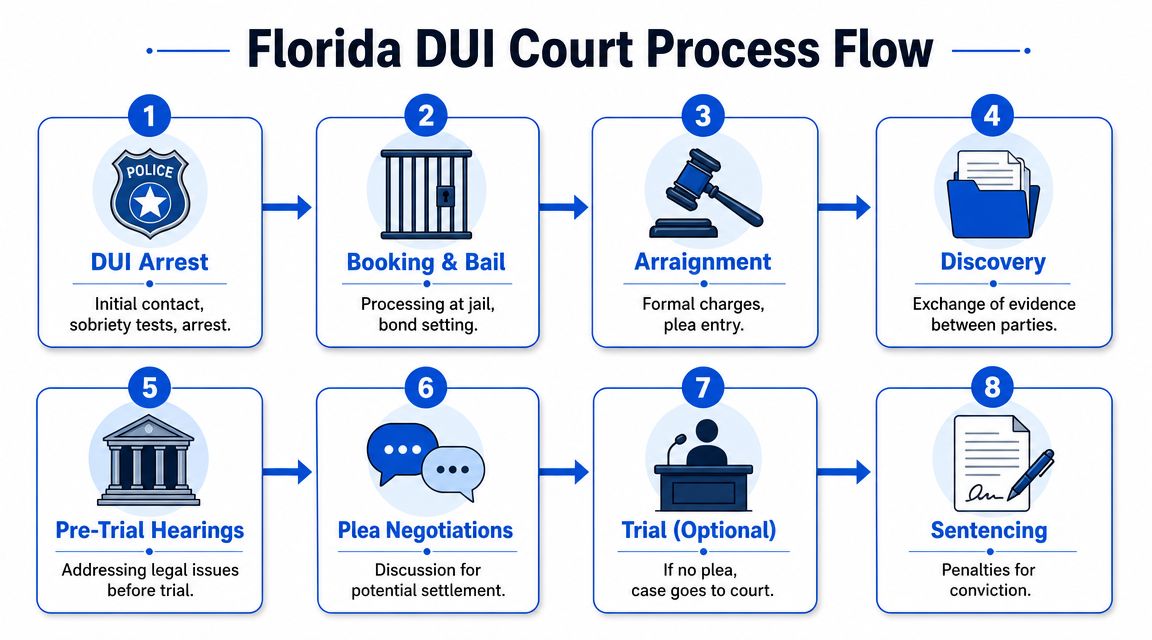
Once the arrest happens, the criminal side starts moving through a sequence that feels confusing if no one maps it out for you. The good news is that the process is usually more structured than it seems in the first few days.
You do not need to panic every time you see a court notice. You need to know what stage you're in and what your lawyer should be doing there.
What usually happens first
After arrest, you're booked. Bond issues may be addressed. Release conditions may apply. Very early appearances are not where the case is won or lost, but they matter because they set the tone and protect your immediate rights.
The next major event is often arraignment. That's where the charge is formally addressed and a plea is entered. In many DUI cases, a lawyer can handle much of that process for you so you're not stumbling through technical procedure alone. If you want to understand that event specifically, review what happens at a DUI arraignment in Florida.
When the case starts taking shape
After arraignment, the case becomes a document fight and an evidence fight.
Your lawyer should be getting the reports, video, testing records, witness material, and any other evidence the state plans to use. Through this process, sloppy police work, overstatements, contradictions, and technical weaknesses often start to appear. A case that sounded strong in the arrest report can look very different when the footage is reviewed carefully.
Early impressions are often wrong. DUI cases change once someone studies the video, the forms, and the testing trail line by line.
Pretrial hearings follow. These are where legal issues are raised, motions get argued, and negotiations start taking real shape. Some cases narrow. Some improve. Some need to be set for trial.
How the case ends
Most DUI cases do not end the same way. Some resolve through negotiated outcomes. Some go to trial. Some result in suppression fights that entirely alter the advantage.
That's why you should stop asking one broad question like “What will happen?” and start asking better ones:
Question | Why it matters |
|---|---|
Was the stop lawful | If not, key evidence may be challenged |
What proof is the state relying on | The defense strategy depends on the proof lane |
Is the video consistent with the report | Inconsistencies create leverage |
Are there aggravating allegations | They can change exposure and negotiations |
Can appearances be handled by counsel | That affects your time, stress, and work disruption |
The timeline is manageable when someone is steering it. It becomes chaotic when you wait, react late, and let deadlines dictate your options.
What Are the Penalties for a Florida DUI Conviction
You need a clear view of the risk. Not a sugar-coated version. Not a scare tactic. The actual exposure.
For a first Florida DUI conviction, public guidance summarizes penalties that include a minimum $500 to $1,000 fine, up to 6 months in jail, probation, 50 hours of community service, and a 6 to 12 month license suspension. If there are aggravators such as a BAC of 0.15 or higher, the fine range and maximum jail exposure increase (Florida DUI penalty summary).
What a first conviction can bring
Those penalties are only the beginning of what most drivers feel.
A conviction can affect employment, insurance, travel, background checks, professional licensing, and any role that depends on a clean driving history. For some people, the hardest part is not the sentence itself. It is the long aftershock.
Florida DUI penalties at a glance
Penalty | 1st Conviction | 2nd Conviction | 3rd Conviction (Felony) |
|---|---|---|---|
Fine | $500 to $1,000 minimum range summarized in public guidance | Penalties escalate | Felony exposure can escalate sharply |
Jail | Up to 6 months | Penalties escalate | Felony incarceration risk is materially higher |
Probation | Possible | Possible | Possible, with more severe conditions |
Community service | 50 hours | May increase or vary | May increase or vary |
License impact | 6 to 12 month suspension | More severe consequences | More severe consequences |
Case level | Misdemeanor in a typical first case | Can escalate based on history and facts | Can be treated as felony depending on statutory circumstances |
What makes the case worse
Florida law punishes certain facts more aggressively. A high alleged BAC can increase exposure. A minor in the vehicle can also make the case worse. Serious bodily injury and fatal cases move into felony territory under the statute. That changes the entire posture of defense.
If your case includes an aggravating allegation, do not treat it as just one more detail in the police report. That detail may control sentencing risk, plea posture, and license consequences.
The right goal isn't only “beat the DUI.” Sometimes the immediate mission is preventing the case from crossing into a harsher statutory category.
If this is your first arrest, don't make the common mistake of assuming “first offense” means “small problem.” In Florida, even a first DUI can carry enough consequences to disrupt work, family, and your record for years.
How Can You Defend Against a DUI Charge
A DUI arrest is not a conviction. That matters. The state still has to prove its case, and DUI cases often contain more weak points than drivers realize.
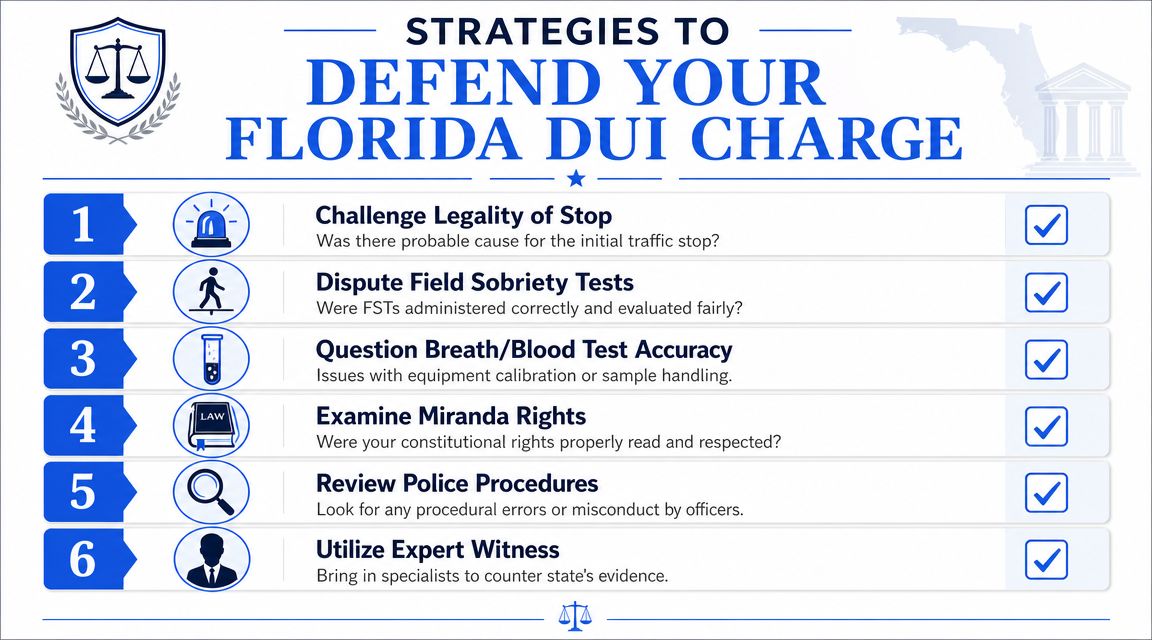
The defense is never one trick. It is a coordinated review of the stop, the detention, the roadside investigation, the chemical testing, the officer's training and wording, the video, and the paper trail. That's where experienced defense work changes outcomes.
Where strong DUI defenses usually start
Some cases begin with the stop itself. If the officer lacked a lawful basis to pull you over or extend the encounter, the rest of the case may be vulnerable.
Other cases turn on roadside exercises. Those exercises are often presented like objective science. They aren't. They can be affected by fatigue, nerves, footwear, weather, medical issues, road conditions, age, body type, and officer instructions.
Then there is the testing process. Breath testing raises questions about maintenance, operation, observation period, and procedure. Blood cases bring chain-of-custody and handling issues into focus. If your lawyer sees a constitutional or evidentiary problem, one major tool is a motion to suppress evidence in a Florida DUI case.
When mitigation still matters
Not every defense is a pure attack. Sometimes the smart move is also mitigation.
If the evidence is mixed, your lawyer may focus on reducing the damage, challenging enhancements, presenting favorable background, and protecting your license and record as much as possible. Strategy depends on facts, county practice, and your personal risk.
A Florida DUI has unusually harsh fallout for certain people. Public guidance notes that underage drivers face a 0.02 BAC threshold, commercial drivers face a 0.04 threshold, and a conviction can remain on a Florida record for 75 years (Florida DUI consequences for underage and commercial drivers). If you drive for a living, hold a professional license, serve in the military, or rely on app-based work, the defense must account for those real-world stakes.
Here are the defense angles I'd want reviewed in almost every case:
Legality of the stop: If the stop was unlawful, the state's evidence may be weakened from the start.
Officer observations: Words like “slurred speech” or “unsteady” need to be tested against video and context.
Field sobriety conditions: Surface, lighting, instructions, footwear, and physical limitations matter.
Chemical test handling: Machines and samples do not interpret themselves. People run them. People make mistakes.
Statements you made: Timing, custody status, and warnings can matter.
Enhancement allegations: High BAC or other aggravators should be challenged aggressively when the evidence is soft.
A careful lawyer looks for the detail that changes everything. Most drivers never see that detail on their own.
Why You Need a Real Lawyer Not an Automated App
A Florida DUI is not a speeding ticket with a nicer interface. It is a criminal case, a license case, and often a work-risk case all at once. That requires judgment. Not automation.
An app can collect your contact information. It can't cross-examine an officer. A middleman can send updates. They can't decide whether to attack the stop, push a suppression issue, or structure a negotiation around a weak impairment narrative.
A DUI case is not a form submission
People often get burned by impersonal systems. They think they hired a defense, but what they really bought was intake.
You need to know who is reading the arrest report. Who is reviewing the body cam. Who is making the call on whether the chemical evidence is the central struggle or a distraction. If you cannot directly reach your lawyer by phone or text, you are already operating with less protection than you should have.
This is also why professional service businesses that want trust in local markets invest in clear, educational communication. If you're curious how firms use educational publishing to earn confidence before a client ever calls, this overview on how to boost local sales with content marketing is useful context.
What direct attorney access changes
Lawyer-led representation changes the case because it changes the decisions.
At Ticket Shield, PLLC, clients speak directly with their attorney by phone or text. That matters in DUI cases because facts change quickly, deadlines are tight, and strategy should not pass through layers of staff, chatbots, or a ticket-mill workflow. You need answers from the person responsible for your defense.
If you're choosing representation, use this filter:
Question to ask | Why it matters |
|---|---|
Will I speak directly to my lawyer | Strategy should come from counsel, not a relay chain |
Who handles court appearances and motions | You need accountability |
How will you attack my specific evidence | DUI defense is fact-specific |
How do you handle the license side | The administrative case needs immediate attention |
Can you explain the next step in plain English | If they can't explain it, they may not be controlling it |
Hire a real lawyer. Do it quickly. Protect your license first. Then build the criminal defense the right way.
If your goal is to protect your license, avoid points where possible, and stop a DUI charge from doing more damage than it already has, get legal help now. Visit Ticket Shield, PLLC for a free consultation and take immediate action toward the No Points goal.