What Happens at a DUI Arraignment in Florida?
Charged with a DUI in Florida? Learn what happens at a DUI arraignment, your plea options, and the immediate steps you must take to protect your license.

You open the mail, see a court date, and your stomach drops. That reaction is normal. A Florida DUI charge under Florida Statute § 316.193 is not a ticket you just pay and forget. It starts a criminal case, and at the same time, your ability to keep driving may already be at risk through a separate administrative process.
Often, the focus is on the courtroom and neglects the more urgent threat. That's a mistake. If you want to understand what happens at a dui arraignment, you need to understand two tracks at once: the criminal case in court, and the license suspension issue moving on its own clock.
Table of Contents
Your First Court Date After a DUI Arrest
At a Florida DUI arraignment, you are formally charged before a judge. You must enter a plea (Not Guilty, Guilty, or No Contest). The court also sets bond conditions and schedules future dates. An attorney can often attend for you.
That first notice feels personal because it is. The State is now moving from arrest to prosecution. If you were booked and held, a DUI arraignment is usually the first formal court milestone after arrest, often scheduled within 24 to 48 hours according to this arraignment overview. That hearing launches the criminal case and starts the timeline for everything that follows.
Why this date matters immediately
Your arraignment isn't where the judge decides whether you were guilty of DUI. It's where the court puts the charge on the record and forces the case into motion. That means the choices made at this point can affect your defense, your release conditions, and how quickly pressure starts building on you.
If you treat this like a minor traffic matter, you hand the State an advantage. DUI under Section 316.193 carries real legal exposure, and the court process starts fast. Waiting to “see what happens” is not a strategy.
Practical rule: Your first goal is not to explain yourself in court. Your first goal is to protect your rights and stop preventable damage.
A lot of drivers also don't realize they may not need to personally stand in court for the arraignment if counsel acts quickly and files the right paperwork. That matters because people often hurt themselves by talking when nobody asked them to.
What the arraignment is and is not
This hearing is procedural. The court identifies the charge, asks for a plea, and moves the case forward. It is not a trial. It is not the moment to argue your facts to the judge. It is not the time to tell your side because you feel the police report was unfair.
Your energy should go into preparation, not improvisation. If you want a broader explanation of the court process, review this guide on what happens at an arraignment hearing.
Keep your focus narrow:
Protect your plea: Don't rush into a conviction.
Protect your freedom: Follow every release instruction.
Protect your license: The driving issue may be moving faster than the criminal case.
Protect your record: Early mistakes are hard to undo.
What Happens Inside the Courtroom
Walking into the Orange County Courthouse in Orlando can feel cold and mechanical. That's because arraignment court moves quickly. Nobody there is slowing down to make sure you feel comfortable.
Who is in the room
You'll usually see the judge, the prosecutor, the clerk, and the defendants waiting for their cases to be called. The setting is formal, but the pace can be fast enough that people miss what just happened.
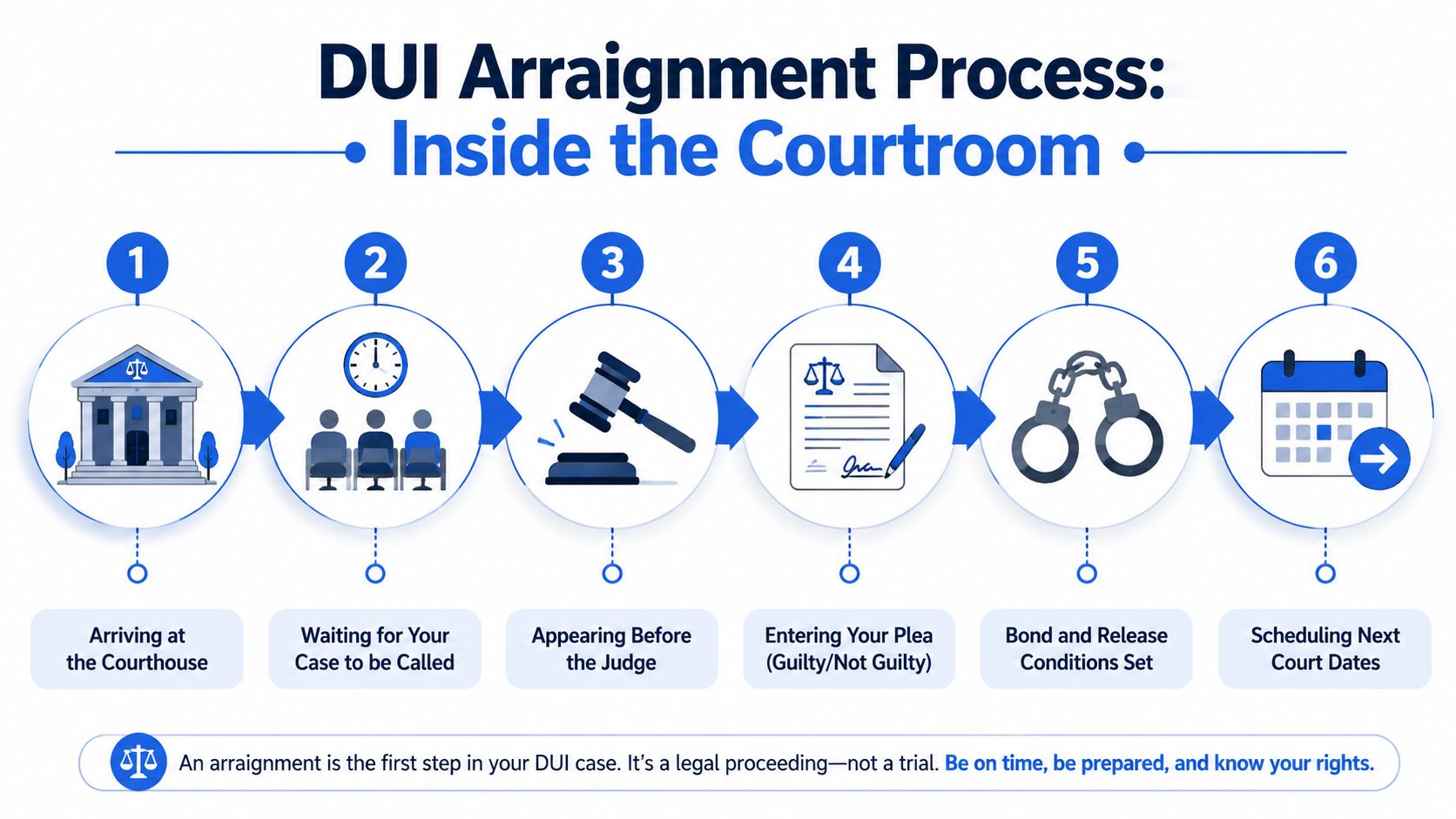
The court's basic sequence is consistent. The judge reads the charges, you're informed of the allegations, you enter a plea, and the court sets the next hearing date. The hearing can be very brief, often lasting only a few minutes, as described in this overview of arraignment procedure.
What the judge actually does
The judge or clerk calls your case. You come forward, or your lawyer appears for you if permitted. The court identifies the charge and asks for your plea.
That's the heart of what happens at a dui arraignment. It's simple on paper, but the consequences are not simple.
Here is the usual flow:
Arrival and waiting: You check in and wait for your case to be called.
Case call: The court identifies you and your charge.
Formal notice of accusation: You are told what offense the State is pursuing.
Plea entry: Guilty, Not Guilty, or No Contest.
Release issues: The court may address bond or conditions.
Next date: The court sets the next hearing.
Later in the hearing process, you may also hear terms like pretrial conference, compliance, or motion setting. Those dates matter. Missing one creates a new problem you do not need.
Here's a quick visual if you want to see how this stage usually works:
What happens before you leave
Many individuals expect drama. Arraignment is usually the opposite. It's administrative, impersonal, and fast. That makes it dangerous for unprepared defendants because the court can lock in obligations before you've even seen the evidence.
The hearing is short. The consequences are not.
Before you walk out, make sure you understand:
Your next court date
Any bond condition
Whether you must appear personally next time
Whether the court entered any restriction affecting your daily life
If anything is unclear, your lawyer should clarify it immediately. Confusion after arraignment leads to missed deadlines, preventable violations, and unnecessary warrants.
How Should You Plead at Your Arraignment
Here, people make the biggest mistake. They think pleading guilty will make the case go away faster. It will. It also gives away your advantage, your defenses, and your chance to force the State to prove anything.
Why Not Guilty is usually the right move
A DUI arraignment is not an evidentiary hearing. It's procedural. A Not Guilty plea is the standard risk-management choice because it preserves constitutional defenses, prevents an immediate conviction, and allows time for discovery and negotiation, as explained in this Florida DUI arraignment discussion.
That doesn't mean you're making some moral statement. It means you are refusing to convict yourself before your lawyer has reviewed the evidence.
Bottom line: At arraignment, a Not Guilty plea protects options. A Guilty or No Contest plea usually closes them.
If you're unsure about the effect of a no contest plea, read this explanation of what is a plea of no contest.
Florida DUI Arraignment Plea Options and Consequences
Plea Option | Immediate Outcome | Ability to Fight Case |
|---|---|---|
Not Guilty | Case continues. The court sets future dates. | Yes. You preserve defenses, discovery, motions, and negotiation. |
Guilty | The case can move directly toward conviction and sentencing. | No, in practical terms. You give up the chance to contest the charge. |
No Contest | The case generally ends with a conviction without an express admission of guilt. | No, in practical terms. You still end the case instead of fighting it. |
A smart DUI defense starts with patience and control. Your lawyer needs time to review the stop, the officer's observations, the testing process, the paperwork, the video, and whether the State can prove impairment or an unlawful breath or blood result under Florida law.
What you should avoid saying
Don't explain the stop in open court. Don't volunteer that you “only had a couple.” Don't try to sound cooperative by filling silence with facts. Your arraignment is not a therapy session, and it is not a negotiation with the judge.
Keep your role narrow. Let counsel do the talking. The right plea buys time. Time gives your defense room to work.
Understanding Your Bond Conditions and License Suspension
A lot of DUI guides stop at the plea. That misses the immediate danger. The main pressure after a Florida DUI often comes from what happens outside the criminal charge itself.
Bond conditions can trip you up fast
The judge may impose rules you must follow while the case is pending. These are not suggestions. They are court orders. If you violate them, you can create a new problem before your defense even gets started.
Common conditions can include:
Alcohol restrictions: You may be ordered not to drink at all.
Monitoring rules: The court can require supervision or compliance measures.
Vehicle-related conditions: The court may address restrictions tied to your driving.
Mandatory appearances: Missing court can trigger a warrant and make release harder later.
Even if the hearing feels routine, bond terms can affect your job, your schedule, and your daily freedom. Read every order. Save every document. Follow every condition exactly.
The license problem is separate from court
This is the issue too many drivers miss. Your DUI case in court and your license suspension problem are not the same thing. They run on separate tracks.
In Florida, the immediate question is often your driving privilege. You have a very short window, often just 10 days, to challenge the separate administrative license suspension before it takes effect automatically, according to this discussion of arraignment and license suspension timing.
That means you can be focused on court while your license problem gets worse in the background.
The arraignment handles the criminal case. It does not automatically save your license.
If you drive to work, transport children, cover sales territory, or rely on your car for deliveries, this issue may be more urgent than the arraignment itself. Review the basics of DUI license suspension in Florida immediately and act before the deadline passes.
Why this distinction matters
You can do everything right in criminal court and still lose valuable driving time if the administrative side is ignored. That's why a serious defense has to address both fronts at once:
Criminal court defense
License protection strategy
Compliance with bond conditions
Fast document review and deadline control
If your lawyer isn't talking to you about both court and license consequences right away, you're not getting a complete defense.
Your Immediate Next Steps After a DUI Arrest
You do not need a motivational speech right now. You need a checklist. Fast action protects you. Delay makes everything harder.
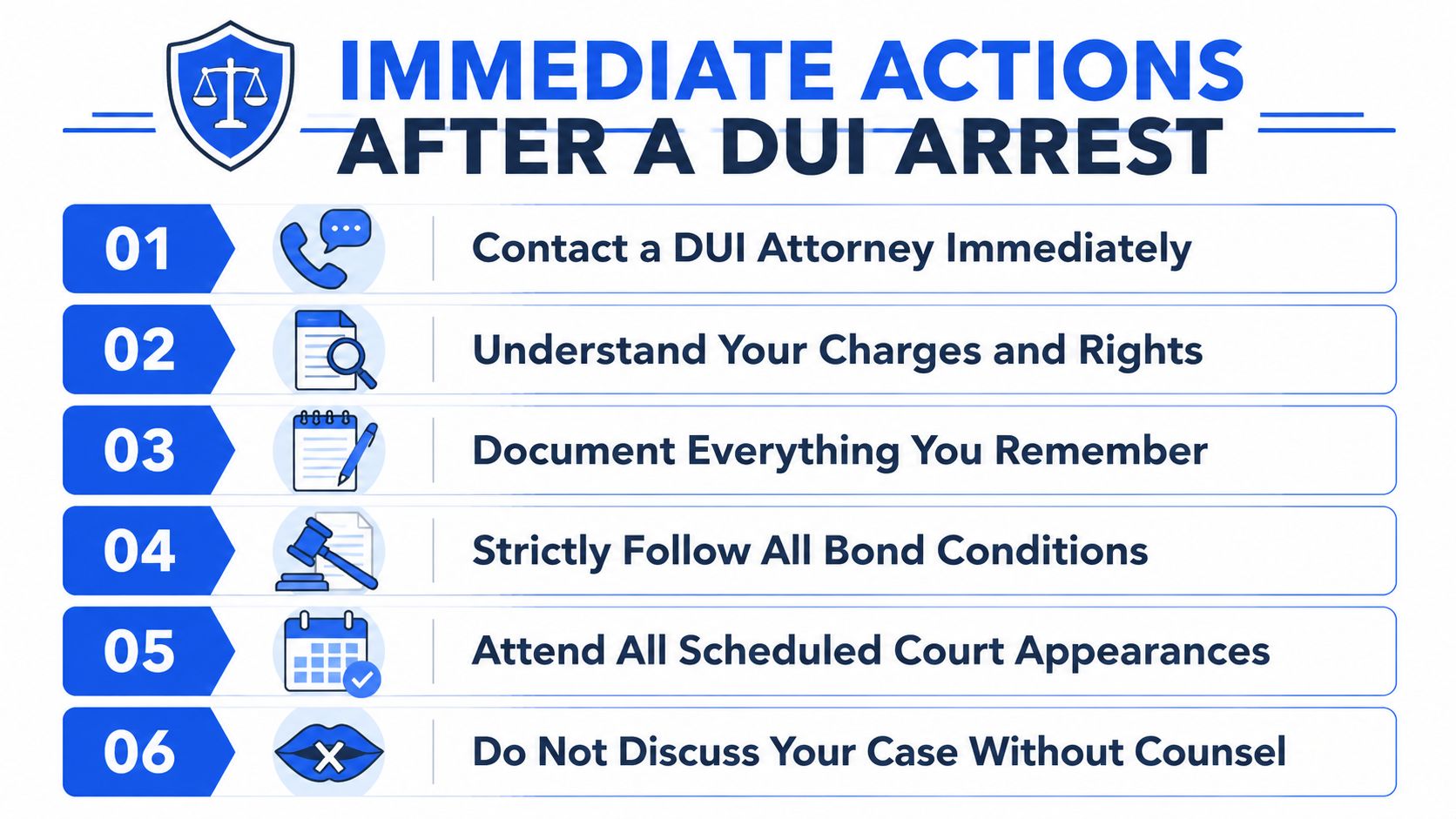
Immediate steps to take
Call a DUI lawyer immediately: Don't wait for the court date. Early legal action can help with plea strategy, appearance issues, and license protection.
Preserve every paper you received: Keep your citation, bond paperwork, notice to appear, towing papers, and any license-related documents together.
Write down what happened: Record the stop, the location, what the officer said, what tests were requested, and anything you remember while it's still fresh.
Stay silent about the facts: Do not discuss your case with friends, coworkers, or on social media. Only talk to your lawyer.
Follow every release condition: Even a careless violation can put you back in front of a judge for the wrong reason.
Address the license issue now: The administrative deadline moves fast. Do not assume court will handle it for you.
If you need a broader roadmap, review what happens after a DUI arrest.
What to bring if you must appear
In many Florida DUI cases, counsel can file paperwork to enter a plea and seek to waive your appearance at arraignment. That can keep you out of court and reduce the chance that you say something damaging. If personal attendance is required, keep it simple and professional.
Bring:
Photo identification
Court notice or charging document
Any bond paperwork
Any paperwork tied to your driver's license
Do not bring an audience. Do not bring excuses. Do not bring a story you plan to tell the judge.
Show up prepared, dressed conservatively, and ready to say as little as possible.
If a lawyer is handling the case early, they can often take control of the process before arraignment turns into a problem. That includes plea entry, waiver issues, and immediate case positioning.
Why You Need a Lawyer, Not an App, for Your DUI
A DUI charge is not a form-filling exercise. It is a criminal case with procedural traps, court deadlines, and license consequences that can move before you fully understand what happened. You need legal judgment, not automation.
Direct legal strategy beats automation
Automated apps and ticket mills are built for volume. They depend on middlemen, canned workflows, and distance between you and the person handling your case. That is a bad fit for DUI defense.
A lawyer-led firm can review the arrest documents, decide how to handle arraignment, address the plea strategically, and move on license issues without forcing you to guess. At Ticket Shield, PLLC, clients speak directly with their attorney by phone or text. That is a factual difference from platforms that route people through intake staff or chatbot-style systems. If you want to compare approaches, read why choose a local lawyer over apps.
You need a defense that does four things immediately:
Protect your right to fight the case
Keep you from making avoidable statements
Track the court deadlines
Address the separate license threat quickly
Your arraignment is the start of the case, not the end of it. Handle it like it matters, because it does.
If you were just arrested for DUI in Florida, act now. A lawyer can often step in quickly, protect your plea, address your court appearance, and help fight for the outcome you want, including the No Points goal wherever available in your overall traffic defense strategy. Visit Ticket Shield, PLLC for a free consultation.