How Do Lawyers Dismiss Traffic Tickets: Protect Your Record
Wondering how do lawyers dismiss traffic tickets? Discover expert strategies to challenge evidence, file motions, and protect your driving record.
Lawyers dismiss traffic tickets by attacking the state's proof. In Florida, that means finding defects in the citation, forcing discovery, challenging radar or officer testimony, filing motions, and pushing for dismissal or a no-points outcome before your case ever gets worse.
You got the ticket. Now you're staring at the deadline, the fine amount, and the risk to your license. Most drivers feel boxed in at this point. You're not.
A Florida traffic ticket is not a conviction. It's an allegation. Under Chapter 316 of the Florida Statutes, including violations often charged under Florida Statute 316.187, the state still has to prove its case properly. That is where a real lawyer changes the equation.
At the courthouse, whether that's the Richard E. Gerstein Justice Building in Miami or another Florida traffic division, these cases move fast. That's exactly why you need strategy early. Not an automated app. Not a middleman. Not a ticket mill that treats your record like a batch file.
Table of Contents
What Really Happens After You Hire a Traffic Lawyer?
You hire a lawyer on Monday. By Tuesday, the court deadline is under control, the ticket stops running your decisions, and the case starts getting handled the right way.
That first shift matters. A Florida traffic case can go sideways fast when a driver pays the citation, misses an election deadline, says too much, or trusts an app that files paperwork without building a real defense. My job is to stop the damage early, preserve every available option, and put the state to work proving its case.
What changes once counsel is involved
The case gets structured.
I review the citation, confirm the county and court procedure, calendar the response date, and decide the first procedural move. That can mean entering a plea, filing the right election, requesting a hearing, or preserving defenses that disappear if handled carelessly. Traffic defense in Florida is procedural before it is persuasive.
Then the case gets tested. I want to know what proof the officer has, what the state can admit into evidence, and whether the file holds together under scrutiny. A ticket mill usually stops at filing appearances and sending generic updates. A real lawyer looks for pressure points in the record and uses them.
Practical rule: Paying the ticket usually means accepting the violation, the points, and the loss of defenses you could have raised.
You also need direct communication with the lawyer responsible for the strategy. Good client contact matters, and many firms use strong systems and solutions for legal practice call handling to keep communication organized. That helps. It does not replace legal judgment.
What your lawyer is actually trying to achieve
The goal is not just “go to court for you.”
The goal is to get the best legal outcome available as early as possible. Sometimes that is a dismissal. Sometimes it is an amendment to a no-points offense. Sometimes it is a result that protects your license, keeps your insurance exposure down, and avoids a conviction that causes bigger problems later.
That work starts long before a hearing date. It includes triage, document review, procedural decisions, and targeted pressure on the weak parts of the case. If you want a clearer sense of what that early attorney review should look like, read this guide on working with a traffic ticket attorney.
Florida courts process these cases every day. That helps drivers who hire someone who knows the routines, the filing mistakes, the proof problems, and the local habits that automated services do not catch. A good lawyer does not just appear. A good lawyer gets in front of the problem early and starts narrowing the state's options.
How Do Lawyers Find Weaknesses in Your Ticket?
You hand an app your ticket, and it spits back a generic script. I do the opposite. I take the citation apart line by line and look for the exact place the state's case can fail in a Florida courtroom.
In these cases, details decide outcomes. The statute listed on the ticket, the officer's stated reason for the stop, the location, the time, the speed-measurement method, and the supporting records all matter. A small inconsistency can stay small, or it can turn into a proof problem the state cannot clean up.
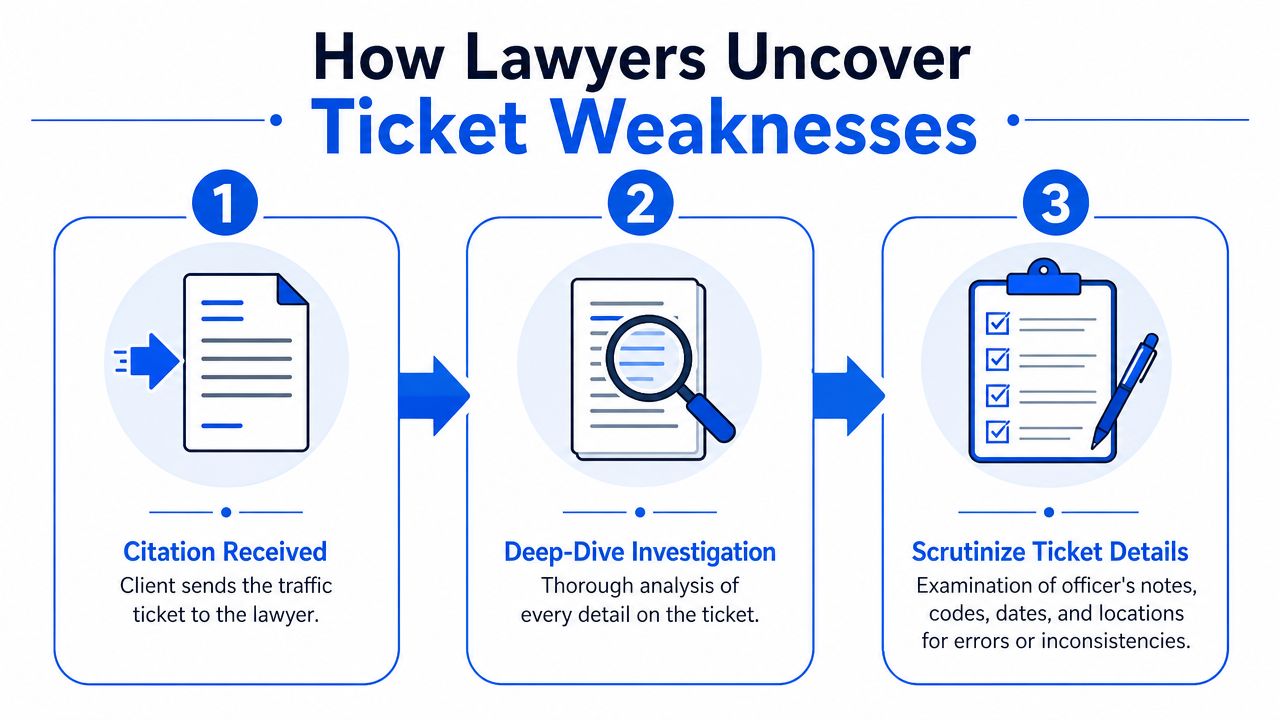
What gets reviewed first
I start with the ticket itself because that document often tells me where to push.
First, I check whether the citation matches the alleged conduct under Florida law. Then I compare the basics. Date, time, location, vehicle description, driver identification, and the officer's narrative. If those facts do not line up cleanly, that gives me room to challenge notice, identity, or the state's theory of the violation.
I also look at how the officer claims to prove the charge:
The statute cited: A mismatched charge creates a real legal problem.
The factual allegations: Vague or conflicting facts weaken the state's position.
Driver and vehicle identifiers: Errors here can affect notice and identification.
The narrative: An officer's written account often locks in testimony before court.
The proof method: Radar, lidar, pacing, visual estimate, and video all create different attack points.
That review is not clerical work. It is strategy.
What the records often expose
A real defense lawyer does not stop at the face of the ticket. I want the materials behind it. That can include notes, video, calibration documents, maintenance records, and any other item the officer or agency will rely on.
If the case depends on a speed-reading device, I examine whether the foundation for that reading is there. I want to know what device was used, whether it was maintained properly, whether the records are complete, and whether the officer can connect that device to your stop without gaps. Drivers who want the basics can read about how radar speed guns work, but the courtroom issue is simpler. A number on a ticket is not self-proving.
The same goes for video. Sometimes dashcam helps the state. Sometimes it hurts them. If the footage does not match the narrative, I use that contradiction. If the officer says one thing in writing and the video shows another, that is not a minor issue.
Automated ticket services rarely do this well because they work from templates. Florida traffic defense is not a template job. It is a record-by-record review of where the proof breaks down, where the paperwork fails, and where the officer's version does not hold up under scrutiny.
That is how weaknesses are found. Not by guessing. By testing every part of the state's case until something gives.
What Legal Tools Can Get a Ticket Dismissed Before Court?
You hire a lawyer because you want the case attacked before the hearing date, not just talked about in front of a judge after the damage is done.
That pre-court phase matters. A good Florida traffic lawyer uses motions, discovery demands, and procedural objections to force the state to prove its case early. Ticket apps and volume services usually cannot do that with any precision. They rely on standard forms. I look for the exact defect that fits your citation, your officer, and your court.
The motions that can end a case early
A motion to suppress asks the court to exclude evidence that should not come in. In a traffic case, that may involve an unlawful stop, a weak basis for detention, or evidence gathered in violation of your rights. If key evidence is suppressed, the state may have nothing left that can carry the case.
A motion to dismiss targets a different problem. It argues that the case fails as a matter of law, or that the state has a procedural defect serious enough to justify dismissal. Delay issues, charging problems, and failures tied to required court procedure can all matter, depending on the facts.
A discovery motion puts pressure where it belongs. If the officer's notes, video, calibration records, or other materials are missing, incomplete, or late, that is not a small administrative issue. It affects what the state can prove and how much confidence the court should place in the citation.
In Miami, judges at the Richard E. Gerstein Justice Building do not dismiss tickets because a driver is frustrated or has a clean story. They dismiss when the record gives them a legal reason.
Tool | What it targets | Why it matters |
|---|---|---|
Motion to Suppress | Evidence tied to an improper stop or flawed method | Excluding core proof can gut the case |
Motion to Dismiss | Legal defects or serious procedural problems | It can end the citation before a final hearing |
Discovery motion | Missing reports, logs, or footage | It forces compliance and exposes weak proof |
If you want a plain-English overview of the larger process, this guide on how to get a traffic ticket dismissed in Florida explains why timing and pressure matter as much as the ticket itself.
Pressure changes settlement posture
Prosecutors do not evaluate every case the same way.
If the officer's foundation is weak, the records are incomplete, or a pretrial motion exposes a real evidentiary problem, the state has to reassess risk. That can lead to a dismissal. It can also lead to an amendment that protects you from points, school requirements, or insurance consequences.
That is the difference between representation and mere filing help. A real lawyer creates pressure the other side has to respect because the case is prepared for litigation, not processed through a template.
A prosecutor negotiates more carefully when your lawyer can identify admissibility problems, force production of records, and argue the motion in court.
Here's a short explanation of how these arguments work in real life:
What Is Your Lawyer's Strategy at a Hearing?
A final hearing is not where your lawyer starts thinking. It's where your lawyer executes.
By the time a case gets in front of the judge, I want a theory. Not a vague complaint. A theory. Maybe the stop was weak. Maybe the officer's memory is thinner than the report suggests. Maybe the video doesn't prove what the citation claims. Maybe the state's witness cannot carry the burden under questioning.
How cross-examination creates doubt
Traffic hearings often turn on credibility. That means the officer's testimony is not sacred. It is tested.
I focus on specifics. Training. Distance. Vantage point. Lighting. Traffic conditions. What the officer remembers now versus what was written then. If the case involves visual estimation or speed detection, the details around observation and operation become fair ground for challenge.
A hearing strategy might involve:
Pinning down the timeline: If the officer can't keep the sequence straight, the court notices.
Comparing testimony to reports: Small inconsistencies can become large credibility issues.
Forcing precision on the method used: “I clocked the car” is not the same as proving a reliable speed reading.
Using the state's own materials: Video, notes, and records can undercut live testimony.
Some cases are won because the officer is wrong. Others are won because the officer cannot prove he was right.
What happens if the officer does not appear
If the officer fails to appear, that can create a real dismissal opportunity. It does not mean the court automatically hands you a win in every circumstance. It does mean a prepared lawyer knows when to object, when to resist delay, and when to ask the court to end the case.
An unrepresented driver often misses that moment. Or says the right thing the wrong way. That matters.
This is also why human-led representation beats an app. A chatbot cannot stand up in court, read the room, react to a witness problem, and preserve the record. A middleman cannot cross-examine. A lawyer can.
And while many clients won't need to be in the courtroom personally, your interests still need a live advocate there. Your job is to keep living your life. Your lawyer's job is to force the state to prove its case properly, every step of the way.
How Does a Dismissal Protect More Than Just Your Record?
You get the ticket dismissed, assume the problem is over, and then your insurance renews higher or a background screening still catches the citation. That happens more than it should. The court result matters, but the aftermath matters too.
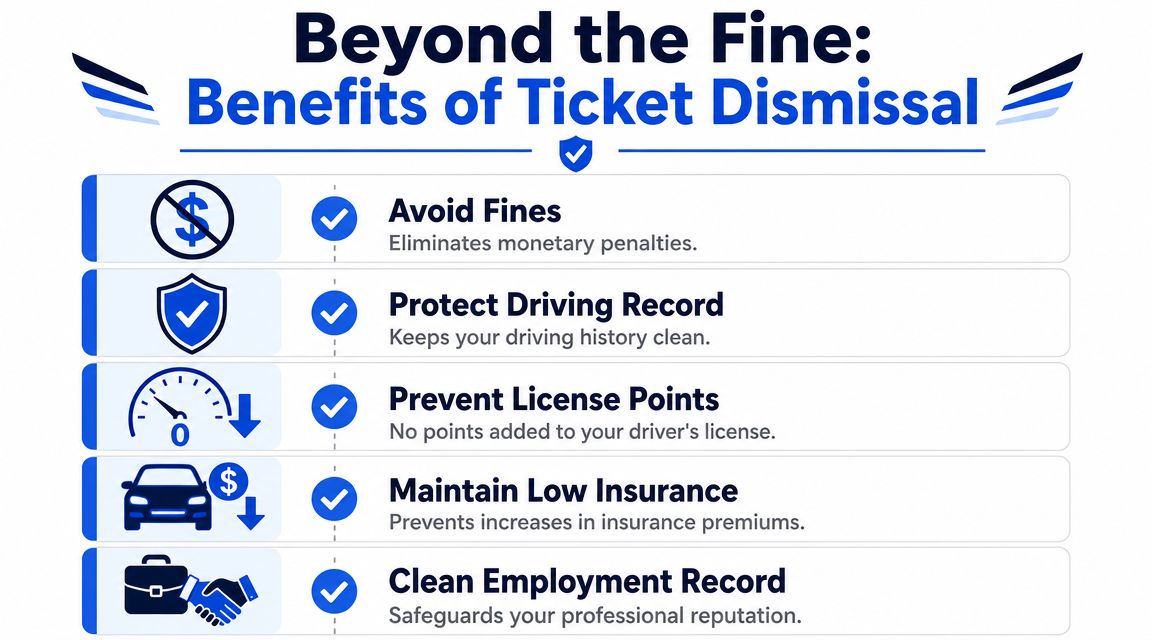
A dismissal helps protect far more than a line on your driving history. It can prevent points from affecting your license status, reduce the risk of insurance trouble, and keep a minor traffic case from creating employment headaches. For many drivers, especially CDL holders and app-based workers, that is the value.
A good result has to carry through the system
Florida traffic cases do not end the moment a judge signs off or the clerk enters a disposition. The result still has to be recorded correctly and reflected where it counts. If that part is missed, you can end up dealing with problems you should not have at all.
That is one reason real legal representation beats a ticket app or a process vendor. An app can send reminders. It cannot spot a reporting problem, push for correction, or make sure the outcome is doing the job you hired counsel to get.
What I want checked after a dismissal
After a case is dismissed or reduced, I want the practical consequences reviewed, not guessed at.
That includes:
Court disposition accuracy: The case outcome should be entered correctly in the court record.
Driving record impact: Improper points or reporting errors should not stay attached to your history.
Insurance exposure: A dismissed case should not turn into a premium problem because bad information kept circulating.
Work-related screening: Professional drivers and gig workers should confirm the citation is not showing up in a way that misstates the result.
If your job depends on screenings, review this explanation of whether traffic tickets show up on background checks.
A dismissal is not just a courtroom win. It is protection against the extra costs and administrative mistakes that follow drivers long after the stop. That is why I treat the file as finished only when the result is correct on paper and clean where it matters in real life.
Is It Worth Hiring a Lawyer for Your Florida Ticket?
Yes, if you care about your record.
That's my view, and I don't think it needs softening. The wrong move is treating the citation like a small bill and paying it just to make it disappear. It usually doesn't disappear. It follows you through points, insurance, and avoidable risk.
Florida traffic law under Chapter 316 is technical enough that technical defenses matter. The state has rules. The officer has procedures. The court has deadlines. If nobody tests those things, you're just accepting the accusation.
Immediate Steps to Take
If you've just been cited, do this now:
Do not pay the ticket: Paying is usually treated as resolving the case against you.
Preserve the deadline: Make sure the citation is contested properly and on time.
Photograph everything: Save a clear image of the ticket and any related paperwork.
Write down the stop details: Road, weather, traffic, officer statements, and anything unusual.
Get legal review quickly: Early review gives your lawyer more room to work.
What I recommend you do next
Choose a lawyer, not a process vendor.
You need direct legal judgment. You need someone who can spot issues in the citation, demand the right records, negotiate from strength, and appear in court if needed. An automated service can collect information. It cannot defend you.
For Florida drivers comparing options, Ticket Shield, PLLC handles traffic defense statewide and gives clients direct attorney communication by phone or text, which is very different from app-based intake models. If you're still weighing the decision, this breakdown on paying a ticket versus hiring a lawyer will help you think through the actual risk.
The goal is simple. No Points. That is the outcome you should protect aggressively.
If you want a lawyer-led Florida traffic defense strategy focused on the No Points goal, visit Ticket Shield, PLLC for a free consultation.