Florida Implied Consent Law: A Driver's Survival Guide
Facing a DUI in Florida? Understand the Florida implied consent law and its harsh penalties. Learn your rights and how a lawyer can protect your license.

Florida's implied consent law means your Florida driving privilege carries pre-consent to certain DUI tests after a lawful arrest under section 316.1932. If you refuse, you face both a criminal problem and a license problem. Act fast to protect your license.
You're probably reading this with a DUI citation on the seat next to you, your license taken, and a dozen unanswered questions racing through your head. Good. That means you're still in time to protect yourself.
The first mistake drivers make is treating a DUI arrest like an ordinary traffic ticket. It isn't. In Florida, the fight starts immediately and it splits into two separate battles. One is criminal. The other is administrative, and that second track can take your license before your court case is resolved.
If your arrest happened in Miami, the consequences can start chasing you long before you ever stand inside the Richard E. Gerstein Justice Building. The roadside decisions you made, or didn't make, now matter. A lot.
Table of Contents
You Were Pulled Over What Happens Next
A Florida DUI stop usually unfolds fast. The officer says they smell alcohol, asks where you're coming from, and starts watching every word, every movement, every pause. Then comes the pressure. Step out. Perform exercises. Blow into a machine. Agree to more testing.
That moment is where many drivers lose control of the case.
Under Florida law, this isn't just about whether you want to cooperate. Your driver's license carries legal conditions. Once a DUI investigation becomes an arrest-based implied consent situation, the officer is no longer asking for a casual favor. They're invoking a law tied to your driving privilege.
If you want a plain-language breakdown of how the stop itself develops, read what a traffic stop really involves in Florida. It helps you understand where the officer's observations begin and where your defense may begin too.
What the roadside pressure is really about
Officers build DUI cases in layers. They start with driving pattern allegations, then physical observations, then your statements, then any test issue. If you refused a chemical test after arrest, the state may try to use that against you. If you submitted, they may try to use the result against you.
Either way, you need to stop thinking about what feels fair and start thinking about what is legally attackable.
Practical rule: The roadside is not where you win your DUI case. The roadside is where the state tries to build it.
What you should focus on right now
Right now, your priorities are simple:
Preserve your license issue first: The administrative side moves quickly.
Write down the timeline: Stop, questioning, exercises, arrest, warning, request for test, your response.
Stop talking about the case casually: Friends, coworkers, and texts can all become problems later.
This is where a protective defense matters. A serious lawyer reviews whether the officer had a valid basis for the stop, whether the arrest was lawful, and whether the implied consent process was handled correctly. Those aren't technicalities. Those are pressure points.
What Exactly Is Florida's Implied Consent Law
You get arrested for DUI, the officer asks for a breath or urine test, and now you are dealing with two threats at once. The criminal case goes one direction. Your driver's license goes another. Florida's implied consent law is the rule that gives the state a fast path to hit your license if the testing request was made the right way.
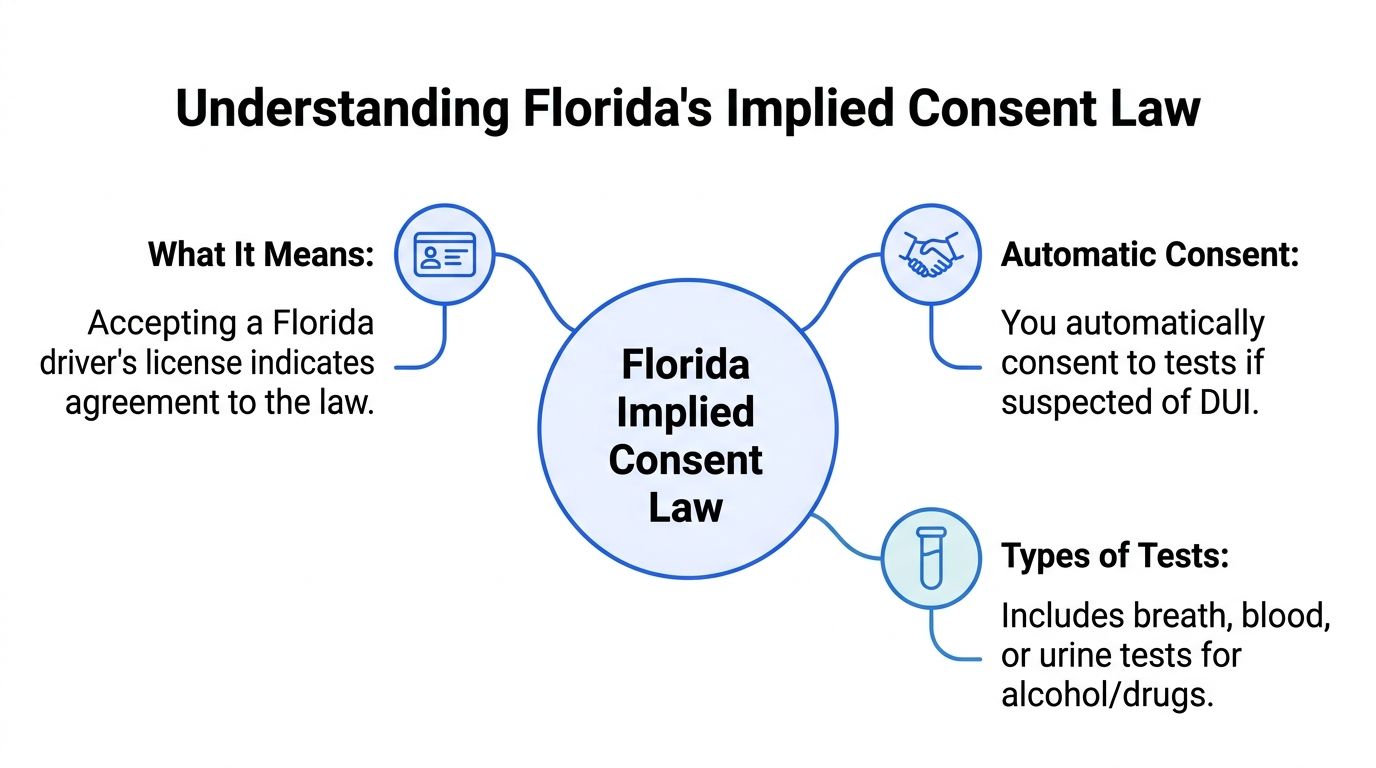
Florida ties driving to conditions. By driving on Florida roads, you are treated as having agreed in advance to approved chemical or physical testing after a lawful DUI arrest for alcohol or drugs, as described in this explanation of section 316.1932.
Why your license comes with conditions
This law does not give police unlimited authority. It gives them a specific tool, and that tool has rules.
The practical point is simple. Implied consent is usually less about helping the prosecutor prove intoxication than it is about creating an administrative license problem the moment a driver refuses. That is why you need to evaluate this case on two tracks from day one. Can the state prove the DUI in court, and can it keep the license suspension in place at the DMV hearing?
If you want more context on the testing side, review Florida's legal blood alcohol framework and related testing issues. It helps you understand why officers push hard for a chemical sample.
What tests the law covers
The statute is narrower than officers often make it sound. It covers approved chemical or physical testing tied to a lawful DUI arrest, including breath testing for alcohol and urine testing for chemical or controlled substances.
That wording matters. A serious defense starts with the sequence and the details. What test was requested? Was the request made after a lawful arrest? Was the warning proper? Was the requested test one the statute allowed under the circumstances?
Those questions are not technical fluff. They are the roadmap for attacking the administrative suspension and, in the right case, weakening the criminal case too.
Implied consent is a process rule with license consequences. If the officer missed a step, your lawyer should press that issue immediately.
The hard truth is that Florida designed this law to pressure compliance and punish refusal. Your job now is not to argue about fairness. Your job is to identify whether the officer followed the statute closely enough to suspend your license and whether that suspension can be challenged fast.
What Are Your Rights During a DUI Stop
It starts on the shoulder of the road. Blue lights behind you. An officer at your window asking where you were, what you drank, and whether you will perform tests. What you do in those next few minutes can affect two separate fights. The criminal DUI case, and the administrative battle over your license.
You still have rights during a DUI stop. Use them. You also need to understand where the state will try to turn a traffic stop into a DUI arrest, because that point often decides whether the license suspension holds up later.

What police still have to prove
The officer does not get a free pass because the report says "DUI investigation." The stop must be lawful. The arrest must be supported by enough facts. The request for a post-arrest test must fit the law.
That sequence matters for one reason. A weak stop or sloppy arrest can help your defense in court and can also provide an advantage in the administrative license suspension challenge.
Here is the practical breakdown:
Stage | What matters legally |
|---|---|
Initial stop | Whether the officer had a lawful reason to stop your vehicle |
DUI investigation | Whether the officer's observations supported probable cause |
Arrest | Whether it was lawful before implied consent was triggered |
Test request | Whether the request matched an approved statutory test |
What you should and shouldnt do
Keep your mouth under control. Be polite. Give your license, registration, and proof of insurance. Do not volunteer where you were, how much you drank, or when you last ate. Drivers talk themselves into arrests every night.
Roadside requests and post-arrest test demands are not the same thing. That distinction matters because the officer may treat everything as one continuous process, while your defense depends on separating each step and testing whether the officer handled each one correctly.
Field exercises are different: Roadside balance and coordination exercises are not the same as a post-arrest chemical test.
Your words matter: “I don't understand” is different from “I refuse.” That difference can matter later when your lawyer attacks the suspension.
Your medical condition matters: Asthma, anxiety, injuries, language barriers, and confusion can affect what the officer thought happened and what the paperwork claims happened.
One bad choice at the roadside can feed both tracks of the case. It can give the prosecutor more evidence to work with, and it can give the DHSMV a cleaner record to use against your license.
If the arrest was not lawful, the state may have a harder time keeping both the DUI case and the license suspension in place.
Do not assume the paperwork is right. It is the officer's version of events, written to support an arrest and a suspension. Your job is to challenge it fast, before the administrative deadlines pass.
What Are the Penalties for Refusing a Test
You get arrested, you refuse the breath test, and you assume you just gave the state less evidence. That is the mistake. In Florida, refusal usually creates a second fight. One case is in criminal court. The other is against your license, and that fight starts fast.
Florida built implied-consent penalties to pressure drivers into testing. As noted in this Florida implied consent warning law discussion, refusal rates historically pushed states to make the consequences harsher. You need to treat a refusal as a serious legal event, not a technical side issue.
The penalty that hits first
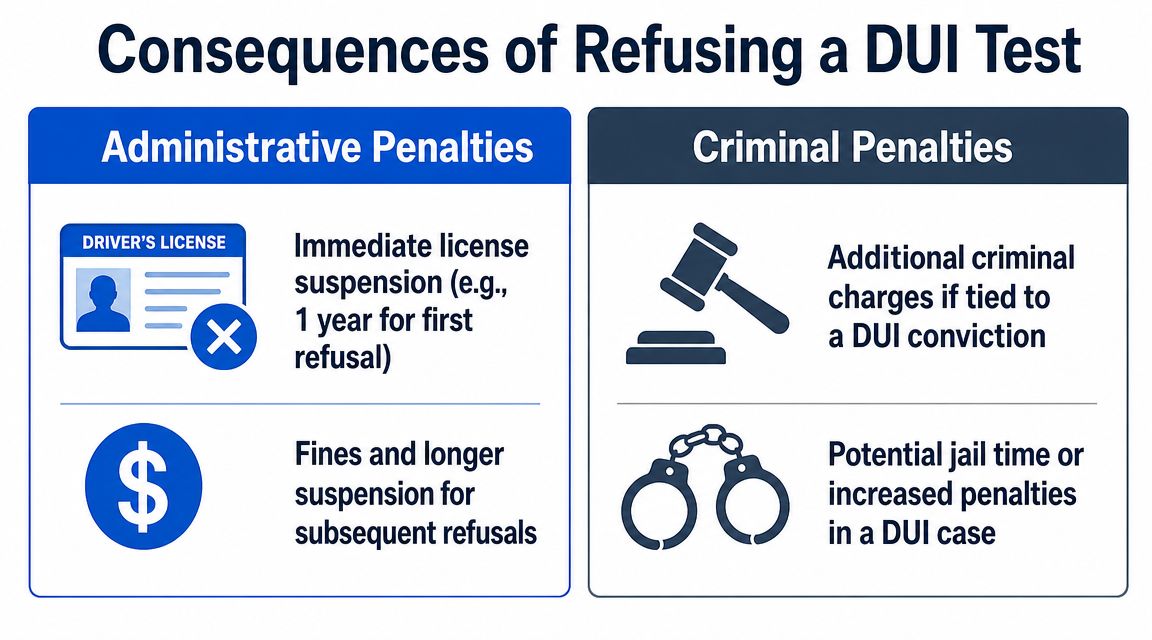
The first damage is usually administrative. A refusal can trigger a 1-year suspension for a first refusal and an 18-month suspension for a second or subsequent refusal.
That suspension matters more than many drivers realize. Court dates feel urgent, but losing the ability to drive to work, pick up your kids, or keep a professional license can do immediate damage. You need to start protecting the administrative side right away by learning how the administrative license suspension hearing process in Florida works and what deadlines control it.
Use this framework:
Track | Consequence |
|---|---|
Administrative | License suspension |
Criminal | Separate refusal offense and use of refusal evidence in prosecution |
A quick overview can help if you want to hear the issue explained in plain language:
The criminal charge drivers overlook
Refusal can also become its own charge. Under current Florida law, a refusal to take a breath or urine test can be charged as a second-degree misdemeanor on a first refusal and a first-degree misdemeanor on later refusals.
That changes the defense strategy. The prosecutor may try to use the refusal as consciousness-of-guilt evidence in the DUI case while also pursuing the separate refusal consequences. You are defending two tracks at once, and each track can strengthen the other if you sit still.
Florida has also tightened the warning language over time, including legislative updates in recent years. The trend is obvious. The state is making refusal consequences easier to enforce, not easier to beat.
Refusal is a trigger for added exposure, especially to your license.
If you refused, stop guessing and start building the record. Get the paperwork, preserve the timeline, and prepare to attack the suspension before the administrative deadline closes.
How Does the Administrative License Suspension Work
The administrative case is where drivers lose valuable time. They assume the DUI court date controls everything. It doesn't.
In a refusal case, the license issue starts almost immediately. The officer typically takes your physical license and leaves you with paperwork that becomes critical. You need to treat that paperwork like evidence, not clutter.
What happens right after the arrest
Most drivers walk out focused on bond, towing, embarrassment, and court. Meanwhile, the clock on the administrative side is already running.
Your citation or related paperwork may function as a temporary permit for a limited period. That temporary period is not a comfort. It's a countdown.
The urgent move is to review the Florida administrative license suspension hearing process and act before the deadline passes. If you miss that window, you can lose an advantage that you can't easily regain.
Why the hearing request matters
Practical defense commences at this stage. The administrative hearing is separate from the criminal DUI case. Different track. Different timing. Different objectives.
Your immediate goals are usually:
Preserve the right to challenge the suspension: Waiting can forfeit that opportunity.
Lock down evidence early: Officer reports, warnings, and timeline details matter more when gathered fast.
Create testimony opportunities: In some cases, the hearing helps expose weaknesses in the officer's account.
The license hearing is not paperwork theater. It can become one of the first real chances to test the state's story.
Drivers who move quickly usually put themselves in a stronger position. Drivers who wait often end up reacting instead of defending. That's a bad place to be when your ability to drive is on the line.
A strong lawyer approaches this hearing as more than a formality. It can be an evidence-gathering tool, a strategy tool, and in the right case, an attack point that helps the criminal side too.
How Can You Challenge an Implied Consent Suspension
You challenge an implied consent suspension by attacking the foundation, not by asking for sympathy. The hearing officer won't care that suspension is hard on your job or family. The legal defects are what matter.
That's why this hearing needs a sharp, technical approach. It is not the place for casual explanations or hopeful improvisation.
The issues that actually win these hearings
The strongest challenges usually focus on whether the state can prove the required legal steps happened correctly. Common pressure points include:
Lack of probable cause: If the arrest wasn't supported properly, the suspension can become vulnerable.
Defective implied consent procedure: If the warning was mishandled, unclear, or incomplete, that can matter.
Disputed refusal: The state still has to prove that a refusal occurred.
Mismatch between the request and the statute: If the requested test didn't line up with the legal framework, that issue should be examined.
These cases are detail-driven. A few words in a report. A missing warning. A timing problem. A vague note about your response. That's often where the defense lives.
If the facts suggest the stop or arrest was unlawful, the broader suppression strategy may matter too, and motions to suppress evidence in Florida traffic and DUI cases become relevant.
Why you shouldnt walk into that hearing alone
A proper challenge is not just showing up and telling your side. It requires document review, legal framing, and aggressive testing of the officer's version of events.
The attorney's value is practical:
Lawyer action | Why it matters |
|---|---|
Reviews the affidavit line by line | Finds procedural errors and contradictions |
Examines the warning issue | Tests whether the refusal process was legally valid |
Cross-checks timeline details | Looks for gaps between stop, arrest, and request |
Connects hearing issues to court strategy | Builds pressure across both tracks |
You should assume the state's paperwork is written to support the suspension. Your job is to challenge it, not admire it.
What Are Your Immediate Steps After a DUI Arrest
You need a checklist, not false comfort. Start here.
Find your paperwork now: Your citation and related documents may control your temporary driving status. Don't leave them in the car or lose them in a pile of mail.
Write your timeline tonight: Include the stop location, what the officer said, whether you were asked to do roadside exercises, when you were arrested, what warning was read, and your exact response.
List every witness and detail: Passenger names, bar receipts, rideshare records, body camera requests, medical conditions, and any communication problems all matter.
Protect your phone evidence: Save texts, call logs, maps, and timestamps. Don't edit or delete anything.
Calendar the deadline immediately: The administrative license issue moves fast. If you delay, you can lose your chance to fight the suspension properly.
Stop discussing the facts casually: Don't post, joke, vent, or explain. Loose statements become admissions.
Get a real lawyer involved early: You need someone who handles the administrative side and the criminal side together, not someone who treats the license issue like an afterthought.
Your first days after arrest matter more than most people realize. Evidence gets fixed in reports quickly. Memories don't.
If you want a lawyer-led option, Ticket Shield, PLLC handles Florida traffic and DUI defense with direct attorney communication by phone or text. That matters when you need quick answers and immediate action, not intake scripts.
Why You Need a Strategic Lawyer Not an Automated App
A DUI refusal case is not a form submission problem. It's a credibility fight, a statutory fight, and often a timeline fight. Automated apps can't cross-examine an officer. They can't spot a weak arrest narrative. They can't build a suppression theory.
You need a lawyer who reads the reports closely, challenges the implied consent process, and protects the license issue before it hardens into a suspension. You also need someone who understands when your traffic matter overlaps with broader legal exposure. If your arrest involved a crash, a separate resource on Haddad & Associates P.A. car accident services may help you understand the civil side of that kind of event.
If you're deciding between lawyer-led representation and technology-first services, read why a local lawyer beats automated apps in serious Florida driving cases. For a case this serious, middlemen and chatbots are the wrong tool.
If you want to protect your license, fight the suspension, and keep the focus on the No Points goal wherever possible, visit Ticket Shield, PLLC for a free consultation.