How to Reinstate a Suspended License in Florida: A Practical Guide
Learn how to reinstate a suspended license in Florida with this guide. We cover the reasons for suspension, DHSMV requirements, and how to navigate the process.
That sinking feeling you get from a license suspension notice is rough, but getting back on the road starts with one simple, crucial step. Before you do anything else, you have to find out the exact reason for the suspension by checking your official status with the Florida Highway Safety and Motor Vehicles (FLHSMV). This single action cuts through the confusion and tells you exactly what needs to happen next.
Your First Move After a License Suspension Notice
Think of a license suspension not as a dead end, but as a specific problem that has a specific solution. The biggest mistake you can make right now is assuming you know why your driving privileges were pulled. Many drivers think suspensions only come from serious offenses, but it can be something as simple as an unpaid ticket you completely forgot about.
I've seen it happen countless times. A driver in Orange County gets a citation, life gets in the way, and they forget to handle the fine. The court then notifies the FLHSMV, which suspends their license. The driver often has no idea until they're pulled over for something minor, turning a simple ticket into a much more serious charge of Driving While License Suspended (DWLS).
Pinpointing the Cause of Your Suspension
Your entire journey to getting your license back begins here: checking your status. The FLHSMV has an online portal where you can punch in your driver's license number and get a real-time look at your driving record. That report will spell out the suspension, including the date it started and, most importantly, the reason behind it.
This step isn't optional. The requirements for getting your license back change dramatically depending on the cause.
Unpaid Fines: Usually requires addressing the original fine, some late fees, and a reinstatement fee.
Too Many Points: Will likely involve completing an Advanced Driver Improvement (ADI) course.
DUI Conviction: This is a much more involved process, requiring DUI school, higher fees, and possibly installing an Ignition Interlock Device in your car.
If you don't verify the cause first, you could waste a ton of time and money chasing the wrong solution. You can get a more detailed breakdown in our guide on how to check if your license is suspended.
Attorney Advertisement: The FLHSMV system can be a maze. An attorney can pull your driving record, explain exactly what it means, and map out a clear plan to get you reinstated. Our goal is to protect your license and record. Office in Broward. Submitting information via our website does not create an attorney-client relationship.
Common Florida License Suspensions and First Steps
Getting a handle on the most common reasons for suspension can help you see what's coming. Each type has its own unique playbook dictated by the state. Knowing where you stand is the most powerful tool you have.
This table gives you a quick snapshot of the usual suspects and the first moves you'll need to make to get things sorted out.
Reason for Suspension | Initial Action Required | Primary Agency Involved |
|---|---|---|
Accumulating Too Many Points | Verify point total and enroll in the correct driver improvement course. | FLHSMV |
Unpaid Traffic Citations | Contact the Clerk of Court in the county of the violation (e.g., Orange County) to resolve the matter. | County Clerk of Court |
Failure to Appear in Court | Resolve the outstanding court case and obtain a D-6 clearance form from the court. | County Clerk of Court |
DUI Conviction | Fulfill all court-ordered sanctions and enroll in the required DUI school. | FLHSMV / County Court |
Failure to Maintain Insurance | Obtain valid SR-22 insurance and provide proof to the FLHSMV. | FLHSMV |
Once you've identified the specific reason for your suspension, that vague, stressful problem turns into a manageable to-do list. This clarity is what allows you to take focused, effective steps toward getting your license back and legally hitting the road again. Past results do not guarantee future outcomes.
Getting to the Bottom of Your Florida License Suspension
So, you’ve confirmed your license is suspended. The next immediate question is, why? Figuring out the root cause is the single most important step you can take. In Florida, a license suspension rarely comes out of the blue from one mistake. It’s usually the final straw after a series of unresolved issues, like an unresolved speeding ticket in Miami-Dade that just kept getting worse.
The reason for your suspension dictates the entire roadmap to getting your driving privileges back. Each cause has its own unique set of hoops to jump through, so you have to know exactly what you’re dealing with before you can make a move.
The Most Common Reasons a License Gets Sidelined
While a serious charge like a DUI or reckless driving is an obvious culprit, a surprising number of suspensions are purely administrative. Many drivers lose their license without ever being in an accident or committing a major safety violation on the road.
Here are some of the most frequent triggers we see:
Too many points from traffic tickets stacked up in a short period.
Failing to resolve court fines or citations. This is a big one.
Being labeled a Habituial Traffic Offender (HTO) after several serious offenses.
Letting your required auto insurance lapse (especially SR-22 or FR-44).
Ignoring a court order to complete traffic school or a driver improvement course.
The most common problem by far comes down to money. A 2019 report revealed a staggering statistic: one out of every eight driving-age adults in Florida had their license suspended for unpaid fines and fees. In fact, a whopping 72% of all suspension notices were tied to court debt, while less than 4% were for actual safety offenses like DUIs.
This created a vicious cycle where people couldn't legally drive to work to earn the money needed to resolve the very fines that got their license suspended. You can read the full report from the Fines and Fees Justice Center to see just how widespread the issue became.
Suspension vs. Revocation vs. Cancellation: Knowing the Difference
It’s easy to get tangled up in the official language the FLHSMV uses, but these terms are not interchangeable. The notice you received will tell you exactly what action was taken against your license, and each one means something very different for your path forward.
Getting this right is crucial because the process for fixing each one is completely different.
Suspension: Think of this as a temporary time-out. Your driving privilege is paused for a specific period. Once you’ve met all the requirements, you can get it reinstated.
Revocation: This is a complete termination of your license. After the revocation period is over (often a long five years for a Habitual Traffic Offender), you have to start from scratch and reapply for a brand new license, which can mean retaking all the driving exams.
Cancellation: This is less common and usually happens if there was a mistake on your original license application or if you've been deemed medically unfit to operate a vehicle.
Attorney Advertisement: An attorney can help decipher your driving record and explain the difference between a suspension and revocation in the context of your specific case. Our goal is to protect your license and record. Past results do not guarantee future outcomes. Office in Broward. Submitting information via our website does not create an attorney-client relationship.
Knowing the exact nature of your license issue is foundational. The steps to clear a points suspension are worlds apart from the process of reapplying after a five-year HTO revocation. If you're still fuzzy on the details, you can read also about the general process for a suspended license in Florida. This clarity is key—it ensures you don't waste time and money on the wrong steps and can focus on what you actually need to do to get back on the road legally.
Meeting Florida DHSMV Reinstatement Requirements
Once you know exactly why your license was suspended, it's time to start checking off the boxes for the Florida Department of Highway Safety and Motor Vehicles (DHSMV). This is the action phase, where each task you complete gets you one step closer to legally driving again. The requirements can be anything from finishing a specific driving course to getting a certain kind of insurance form filed.
Getting through this part is all about precision. You have to complete the right course and address the right fees for your specific suspension. I've seen drivers waste time and money by taking the wrong class, which just delays the entire process and adds to their frustration.
First, you need to understand the difference between a suspension, a revocation, and a cancellation. They sound similar, but each one triggers a completely different set of rules and timelines from the DHSMV.
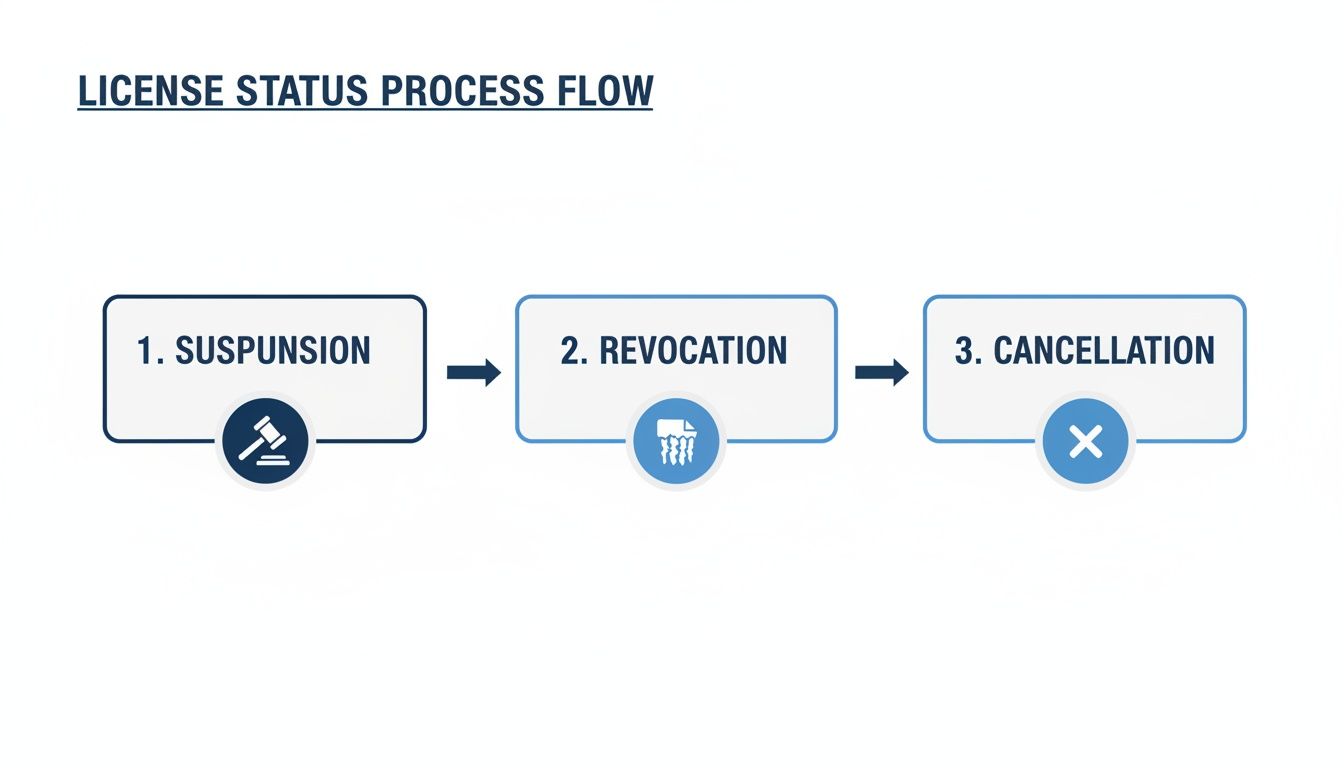
This distinction is crucial. Getting it wrong means following the wrong path and hitting a dead end.
Educational Courses and Insurance Mandates
Depending on what landed you in this situation, the DHSMV is going to require you to complete certain educational programs. For example, if your license was suspended for racking up too many points, you'll likely have to complete an Advanced Driver Improvement (ADI) course. A DUI conviction, on the other hand, means enrolling in a state-approved DUI program. It's not optional.
Another common hurdle is proving you have proper insurance. This is usually done with an SR-22 or FR-44 form. Think of it less as insurance and more as a certificate your insurance company sends directly to the state, verifying you have the liability coverage they demand.
Here's a quick rundown of the most common requirements I see:
Basic Driver Improvement (BDI) Course: This is often an option for minor tickets to keep points off your license in the first place.
Advanced Driver Improvement (ADI) Course: A mandatory 12-hour course for anyone whose license was suspended for points.
DUI School: Required for any and all alcohol or drug-related driving convictions. No exceptions.
SR-22 Filing: A common requirement for violations like driving without insurance or for a point-based suspension.
FR-44 Filing: This is a more serious requirement, demanding much higher liability coverage and reserved for DUI convictions.
For drivers who are eligible, getting these steps done is often the key to applying for a restricted license to get back and forth to work. If that's your goal, you should check out our guide on the requirements for a hardship license in Florida.
Attorney Advertisement: Figuring out the right courses and forms can be a real headache. An attorney can pull your driving record and tell you exactly what you need to do, making sure you don't make any costly mistakes. Our goal is to protect your license and record. Office in Broward. Submitting information via our website does not create an attorney-client relationship.
Ignition Interlock Devices and Official Paperwork
For more serious offenses, especially DUIs, Florida law requires you to install an Ignition Interlock Device (IID) in your vehicle. This is basically a breathalyzer that's wired into your car's ignition. You have to blow a clean sample for the car to start, and it will prompt you for random re-tests while you're on the road to ensure you remain sober.
Beyond these specific gadgets and courses, there's always paperwork and fees. When you're ready to submit your documents to the Florida DHSMV, you have to follow their procedures to the letter. If you're sending things in, it's worth reviewing resources on how to file official documents via fax to make sure it's done correctly.
A Real-World Points Suspension Scenario
Let's walk through a common example. Imagine a driver in Broward County gets 12 points on their license within 12 months. This triggers an automatic 30-day suspension. Here’s how they would get back on the road:
Get the Notice: The DHSMV mails them an official suspension letter.
Sign Up for ADI: They immediately find and enroll in a 12-hour ADI course, which is mandatory for this type of suspension.
Finish the Course: They complete the course and get their certificate of completion. This is their proof.
Pay the Fees: As soon as the 30-day suspension period ends, they go to the FLHSMV online portal and pay the reinstatement fee. For a first points suspension, this is typically $45.
Get Confirmation: After payment, they check their license status on the same portal. They do not drive until it reads "VALID."
This shows that if you have a clear plan, the process isn't impossible. But every single step has to be followed precisely. Past results do not guarantee future outcomes.
When You Should Call in a Professional
Trying to get your license back in Florida can feel like navigating a maze blindfolded. The DHSMV paperwork, the deadlines, the weirdly specific requirements—it’s a bureaucratic headache that can easily overwhelm anyone. While some situations are simple enough to handle on your own, many are tangled messes that are best left to a legal professional.
An attorney who focuses on traffic law becomes your advocate, cutting through the red tape and making sure every single detail is handled correctly from the get-go. This is especially true if your suspension is a complicated one, maybe involving old, unresolved fines scattered across different counties or the dreaded Habitual Traffic Offender (HTO) designation.
How a Traffic Law Firm Can Get You Back on the Road
A law firm with experience in these matters does way more than just fill out forms. An attorney can speak directly with the DHSMV or the court system for you, which is a massive advantage when you’re stuck in a loop of confusing answers. They’ll dig into your entire driving history to make sure the suspension is even valid in the first place, hunting for any errors that could be challenged.
For a lot of drivers, the biggest roadblock is a mountain of outstanding fines. A legal team can explore all your options for tackling that debt, sometimes by negotiating with the courts or helping consolidate everything into a manageable plan. It’s a proactive strategy designed to break the cycle of debt that keeps so many Floridians from driving legally. Our practice focuses on traffic and DUI defense, and our goal is to protect your license and your record. You can see exactly how a suspended license lawyer can assist you.
The Power of a Focused Legal Push
The impact of having a knowledgeable advocate working to resolve your license suspension isn't just a sales pitch—it’s been proven right here in Florida. Just look at what happened in Miami-Dade County. Back in 2022, the county was dealing with a staggering 915,424 suspended driver's licenses.
In response, they created the Driver’s License Suspension Task Force, funded by the American Rescue Plan. This initiative launched the Driver License Assistance Center (DLAC) to give residents direct, targeted help. The results were incredible: the number of suspensions plummeted by 73% to just 246,676, and a whopping 85% of the drivers who used the DLAC program got their licenses reinstated successfully. You can read more about this powerful initiative on communitynewspapers.com.
This real-world success story from Miami-Dade proves that when people get guidance, they can break through the bureaucratic walls that once seemed impossible to climb. Think of legal counsel as your personal guide, showing you the most efficient path forward while helping you sidestep the common traps.
Attorney Advertisement: This content is for informational purposes only. Submitting information via our website does not create an attorney-client relationship. Our office is in Broward, and we handle criminal traffic matters across Florida.
Is Legal Help the Right Move for You?
So, how do you know if you need to hire an attorney? It really comes down to the complexity of your situation. Here are a few scenarios where getting professional help is a practical choice:
Multiple or Old Violations: If your suspension is tied to a bunch of tickets in different counties or offenses from years ago, just tracking it all down is a nightmare. An attorney can untangle that web for you.
Habitual Traffic Offender (HTO) Status: An HTO designation isn't a suspension; it's a five-year revocation. This is a life-altering penalty, and navigating the reinstatement process requires serious legal experience.
Driving While License Suspended (DWLS) Charges: If you got caught driving on a suspended license, you’re now facing a brand-new criminal charge on top of everything else. This is a critical moment to get legal advice.
You're Just Plain Confused: If you’ve read your suspension notice and feel completely lost, an attorney can give you the clarity you need to move forward with confidence.
Ultimately, the choice is yours. But investing in legal guidance can often save you a ton of time, stress, and costly mistakes that could push your reinstatement date even further down the road. Past results do not guarantee future outcomes.
Avoiding Common Mistakes During Reinstatement
Getting your license back is a journey, and like any journey, there are plenty of potholes you can hit along the way. These aren't just minor bumps; they're mistakes that can add weeks, months, or even years to the time you're stuck without a license. Knowing what these common errors are is the first step to making sure your reinstatement process is as smooth and quick as possible.
One of the simplest yet most damaging slip-ups is not keeping your address updated with the Florida DHSMV. It sounds trivial, but it's a huge deal. Every official notice, from the warning that you're about to be suspended to the reinstatement requirements, goes to the last address they have on file. If you’ve moved, you might not even know your license is suspended until you’re pulled over.
The Single Biggest Reinstatement Mistake
Let me be blunt: the absolute worst thing you can do is drive while your license is suspended (DWLS). I get it. The temptation to make a quick trip to the store or drive to work is strong, but getting caught turns an administrative headache into a full-blown criminal offense.
A first-time DWLS charge (without you knowing about the suspension) is a misdemeanor, but it escalates fast. A third DWLS charge can be a third-degree felony, which carries penalties of up to five years in prison and a $5,000 fine. It can also brand you as a Habitual Traffic Offender (HTO), triggering a five-year license revocation that makes getting back on the road incredibly difficult.
The fallout from a suspension is massive. A 2022 report from the Crime and Justice Institute found that 86% of stakeholders see transportation issues from suspensions as a major reason people on probation or parole end up back in trouble. It’s a cycle that’s hard to break, and as this Florida Politics report on debt-based license suspension shows, it hurts the whole state's economy.
Misunderstanding the Specific Requirements
Another common pitfall is getting the details wrong on your specific suspension requirements. The DHSMV is not forgiving about this. Little mix-ups with courses or insurance forms can get your application flat-out rejected.
Here are a few classic errors we see all the time:
Taking the Wrong Course: You signed up for a standard Basic Driver Improvement (BDI) class when your points suspension required the 12-hour Advanced Driver Improvement (ADI) course. The state won't give you credit for the wrong one.
Incorrect Insurance Forms: You filed an SR-22 form when your DUI suspension demanded an FR-44, which has much higher coverage limits. It’s an instant denial.
Letting Insurance Lapse: You forgot that your SR-22 or FR-44 has to stay active for the entire required period—often three straight years. The moment your insurer tells the state it lapsed, your license gets suspended all over again.
Attorney Advertisement: Keeping track of these details is tough. An experienced attorney can cut through the confusion, lay out the exact steps you need to take, and make sure everything is filed correctly the first time. Our goal is to protect your license and record. Office in Broward. Submitting information via our website does not create an attorney-client relationship.
The Pitfall of Incomplete Payments
Finally, a lot of drivers think paying the DHSMV reinstatement fee is the final hurdle. It’s not. That state fee is completely separate from any court fines or ticket costs that triggered the suspension in the first place. You have to settle up with the specific county court, like the Broward County Clerk of Court, before the DHSMV will even look at your reinstatement.
Always double-check that every single financial obligation is addressed. That means handling the original ticket, any late fees tacked on by the court, and then paying the state's reinstatement fee. Only when every box is checked and every penny is accounted for will your license status flip back to "VALID." Past results do not guarantee future outcomes.
Your Questions About License Reinstatement, Answered
When you're dealing with a suspended license, a million questions run through your head. Let's tackle some of the most common ones we hear from Florida drivers every day.
This information is for educational purposes and is an attorney advertisement. Submitting information through our site does not create an attorney-client relationship.
How Much Does It Cost to Reinstate a Florida License?
There’s no single answer here. The total cost to get your license back depends entirely on why it was suspended in the first place.
The Florida DHSMV has its own set of administrative reinstatement fees. You’re typically looking at $45 for a suspension due to points, or $75 if it's happened before. But if the suspension is tied to a drug or alcohol offense, that state fee jumps up to $130.
It's absolutely critical to understand that these fees are just one piece of the puzzle. They don't cover other costs you'll almost certainly have to deal with, like:
Any outstanding court fines or unpaid ticket fees.
The cost of mandatory classes like Advanced Driver Improvement (ADI) or DUI school.
The expense of getting and maintaining SR-22 or FR-44 insurance.
The only way to know for sure is to check your official suspension notice from the state or log into the FLHSMV online portal to see the exact breakdown for your case.
Can I Get a Hardship License During My Suspension?
Yes, in many situations, you can apply for what’s called a hardship license (officially a Business Purposes Only or BPO license). It’s not a get-out-of-jail-free card—it’s a restricted license that lets you drive for essential reasons only, like getting to work, driving for your job, going to school, or making it to medical appointments.
But not everyone qualifies. Your eligibility hinges on the reason for your suspension and what your driving history looks like. Some very serious offenses, like a DUI conviction, come with a mandatory "hard suspension" period—a blackout period where you are not allowed to drive at all, no exceptions, before you can even think about applying for a hardship license.
Getting one is a formal process. It usually involves completing a 12-hour Advanced Driver Improvement (ADI) course, paying a separate application fee, and showing proof of SR-22 insurance before you can even get a hearing. For many people trying to keep their job, though, it's a lifeline.
Attorney Advertisement: Navigating the hardship license hearing process requires careful preparation. An attorney can help you understand your eligibility and present your case effectively. Our goal is to protect your license and record. Office in Broward. Submitting information via our website does not create an attorney-client relationship.
How Long Does Reinstatement Take After Meeting Requirements?
Once you've jumped through all the hoops—resolved every fine, finished every class, and filed all the right paperwork—the final step can be incredibly fast.
If you handle the final payment online via the FLHSMV's website or do it in person at a DHSMV service center, your driving record is usually updated almost instantly. But here's the crucial part: you have to personally check the state's website to confirm your license status says "VALID" before you even think about getting behind the wheel.
Going the snail-mail route is a different story. If you mail your documents and payment, you need to budget several weeks for processing. Any little mistake or missing piece of information in that envelope can cause major delays and send you right back to the beginning. For more in-depth answers, check out our main Florida traffic law FAQs. Past results do not guarantee future outcomes.
If you're struggling to get your license back in Florida, you don’t have to take on the DHSMV by yourself. The team at Ticket Shield, PLLC has the experience to walk you through the entire process, helping you understand exactly what you need to do to get back on the road. Call us 24/7 at https://www.ticketshield.com for a free consultation.